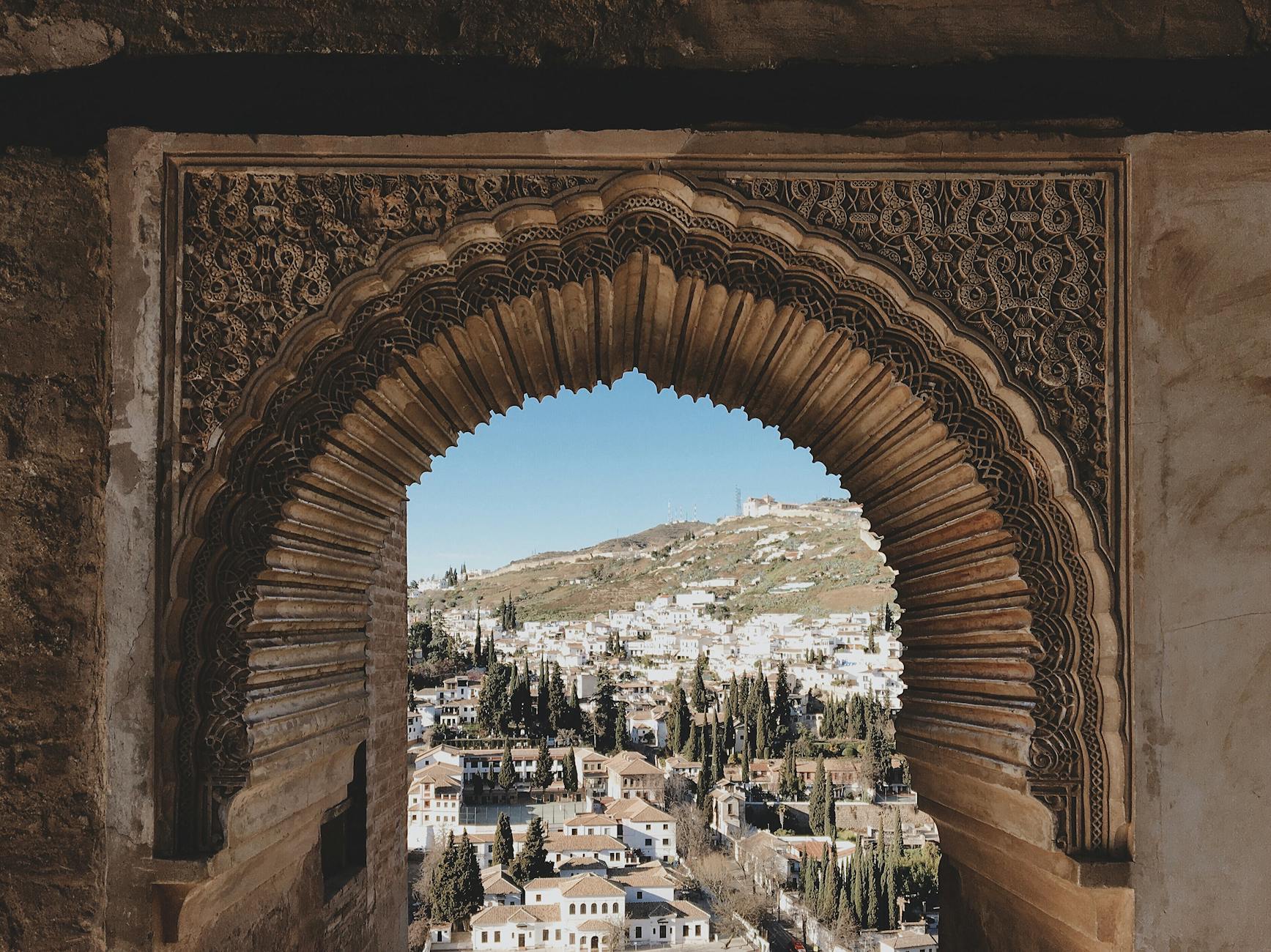
Granada behind an ornamented wall in Al Hamra / Alhambra, Photo by Çisellee
Forget fear mongering! Arab, Turkish and European unification is the way forward
.
by Phil Hall
.
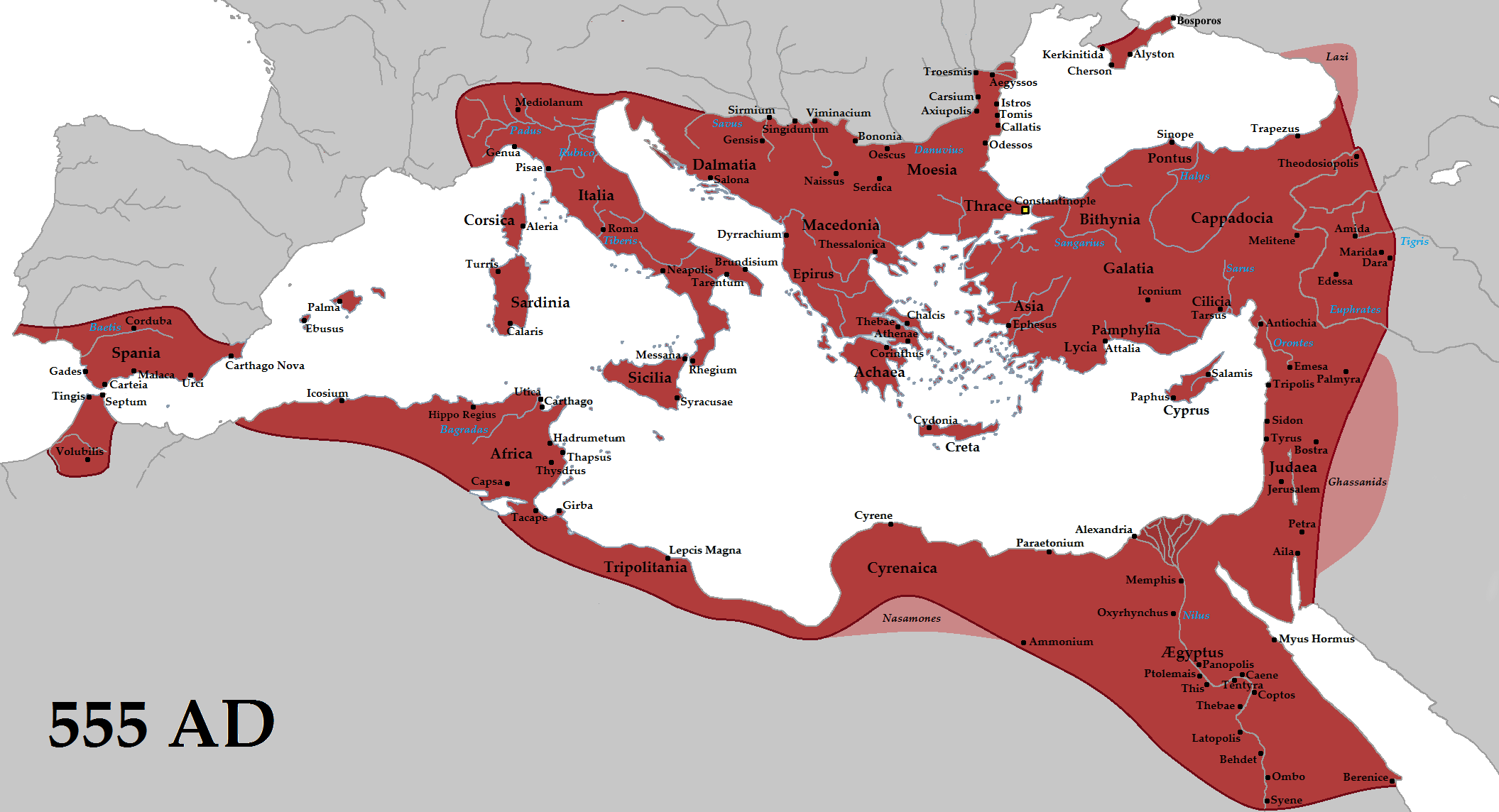
The Mediterranean has always been a crucible of civilisations, a vast, interconnected world where cultures, religions, and peoples have mingled for many centuries. At its height, the Roman Empire stretched across both shores of this inland sea, uniting Europe, North Africa, and the Levant under a single political, cultural, and economic framework.
This shared history laid the foundation for much of what we might call Western civilization—what Kenneth Clark simply called ‘Civilisation’. But the roots of Europe are deeply intertwined with those of the Arab world and beyond. The Abrahamic religions—Judaism, Christianity, and Islam—all emerged from the same region, binding our lands together in a common sharing as the peoples of the book. Yet, despite this common heritage, religion can divide us and often obscures a deeper unity.
The ebb and flow of empires and conquests have blurred the lines. Arabs once inhabited parts of Europe, most notably the Maghreb was the metropolis for the periphery of Al-Andalus. Islamic Spain became a beacon of learning. The philosopher Ibn Rushd (Averroes) and the Jewish scholar Maimonides, both products of this era, exemplify the intellectual flourishing of that period. Centuries later, European powers pushed back, leaving their own mark on Egypt, Algeria, Tunisia, Morocco, Libya, Lebanon, Iraq—in fact, on every Arab country, as colonial powers, most infamously on Palestine.

Spain is a living testament to the influence of the Maghreb: its architecture, language, and culture are imprinted with the cultural power of the Maghreb – it was an integral part of it. The Alhambra in Granada and the Great Mosque of Córdoba, later converted into a cathedral, endure as symbols of this unity. It wasn’t the Arabs who built Al Hamra (the Red One), but the people of Al Andaluz. The Great Mosque in Córdoba, is the younger sibling of the Great Mosque in Marrakesh.
Even as Spain denies its mixed heritage and persecutes its Moroccan migrants—treating them unjustly—the evidence of a Moroccan past is everywhere: in the genes of its people, the flavours of a shared paella, and the rhythms of Flamenco. All the islands of the Mediterranean are layered with traces of people from both the north and the south. Ojala, despite what some Spanish may claim, comes from Insha’Allah.
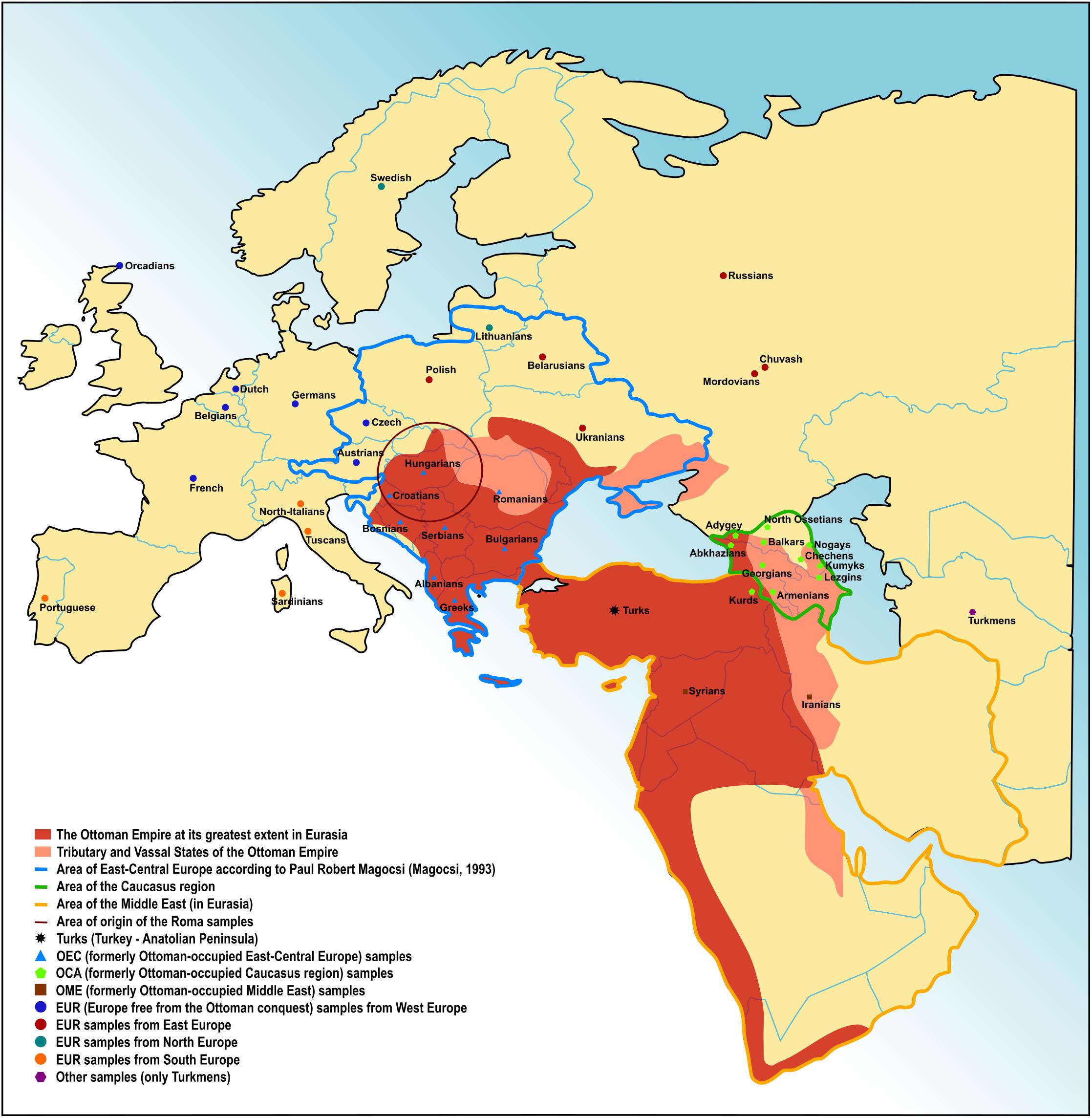
The story of Greece and Turkey offers another example of underlying unity. Though divided by modern borders and historical grievances, their cuisines, music, and even genetic makeup reveal Byzantium—the Eastern Roman Empire. The Ottoman Empire, in turn, left its mark on the Balkans, creating a cultural tapestry that weaves together Greeks, Turks, Macedonians, Serbians and Bulgarians. The poetry of Yunus Emre, a Turkish Sufi mystic, resonates with the same themes of love and unity found in the works of Greek Orthodox theologians.
Romanticised histories of ancient Greece as ‘the cradle of Western civilization’ were kindled by Mitteleuropa and Great Britain. Their Philhellenism obscured the fact that the Greeks come from roughly the same corner of the Eastern Mediterranean as the Phoenicians, who also made a huge contribution to our shared culture. Great Britain, especially, appropriated Greek culture—we even display the carved statuary of the Parthenon and refuse to return it. Our historians strip Greece of its Eastern context by omission. There were Greek cities everywhere, even in Egypt, on both sides of the Mediterranean. This false perspective, perpetuated by Northern Europe, has contributed to a culturally fabricated and artificial division between Europe and “the East.”

The rise of Northern Europe, particularly Britain, deepened divisions in what had once been a united culture. Britian had few connections with the Mediterranean. Built on piracy, slavery, and colonialism, Britain’s wealth and power came at the expense of the decline of Southern European powers like Spain and Portugal. Northern Europe rewrote history—famously, Edward Gibbon, with his History of the Decline and Fall of the Roman Empire reaches for ownership of the story as the British Empire looked for parallels in the Roman Empire – preening. A false dichotomy was created. Orientalism, the Palestinian American Edward Said pointed out, invented the idea of an advanced, modernised, scientific North and a “backward” South. Yet, even as Northern Europe grew in power, the Mediterranean still traded and shared. The earliest Londoners, for example, could just as easily have come from Libya as from Thrace. There are even the seeds of this lost underlying unity in the Roman pavements we dig up in 2025. The London Stone, embedded in a wall in the City, was supposed to have been laid down by Brutus of Troy—the mythical founder of London who originated in what is now Turkey.
Today, we are all at a crossroads, north and south of the Mediterranean. As religion fades in importance and secularism rises, the old divisions between Christianity and Islam start to lose their grip. In North Africa and the Middle East, Islam is increasingly recast in political rather than religious terms, reflecting national aspirations and opposition to modern colonialisms, interventionism, neocolonialism, and exploitation. Leaders like Mohammed bin Salman envision a “new Europe” in Saudi Arabia, one that embraces modernity while retaining its cultural identity. He does so because, underneath it all, he identifies with Europe, too. MBS holidays in Golfe Juan and owns a house in London. At the same time, Europe’s southern neighbours—North Africa, Turkey, and the Levant—hold the key to its future in a multipolar world. The Southern and eastern past of the Mediterranean, with its resources, youth, and dynamism, is a natural equal partner for a Northern Mediterranean that is increasingly isolated and resource-poor.

The integration of migrants into Europe as it is, is not only a challenge but an exciting opportunity. The arrival of millions of people from North Africa, the Middle East, and beyond is a reminder of our common past. Be honest! The skin colour of an Andaluz and a Moroccan will barely differ—these are cousins. The works of authors like Tahar Ben Jelloun, who explores the complexities of migration and identity in Leaving Tangier, or Elif Shafak, whose novels bridge Turkish and European perspectives, highlight the potential for a rejoining of the old geographical, cultural, political, and economic entity of Rome, the space that we have all longed for: the common space of a new community centred on the Mediterranean. The music of Franco-Arab artists like Rachid Taha, blend raï with rock, the films of directors like Ferzan Özpetek, explore the intersections of Italian and Turkish culture, El Lebrijano collaborated with a Orquesta Andalusi de Tanger
The idea of a “Eurabia,” often invoked as a fear-mongering term by those who oppose migration, must be reimagined as a return to unity. Just as Al-Andalus once served as a model of coexistence and cultural exchange, the idea of a new Eurabia embodies a better shared future. This would require not only integrating migrants but also addressing the structural inequalities that drive migration in the first place. It means investing in the development of North Africa and the Middle East, creating opportunities for people to thrive in their homelands, and fostering a sense of shared destiny.
The vision of a united Mediterranean, encompassing Europe, North Africa, the Middle East, and Turkey, is not just a nostalgic dream but a practical necessity. It requires acknowledging a shared history, while also confronting the legacies of colonialism, slavery, and exploitation that have divided us. It means recognizing that the peoples of the Mediterranean and surrounding countries are members of the same body.
As religion fades or transforms, we see reality. Let’s leave behind the narrow stories of ‘Anglo-Saxon’ and ‘Nordic’ (with all their toxic associations) exceptionalism and reconnect. Only by doing so can Europe hope to navigate the challenges of a multipolar world and build a future that is inclusive, equitable, hopeful, and properly rooted in the past.

And, there are concrete potential benefits. Acting responsibly, a new unified Eurabia might help solve the Israel-Palestine problem, much as it helped resolve divisions in Northern Ireland. The success of the Good Friday Agreement in Northern Ireland is an example of how regional integration and shared rights can mitigate conflict. By granting people the freedom to move, work, and live across borders, the EU has the potential to reduce the zero-sum mentality that often fuels territorial disputes. In the case of Palestine/Israel, this could mean shifting the focus from competing claims over land to shared opportunities within a larger European framework.
Including Palestine/Israel in the EU would bring significant economic benefits to both communities. Access to the EU’s single market would stimulate economic growth, create jobs, and attract investment. For Palestinians, this could mean an end to the economic isolation imposed by occupation and blockades, while Israelis would gain access to new markets and opportunities for collaboration.
The freedom of movement within the EU would also allow Palestinians and Israelis to build lives outside the confines of the conflict. This could reduce pressure on the land itself, as people would have the option to relocate to other parts of Europe while maintaining ties to their homeland. Over time, this could help depoliticise the issue of borders and settlements, creating space for a more pragmatic resolution. Moreover, the presence of Palestinian and Israeli communities across Europe could foster greater understanding and dialogue. Just as the migration of North Africans to Europe has enriched European culture, the movement of Palestinians and Israelis would bring new perspectives and ideas, further blurring the lines between Europe and North Africa and Turkey and the so called Levant.
When it comes to religion, unity across the Mediterranean would acknowledge the shared heritage of Jews, Muslims, and Christians. The Holy Land is a microcosm of the Mediterranean’s diversity, and its integration into the EU would serve as a powerful symbol of unity. Perhaps the capital of a future Eurabia should be Jerusalem.
This approach could serve as a model for other conflicts in the Mediterranean, such as those in Cyprus or Western Sahara. It demonstrates that the solution to division lies not in building walls but in creating bridges—bridges that connect people across borders and foster a sense of shared destiny.
With this vision in mind, I set up a petition on the Downing Street website in 2009 calling for the inclusion of Israel / Palestine in the EU, anticipating that it would be met with puzzlement. Still, I hope it planted a seed.
Strategic Foresight: Europe’s Southern Turn
As Europe finds itself increasingly isolated in a multipolar world, we must confront a tough reality: our traditional alliances with the United States and the possibility of healing our relationship with Russia are no longer sufficient to secure our future. The rise of China as a global superpower, the shifting dynamics of transatlantic relations, and geopolitical tensions with Russia have left Europe in a precarious position. In this context, the Mediterranean region—North Africa, the Levant, and the Middle East—emerges not just as a historical partner but as a strategic imperative for Europe’s survival and prosperity.
Europe’s future lies in a humble and deliberate pivot toward its southern and southeastern neighbours. This shift requires more than just economic cooperation or diplomatic overtures; it demands a reckoning with the past. Europe must acknowledge and make reparations for the legacies of violence, colonialism, exploitation, and division that have shaped its relationship with the Mediterranean world. From the extraction of resources to the imposition of arbitrary borders, Europe’s historical actions have left deep scars that must be addressed to build trust and genuine partnership.
Reparations could take many forms: investments in infrastructure, education, and healthcare in North Africa and the Middle East; debt relief for struggling economies; and support for sustainable development projects that empower local communities. By addressing the structural inequalities that drive migration and instability, Europe can help create a more equitable and prosperous Mediterranean region—one that benefits all its peoples. I wrote an article touching indirectly on this subject in the Guardian in 2008.
The reunification of the Mediterranean world holds the potential for unexpected synergies—a fusion powered release of progress that could transform the region. Just as the fusion of atomic nuclei releases immense energy, the coming together of Europe with our southern and south East Mediterranean neighbours could unleash a wave of innovation, creativity, and growth. By fostering cross-cultural dialogue and collaboration, Eurabia could reignite this common intellectual tradition. Universities, research institutions, and cultural organizations could play a key role in this process, creating networks that span the Mediterranean and beyond. All Europeans should start learning Arabic as a second language.
Europe stands at a crossroads. The old alliances and paradigms that have shaped its history are no longer sufficient to meet the challenges of the 21st century. This is not just a matter of strategic necessity; it is a moral imperative. The Mediterranean is more than a region—it is a shared home, a cradle of civilisation, and a beacon of hope. The time to act is now.

Phil Hall was born into an ANC family in South Africa. The family was forced into exile in 1963 after his mother was imprisoned and his father banned. They relocated to East Africa, where his parents continued their activism and journalism. In 1975, after a period living in India, they journeyed overland back to the UK, eventually settling in Brighton.
Phil pursued a broad education, studying Russian, Spanish, politics, economics, literature, linguistics, and English grammar and phonology. His path led him to live and study in Spain, the USSR (in Ukraine), and later in Mexico, where he married and started a family. Over the next decade, Phil and his partner balanced activism with work before relocating to the UK—a move initially intended to be permanent.
However, professional opportunities took him to Saudi Arabia and then the UAE, where he spent ten years before returning to the UK during the COVID-19 pandemic. Back in Britain, he founded Ars Notoria Magazine and, alongside fellow humane socialist Paul Halas, launched AN Editions, a small venture dedicated to publishing thoughtful, progressive and exciting new books.
Discover more from Ars Notoria
Subscribe to get the latest posts sent to your email.



You must be logged in to post a comment.