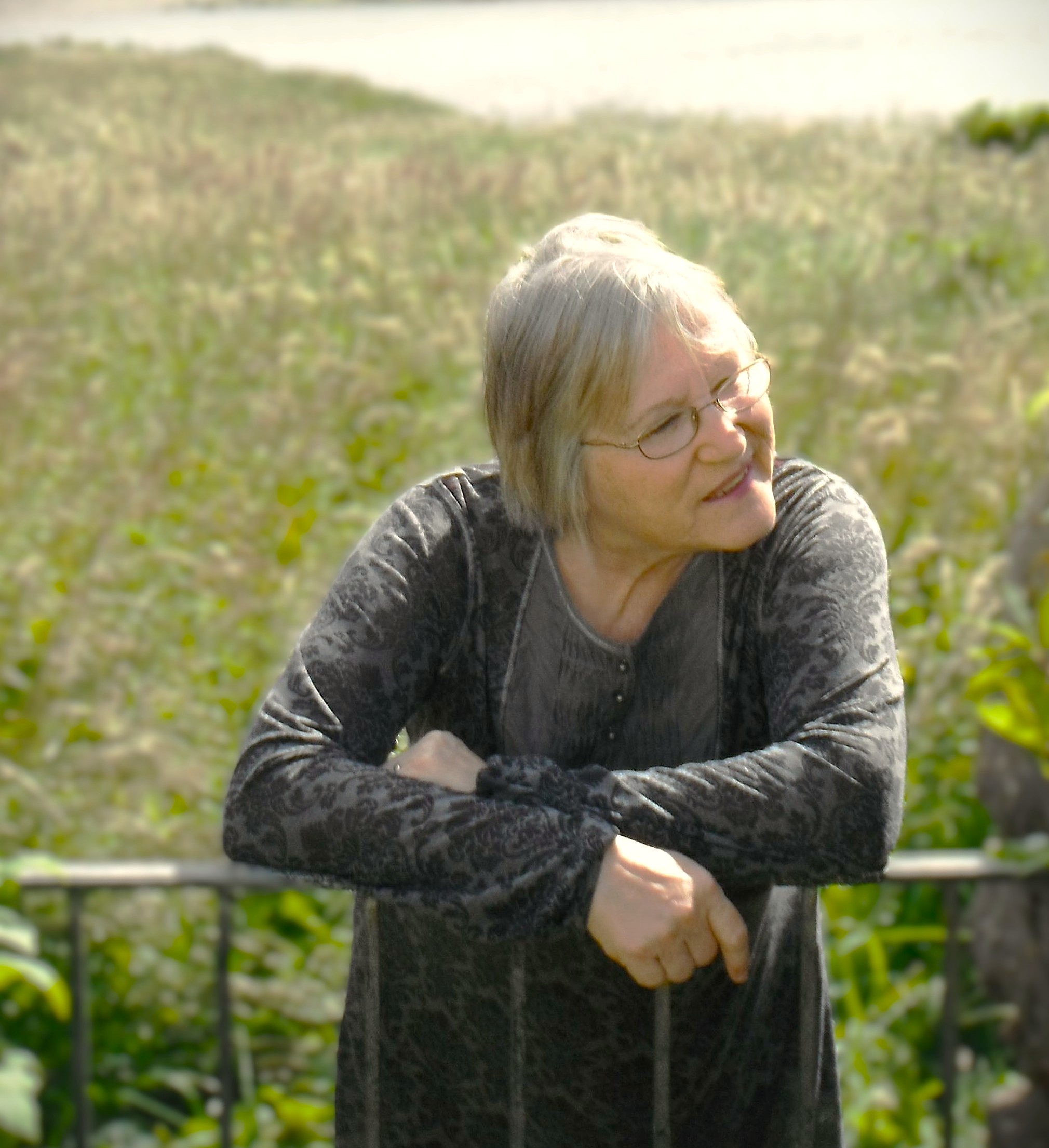
Sheenagh Pugh at her back gate in Hoswick, Shetland, from the personal archive of Sheenagh Pugh
Sheenagh Pugh was born in 1950. She lives in Shetland with her husband. She has published nine collections of poetry and translations, plus a Selected Poems and a sort of mini-Selected, two novels and a critical study of fan fiction. She translates poems mainly from German but sometimes also from French and Ancient Greek. She read German and Russian at the University of Bristol and used to teach creative writing at the University of Glamorgan. She still visits Cardiff, where she used to live, regularly.
Sheenagh has won the Forward Prize for best single poem of 1998, the Bridport Prize, the PHRAS prize, the Cardiff International Poetry Prize (twice) and the British Comparative Literature Association’s Translation Prize. Her poems have been included in several anthologies, notably Poems on the Underground and The Hutchinson Book of Post-War British Poetry. They have also been set to music, have appeared on the trams of Helsinki and the St Petersburg Underground, and have been translated into German, French, Italian, Russian, Bulgarian, Croatian, Spanish, Portuguese and Dutch.
Her interests are language, history, northern landscapes from Shetland to the Arctic and all points in between, snooker, mortality, cyberspace —”I waste massive amounts of time online”— and above all, people. She says she likes to use poems to commemorate people and places, sometimes to amuse, to have a go at things she doesn’t like (censorship, intolerance, pomposity) and above all to entertain. She has been accused of being “populist” and “too accessible”, both of which she hopes are true.
Interviewer: Roger Murphy

.
Sheenagh,
The questions below spring from the reflection that most interviewees must find it tedious to answer the same questions all the time. So I have risked a few things, which, if too annoying, can safely be ignored.
Yours,
Roger Murphy
.
––––––––––––––––––––
Roger Murphy: Current obsessions in modern thinking too often seem to intrude into contemporary poems or the analysis of them. Which drugs do you find most effective when dealing with this?
Sheenagh Pugh: I’m not sure I understand the question. It would seem fairly natural, indeed inevitable, that whatever people are currently thinking about would find its way into whatever they write. Having said that, I try not to make poems obviously issue-led, because though politics and ecological questions are hugely important to me and will certainly feature in my writing, poems need to be language-led. I did avoid writing about Covid, because everyone on earth seemed to be doing it and I got bored with the mere word. There were whole collections of covid poems, which I carefully ignored.
Roger: Which books on your shelves do you return to again and again? Why?
Sheenagh: In poetry, the work of Paul Henry and Louise Glück, both of whom have a musicality and nostalgia that appeals to me. Older poets too – Dunbar, Henryson, Wyatt, Cavafy, mediaeval French and German poets – but not as much as you might think, because I know a lot of them by heart. When I was younger, I could memorise anything in rhyme or blank verse, which came in very handy for exams. Milton practically wrote his own essays, as a string of quotes. It would be more of an effort now, clearly memory changes with age, but I still have much of what I memorised then. In history, whatever period I’m fascinated by at the time. In novels, Hilary Mantel’s A Place Of Greater Safety, set in the French revolution, Andrew Drummond’s Novgorod the Great, set in 19th-century Russia, Stefan Heym’s The King David Report, set in Old Testament Jerusalem, and the Marcus Corvinus detective novels of David Wishart, set in 1st-century Rome – you see a pattern emerging…
Roger: Which contemporary poets do you think will be remembered a generation hence? For what qualities?
Sheenagh: I really hope, Paul Henry and Louise Glück, for their musicality and thoughtfulness. But who knows? I once had the great pleasure of visiting George Mackay Brown (who will surely also be remembered, because he has given so much entertainment) and he believed that in a couple of generations nobody currently fashionable who didn’t deserve to be remembered would be, whereas those unfairly ignored in their lifetimes would. So there’s hope for us all…

Roger: Less than 40 years ago Italo Calvino could write an article “Why read the classics?” explaining why we continue to read and love them. Do we do so any more?
Sheenagh: I do. I don’t know about “we”. I can’t really speak for anyone else. You’d need to ask a librarian. I do know that when I was teaching, I introduced some students to stuff they hadn’t read, and by and large they were enchanted with it. The Just So Stories and Harry Graham’s Ruthless Rhymes were particular favourites, and they took to writing their own versions of both.
Roger: An intruder, intent on theft, is distracted by your bookshelves. On which books would you like to learn his fingerprints were later found?
Sheenagh: Any, as long as the police could identify them and catch him. I don’t get sentimental about burglars. The poet Leslie Norris was once judging a big poetry competition and copies of some of the entries were sent to him in a Securicor van, which got robbed on the way. He was most tickled to think of the thieves eagerly opening packages that might have been banknotes, only to find poems. But he didn’t kid himself that they might read them and be magically improved.
Roger: Which modern writers make you laugh?
Sheenagh: Andrew Drummond, David Wishart, Victoria Wood, Alan Bennet. I used to advise my students to study stand-up comedians, because they have many skills poets need – like timing and a sense of what to leave out.
Roger: Which contemporary poets seem to you to value the music of language most or best?
Sheenagh: Paul Henry and Louise Glück

Roger: I think it was the Irish writer, Sean O’Faolain, who learned German to read the great works of that literature in the original. Later, he declared it had largely been a waste of time. Was he right?
Sheenagh: No, but I also doubt he was entirely in earnest. Folk do say some random stuff in those situations – Michael Gambon used to tell appalling porkies in interviews. I have always felt sorry for monoglots, it must like seeing the world only in 2-D or black and white. Among my students, those for whom English was a foreign language used it with great inventiveness, and anyway I don’t think anyone ever speaks their own language as well as they might, unless they know at least one other. What do they know of English, who only English know? I can read books in three languages apart from my own (it would be four, but I let my Russian lapse) and I know nothing to equal the first time you wake up and realise you have dreamed in a different language.
Roger: Which contemporary poets do you feel show the greatest command of poetic forms?
Sheenagh: George Szirtes, Paul Muldoon, Alicia E, Stallings, Jacqueline Saphra.
Roger: Which contemporary poets make you weep with envy? Even just a little bit.
Sheenagh: I don’t know that any do. I admire many, but don’t necessarily want to write like them. It’s enough that they write like them. I couldn’t write like them without being them and having lived their life.

Roger: What is the most difficult lesson you have learned as a writer?
Sheenagh: Not to panic when I can’t write. The late Michael Longley said a very useful thing I’ve kept by me ever since: “Poets, like fields, sometimes need to lie fallow, and like fields, they are still working when they do”. He was right, of course; one is still observing and processing the world. But it’s very frustrating when one can’t seem to do the shaping.
Roger: When you were at school, were you required to learn any poetry by heart? What have you retained?
Sheenagh: Not required, but I found I could do so fairly naturally and it was handy for exams, as I’ve said. I retained very little of the Milton, but I learned the first few scenes of Marlowe’s Edward II by heart and still have them.
Roger: Chaucer, Shakespeare and Milton. Which would you invite to Up Helly Aa and which do you think would write the most entertaining report of it for a mainland publication?
Sheenagh: Chaucer, out and away. Milton would be hopeless; it’d just be a pagan rite to him and he wouldn’t much like the drinking. Chaucer was a travelled man, so the sea journey wouldn’t prostrate him. Shakespeare may have been to sea – he writes as if he had, but then he also writes murder convincingly and he hadn’t done that.
Roger: Perhaps, with your work having been accused of being ‘too accessible’, you are in a position to say how a young, aspiring contemporary poet might achieve much-to-be-preferred inaccessibility?
Sheenagh: Oh well, that’s easy enough if you want to do it. Just write a normal poem that makes sense and then replace all the nouns with the one three nouns along in the dictionary. I could name some poets who seem to have done that very thing, but it’s no ambition of mine. One should not help the reader all the way up the ladder, he’ll be bored, but one can at least get his foot on the bottom rung.

Roger: Who are the modern masters of poetic rhythm?
Sheenagh: Paul Henry and Louise Glück.
Roger: Do you feel Terza Rima is awkward and almost unnatural in English?
Sheenagh: No, or I wouldn’t write so much of it. I like the strange inevitability of its chain structure.
Roger: If contemporary poets are developing new forms, conducting experiments and adding to English poetic traditions what else could they learn from Sir Thomas Wyatt?
Sheenagh: That total regularity is the killer of rhythm and movement. It is the irregularities in his metre that make his words move on the page, take off and fly. Early editors of him, including that fool Henry Howard, an arrogant idiot like the rest of the awful Norfolks, didn’t understand this and tried to smooth out his lines, to their great detriment. Can you imagine anyone being daft enough to change “That now are wild, and do not remember” to “That now are wild, and do not once remember” – thereby putting in the accented syllable he deliberately left out, and losing the gap that throws such a heavy stress on to “remember”? As Joost Daalder says in his introduction to Wyatt’s Collected Poems, “it is evident from more than one of Wyatt’s revisions that he had no consistent desire to make his lines iambic and any attempt to read all of his verse as though he had is doomed to frustration”.
I probably said all that in a talk on Wyatt at St Anza. Sorry to be repetitious, but there you are, I’m 74 so it’s allowed. I was lucky enough to see Kris Kristofferson perform live in Bristol in his old age and at one stage he momentarily forgot the next line. He said “hell, I’m 72, I don’t recall what I had for effin’ breakfast”. He sang as well as I’d ever heard him do.
.
Roger Murphy was born in 1955. Instead of studying music he joined his father’s newspaper and magazine design business and when his father died took it over. His company has designed magazines for some of the most important corporations in the world. He has also lectured in design at universities in the UK, Europe and in the USA. When Covid broke out he did a degree in creative writing at Birkbeck College where he specialised in poetry. You can find his poetry on his website RM.
Discover more from Ars Notoria
Subscribe to get the latest posts sent to your email.


Comment
Comments are closed.