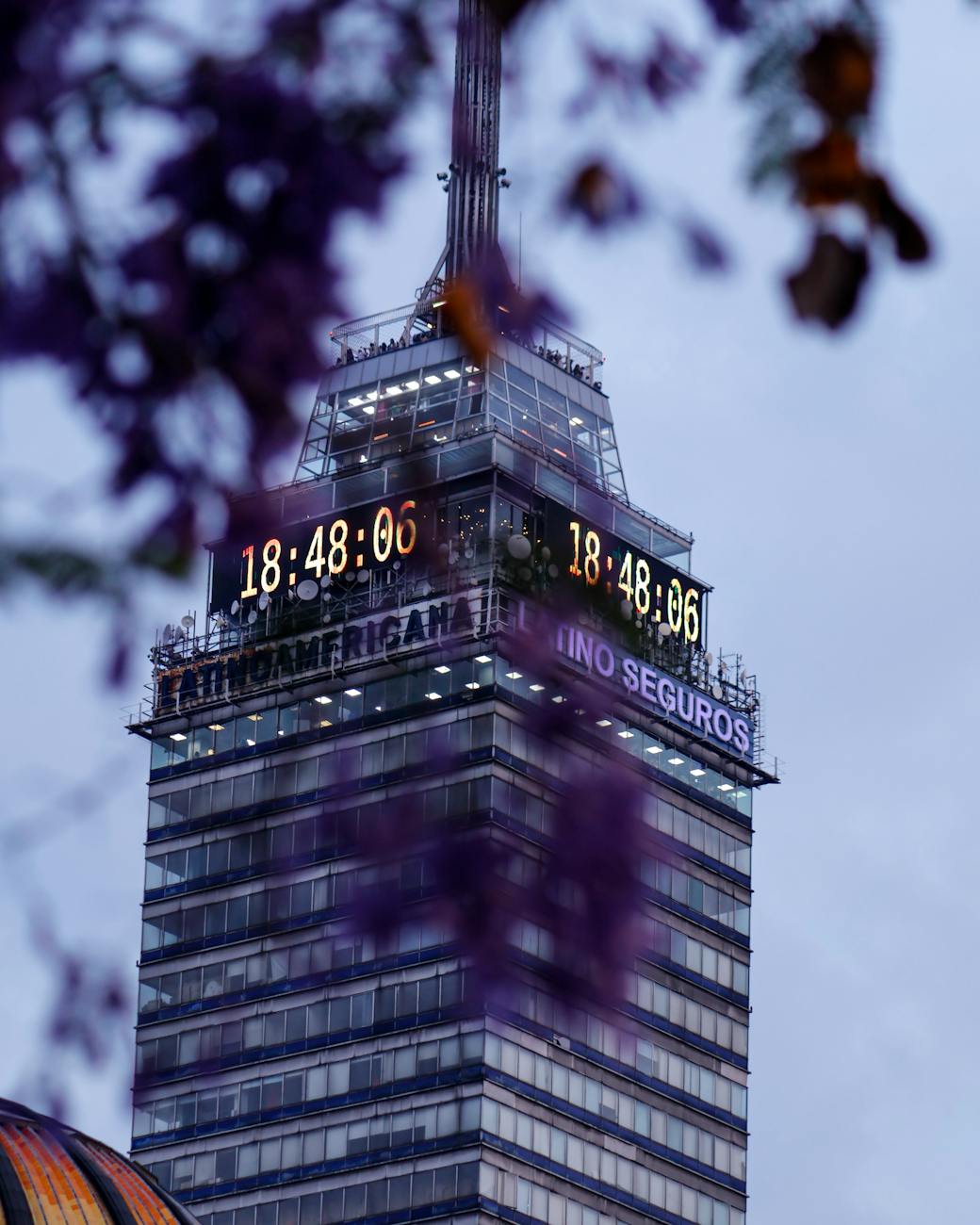
Torre Latinoamericana, photo Andres Perez pexels
by Phil Hall
.
It was 1984, a year before the earthquake. I only had a small amount of money left and so bought a third class train ticket to Mexico City. The seats, set close to the floor, were made of hard polished slats of wood. El pueblo travels third class and the carriages were full. Everyone was polite and relaxed, though it was a little squashed. The train moved slowly, and stopped and started, and at every stop people came on board to sell snacks and drinks and stepped off the train again before it set off.
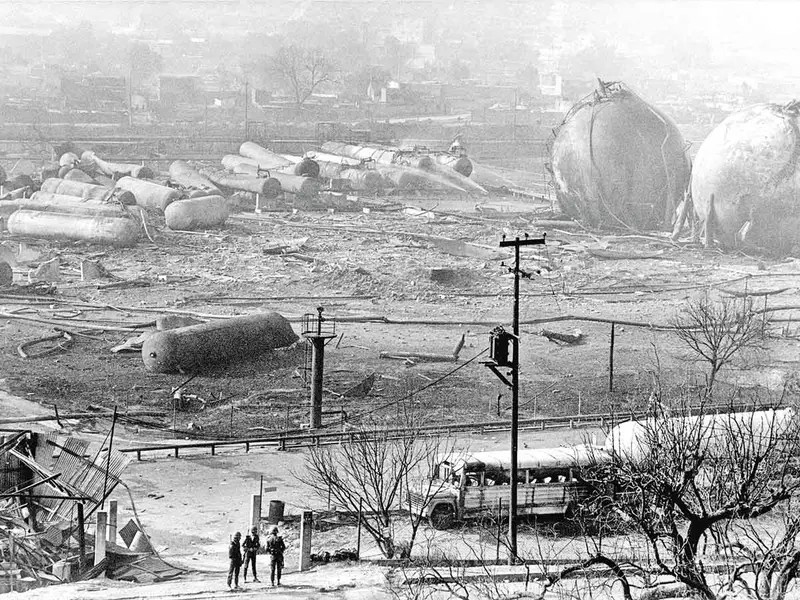
I had read about the explosions of San Juanico in November. Many people were killed and injured at the PEMEX facility when two liquid gas tanks exploded. We rolled through the scene of destruction. The landscape was blackened by the fire and smoke. The gas tanks were still smouldering.
On Christmas Eve, at the taco stand in the Alameda, pale meat scraped off the skull of a sheep—barely thick enough to dice—was frying on a griddle. Little heaps of nopalitos and onions were swept up into three tacos with a quick cleaver under a string of bare light bulbs. I added coriander, a few spoonfuls of a dark red chili sauce, a squeeze of lemon, and a dash of salt. The tacos were ready to eat: tacos de cabeza.
The old Hotel Regis (which would later collapse in 1985, killing everyone inside) loomed to the right. The Teatro de Bellas Artes was lit up and visible through the trees to the left. and, had I bothered to look up, I would have seen the tall, blocky shape of the Torre Latinoamericana rising.

Next to me, eating his own tacos, was a young European man—perhaps around 32. He wore light blue jeans, a blue shirt, and had a thick blond beard that covered much of his face. He looked slim and athletic. He wanted to talk. It was Christmas Eve, after all.
“Where are you from?” he asked. So I told him I was a student at the University of Veracruz in Xalapa.
“Ah,” he said. He may have wanted company, but he didn’t say much.
“And where are you from?” I asked him.
“Germany.”
“I see.”
But he wasn’t talkative. What was he doing here? Something didn’t fit. He was on his own. He wasn’t a student or a tourist. He didn’t want to talk about Mexican beaches. I was fed up with meeting British and American students whose only purpose in staying in Mexico boiled down to tourism.
So I began by criticising the denazification process following WWII. Now, he looked at me with interest. He asked about my family, my political opinions, and my experiences. I told him I was studying Russian and that I was a socialist.
His lip curled. Hooked! As he listened, he said almost nothing about his own views. He offered me tea at his hotel and then began telling me about German counterculture. I asked him to explain. My intuition was picking up on a half-baked, dogmatic revolutionary extremism.

I said as much.
It became obvious that he, in turn, despised my conventional socialism. “Actions speak louder than words,” he said. When I asked him what he meant he said that there were things he couldn’t talk about. It was ”too dangerous”.
In an effort to flush him out, I went back to discussing the denazification process. Many Germans had been complicit in allowing nazi atrocities. The East German Brown Book detailed how the entire nazi infrastructure had been left in place by the Americans and British as a bulwark against communism. Only in East Germany had the country been sufficiently denazified.
“Not quite,” he said. “East Germany wasn’t completely denazified either—that’s a myth.”
Then, ominously: “There are those who oppose the capitalist system in West Germany, and they are fully aware of the failure of denazification—and they are ‘Doing Something About It.'” I could hear the capital letters.
“But what?”
“Aha!”
We reached his hotel, and he made me tea in his room. It was a basement room in a cheap hotel—the shambles of an huge old house. I imagined it brimming with Raskolnikovs. The room was badly lit and I could hear crickets. Next to the pillow on his bed was a door, and behind it, a toilet flushed loudly from time to time. The only window was high and barred.
After tea, he said, “You really must stay here. It’s much cheaper than your hotel. I’m leaving tomorrow. Feel free to take over the room. I’ve already paid for tomorrow, so give me the money, and we’ll call it quits.”
It was so little, and I had so little money left, that I decided to accept. He took out an avocado and split it in two to share half with me. That was my Christmas Eve in Mexico City in 1984.
I thanked him for the tea and the avocado, got up, and started walking back to my hotel in the direction of Hidalgo. By then, it was about 1 a.m. and the streets were quite empty. I heard the sound of a police siren in the distance.

The police car sped by me, then suddenly swerved. The doors swung open and two policemen jumped out—one pointing his gun at my chest.
“¡Manos arriba!“
I stood stock-still and raised my hands. “I’m a tourist—a student.”
“Lift the edge of your jacket to the side. Very slowly.”
And I saw what he was looking at: a colorful shoulder strap I had bought for my new camera. I felt like laughing. I was very calm, relaxed. My calm surprised me.
“Fool!” I thought, ”Why did I use a strap for a camera? There was no need.” Slowly, I pulled my brown leather jacket open to let him see it.
“Identificacion!”
I slowly took out my wallet, and opened it to show him my passport. He tugged at the wallet, but I wouldn’t let go.
He lowered his gun. “There was a robbery back there, and we’re looking for the thieves,” he said. Both policemen leaped back into the car and sped off.
I continued on my walk back to the hotel.
The next morning, I went back to the German’s room. He was gone, as he said he would be. That night, I brushed crickets off my bedding and looked out at the sky through a barred basement window and I wondered if I had really been talking to a member of second-generation Baader-Meinhof, or Red Army Faction—I wondered if my presence in that hotel room wasn’t part of his elaborate attempt to confuse anyone who might be on his trail.
Discover more from Ars Notoria
Subscribe to get the latest posts sent to your email.



You must be logged in to post a comment.