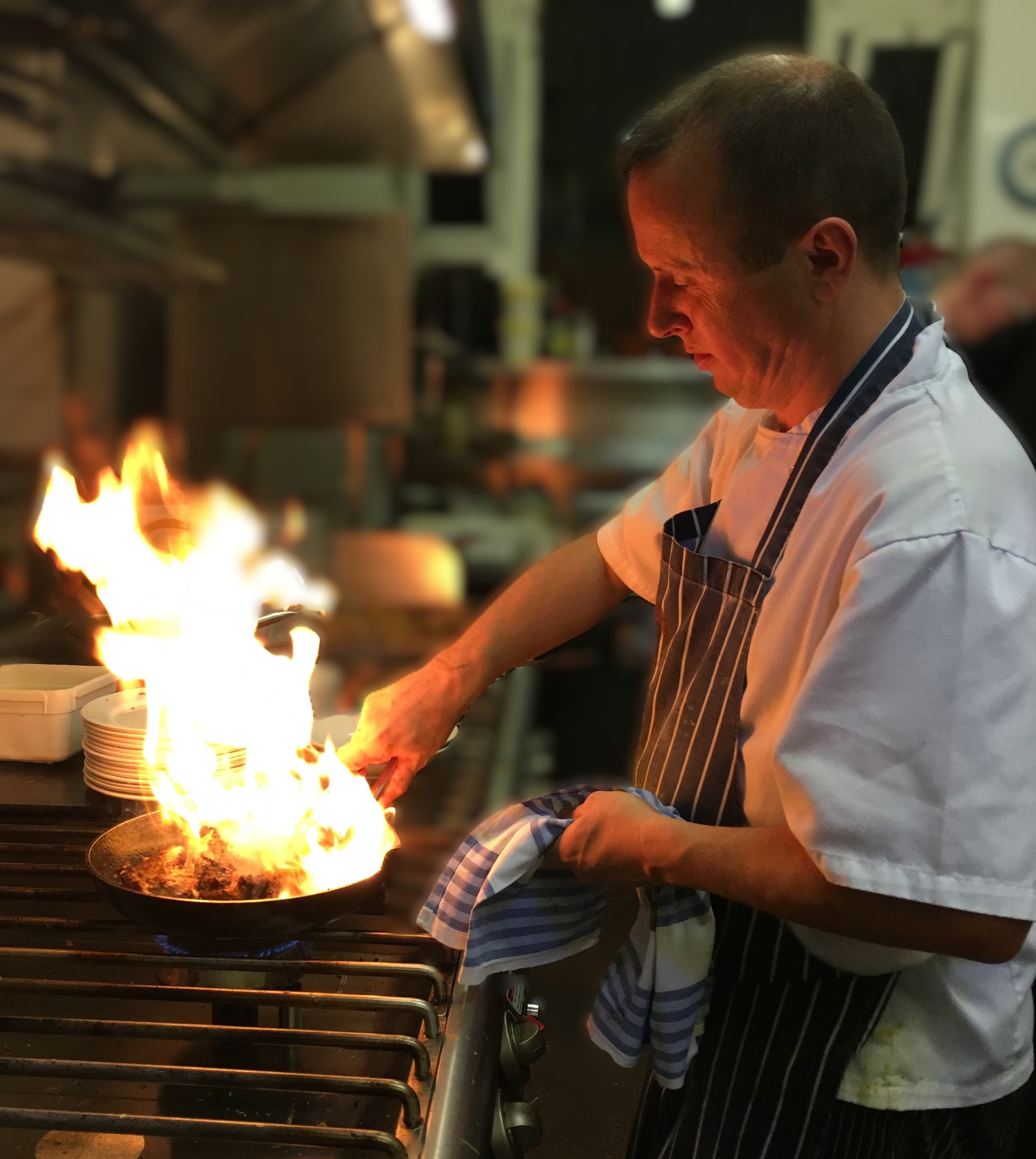
The Flame, photo Arun Kapil at Cork Pop-up
Just gimme some truth!
by Arun Kapil – founder of Green Saffron & defender of 10-minute magic
It used to start with a sound. A sizzle. The hiss of butter hitting heat, or onions tumbling into oil. Not just aroma but evidence – that someone was there, stirring, feeding, caring. The kitchen was never silent. It was loud with the grammar of food: lids clattering, eggs cracking, mixers whirling, tins opening, salad splashing in sinks – snails, slugs and tiny insects relinquishing their grip – spices crackling, toast popping up in surprise. You get the picture…. Now? Too often, silence. A beep from the microwave. A plastic film peeled back. A hollow hum as the fridge door opens again, hoping something will appear.
Let’s not romanticise the past – there’s nothing noble about being chained to a stove out of duty. But something has gone missing. And it’s not just the turmeric or the ghee. It’s not about missing ingredients. I believe it’s about missing inheritance. Because once upon a time, food travelled hand to hand. Not from Deliveroo to doorstep, but from grandmother to grandchild, parent to impatient teen. A sharing of knowledge that came with burnt fingers, not barcodes. You didn’t need a cookbook; you just needed to hang around long enough while someone you loved was cooking. There was time for it. There was space.
Now, the world tells us cooking is a chore. An inefficiency. Something to be outsourced, automated, streamlined, or skipped altogether. We’re being sold “freedom” in the form of boxes, packets, pretty little freezer meals with parsley carefully airbrushed onto the cardboard. But make no mistake: this isn’t about convenience. It’s about control. About profit. About keeping you too tired, too busy, too unsure to question what’s in that plastic tray.
Real cooking’s been rebranded from an everyday act to occasional luxury, then spun again to us as actual modern burden weighing us down – tiresome, unnecessary. And we’ve swallowed that story whole. But here’s the truth no one’s bottling and selling: you don’t need a perfectly curated pantry full of Mason jars, beautifully labelled tins and the like to take back your kitchen. You just need ten minutes and a reason. A cracked egg. A bag of spuds. A chopped onion. A slice of cheese, a jar of pickles. The kind of food that doesn’t try to impress, but just is.
Because what’s really missing from our kitchens isn’t cumin or fresh herbs – though these can significantly help… It’s the spark. The passed-down ritual. The daily flex of “I made this for you.” And once that flame goes out, then the packets win.
The Great Forgetting

Here’s where it gets a bit sticky. It’s not that we don’t care about food anymore – we do. Deeply. Viscerally. But somewhere along the way, we were told we shouldn’t. Or couldn’t. That real cooking belonged to professionals, influencers, or people with time to spare and copper pans to show for it. That unless you had the “right kit” – the cast-iron casserole, the twelve-hour timer, the sous vide wand – you weren’t allowed to play. But what of the real tools? A wooden spoon, a warm pan, a spice grinder that hums with memory. What of these? To me, the humble spice grinder is a tool of touch, scent, and instinct, not status.
And the world didn’t stop to correct that. In fact, it profited from it. Convenience became king, choice became code for compromise, and somehow, we ended up apologising – for not cooking, or for daring to even try. A clever sleight of hand. Because here’s the thing: a ready meal isn’t just easy. Sometimes it feels like rescue. When your day’s run dry, your energy’s gone AWOL, and you’re balancing life on a shoestring, that tray in the fridge starts to look like a lifeboat. But it was never built to nourish. Only to fill. There’s a difference.
This is food that bypasses memory, skips tradition, and heads straight for your dopamine. High-flavour, low-care. It doesn’t smell like anything your grandmother made and it doesn’t linger the way her food did, either. But this isn’t about shame. It’s about noticing. About wondering who decided that scratch cooking was an expensive chore, or that feeding ourselves with care was a luxury. Who told us that a cardboard sleeve-entombed lasagne from a foil tray was “home-style”? It wasn’t your Nan. Not your Grandma.
So maybe what’s missing from the kitchen isn’t just time or tools or confidence. Maybe it’s the quiet reminder that cooking isn’t a performance. It’s a practice. A way of remembering who we are – and who we love. And every pan stirred, every onion softened, every finger tasted? That’s not just dinner. That’s an act of presence. Of care. And care, unlike calories, doesn’t come with a traffic light label. It’s not measurable. It’s just felt.
Back to the Flame

So how do we take it back?
Not with guilt. Not with perfect pantries. And definitely not by pretending we’ve all got three hours a night to slow-roast a beetroot. We take it back a little at a time. One fried egg. One honest plate. One evening where you decide not to eat from a box. That’s how culture returns – not as a grand gesture, but as a whisper: “This matters”. And it’s not just big names in test kitchens showing the way. Jamie Oliver’s still knocking out traybakes with swagger. Nadiya Hussain’s reminding us that a packet of noodles and a tin of beans can sing. It’s not about fanciness. It’s about feeling. About giving what you’ve got a little love, a little heat, and calling it dinner.
Mum always cooked a bit more rice than needed – tomorrow’s quick stir-fry insurance. Pasta, cooked the day before, would become something else entirely with a spoon of garam masala, a handful of frozen peas, and whatever scraps the fridge offered up. These weren’t recipes. They were reflexes. Little daily acts of hope, passed down like kitchen myths. Variety? It came not from shopping, but from seeing differently. A bruised apple baked with cinnamon. A tin of chickpeas turned chaat. A leftover heel of cheddar grated onto toast, sparked with mustard, cracked pepper, a little swagger.
And here’s the thing: from whatever spice bubble of cooking joy and convivial circle of eating I enjoy, I really do think there’s a realisation welling up in us. In us all. More and more are waking up and smelling the fresh brewed – or delightfully tea-spooned instant – coffee. We’re sniffing out the truth in the supermarket aisles, behind the barcode gloss and sugary sodium slicks. And we’re turning, quietly and deliberately, towards makers we trust. Small-batch producers. Local disruptors. Brands with mud under their nails and flavour on their breath. People who haven’t forgotten that food is joy, not just fuel.
It’s not nostalgia. It’s rebellion!
Because convenience doesn’t have to mean compromise. There’s a new kind of store cupboard being built – one that’s got spice and soul and actual nutrients in it. A few clean-labelled jars. A helpful sachet or two of judiciously mixed spices. A bag of lentils, tins of beans, sardines and much more. That bottle of oil that smells like something real. A full crisper drawer packed with leaves and herbs scenting the fridge, enticing you in. Maybe a good steak, a pack of butter, vibrant vegetables, honey, fruit that bruises before it glows. Real things. With the right allies, ten minutes becomes enough again.
There’s no perfect way to begin. Just light the flame.
This isn’t about going backwards. It’s about going home. Home to a kitchen that doesn’t judge you. A kitchen where time bends, because flavour doesn’t ask for perfection – just presence. So no, what’s missing from our kitchens isn’t some magic ingredient. It’s not about Indian food or Irish or Italian. Mexican, Chinese, Korean – or even that latest “foraged on a cliff edge” trend. It’s not about gear, either. Or some lost paysan technique. What’s missing is the permission to care again.
The freedom to cook badly. To burn the onions. To try. Because food isn’t a flex. It’s a flame. Still burning in the cracked pan, the dented tiffin, the fridge full of maybe-somethings. And no multinational in the world can sell you that – though they’ll try.
The real thing? It’s sitting there on your chopping board, waiting to be peeled, stirred, shared.
Still yours. Still ours. If we want it.
Recipe of the Month: Garlic Butter Masala Spaghetti

Pasta night, but not as they know it
No plan? No problem. This is the back-pocket, front-flavour kind of supper that makes something out of nothing. Garlic hits the pan like it means it. Butter melts into spice like it’s been waiting all day. And spaghetti – humble, global, gloriously slippery – carries it all with grace. And if you’ve got an egg, fry it with crisp, lacy edges and drop it on top like a crown. Regal, reckless, and ready in ten. Not fusion. Not fancy. Just fast, fragrant, and exactly what you needed. It’s instinct.
Boil 150g spaghetti in salted water – you’ve done this before. Meanwhile, melt a generous spoonful of butter in a wide pan. Add 4 smashed garlic cloves (yes, smashed), 1 tsp cumin seeds, and a little crackle of chilli powder or a pinch of red pepper flakes. Let the garlic go golden, not brown. Add a teaspoon of your House Garam Masala – ask me for a spice blend recipe or use a store-bought one you trust – and a grind of black pepper. Swirl. Now in with a ladle of pasta water. Let it emulsify into something silky and smug. Drain the pasta, toss it straight into the pan. Stir with flair. Finish with lemon zest and juice, fresh coriander or parsley, and if you dare, a soft fried egg with crisp edges dropped on top like a crown.
Eat hot, with fingers if you must. This is your kitchen. Your rules.
Next Month: Fridge-Door Alchemy
What do you cook when all you’ve got is a sad carrot, half a tub of yoghurt, and a tin of something you don’t even remember buying? Next time, we’re talking thrift, instinct, and the quiet art of making something from not very much. Because the best cooks aren’t show-offs, they’re magicians. And flavour? It’s never about how much you spent. It’s about how you see.
Arun Kapil, Food Editor of AN Editions, founded and owns a spice company, Green Saffron Spices. He works sustainably direct with partner farms mainly to the west and north of India and some in the south. He works directly from source. He owns total chain of custody, depleting links in the chain, bringing direct line of sight to fields of cultivation. Arun and his partner Olive began by selling one or two sachets a week of bespoke blends with accompanying recipes at a farmers market stall in Mahon Point, Cork. They now sell spices and seasonings to globally based blue chips, onward food processors and are just in the throes of re-launching their brand, based on Modern India meal solutions, sauces, spice blends, naan, condiments and basmati. They started the business boot-strapping from the bottom up, managed with a good deal of jugaard. He considers himself to be a masaalchi and at best a khansama supported by a strong network of Irish, Indian and British agri-experts and businessmen.
Discover more from Ars Notoria
Subscribe to get the latest posts sent to your email.
You must be logged in to post a comment.