
Professor Sigmund Freud, photo Max Halberstadt
The less seriously we take Freud, the more they like it
by Phil Hall
Sigmund Freud, the neurologist who founded psychoanalysis and treated psychopathology through dialogue between a patient and a psychoanalyst, revolutionised our understanding of the human mind. He believed that a lot of human behaviour was influenced by unconscious thoughts, desires and memories. He believed that there was the conscious mind, the preconscious mind, and the unconscious mind. The unconscious he said was the largest part. If you think about it, people deny the relevance of the ideas of Freud and debunk him, but their conversation is still informed by his ideas. All advertising, especially lifestyle advertising, operates on the premise that we do all have unconscious desires and instincts – and repressed memories. Advertising uses this to manipulate us and does so successfully.
‘It is chiefly the psychologists of the school of Freud who have pointed out that many of man’s thoughts and actions are compensatory substitutes for desires which he has been obliged to suppress. A thing may be desired not for its intrinsic worth or usefulness, but because he has unconsciously come to see in it a symbol of something else, the desire for which he is ashamed to admit to himself. A man buying a car may think he wants it for purposes of locomotion, whereas the fact may be that he would really prefer not to be burdened with it, and would rather walk for the sake of his health. He may really want it because it is a symbol of social position, an evidence of his success in business, or a means of pleasing his wife.’
Bernays (1928)
Freud believed sexuality developed gradually and did not simply emerge at the stage of puberty. And I think that if we all reflect on it we know this to be true. Freud didn’t underplay the sex drive. Freud talked about the development of sexuality through different stages: first the focus on sucking, biting, then toilet training, developing complexes, repressing them and finally after puberty, emerging into sexual relationships. Perhaps Montessori was inspired by Freud. If you look at someone like Piaget or Montessori, they both assert that motor-sensory skills build up layer by layer, and explain how, for example, a child needs to acquire control of the forefinger and thumb before he or she can write. You see the compulsive behaviour of trying to open bottles, to pick things up, to drop things which are all a part of motor-sensory development. Piaget and Montessori also thought in terms of stages of development, though they concluded cognitive development was more important.

Freud continued his explorations, and he talked about primitive basic drives, discussed the sense of self, and he talked about how we have a moral conscience. None of these ideas are false. The id, the ego and the superego are names for things that actually exist. You could argue that concepts like the id, the ego and the superego are notional, and unprovable, but to do so would be a sign of stubbornness. Freud’s ideas lay eggs. They are useful. People do have primitive instinctive drives and a pleasure principle; they do have an ego and a sense of themselves, and they do have a moral conscience and an internalised set of societal rules and values. So, what is there to debunk here?

Sigmund Freud discusses defence mechanisms, and so do we. We talk about repression, denial, projection, displacement, and sublimation. He explained that these were techniques by means of which the ego uses unconscious strategies to reduce anxiety caused by conflicts between the id and the superego. Freud had ideas and insights into the nature of dreams; that dreams were the bridge to the unconscious. If you look at an infinitude of artists, they all use his idea. So many of them strive to create images that work on the unconscious, that bridge the conscious with the unconscious – the unconscious as our connection to the feeling that we exist, our feeling of being real in the world. Our unconscious is more about ontology than epistemology, and anchors being in the world. The fascist Heidegger stole ideas from Freud.
For example, Werner Herzog, specifically takes on board the idea of using powerful images and scenes to build bridges to the unconscious in a sort of modern post WW2 way of expunging; a modern method of getting rid of the bad blood of the repressed German unconscious. From the point of view of psychology Werner Herzog is a quack, but Freud’s ideas give his work additional artistic power.

If we are looking at the ideas of the human psyche as Freud did, and comparing the human psyche to an iceberg (as Freud did) the unconscious is the largest part and the most important part. The unconscious is the centre of our being and gives us the feeling of being alive. With our unconscious we perceive the world directly, phenomenologically. Our ego is just the editor chopping and pruning away under the surface at something alive and growing. Freud’s psychoanalytic method was an effort to get past the editorialising and storifying of the ego by means of techniques like free association and dream analysis; to understand the entanglement of a human being’s hidden motivations and repressed memories. According to Sigmund Freud, to so do we require an understanding of the imagery of dreams. People call this Jungian, but at root it is Freudian. Jung provided another layer of reanalysis and understanding. He merely re-interpreted Freud’s interpretation of dreams.
Often when people brought up in the Western tradition talk about the ego and the evil of the ego and the need to repress or eliminate the ego they demonstrate how naive they are about the unconscious. When they use the word ego they may think they are talking about the philosophies of Buddhism and Hinduism, but they are using the constructs of Freudianism to do so. They’re seeing Buddhism through the lens of Freud.
Freud has not been debunked, merely insulted.
Nowadays, therapists criticise Freud for his overemphasis on sexuality and sexual development, while contradictorily many of those who argue against his views also argue that sexual preferences and gender are vital to the way a human being interacts in any society (and by any society they mean capitalist society). People are born homosexual or heterosexual, or somewhere along the spectrum, or they are born into one body and do or do not want to be in another body. So while fierce advocates for seperate gender and sexual identities may attack Freud for overemphasising sexuality, at the same time they themselves overstate the importance of sexuality as one of the ways to adapt well to society – to a capitalist society that manipulates people through gender and sexuality.
Freud talks about repressed early life traumas. This insight of Freud’s has become a truism and a one size fits all explanation for all sorts of crime and dysfunctionality; so that now every newspaper from rag to broadsheet in the whole entire country will explain some horrifying or cruel story by posting pictures of the parents and the readership will nod wisely to themselves and think they understand. More serious criticisms of Freud’s ideas come from feminism. His theories of sexual development have been interpreted as misogynistic and as a justification for abuse. According to Jeffrey Moussaieff Masson, Freud abandoned his seduction theory, which stated that hysteria was caused by sexual abuse during infancy because of the intense opposition he faced from peers.
But the idea that early traumas motivate us in adult life is a Freudian idea, and it is utterly ubiquitous – unlike the Enneagram and despite Cognitive Behavioural Therapy. An emphasis on the importance of repressed traumas may clash with positive psychology and so on and so forth, nevertheless the base assumption in our society seems to be that we are all traumatised by bad parenting. As Philip Larkin wrote. They fuck you up your Mum and dad, they do not mean to but they do.’ Freud has not been debunked, merely insulted.

We talk about slips of the tongue and about Freudian slips and neurotic behaviour while at the same time the people claim the idea of neurosis has been debunked. The same people hoard, look after ten cats and seventeen foxes in small flats, rush back several times to check they didn’t leave the stove on and the door unlocked and the taps running, and tremble and twitch with anxiety when someone looks at them funny.
The fact that theories involving human consciousness and subjectivity are untestable and not falsifiable is neither here nor there because psychoanalysis is not a science like psychiatry. It is not rooted in the brain, as Douglas Dennett the philosopher used to say, the mind is an emergent property of an intentional complex system; you can’t see its contours clearly on a brain scan. When it comes to consciousness and awareness so-called evidence-based, measurable approaches are themselves built on sand, on the the ideas of Burrhus Frederic Skinner and Ivan Petrovich Pavlov, on the basis of long-ago-debunked behaviourism – the influential Lysenkoism at the heart of the US educational system.
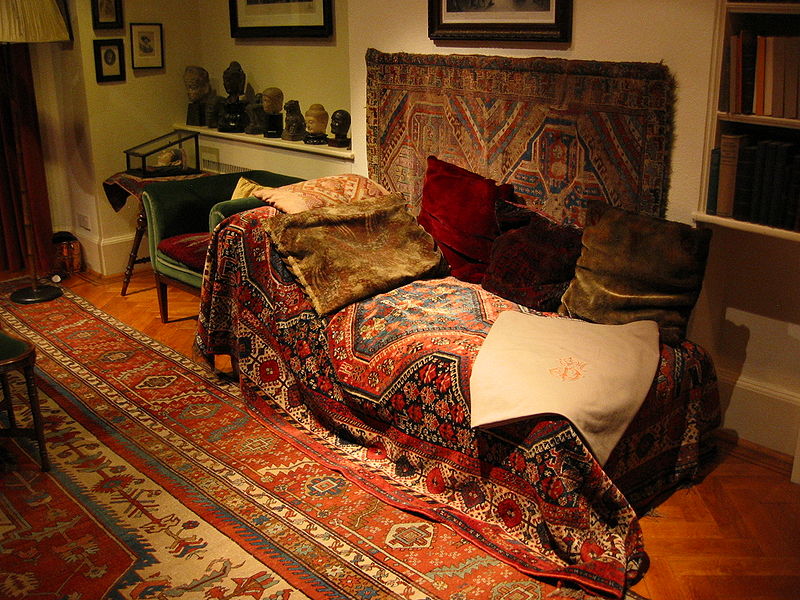
There is something deeply humane and trusting about Freud in the sense that his methods argue that it is only by understanding and coming to terms with our unconscious motivations, traumas, and experiences and by discussing them that we can advance in life. Freudian psychoanalysis gives encouragement to the idea that we can open our eyes to the world and live our lives wide awake. Unfortunately, therapy is expensive for most ordinary people and very much in demand on the NHS. It is no coincidence that people with lots money go into therapy (which isn’t called psychoanalysis anymore) and pay for the privilege of getting to understand themselves. (After all, the very rich and their apologists and flunkeys need to be able to come to terms with their sociopathy.)
Freud’s ideas travelled along the electric rail of sexuality, but others talked about the unconscious in relation to cognitive, social, and emotional development. Attachment theory emphasises the importance of early bonds and nurturing. So yes, of course Freud’s 20th century theory was not all embracing and complete. He was dealing with the nature of the human being itself. Other psychoanalysts reacted to the gaps in Sigmund Freud’s work and drew their own assumptions and either modified his ideas, or rejected, or built on them. But a lot of what they were writing was a kind of fan fiction. When people do not take Freud seriously they are being intellectually dishonest; it is as if Freudianism were some sort of intellectual DNA embedded into the culture – ignored, denigrated, but still there. The question of libido is a third rail in a capitalist society where sexuality is one of the main ways by means of which we are all manipulated.
Freud and the Trans debate
One additional reason why Freud is a target is because of his idea of polymorphous perversity, which suggests that in our beginnings we lack innate sexuality. Sexuality becomes determined along a spectrum of possible outcomes. The suggestion is that sexual behaviour, perhaps, can be context-dependent. For example, prisons, single-sex schools, and navies are full of people who have many homosexual experiences who may or may not define themselves as LBGTQ+. Freud uses the idea of polymorphous perversity in a more technical, specific sense, but in general, this concept goes against the idea that we are born one way or the other.
My view of gender essentialism is that it is Platonic. If somebody says, “I was always meant to be a woman or meant to be a man,” then what they’re doing is referring to their soul, not to a biological mechanism or feature. There’s a connection between the trans debate and the religious debate because the idea of gender becomes a Platonic idea arising out of a dualistic philosophy. Subjectively real, gender is refined into something that nestles at the core of identity.
Because if there’s a biological mismatch between gender identity and a human beings sex, there isn’t a biological reason for the mismatch. Rather it is a spiritual reason: the true self is an essential defining idea of the self. Then the way we deal with this becomes a matter of respect for other people’s choices. If someone feels female ‘neurologically’ or male ‘neurologically’, then we must respect that.

The problem being, of course, that if we try to be nuanced in an argument, then the red flags go up because this signals dubious motives, perhaps. To draw an analogy with climate change denial: if somebody asserts we’re not all going to drown under 10 metres of water by 2050, then other people will question their motives and scream at them, accusing them of ignoring the danger of climate change. In discussing questions about the reflectivity of clouds a senior scientist is accused of denying global warming. And so, in an argument between irrational conservatives trying to preserve the status quo and people defending their precious identities, questions of gender fluidity become a very touchy subject indeed; on the one hand, gender self identification is denied, and on the other hand, ideas about gender fluidity (inspired partly by Freud’s notion of polymorphous perversity) are a threat to gender essentialism.
In truth, for me, as an outsider to the debate, the idea of a true self being gendered differently is an argument from dualism – a soul in a wrong body. There is no trans gene, there is a trans soul. Why is the subject touchy? Because capitalism weaponises gender in order to organise its society, and threats to gendering threaten capitalism and the patriarchy.
But if you could find a button, and if you push that button, you could change sex and have the experience of being a different sex for a year or two years or 10 years – or maybe even stay that way – would you do it? I think a lot of people would, if perhaps only out of boredom. But then again, you could say the same about a magic button for all sorts of things. Good writers writing, use their imaginations, and transcend gender. An artist, a human being who loves and associates with people of different genders, sees things through their eyes. Shakespeare is Cleopatra and Coriolanus – empathy and compassion give us license to imagine. Shakespeare, in his eternal universalism explores gender identity often in his plays.
The problem here is that we are manipulated through our unconscious in a capitalist society (by Edward Bernays and his million acolytes), and the less seriously we take Freud, the more they like it.
Beck, A.T. (1979) Cognitive Therapy and the Emotional Disorders. New York: Meridian.
Bernays, E. (1928) Propaganda. New York: Horace Liveright.
Bowlby, J. (1969) Attachment and Loss. New York: Basic Books.
Butler, J. (1990) Gender Trouble: Feminism and the Subversion of Identity. New York: Routledge.
Chodorow, Nancy (1991), Feminism and Psychoanalytic Theory, New Haven, CT: Yale University Press
Dennett, D. (1991) Consciousness Explained. Boston: Little, Brown and Company.
Freud, S. (1900) The Interpretation of Dreams. Standard Edition 4-5. London: Hogarth Press.
Freud, S. (1905) Three Essays on the Theory of Sexuality. Standard Edition 7. London: Hogarth Press.
Freud, S. (1923) The Ego and the Id. Standard Edition 19. London: Hogarth Press.
Heidegger, M. (1927) Being and Time. Translated by Macquarrie, J. and Robinson, E. New York: Harper & Row, 1962.
Husserl, E. (1913) Ideas: General Introduction to Pure Phenomenology. Translated by Kersten, F. (1982). The Hague: Martinus Nijhoff.
Jung, C.G. (1964) Man and His Symbols. London: Dell Publishing.
Larkin, P. (1974) High Windows. London: Faber and Faber.
Montessori, M. (1912) The Montessori Method. New York: Frederick A. Stokes Company.
Masson, J. M. (1984). The assault on truth: Freud’s suppression of the seduction theory. Farrar, Straus and Giroux.
Palmer, H. (1988) The Enneagram: Understanding Yourself and Others in Your Life. San Francisco: HarperOne.
Pavlov, I.P. (1927) Conditioned Reflexes. Translated by Anrep, G.V. Oxford: Oxford University Press.
Piaget, J. (1936) The Origins of Intelligence in Children. New York: Norton.
Skinner, B.F. (1938) The Behavior of Organisms. New York: Appleton-Century
Discover more from Ars Notoria
Subscribe to get the latest posts sent to your email.



You must be logged in to post a comment.