
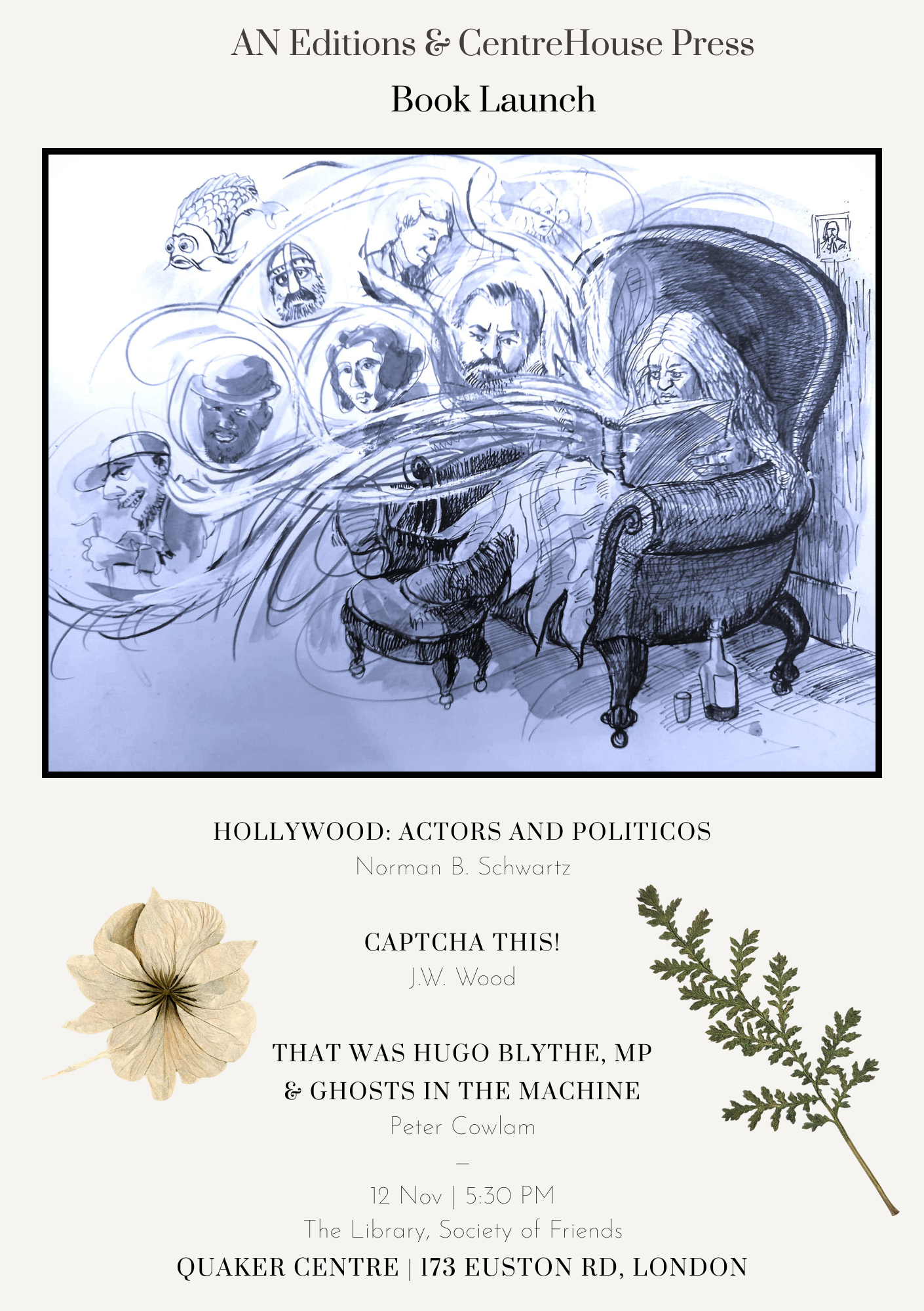
That Was Hugo Blythe MP, cover art credit Phil Hall
a novel by Peter Cowlam, published by AN Editions
That Was Hugo Blythe MP is the memoir, in diary form, of government researcher Alaric Casteele. It is set in a vaguely determined period in the early 2000s at the height of the New Labour project. Casteele’s boss is the Right Honourable Hugo Blythe MP, who jokingly refers to his department as the Department of Cult. The following is an excerpt from Casteele’s diary.
December 28 There remains under the wattage of my bedside lamp a plate with its breakfast crumbs, and under that – because for days it followed me round – Hugo’s file. Plucked out of it today was his prison correspondence with a man with a nom de guerre. I call him Lemuel. Hugo, as Hugo, was once also Lem’s MP. Lem’s brother is Samuel or Sam, while his sister-in-law is Joan. Joan and Sam left the grind of London life in September 1994, when the latter’s image archive, its revenues royalty-free and run on one-off fees, they could operate from anywhere. That anywhere they chose was a granite intrusion combed with wind and damp with mist, under a violet knuckle of rock, westward in Pentrarth, a hamlet-ette in the moorland depths of Kernow – Kernow a land of megaliths and other stony crops. This happy remoteness was also their disadvantage, a point they understood in the following June, only weeks into the life of a first offspring (a daughter I’ll call Bo).
Joan being Joan was still restricted by her L-plates, and her mother – who’d bundled a hasty suitcase onto the train – had never learned to drive, which was fair given her terrors, fully flowered in her one abortive lesson way back. That should have left Sam as the natural choice, whose options were a fast coupé and a sober four-wheel drive – but that was the quandary. Sam had engineered his one fleeting chance of photographic rights to artworks lodged motorways away at Shugborough Hall. His first idea was not to go, but his second lit on Lem, who’d doubtless appreciate a break, and be on hand for Joan, who couldn’t be without her marts and shopping malls.
Lem arrived the day after his brother left, and was probed little about that by counsel for the defence. On the day after that, once he’d togged up in hiking boots, and a set of lightweight waterproofs, and braved the rugged luxuriance in and around Pentrarth, there were ample promptings as to the man he was. A youth worker, a member of the Outdoor Writers’ Guild, and qualified to lead climbers and canoeists, his not so solid defence lingered on the good honest stoutness and healthy outlook of his character (Me? Wield a knife?). You couldn’t help but think the jury must have puzzled over this. But here other things concerning Lem could not explain his precarious moment with politics, or the time he’d spent in southern terrains distributing anti-corporate literature. You could not brush that aside, asking would an able counsel really have crossed the Tamar only to talk about human rights? Of course it would not.
What it did do was bat about the court the image of a man who had written for Rockface, the UK’s foremost climbers’ magazine, and until last year had led inner-city teenagers on summer retreats into forests and fens. Lem’s simple rationale was this: the deprived in society see the world in wider contractual terms, once having entered a comradeship that encounters the elements, and not the city streets.
Day three. All scraps of information borne to the lee of Hugo’s file suggest that Joan was lethargic, and probably lacking her usual iron supplements. We trace a leaden tread as she stepped from her bedroom, no more her private conjugal retreat, but rather the locus of too much interrupted sleep. Her own ma reports what glories there were in the sound of the sea – soft caressing zephyrs rolling in on a roaring Atlantic tide – and a radiant sun, with its yellow kitchen glare a strain on Joan with her sleepy, drooping eyes. Grandma scoured the place for dirty laundry, and insisted she didn’t mind being left with the washing machine, a good chance she thought for Lem to drive the other two the thirty miles to Razy. A reddish golden glitter brightened that town’s pinnacles, in whose rotating shadows waves of holidaymakers, pressed to the streets on an annual pilgrimage from shop to medieval shop, were joined by a tired-looking Joan, who with Bo strapped to her waist and bonneted roamed the arcades. Not much can we say about her purchases, beyond a fancy box of Echinacea tea, and a special brand of sanitary towel. Nappies she also bought, and a tub of coloured vitamin pills. Lem spent time examining a newly thought-out survival kit in one of the camping shops, and having weighed that possibility stepped across the street and entered a newsagent’s, where first he browsed, then with some gusto bought a yachting magazine [I’m looking at it now. It’s dated June / July 1995, and has as its cover a quilt of coloured sails spread out against a Mediterranean marine].
Lem’s decision it was, catastrophically, not to drive directly back to Pentrarth. Instead he forsook the long home stretch of dual carriageway, and followed a winding detour up through a flanking moorland pasture, on a trail where at strange and not predictable intervals the verge was grazed with sheep. At the summit was a church, and a village green, and a flowering chestnut tree, and a hostelry he’d read about, whose name was the Jolly Jackanapes, unusually. Lem parked up. They left the car, and crossed the threshold, where he and his sis-in-law recoiled, their venue not so quaint as the brochure they’d looked at seemed to suggest. Here were the regulation posts and beams, blacked – and a lot of old-world tables darkly stained – with hardly a gleam of natural light, the windows small and square and deeply recessed. A Gothic-looking student, with a team of four or five others grouped round him, parleyed obscenely with a fruit machine, which not very obligingly had spat out only a single coin in exchange for the dozens he’d coaxed it with.
Joan and Bo retreated to the garden, while Lem ordered drinks and a round of sandwiches. That too was regrettable, since a score or so – not all of them male – and the main phalanx ahead of the group inside, monopolised the outdoor furniture, all of it heavy wooden integrated bench-and-table-style, some skewered, some not, with coloured parasols. Lem recalled that as he teetered out with a tray, Joan was perched on the only vacant bit of seat, while those she shared it with had taken exception to this. To be precise they said some awful dismal things, before Lem intervened – tragically for him. The ensuing injuries were summarised as Exhibit 64, which the judge – Judge Penhale – ruled inadmissible as evidence. That exhibit read—
Wounds to both temples, wound to occiput. Deep gouge above right eye. Lacerations to throat below right ear. Bruising to forehead. Bruising behind left ear. Nose, broken. Abrasions to left cheek, abrasions to chin. Contusions to throat and neck, impairing speech. Deeply bruised arms, chest, stomach. Severe swelling to lower lip. Left ribcage cracked. Internal complications with right knee. Both knees bruised. Ditto legs. Deep incision left palm and index finger. Cuts to hands, wrists. Damaged teeth.
He remembered gasping for breath and stumbling to his feet, only to fall again where a wave of gravel edged the car park. Others joined in and held him down, his face pinned to the grit, while Joan, unable to do more, scampered inside, screeching at but not engaging the landlady, who refused to phone the police – so that she, Joan, did. By then Lem had foreseen the end of his life, but clutching at one last hope refused to relax his grasp, despite the searing pain, on the blade of a knife his candidate assassin had dropped inadvertently – and here was the crux of it. A negotiated peace came only on the demand that he release it, and the promise in kind that they would let him go, and nervously both parties kept to that deal. How, one couldn’t say, but by some miracle he drove, with Joan’s assistance, cranking through the gears, to the nearest hospital, where the gore was staunched, and where an hour after that the police arrested him – on five counts, they said, of wounding with intent. When Lem inquired what this intent had been, the answer was: ‘To cause grievous bodily harm – sir.’
Exhibit 64 was not the only evidence the jury shouldn’t have to consider, according to the judge. The odontologist called upon to examine the accused saw his observations also withheld—
Two front teeth dislodged palatally, the crown in the right one loosened [that crown fell out into the bowl of gruel Lem was trying to eat a fortnight later]. After a lapse [of weeks], root exposed through gum. Left central incisor fractured, with pain and swelling to supporting gingiva. Injuries sustained consistent with trauma caused by blow to face. Tooth, irreparable. Force required to loosen crown and fracture root, in my view considerable – a punch, an elbow, a kick.
Tra la.
What injuries his assailants suffered weren’t looked at either, amounting as they did to minor scratches, a point not consistent with the prosecution case – that, crazed with indignation, Lem, a Londoner, had launched a frenzied knife attack on a group of law-abiding students (they mostly Peninsula University), out to sun themselves after the last of their exams. Nor was there any mention of one other vital piece of evidence, inscribed on the till roll the Jolly Jackanapes generated on that fateful morning, a heady catalogue. Here’s what our Goths had consumed: malts, sherries, brandies, a half bottle of Pernod (all gone), other aniseed aperitifs, and a blur of disgusting mixers (coloured pops the contaminant, Scotch the hit). There was rum (yo ho), and there were cannabinoids, detected in the blood of three at least (spliff-ends there were aplenty, littered in the grass). Other veins were not available to sample, when few of those peripheral to that lunchtime sport ever volunteered themselves. To that you’d add the police – too busy with highway surveillance – who lacked the resources in tracing down the rest. It means one can’t be over-simpatico for Lem, who puttered down the hill, seeking a salve for his many excruciations, while the core of those responsible dissolved into a serenely untroubled, and perfectly sunlit countryside.
Lem remained in custody for over a year, before his case was tried. He was acquitted of three of the five offences, but convicted of two. He was also convicted via charges added later of unlawful wounding. After six more months he was sentenced to twelve years concurrent under Section 18, and five years – also concurrent – because of the retrospective charges. More depressing still was the certainty of successive Home Secretaries, who ruled solemnly that after sifting through the ‘facts’, no miscarriage had taken place. I am looking at a press cutting from the Razy Independent, whose inner pages picture a beatified Adrian Penhale, on the occasion of his graduation from the Marine Management Faculty, Peninsula University – a story Joan thought worth inclusion in Hugo’s file.
Ho ho.

Peter Cowlam studied Performance Writing at Dartington College of Arts, and was trained in IT at the Control Data Corporation. Since then he has had plays performed in the UK and play readings in the USA. He has won the Quagga Prize for Literary Fiction twice, most recently in 2018 for his novel New King Palmers. New King Palmers is at the intersection of old crumbling empires and new digital agglomerates. The Quagga Prize is awarded for independently published novels. Peter Cowlam is the Literary Editor at Ars Notoria.
Discover more from Ars Notoria
Subscribe to get the latest posts sent to your email.


You must be logged in to post a comment.