Mongolian Nomads Hold on to their Way of Life
by Andy Hall
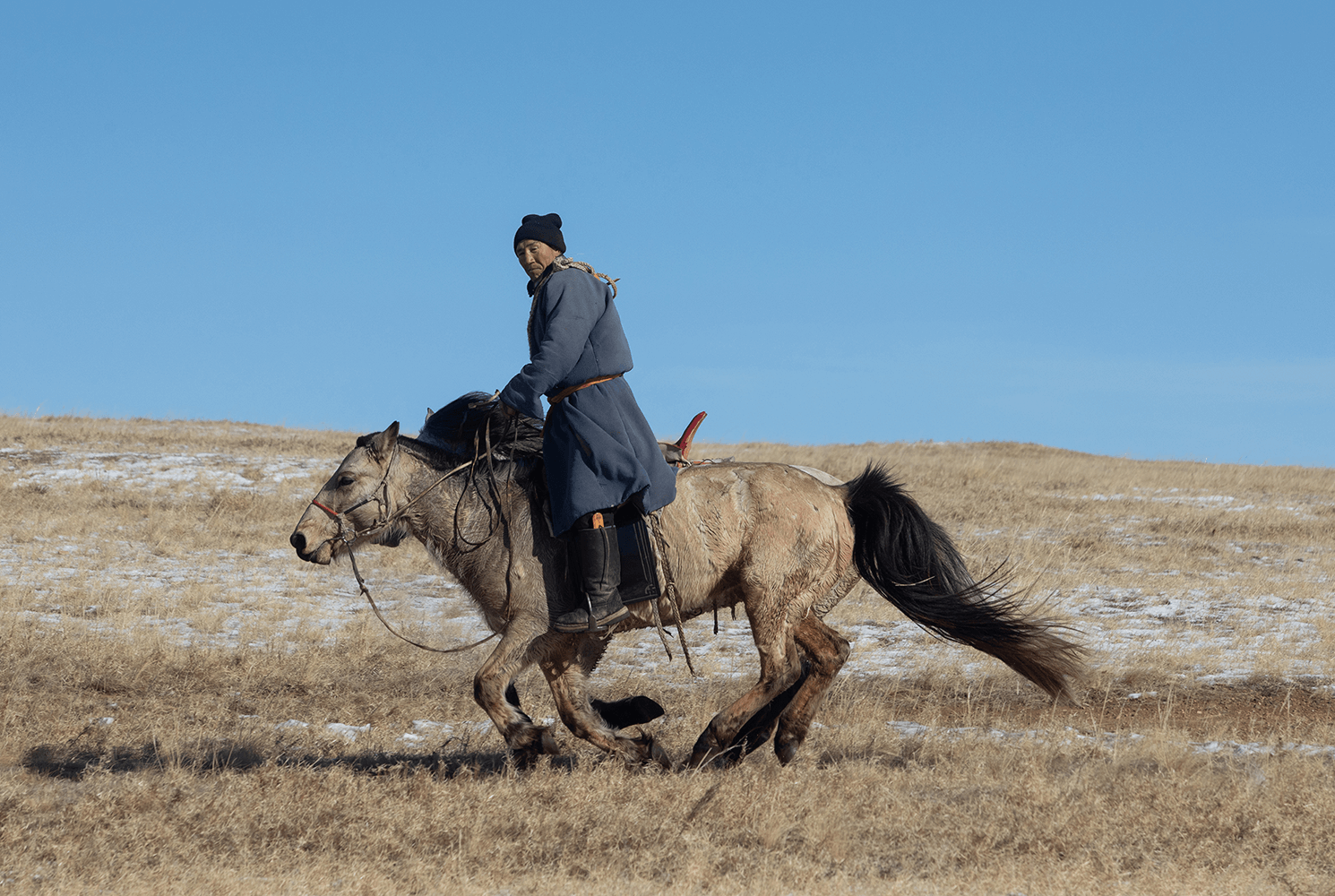
the herdsmen would all have a spare horse tethered to the horse he was riding © Andy Hall
The steppes were every bit as beautiful as I just imagined them to be. Very soft on the eye. Soft and gentle. A harsh landscape but an incredibly open landscape, one of the most open landscapes, and most elemental I’ve ever experienced. When we were there, it was at the very end of winter. We were expecting temperatures of up to minus 40, but actually, it was a balmy minus 15. And we went to an area in the eastern steppes that was very close to where Genghis Khan was born and came from.

The story I did for the Guardian was really tied in with climate change and its effect on the nomads who were moving away from the steppes and looking for work in towns and cities. Mainly because of the extreme changes in temperature and climate. These changes were ruining the well-being and health of their livestock.

But the people we met on the steppes were still sitting spread across their land, really. We went to visit about three homesteads. And every homestead was in the middle of nowhere. They live in yurts. Obviously, there were horses, but they also each had motorbikes and pick-up trucks. So it wasn’t totally traditional and old-fashioned.

The first homestead we went to was to see a man who is renowned for his horsemanship. A lot of his reputation was based on this. He and his horses are winning races. I think his horse came second in the last big race. They have an annual horse meet every spring, and one of his horses came second overall. We followed him out onto the steppes and watched him herd his goats. He had longhorn goats and sheep. And a lot of what the riders do is herd long horn goats and sheep.


They ride with two horses together. It’s strange that they ride with one or two horses alongside them. Usually, only one. And he had to take the one he wasn’t riding with him even though he wasn’t riding him, otherwise the horse would have been jealous and skittish.

I followed him on the way as he worked. I took pictures of him from a truck. I got the driver in our pickup truck to chase after the Mongolian nomad while he rode his horse, with the other horse running alongside. I got some nice shots on a long telephoto lens from about 100 yards away, just following him and taking pictures of whatever he was up to.

Then I got out of the car and ran alongside him for a while. Otherwise, I used angle shots. I was awestruck by the rider’s ability. Their horsemanship is just unbelievable. I’ve never seen how horses can be so ingrained into a people’s culture as it is for the people of the steppes.
Then we visited another homestead, and that was the story of a couple. The woman, Baigal Batulzi, wanted to go to the big town, but Baterdene Tuvshintur was intent on living out on the steppes with his family. It was obvious that the woman was not as keen on living out in the middle of nowhere in the traditional fashion. She got very excited about us being there because it gave her a chance to wear her Sunday best and put on her glad rags for the cameras.

On the other hand, her husband was obviously loving his life with his two sons. His wife was missing the city because they had lived there for several years before they went back into the steppes. Anyway, that was the other, quite a few homesteads.


We visited Genghis’s City, Chingis City which is a town right in the middle of the steppes. And it was Soviet style, with big apartment blocks. And it lay in the middle of the steppes. I remember walking back from the homestead on the open steppes and far into the distance was this tiny little city in the middle of nowhere, plunked down. On the way back, closer to civilisation, we saw lots of open cast mines. And of course, that’s behind a lot of the problems of pollution on the steppes. Mongolia relies too much on the income it gets from open cast mining. I took some pictures of lonely homesteads in the middle of nowhere, but the air was still smoggy and the backdrops to the photos are smoggy. Open cast coal mining getting in the way of traditional nomad lifestyle.

Again, as they rode, the herdsmen would all have a spare horse tethered to the horse he was riding. This practice goes back to the days of Genghis Khan and the Golden Horde. The rider would jump on the one horse when the other got tired – without stopping. It was tethered to the horse he was riding.

We were driving on the open road on the way back. Horses had appeared from nowhere with riders on them and we would suddenly come across people who were herding. Usually they were herding horses, but a couple of nomads herded cows. One of the herdsmen noticed me in the car and he got up alongside the road galloping at full pelt. He was using an implement on the neck of one of his horses. It wasn’t the horse whip, but it made the horse go faster. It was stunning to watch him ride.

Andy Hall, recently won the prestigious Trieste Photo Days award for best author. The competitions was judged by the Magnum photographer Harry Gruyaert, who said: ‘I chose this work because it’s the kind of work I would have liked to have taken myself. His compositions stand out; he’s pulling order from chaos and some of these images are truly powerful.’
Andy Hall is an editorial photographer based in London specialising in reportage, with over 35 years experience; travelling all over the world on commission for numerous publications and organisations including the Guardian and the Observer and UNHCR. His work has featured in many exhibitions and he has collaborated on a number of book projects. His work on the Sahel region of Africa was screened at the Visa Pour’Image Festival in 2012 and his street photography has earned him accolades, including Finalist in the Brussels Street Photography Festival in 2019 and 2024, and Finalist in the Lensculture Street Awards 2021.
Discover more from Ars Notoria
Subscribe to get the latest posts sent to your email.


You must be logged in to post a comment.