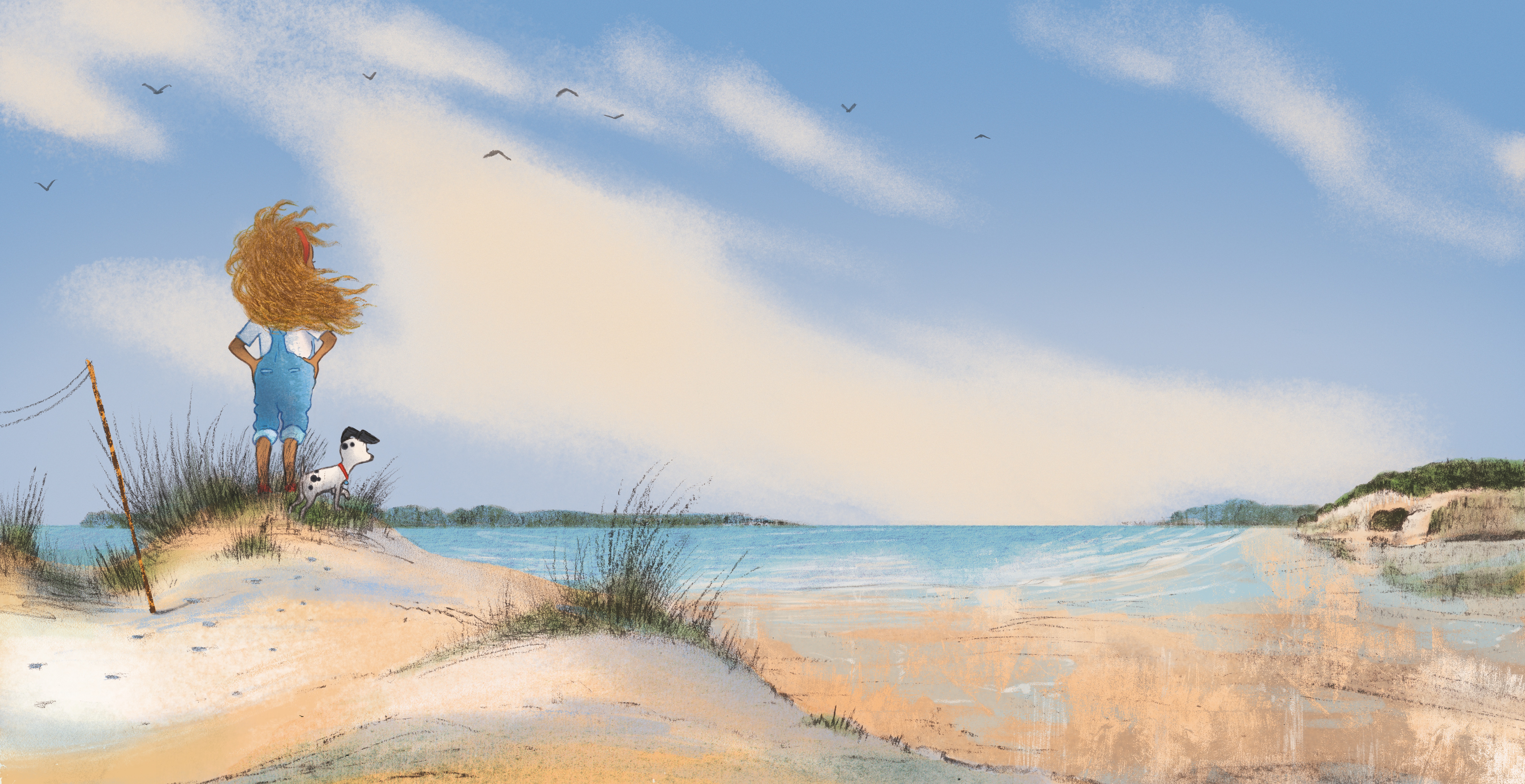
From Goldilocks and the Three Crocodiles, ©David Melling
Interview by Paul Halas
The choice of illustrated children’s books available is dazzling, almost bewilderingly so, but for every generation of kids and parents looking for something special there are a few illustrators and writers who stand out from the crowd. Whose books are charmingly illustrated without being saccharine, and whose stories succeed in keeping the little ones enchanted. One such illustrator/author is David Melling, whose books have been familiar to parents and children for thirty or so years. The key to his success has been a thorough grounding in draughtsmanship, and his mastery a number of visual styles. Pen and ink, watercolour, ligne-claire, cartoony, quirky, sometimes even quite Gothic and dark, Melling is certainly not one of those artists whose drawings stick to an unvarying formula. The quality of his artwork is such that one feels a wide variety of artistic avenues could have been open to him, but he’s best known for his work in children’s books. When asked if there had been a watershed moment when he decided to specialise in children’s books, he replied:
One has to go back a long way for that, to a time before the internet and computer-assisted artwork… I’d always been keen on drawing and painting, so after leaving college and running through a diverse series of jobs, I decided that I wanted to be a professional artist – and at first I drifted into becoming a general illustrator for magazines and advertising… and I really didn’t get on with it at all. I thought there really had to be more to illustration work than just that. But then I had the opportunity to work in an animation studio, and it woke me up to a world of storytelling and narrative illustration that showed me the way I wanted to go. It was a natural path for me to follow.
There have been times when people have asked ‘Have you ever thought of doing anything outside children’s books?’ and the answer is I’d love to, but the opportunities are very limited, certainly more so now than ever before. I’ve always thought I’d love to do other things – stories for adults, anthologies, even non-fiction, but as soon as I got into the children’s book work I was very lucky. It was a slow build, but I’ve always had work ever since. As I was coming to the end of my first job another one came along, and another, and another… As I say, I’ve been very lucky, and I’ve had that all my career. I’ve never been out of work, which is a real blessing. So really, I’ve just followed my nose in that respect. But as the years go on – most recently in particular – I’ve thought I’d love to move to other areas. But… when you’re a freelancer, it’s very difficult to turn down work that’s put on a plate for you.
Paul Halas: Looking through your work, your versatility is amazing. From the very simplest of drawing, for the tiny tots, to complex, almost steam-punk type artwork that would go with fantasy novels, the Terry Pratchett-style stuff. One particular illustration of yours stands out in my mind, a simple ink and wash picture of a cat holding a cup of tea.

It’s very Japanese in feel, almost like one of those wonderful old prints – understated but beautiful. It’s stylised but acutely observed. Do you keep your hand in by drawing from life?
David Melling: Not as much as I’d like. And curiously enough, over the past year I’ve been telling myself I need to more of that. But just going back to my versatility, from early in my career I prided myself that I could do a wide variety of styles, but found myself pigeonholed into a producing a certain look, particularly with books for the very young. Publishers like to put people in boxes, now more so than ever, and that’s true in adult fiction and music and all sorts of other areas. Once you do something successful they want more of the same, and it can be a frustration. In the middle period of my thirty or so years in illustration, my decade with Hugless Douglas came along.

In many ways it was the best thing that happened to me, but it also put boundaries on my output. I spent 90% of my time over the next decade doing one character, because it had been something very different, and it became huge… it really took off… an enormous success. And so the publisher said, ‘Right, do another one, do another one…’ So I got caught up in that, and for about five or six years I was very happy to do it. But then the hamster wheel feeling came in… and I like to do other things. So, by the time I’d finished – ten years is a long time in any career – I was more than ready to branch out. I owe those books an enormous debt, but it was time to move on. When I was taking my portfolio of work around, however, showing the variety of work I could do, people would say, ‘Why are you applying for that kind of work? Do your Hugless Douglas.’
Getting back to the question of working from life, I’ve done my best to keep that up, but in the commercial world it’s fair to say I’m a little bit restricted in what people expect me to do. However, I’ve always had the drive to exercise those muscles. In recent years I’ve enjoyed varying my styles rather more, drawing differently, using watercolours (as with the cats)… just trying to keep things fresh. And yes, a part of that is drawing from life.
Paul Halas: Looking at your sketchbooks, there are illustrations in a wide variety of styles. I particularly like the darker ones, the Tolkien-y, Terry Pratchett-y ones, and some are almost pure Dickens. They remind me of George Cruikshank’s illustrations. Is that a direction you’ll be heading in more?

David Melling: I would absolutely love to. In fact I’m doing a book – working title Ghost Wolves – and although it’s still a children’s book, it’s for a slightly older age range. It’s a bit more like my picture book The Tale of Jack Frost, for example, or the Goblins young fiction series.

And that’s my preferred area. Hugless Douglas was for the very young, and because it was very successful, that kind of work was subsequently what people wanted from me, but it brings me to the word that I most dislike: ‘cute’. Hang on, though. Of course one’s work has to be appealing, it’s what’s demanded, you’re drawn into it, but that’s why my default setting is humour. I try to balance out the cute with the humour. So, I’m not going for full-on cute; I’m going for the humour.
Phil Hall: Can I ask your opinion on Peppa Pig?
David Melling: Actually, I think it’s excellent. No kidding. I saw that when my kids were little, and now they’re twenty. I found the stories refreshing because they’re all about the characters and the writing was excellent. It really spoke to the kids and it spoke to the parents. And it just shows you don’t need an all-singing, all-dancing animation style to be very engaging. So I liked it. It hit the right notes. Of course it’s still going strong after twenty years so things might have changed, but for the very young it worked.
Paul: You mentioned you worked in an animation studio. How did that affect your artistic development?
David: It was profound. From early on I took inspiration from Laurel and Hardy, Asterix and Obelix, Tom and Jerry… those are just a few sources. I grew up loving them – especially the good old Tom and Jerries, the ones from the 1950s.
Paul: The early Tom and Jerries were almost a bible for aspiring animators. Genius animation – how did they make them move like that, and with such economy?
David: Everything about them was beautiful; they were an inspiration for my work… from way back. Back in the 1980s, when I started working in animation studios, I used to do backgrounds and bits and bobs as a renderer. And it woke me up to the whole world of narrative illustration. The sequential process of images and ideas. How to develop character through my drawing. How characters move and where they go, how they walk, how they react. Pose and posture. Expression. All that ends up channelled into my work.
Paul: Did your grounding in animation, and working from storyboards, help you to develop your own techniques of storytelling?
David: Enormously. I took a year out living in Italy, and obviously I was limited in what I could take with me. The one book I brought was Disney’s The Illusion of Life – a compendium of animation techniques, storytelling, anecdotes and cartooning wisdom. I drank in every word of it, from beginning to end. And so much of it translated from classic animated film into my world of children’s books. The way I approach storytelling is very much in an animated way, and it’s been heavily influenced by those years of working in animation studios and… reading and watching.

Paul: Would you say there’s a lot of difference between working in books and producing the artwork for animation?
David: Most of the animation disciplines hold true in book illustration as well. Model sheets, storyboards, character size comparisons etc. I have to say that when these tools are used the results are often better.
Paul: Can you tell us what got you into animation… and what got you out of it as well?
David: Working for magazines and adverts wasn’t going so well and it wasn’t satisfying, so when someone said, ‘There’s a TV series, they’re looking for animators and background artists… they want people with coloured pencils,’ I went for it… and got the job. Very quickly I got into rendering, because there was naturally more availability for renderers than background artists. So I worked on a numerous projects in numerous studios, such as TVC and Grand Slamm Animation, both heavyweight studios producing some of the best animated films of the 1980s, but in many others as well, and, like many freelance artists, I kept circulating between them. It was at TVC, however, when the studio was working on Grandpa, that its creator, John Burningham, spent some time in the studio. I don’t think I spoke to him, but he was obviously very nice, very involved, and I just thought, ‘I need to be that guy, I don’t just want to be the guy working on that guy’s work.’
So I made the difficult decision. It was very easy to yet get another three or four month studio job, which would’ve made around £300 per week (which was pretty good in those days), so to say, ‘No, I’m going to spend time getting a portfolio together’, that wasn’t easy. And it took a stroke of luck. Especially as by then – the late 80s and early 90s – the world of animation was changing, with more of the processes done by computers and fewer by real people. Renderers were becoming obsolete; the days of manual paint and trace were on the way out. But I didn’t see that. I was just fortunate that the timing just worked out for me…
Paul: When you change course like that it can come down to simple serendipity. The flip of a coin almost.
David: Exactly. That’s what happened. About six months into building my portfolio – I was sharing a photographer’s studio at the time – someone realised I was doing children’s book-style illustrations and put me in contact with a friend, a member of the Chelsea Arts Club, who put me in touch with her friend (as these things happen), whose wife was just setting up as an agent for children’s illustrators and writers. So I ended up showing her my work. I hadn’t been thinking commercially, it was mostly large black and white artworks, narrative stuff – somewhat influenced by Ronald Searle and Ralph Steadman – but she liked my work. Within 15 minutes she had become my first agent, and I was her second client. As you say, serendipity; right place, right time.
It still took me two years to get my first real job because I had to recalibrate my style, to make it more compatible with the kind of children’s book work I wished to do, so in the meanwhile I was doing all sorts of bits and pieces – helped by my versatility as a draughtsman. At one point I illustrated an activity book based on Raymond Briggs’ Snowman (with his blessing of course), but that was little different from the kind of rendering I’d been doing in animation studios. However, by 1996 my first book had rolled off the presses, and Hugless Douglas was on the immediate horizon.
Paul: As well as producing solo works, you’ve been associated with some very illustrious authors. My colleague Phil and I are political animals, so Michael Rosen springs immediately to mind. There’s something delightfully subversive in even his children’s writing, and that’s also very visible in the illustrations you’ve created for his books. Was it fun to work with him?

David: Working with him was an absolute privilege. I almost pinched myself when the opportunity arose. When you meet someone of that stature you don’t know what they’re going to be like, and he was an absolute delight. We were able to meet several times during our collaboration, which was a great help and a pleasure, because so often you have to make do with a few quick Zoom meetings… which just aren’t the same.
Paul: Did you work to a tight brief from Michael Rosen, or were you given freedom to interpret his work as you saw it?
David: Zero specification, 100% freedom. He said he does the words, I do the illustrations. He’s like that with all the artists he works with, and he’s always pleased with the end product. It’s not that he’s uninterested in the result, it’s more a question of trusting the people you collaborate with.
That’s not always the case when collaborating with writers. I’ve been very lucky but I’ve heard stories of issues arising when writers take a highly prescriptive approach and become quite assertive in their demands. I wouldn’t like that. Some things need to be specified for the sake of the narrative, but too much and it’s limiting and wearing.
Paul: Do you prefer to work completely on your own or in collaboration with a writer?
David: There’s a special satisfaction in producing work that’s all your own, but I still consider myself an illustrator who writes… After all, I’d been an illustrator for eight years before I got anywhere near writing. I think it started when I’d been handed a story I found rather too twee for my taste, so my editor suggested I write one myself… so I did. And I’ve developed what one would call an illustrator’s way of writing.
Maurice Sendak invented an exercise in sequential drawing he called fantasy sketches, in which you take a sheet of paper, start top left and finish bottom right, and just draw your figures or images in a row, without thinking too much about it. I’d give myself about ten minutes for one of these, and the results were frequently amazing. You almost cut conscious thought out of the process. I’ve adapted this for my professional work, at least in part, and it’s effective. After a while you get to know where you’re taking your narrative.
Paul: So in effect you’re setting out without knowing your destination. Are you ever surprised by what you come up with?
David: Frequently. What you produce is like a scene in animation. You may not get a complete story, but you can create wonderful sequences.
Phil: Some caricaturists and artists can get very dark. Even in comics, there can be a lot of blood and gore. Yet there’s a kind of humorous goodness to your art. I wonder if you can do dark?

David: I’m quite interested in that area, you know, I’m quite interested in that area. In fact recently, I’ve been sending my agent some darker material, I’d love to be doing more like that. Yet we come back to the fact that I’m known for making children’s books. The dreaded world branding springs to mind. My brand. ‘Oh, you’re doing goblins, but I thought you were Hugless Douglas.’ But it does appeal to me to go off-piste and do something completely different.

Phil: I’m thinking in terms of Goya’s monster biting into a human being.
David: that kind of feel is of great interest to me. But I suspect that at this stage, it’s a case of me trying to find the time for a passion project that’s sufficiently finished to show publishers.
Paul: Are you able to make time to develop your own projects?
David: Only to an extent. To be honest I count myself very lucky – making a living from doing what I love. When it comes to making time for my own projects, yes, I put a certain amount into that. But nowadays publishing is much more challenging in terms of getting new material over the line – people don’t appear to know what they like until they see it presented in a very finished way. As it happens I’m working on a ghost story, quite spooky, without being too deeply dark and adult, and with only a few illustrations. But it’ll only be submitted when it’s sufficiently advanced.
Paul: Many years ago you made the move from London to Abingdon. Not exactly the deepest wilderness, but a big change from the Metropolis. Do you feel you’ve had to make a trade off, swapping the cultural buzz of the capital for the beauty of the Thames Valley?
David: I recognise what you’re saying, but it wasn’t really like that for me. I enjoy all the nature and the environment here, and I think that gets absorbed into one’s work, but in truth the move wasn’t that great a wrench for me because I’m quite a solitary person anyway. I spend quite a lot of time alone. I’m going to drop one of my favourite quotes in here, by James Thurber, ‘The hardest part of my job is to persuade my wife that when I’m looking out of the window I’m actually working.’
Paul: That’s too good not to steal.
David: As it happens the animator Geoff Dunbar (Ubu, Rupert and the Frog Song…), who I knew from London days, also lives in Abingdon, and we’ve been known to enjoy many a glass of wine together and chew that fat over all sorts of arty matters, so I’m not in a complete cultural desert, but in the main being away from London has little bearing on things.
Paul: One area of illustration we haven’t talked about is comics. There’s some great work being done in the world of graphic novels. Have you ever felt tempted to try your hand at one?
David: When I did my Jack Frost and goblins Geoff suggested the same thing. The truth is, the commercial reality comes up and gives you a nudge. Creating a graphic novel is very much a labour of love; it takes you at least a year, and the financial rewards are very seldom that great. My chosen path has been very fulfilling, and I consider I’ve been very lucky to have this career in children’s books. Graphic novels would’ve involved taking a somewhat different course, but when it comes to creating some darker stuff – watch this space. My newest project is now well advanced, and, as they say, ‘If you get an idea, do it quickly because if you’re not careful, someone else will come up with it.’
Paul: We look forward to seeing it! We really appreciate your taking the time to speak with us, and thank you so much for taking time to talk with us.
Phil: Likewise, thank you. It has been most informative.
David: It was a real pleasure to meet with you and spend time. So thank you too.
Paul Halas, the Arts and Lifestyle Editor of Ars Notoria and co-founder of AN Editions, is a writer of Jewish heritage whose escape from 1970s hippiedom was the discovery that he could invent stories. He spent forty years contributing to various Disney magazines and books, as well as a variety of non-Disney comics, books and animated films. He recently finished the second edition of his book The Rights of Man and Fish which was launched in March 2025 and is working on his next book: The Sarah Chronicles. Halas is a self described Humane Socialist.
Discover more from Ars Notoria
Subscribe to get the latest posts sent to your email.
You must be logged in to post a comment.