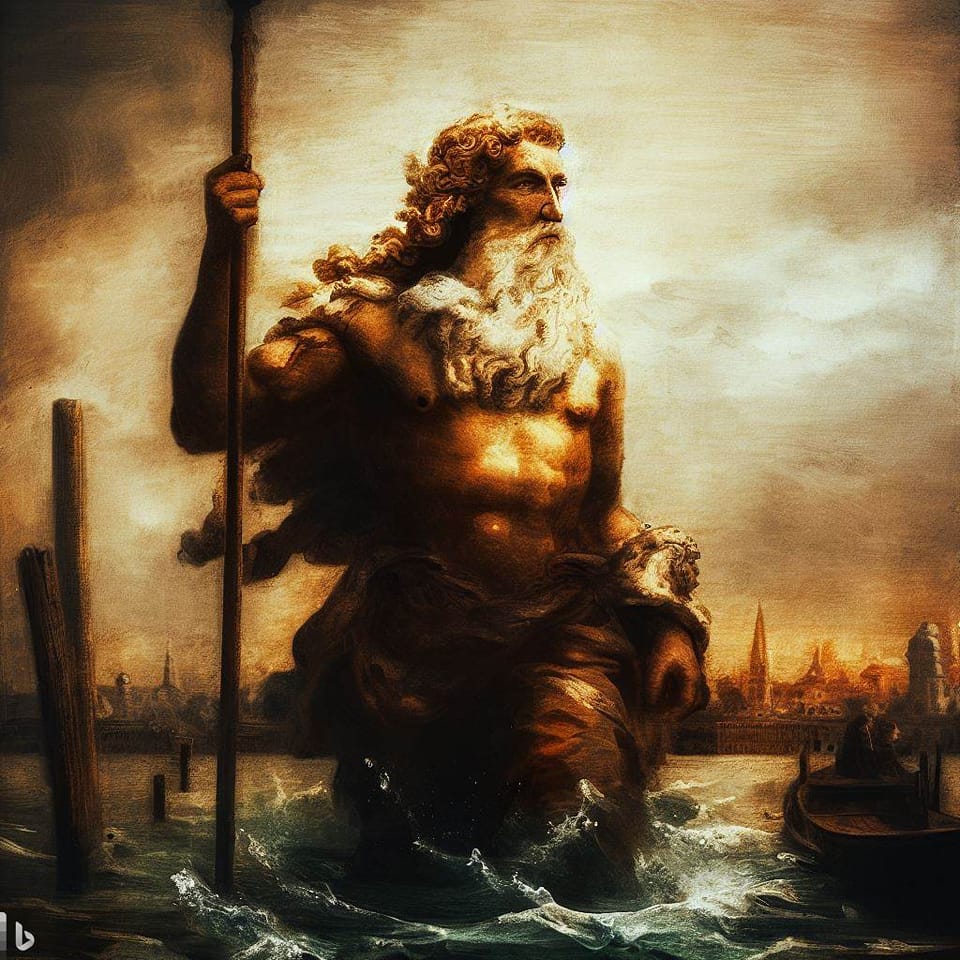
Poseidon in the Lagoon, Phil Hall / Bing
We need a Deliberate Act of Civilizational Triage
by Phil Hall
“We are glad to make special inquiry about you, whom the nature of your dwelling-place and the fertility of your soil commend. For you live like sea-birds, with your homes dispersed, now here, now there, across the surface of the water. The solidity of the earth on which they rest is secured only by osier and wicker; yet you do not fear to trust your frail foundations to the deep. Your people alone are not distressed by the raging of the Goths, for you live as it were beyond the world. To you, the riches of the sea are harvest enough. Salt is your plough, and the winds are your oxen. For you, all things are produced by ships. Hence, among you alone does that envy which rules the rest of the world have no place.”
(Cassiodorus, Variae 12.24, Translation by S.J.B. Barnish)
Look at the awful situation we face in the 2020s. The American Empire and its allies carve the Earth’s flesh, piece by piece. Dusty blood-soaked bodies pile high in Israel and Ukraine. Cheap energy is severed. Manufacturing is exported to the countries that provide the cheapest labour. Migrants are scapegoated.
What is the United States if not Greater Israel, the most successful, arrogant, and violent settler colony Europe ever spawned? Study a map of the nations that voted against Palestine’s statehood under the spell of the USA and you’ll hold the X-ray of the capitalist metropolis; an evil that threatens the world with nuclear annihilation. An evil that murders tens of thousands of children with alacrity—just as it always has from the time of the slave trade to British piracy, from colonialism to neocolonialism, and finally to the emergence of the global corporate capitalist hydra that began to dominate US foreign policy in the second half of the 20th Century; you know, the one that General Eisenhower warned against.
And yet the barbarians are at the gate. The planet’s once greatest military power, the once largest economy, stands encircled. An old, unwritten pact of dominance with the threat of economic and military punishment is now eroded as the world’s most powerful economy, the People’s Republic of China, rises and makes common cause with the world most powerful military, and largest nation; the Russian Federation.
Africa stirs, and with the bitterness of historical memory joins with them in BRICS. India pivots. Even much of Latin America, trapped in the USA’s backyard, attempts to navigate its own course.
Meanwhile, geopolitical analysts debate the future of this corporate-capitalist entity with hope, whispering about “reform” as if redemption and change were possible and feasible.
Abandon hope, all ye who enter here. We need a deliberate act of civilizational triage. The first step to survival isn’t hoarding guns, food, or medicine in a bunker in Iowa, it’s thinking like a Venetian.

In an age of collapse, the most radical act may not be resistance alone (so readily manipulated by the powerful with the technology of repression at their command) but more importantly, the building of an imaginative alternative, and to engage in the strategic, defensible construction of future effective ways of living together.
Venice’s millennium of survival offers us inspiration for how we could transit our own turbulent future. In the year 421, as the Western Roman Empire fell apart under barbarian invasions, a group of desperate citizens made a radical choice. Rather than fight on to the bitter end or beg for mercy, they waded into the swamps of the Adriatic lagoon, and sank wooden pilings into the mud to build towns there where no towns should have existed.
Over the centuries, Venice, that improbable labyrinth of canals and marble, arose and would, in the end, endure for over a thousand years, outlasting the Roman empire that gave birth to it. Venice’s founders understood something: when civilization collapses, survival is not about holding ground. It is about looking for the right ground to hold.
Venice engineered its own survival. Its physical foundations were an act of defiance against environmental conditions. The lagoon should have been uninhabitable—a salt-water wasteland where freshwater met the Adriatic. But the founders of Venice realised that the same unwelcoming instability that made the site hostile to invaders made it perfect for fugitives from invasion and disaster.
Our task is no longer to save the mainland and the rotten power structures in our Western societies, but to rescue the people. To identify new lagoons; geographic, digital, and social, where the next thousand-year society might begin and then win. The pilings will be different. The tides have changed. But the choice remains the same: drown with the empire, or, working together, learn to build on water.

They began with the pilings; oak trunks, chopped down in Slovenia’s forests, were sunk vertically into the mud. Below the waterline, deprived of oxygen, the wood petrified. Above, platforms made of big slabs of limestone almost impervious to corrosion were laid down on the trees as foundations.
The city stood on a growing forest of preserved trees. The hydrological engineering was even more sophisticated. Canals were dredged to follow natural tidal flows, creating a self-scouring system that prevented silting. When the Brenta River threatened to dump sediment into the lagoon in the 12th century, by then the Venetians were in a position to divert an whole river – centuries before anyone else.
Stone and water were only half the architecture. Initially, Venice was an society of equals working in concert, but as the city grew richer and more sophisticated and powerful, it developed into an oligarchical republic with a phobia for tyrants and Caesars.
Of course, there are historical precedents. The Phoenicians built Tyre and Carthage and many other trading outposts on islands a little way off the coast. Though the furthest northern settlements of the Phoenicians were along the Italian coasts of Sardinia and Sicily, with some trade networks reaching Etruria. The Adriatic’s shallow lagoons and lack of major river systems likely made it less appealing to Phoenician traders. However, perched on their human made island, exactly like the Phoenicians, Venetians became master shipbuilders and Venice a commercial superpower.

There were a set of wonderful Roman cities in the north when the Goths invaded, including Aquileia, the 9th largest of all Roman cities, but it was only when these last Roman citizens lost hope and were forced to face the next invasion by the Huns that many of them chose to build in the lagoon and live there permanently. In 410, Alaric sacked Rome, and in 421, Venice was founded on the 25th of March—La Serenissima, married to the sea. Its founders, according to Cassiodorus, rejected nostalgia. They did not waste energy mourning Rome. Instead, they built something entirely new: a society optimised for the environment of the lagoon, egalitarian and without kings. Venice succeeded not only through necessity, but through planning, innovation and design in real time.
Today, in the 2020s we face our own barbarians, not with swords, but with profit and loss spreadsheets. Late capitalism’s decay, war and the armaments industry, climate breakdown, and algorithmic feudalism are the new marauding Huns, together with our corporate captured institutions. Governments, banks and even universities begin to crumble around the edges like old Roman buildings.
According to Marxists, capitalism as a system will collapse despite—or because of—all the attempts to restore it. This is looking increasingly likely. The question is not whether the ship of Western capitalism is sinking, it is whether we can build lifeboats fast enough. Our post-capitalist systems must abandon “reform” and instead design new structures invisible and protected from predatory capital.
The Venetians used the landscape to their advantage. The lagoon was a natural fortress, impassable to invaders but perfect for trade. The city’s streets were canals, its walls were tides, and its defense was obscurity. At its beginnings, who would attack these floating towns that could vanish in fog? Who would bother to go to the trouble and discomfort of travelling into the lagoon to attack them?
In most of Europe, power rode on horseback. Armored nobles lived in fortified castles, untouchable by the masses. Not in an open place like Venice. The streets are too narrow for carriages: the richest merchant and the poorest gondolier walked the same alleys. No barricades, no escape routes. Bridges were choke points: Every crossing was a potential ambush spot. No one was safe in a crowd—not even the Doge.
The slim, easily concealed stiletto was invented in Venice for a reason. Violence was intimate, personal, and democratic. Elites had to be polite. Oppress the people? They’d meet you in a dark alley.

Venice’s government was a masterpiece of checks and balances: a doge who could not act alone, councils that monitored each other, and a legal system that prized stability above all else. Corruption was not merely punished; it was made structurally impossible.
Take the doge. In any other medieval state, such a figure would have been a king. Venice neutered the office. A doge could not open official correspondence without witnesses. His relatives were barred from high office. Upon death, his estate faced an audit; if corruption was found, the family paid reparations. The message was clear: power was a temporary loan from the Republic, revocable at any moment.
Then there was the Council of Ten, established after a failed coup in 1310. Part supreme court, part intelligence agency, it operated under rules that would make a modern bureaucrat shudder. Members served one-year terms. Deliberations were secret. Citizens could denounce corruption by slipping notes into the bocche di leone (lion’s mouths) scattered across the city. The system was ruthless, but it worked: between 1350 and 1600, Venice executed just four officials for graft. Compare that to the chronic kleptocracy of Renaissance Florence or papal Rome. All this institutional brilliance served one master: trade.
Venice understood that in a collapsing world, the key to survival was not territory but valuable commodities and the means to trade in them. The achievements of this little state in innovating in art, architecture, law, governance, banking, science, diplomacy, fashion and cosmetics, cuisine, engineering, shipbuilding and in the practical arts of statecraft are blinding. It’s culture and arts astounded: the birth of opera and Monteverdi, Vivaldi, Titian, Gentile & Giovanni Bellini, Tintoretto, Canova, Canaletto, Giordano Bruno, Casanova, Lombardo, Vittoria, Codussi and many others.
Venice Is Not a Model, Merely an Inspiration

For all its brilliance, Venice was no utopia. Its stability came at a cost. Shakespeare captured a sense of this in The Merchant of Venice: a society so focused on contracts, money and expediency that it forgot morality. The city’s legalistic cruelty is laid bare. Venice’s flaw was amorality. The Jewish ghetto, established in 1516, was both a prison and protection racket. If the Arsenale’s shipbuilders attempted to leave Venice, assassins would follow them. Any modern attempt to replicate Venice’s resilience must avoid this trap. Survival is not enough. We must also ask: survival for what? Even so, Venice survived the Black Death by implementing the world’s first quarantine (quaranta giorni) and Venice had sufficient perspicacity to pivot from trade to finance when the time was right.
The question is not whether we can build a better world. It is whether we can build it fast enough. Venice’s answer was yes. They had the right attitude. Global warming is here and the waters are rising. The Neo-Venetian must cultivate hybrid identities, form into collectivities, and prepare to outlive rather than outfight the coming storm. This means drafting and committing to barbarian-proof social contracts, binding communities to shared survival.
This is not about passively “waiting for collapse.” It’s about planting the seed of the idea now and building the new defensible geography before the flood arrives. That geography begins with delinking: digitally, economically, and politically; severing dependence on the empire. BRICS is already attempting to do this. Forget physical islands; the future belongs to epistemic archipelagos; closed-loop communities networked together and interlinked digital “lagoon” economies, floating beyond the reach of predatory hegemonic power. The work begins with small acts of defiance: a community solar grid here, a shared data archive there. The tools are already in our hands.
Venice’s founders did not wait for permission. They saw the tide rising, and they built higher. We must do the same. The barbarians are at the gates. They are in the boardrooms, the parliaments and in the algorithms. But the lagoon is still there, waiting. We need to consider establishing new decentralised computer networks, firewalled open-source AI, safe information channels, and take decisive, direct action outside traditional power structures, just as Venice’s traders once operated beyond emperors’ reach.
Progressive arcologies are self-sustaining urban ecosystems. Modern experiments, from eco-villages to sea-steading, echo Venice’s insulated mercantile connectivity. They prove another way of living is possible if we have the courage to embrace it. Even literal floating cities are possible, unreachable cities in the northern wastes, cities and towns in the deserts and in the rainforests.
To rescue civilisation we must embrace Venice’s mindset, without its ruthlessness and materialism.
Bibliography
Cassiodorus. Variae. Translated by S.J.B. Barnish. Liverpool: Liverpool University Press, 1992.
Norwich, John Julius. A History of Venice. Vintage Books, 1989
Shakespeare, William. The Merchant of Venice. Edited by John Drakakis. London: Arden Shakespeare, 2010.
Shakespeare, William. Othello. Edited by E.A.J. Honigmann. London: Arden Shakespeare, 1997.
Phil Hall was born into an ANC family in South Africa. The family was forced into exile in 1963 after his mother was imprisoned and his father banned. They relocated to East Africa, where his parents continued their activism and journalism. In 1975, after a period living in India, they journeyed overland back to the UK, eventually settling in Brighton.
Phil pursued a broad education, studying Russian, Spanish, politics, economics, literature, linguistics, and English grammar and phonology. His path led him to live and study in Spain, the USSR (in Ukraine), and later in Mexico, where he married and started a family. Over the next decade, Phil and his partner balanced activism with work before relocating to the UK—a move initially intended to be permanent.
However, professional opportunities took him to Saudi Arabia and then the UAE, where he spent ten years before returning to the UK during the COVID-19 pandemic. Back in Britain, he founded Ars Notoria Magazine and, alongside fellow humane socialist Paul Halas, launched AN Editions, a small venture dedicated to publishing thoughtful, progressive and exciting new books.
Discover more from Ars Notoria
Subscribe to get the latest posts sent to your email.

You must be logged in to post a comment.