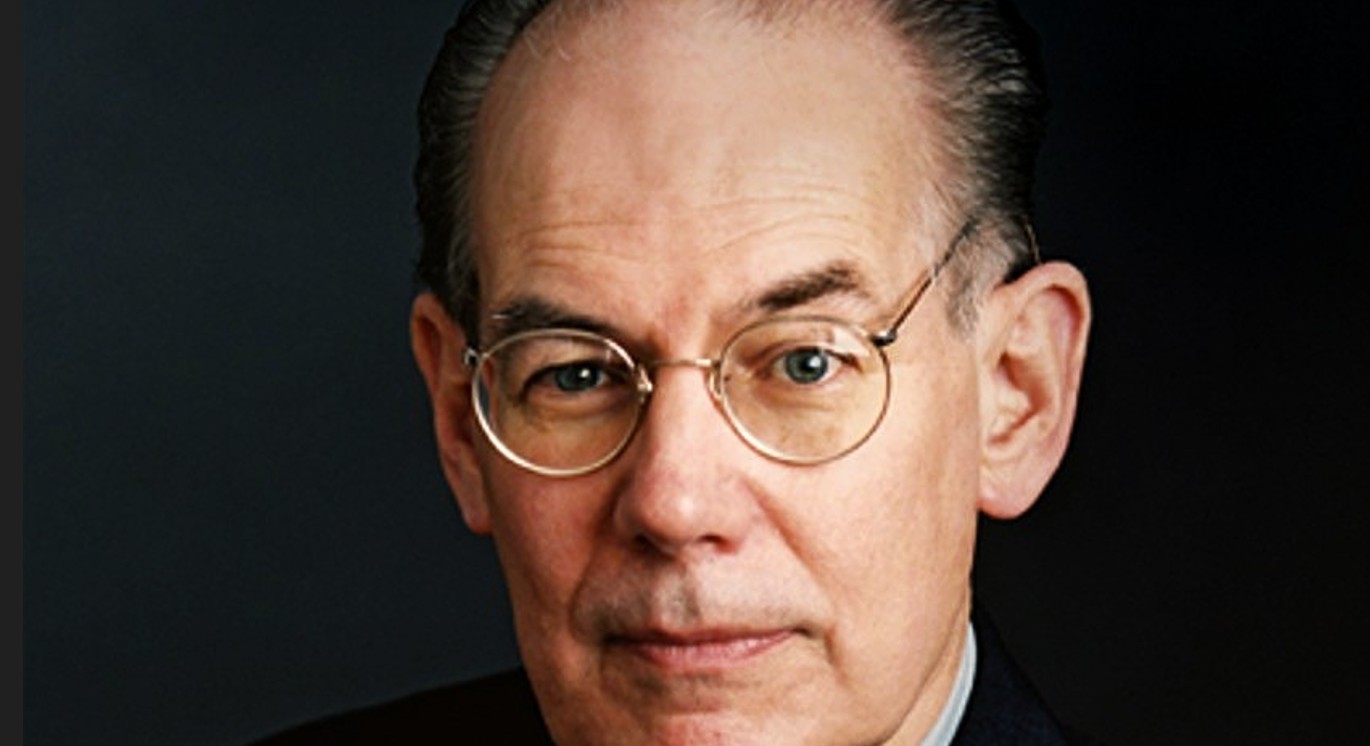
John Mearsheimer, photo John Mearsheimer, Wikimedia Commons
by Philip Hall
John Mearsheimer’s view, a development of the work of Kenneth Waltz, is that states seek to maximise power, defined primarily in military and territorial terms. Economics is a component of power, but it is secondary to the security dilemma in an anarchic system. On the basis of this theory, John Mearsheimer’s analysis of the war in Ukraine has called for US realism and the recognition of the Russian Federation’s ‘natural’ great power security needs. But at the same time, and on the basis of the same ideas, he argues for the ‘containment’ of the People’s Republic of China.
The core fault in Mearsheimer’s theory is that it treats power as an abstract, amoral goal, divorced from the specific, often brutal, economic and ideological systems that generate and exercise it. You cannot understand these conflicts without understanding the functioning of capitalism and imperialism.
Mearsheimer is a one-eyed man in the land of the blind. International relations theory in the USA and Europe is a discipline which systematically obscures the core dynamics of imperialism, class war, and capitalist exploitation.
John Mearsheimer’s Offensive Realism has a single insight: that states are condemned to a perpetual, aggressive struggle for power. For this, he is hailed a realist prophet in a sea of idealists. Yet, from a Socialist/Marxist/Anti imperialist and BRICS standpoint, putting Mearsheimer’s contribution on a pedestal is a testament to the poverty of Western International Relations theory.

Mearsheimer takes the specific, historically constructed hierarchy established on the basis of a former 19th and early 20th century colonial world order, and labels the international environment simply as ‘anarchy’. In doing so Mearsheimer is, in effect, naturalising the global order that has existed up to this point, making it appear to be a timeless, unchangeable reality rather the result of the victory of a specific dominant section of the ruling class with its centre in the USA.
Whose interest does the US state serve when it pursues ‘power’? It is not the interest of the zero hours contract worker, or the laid off miner, an indebted student, or a worker enslaved to Amazon. It is the interest of the military-industrial complex, the Wall Street banks and the City of London financiers, the Silicon Valley monopolists, and the fossil fuel conglomerates. Foreign policy is conducted in the interests of a transnational capitalist class whose loyalty is purely to shareholder value and capital appreciation, not to any nation or people. Let’s not kid ourselves.

Why, then, is this one-eyed man of Offensive Realism, John Mearsheimer, a king? Why is Offensive Realism still so venerated within Western academia and IR policy circles? Its appeal is not its truth, but its utility. It is a theory perfectly tailored for the era of late capitalism.
The core-periphery hierarchy, established through centuries of colonialism, was being challenged in the second half of the 20th century by revolutionary movements and two major rival socialist powers. The interventions by the capitalist metropolis (the US ruling class and its allies) in Southern Africa, Southeast Asia, and Latin America were not about balancing Soviet power for its own sake, but about preserving the capitalist world-system and its ability to exploit the periphery. The Soviet Union, for all its flaws, acted as a material and ideological counter-balance that supported many countries and allowed others some degree of neutrality.
Cold War interventions were the logical, violent actions of a metropolitan core defending its privileged position in the global capitalist system.
This theory provides a palatable, pseudo-intellectual alibi for the policies of the imperial core. It allows policymakers and the public to believe they are engaged in a ‘tragic but necessary struggle’ for security in an anarchic world, rather than admitting they are enforcing a brutal system of global capitalist exploitation
Of course, true capitalist offensive realism is the open-eyed analysis of power and how to use it without any scruples whatsoever and at the cost of millions of lives: in places like Indonesia, Vietnam, Iraq, Ukraine and Palestine. This kind of realism is indeed practiced by the imperial core. In defending the global order, global corporate capitalism centred in the USA, operates with an utter ruthlessness that it would never admit to publicly.
It effectively identifies the nations and the liberation movements, socialist governments, economic nationalists that threaten its hegemony and sets out to destroy them and subvert them using a wide range of tools at its disposal and vast amounts of dollars printed on demand at the cost of paper and ink.

The CIA, State Department, and Pentagon analysts and corporate think tanks are trained to understand the economic base of a foreign country: who owns the land, the mines, the factories; what is the structure of the working class; what parties or leaders represent a threat to their interests. The entire purpose of this agglomeration of actors is to identify who are the people hostile to the interests of US based transnational capital, and then ways are found to neutralise them.
Every intervention is ultimately justified by the need to maintain control of local markets, protect investments, secure resources, to control and discipline labour to ensure low wages, to undermine the national bourgeoisie (who might actually act in the interests of their own country) and to boost the power of the sell-out comprador class and undermine the legitimate interests of the country this agglomeration decides to target. This is a brutally materialist, and realist calculation in the service of capital. The real power behind US and western foreign policy making understands that politics is indeed expression of economic interest.
In contrast, Mearsheimer’s academic theory mystifies this brutal global imperialism. By refusing to name capitalism as the engine, offensive realism provides an idealised idea of the state willy nilly. The state is no longer, then (according to Offensive Realism) a tool of a powerful global elite class, but a rational individual great power state actor.
This theory provides a palatable, pseudo-intellectual alibi for the policies of the imperial core. It allows policymakers and the public to believe they are engaged in a ‘tragic but necessary struggle’ for security in an anarchic world, rather than admitting they are enforcing a brutal system of global capitalist exploitation. John Mearsheimer’s Offensive Realism sanitises empire and provides justification for the US aggression against the People’s Republic of China.

The ultimate idealist trap is presenting a historically constructed, class-based order as a metaphysical inevitability. Rather it is Mearsheimer’s theory which is the idealist fairy tale told to make that brutal exercise of power of a capitalist state fronting transnational corporations seem inevitable – divorced from the dirty business of capital accumulation.
The Imperial Strategist is the true “Offensive Realist”: They see the world as a ruthless class struggle, identify their enemies based on a material analysis of their threat to the economic order, and offensively use all instruments of national power (economic, diplomatic, military) to crush those enemies and maintain their dominance. They act upon the real array of forces they see opposed to them. With another pliant Boris Yeltsin in power in the Russian Federation the US metropolis would have no conflict with the Russian Federation.

A genuine realist understands that a fundamental driver of social and political organisation is the mode of production; how a society organises itself to produce the necessities of life like food, shelter, energy, and essential goods.
Laws, political institutions, culture, dominant ideas and foreign policy do not arise independently, but reflect, and serve to stabilise and legitimise and conserve the existence of the underlying economic basis of society. A law protecting private property, for example, is a political expression of an economic reality.
A realist who is a socialist and anti-imperialist rejects the myth of the national interest. In reality the state does not represent the common good. Instead it is a mechanism for managing the affairs of the country to benefit the dominant capitalist class. Foreign policy is crafted to advance the interests of the specific factions of capital such as finance, energy, military-industrial, technological sector that together dominate the state apparatus. The national interest then becomes, in large part, the interest of this class, merely disguised as the national interest.

The state is certainly not a unitary, rational actor with a singular goal of survival, justifying John Mearsheimer in his erasure of the central role of corporate capitalist imperialism.
The Realist School of IR is exposed as what it is: not a cold-eyed view of the world as it is, but a bourgeois idealism that takes the specific, historical product of capitalist imperialism labels it as eternal, unchanging principles of nature. It is a theory that is supremely useful to the powerful precisely because it is realistic enough to describe the violence of the system, but idealistic enough to never question the economic engine that drives it.
Mearsheimer’s theory is not a radical challenge to the orthodoxies of imperialism but a cynical and fatalistic apologia. It is a theory that correctly identifies a symptom—the relentless aggression of states, particularly those of the metropolitan core—but deliberately mystifies its cause, attributing it to an ahistorical, metaphysical ‘anarchy’ rather than the concrete, historical logic of capital accumulation.
It is the one-eyed man who sees the violence of the system with terrifying clarity, yet whose singular vision is structured to never, ever look down at the economic engine driving it, nor at the class that profits from its operation. Offensive realism is not a fully functioning theory of international politics grounded in facts, but as the ideological superstructure of a senile capitalist system, naturalising its pathologies.
The ‘great power competition’ between the United States and the People’s Republic of China is not a timeless Thucydidean drama; it is a struggle between a declining hegemonic corporate imperialist metropolis which is not confined to one nation, and a rising challenger with a different political system and different motivations for acting on the world stage that accord with its governing economic system and the expression of that system in its international actions that cannot be reduced ad absurdum to a struggle for security. China frames its own foreign policy as Community with a Shared Future for Mankind (人类命运共同体).
The United States is not a ‘normal’ nation-state seeking security in an anarchic world. It is the metropolis, the core state of a global capitalist empire. Its foreign policy is not about balancing power; it is about enforcing a neocolonial system of extraction. Institutions like the IMF and World Bank are not neutral financial entities but the agents of global finance capital’. The US military is not a tool for national defence but the ultimate enforcer of this system, a force designed to guarantee the ‘right’ of capital to move freely and the ‘right’ of the periphery to remain in a state of dependent underdevelopment. The relentless expansion of NATO, framed by Mearsheimer in abstract power-political terms, is seen from the outside as the military consolidation of this metropolitan core, extending its security umbrella to lock in the gains of the post-Cold War neoliberal expansion and strategically pen in rivals like Russia.

This brings us to the ultimate expression of Mearsheimer’s one-eyed vision: his analysis of the Ukraine conflict and his work on the Israel lobby. In both cases, he correctly identifies a violent and aggressive policy, absolving the system itself. His explanation for the Ukraine war rests on NATO expansion provoking a Russian security dilemma. While true to an extent, Mearsheimer’s is a superficial analysis. The conflict as the violent pursuit of a decades-long project of integrating the post-Soviet space into the Western capitalist sphere, a process that threatened not just the abstract ‘power’ of the Russian state but the specific economic and strategic interests of its own oligarchic capitalist class; the conflict cannot be framed simply as a timeless security dilemma.
Even more revealing is Mearsheimer’s analysis of the US-Israel relationship. In The Israel Lobby, John Mearsheimer and Kenneth Waltz argue that US support is a strategic liability driven by a domestic political lobby. But to suggest that the tail wags the dog, especially after the combined Israeli US attack on Iran (egged on by US allies) is to fundamentally misunderstand.
Israel is not an independent actor manipulating the US. It is a settler-colonial outpost and a forward military base for US imperial interests in West Asia. Its function is to control and manipulate populations and states (Palestinians, Lebanon, Iran, formerly Iraq, Libya, Syria) and ensure imperialist hegemony over the region and its resources.

The relationship is not a deviation from the US ‘national interest’; it is the perfect embodiment of the metropolitan core’s need to control its periphery. The ‘lobby’ is merely one conduit of influence within a much deeper, structural symbiosis between two capitalist states with aligned imperial projects. By blaming a ‘lobby’, Mearsheimer’s theory lets the entire US imperial establishment; the weapons manufacturers, the oil companies, the strategic planners in the Pentagon, off the hook, circumscribing a problem that is utterly systemic. The Israeli hand may offend the USA corporate metropolis, but it will not cut off its own hand.
Offensive Realism offers a pseudo-radical critique that changes nothing. It allows its adherents to posture as hard-headed cynics who see through liberal idealism, while remaining entirely within the ideological confines of capitalism.
Offensive Realism describes the horrific violence of the international system while systematically erasing the words capitalism, class, exploitation, and imperialism from the explanation. It is a theory that pretends it explains everything about international politics except what is actually happening.
Phil Hall was born into an ANC family in South Africa. The family was forced into exile in 1963 after his mother was imprisoned and his father banned. They relocated to East Africa, where his parents continued their activism and journalism. In 1975, after a period living in India, they journeyed overland back to the UK, eventually settling in Brighton.
Phil pursued a broad education, studying Russian, Spanish, politics, economics, literature, linguistics, and English grammar and phonology. His path led him to live and study in Spain, the USSR (in Ukraine), and later in Mexico, where he married and started a family. Over the next decade, Phil and his partner balanced activism with work before relocating to the UK—a move initially intended to be permanent.
However, professional opportunities took him to Saudi Arabia and then the UAE, where he spent ten years before returning to the UK during the COVID-19 pandemic. Back in Britain, he founded Ars Notoria Magazine and, alongside fellow humane socialist Paul Halas, launched AN Editions, a small venture dedicated to publishing thoughtful, progressive and exciting new books.
Discover more from Ars Notoria Magazine
Subscribe to get the latest posts sent to your email.
You must be logged in to post a comment.