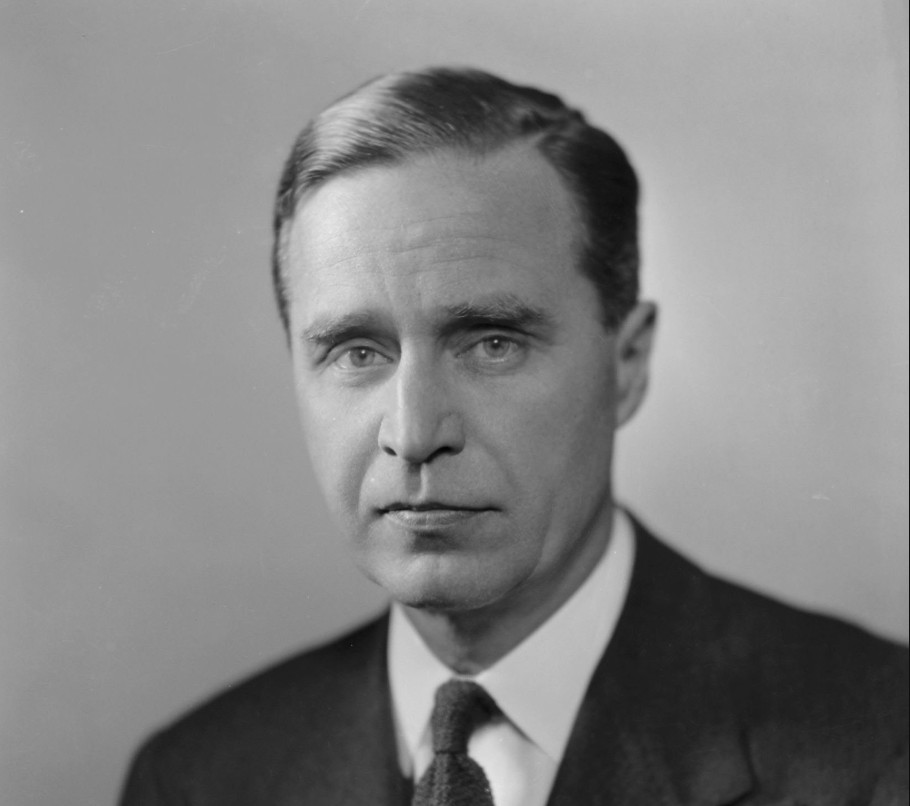
Prescott Sheldon Bush, Senator, photo Louis Fabian Bachrach Jr. – Bachrach Studios
…the Bushes
by Norman B. Schwartz
They are one of America’s few dynastic clans, the first since the Adams family who can legitimately claim to have sent two presidents – George Herbert Walker Bush and his son George Walker Jr – to the White House. With their roots in the oil and gas business, many people think of them as quintessential Texans, but that is not the case. Both men were born in Connecticut and educated at Yale University in New Haven.
The patriarch of their family, the now forgotten Senator Prescott Sheldon Bush Sr (1895–1972), graduated from the same school, where he played varsity golf, sang in the Whiffenpoofs glee club (“Gentlemen songsters all on a spree”) and been a member of Skull and Bones – the secret society that would one day welcome both his son and grandson. After serving in the First World War as a captain in the field artillery in France, he followed the path so many of his fellow-officers and gentlemen Bonesmen in the Roaring Twenties: he went to work at an investment banking firm on Wall Street. In Prescott’s case, one in which his future father-in-law was president.

Prescott had, as photographs show, all the Arrow Collar good looks of a gentleman of his class, but unlike many other young men of his time who spent their nights dancing the Charleston, drinking bootleg gin and swallowing goldfish, Prescott embraced a more conventional bourgeois life. In 1925, after the United States Rubber Company offered him a job as an executive, Prescott moved his family from New York City to the quieter suburbs of Connecticut where he could spend more time with his children and to playing golf.
In those days, the eastern seaboard Republican Party still had a liberal wing that supported social causes. Prescott contributed or raised funds for many charities, including the American Birth Control League, Planned Parenthood, and the United Negro College Fund. In 1948, enticed by what he had heard about the fortunes to be made in oil and gas, he courageously left the comforts of New England and the golf course and bought a house in distant Texas. In those days, now long forgotten, Texas was part of the southern block in Congress that voted Democrat.
All that was to change in 1952. For the first time in history, Texans voted Republican and elected former general Dwight D. Eisenhower their president; and in a special election, the party sent Prescott to Congress as a United States senator – not from his Texas base but from his old home in Connecticut. Once in Washington, Prescott continued to advocate his liberal views: he was a member of his party’s majority who censured fellow Republican senator Joe McCarthy. Eisenhower, no fan of the junior senator from Wisconsin, thought so well of Prescott that he suggested his golfing buddy as one of his possible successors. But in 1950, his party chose someone else – their ultra-conservative communist-hunter from the western states, ex-Naval officer Vice-President Richard Nixon from California, who ran against the charismatic Democrat candidate from Massachusetts, Senator John Kennedy. The unshaven Nixon, unaware of the power of that new-fangled device television, debated Kennedy of the movie star looks and lost.

Senator Bush continued serving his country in the Senate during the Kennedy administration, voting in favor of the Civil Right Acts of 1957 and 1960, but in 1963, sensing that there would soon be no place in the Grand Old Party for grand old men of liberal views like himself, he retired from the United States Senate at age sixty-seven. That November, Kennedy’s assassination led to Lyndon Johnson becoming President . In 1969 Nixon, defeated once, ran again. This time his opponent was a less popular figure: the Democrat Michael Dukakis, Governor of Massachusetts. Nixon won the election and became the 37th President of the United States.
After the Second World War, Prescott’s second son, George Herbert Walker Bush (born 1924), returned to Texas a war hero. Helped by money given him by his father, George H. W. Bush bought the burgeoning Texas oil company Zapata Off-Shore, whose stock he sold for approximately $1 million. Rich, if not as rich yet as Prescott, H. W. decided the time had come to enter local politics, benefiting (so he hoped) from having avoided what he considered to be his father’s old-fashioned Republican liberalism.

The ambitious H. W. observing how Nixon’s star had ascended, understood immediately that the pendulum was swinging away from his father’s progressive politics to his state’s conservatism. Reactionaryism in a Stetson hat would be the politics of the future. Pragmatic as he was, H. W. ran against the incumbent Democrat Ralph Yarborough in the 1964 election for the Senate. Because Yarborough had voted in favor of the Civil Rights Act of 1964 that banned racial and gender discrimination – a cause his father had long supported – H. W. allegedly accused his opponent of being a leftist. In return, Yarbrough, born in Henderson County, Texas, a much savvier and more experienced politico, reputedly ridiculed H. W. as non-Texan, a recent arrival from the east coast, and defeated him.
Two years later, H. W. tried again. This time, lowering his sights from the Senate to the lesser House of Representatives, he finally won election to public office. Once in Washington, he turned out to be a loyal supporter of almost all of President Nixon’s Vietnam policies, breaking with him only by supporting birth control and the Civil Rights Act of 1968. In 1970, he tried once more for the more powerful Senate seat and lost. After so many defeats, many people thought George Herbert Walker Bush’s chances for higher office were over.
For the next twenty years, he did not serve in either the Senate or House of Representatives. H. W. went from one appointed and respectable government job to another. He was for a time Ambassador to the United Nations, Director of the CIA, and, most important of all, Chairman of the Republican National Committee.

In 1980, Ronald Reagan, then President of the United States, sensing he needed a moderate Republican on his ticket, decided H. W., with his history of liberalism, would be an ideal Vice-Presidential running mate. There weren’t many left in the party. When Reagan left office, his party rewarded H. W.’s long years of loyalty and fund-raising by finally running him for the job he had so long coveted. In 1988, almost two decades after the last defeat for the senator from Texas, he ran against and easily beat the Democrat candidate Governor Michael Dukakis from Massachusetts. George Herbert Walker Bush of Texas, son of Connecticut Senator Prescott, became the 41st President of the United States.
Of all the actions he undertook in his two terms, H. W. is perhaps best remembered today as the man who got the United States into the Gulf War. After Iraq invaded Kuwait in 1990, Paul Wolfowitz, Under Secretary of Defense, advised Defense Secretary Dick Cheney that if Hussein kept Kuwait, he would be in control of twenty per cent of the world’s oil. The younger Bush somehow convinced Margaret Thatcher and Jacques Chirac that sending troops to fight alongside the American military was in their countries’ best interests.

Operation Desert Storm, as the First Gulf War was called, began with aerial bombing followed by the land campaign that ended approximately 100 hours later. We cannot determine the exact number of Kuwaiti and Iraqi casualties – one report stated that over 1,000 Kuwaiti and 3,664 Iraqi citizens died – but we do know that only 148 US citizens and 47 British servicemen perished. Many wondered why Bush did not take advantage of his obvious opportunity to enter Iraq and depose its dictator, Saddām Hussein. H. W. had his reasons. Apparently, what mattered most to those like him who had come out of the oil and gas world, was not the removal of a tyrant but how to keep crude petroleum moving safely through the Persian Gulf. Bush and associates felt Hussain was the only man powerful enough to hold together a country with so many various warring religious and tribal animosities. They reasoned the dictator would not disrupt his country’s oil industry as long as it continued putting some of its rich revenues into his pocket.

In 1992, H. W. ran again for president against the relatively unknown Governor of Arkansas, Bill Clinton, and lost– lost an election not for the first time. H. W. returned to Texas where he did unto his son, George Walker Bush Jr, what his father had done unto him. He encouraged his politically ambitious boy, both psychologically and financially, to run for public office. George Junior, or just Junior, as he was called to distinguish him from his father, had been only two years old when George Senior first moved the Bushes from Connecticut to the Lone Star state. Growing up as he did, Junior had one enormous political advantage over his father and grandfather: he was without the slightest trace of a New England accent or the white-shoe patrician manner that so many party members continued to associate with the now discredited liberal wing of the Republican party. From the way he spoke to the bottom of the cowboy boots he wore, Junior was a true Texan.
In January 2001, eleven years after the First Gulf War, another Bush ascended to the presidency. It was now Junior’s turn. In September of his first year in office, members of al-Qaeda, most of whom were Saudi Arabian, operating out of Afghanistan, crashed their planes into the World Trade Center in New York and the Pentagon in Washington. Dick Cheney, who had been Junior’s father’s Secretary of Defense during the First Gulf War, had now returned as Junior’s Vice President. Cheney knew that as most Americans had no idea where Iraq was, it would not be difficult to convince them that the terrorists came from there, just as Junior, once a pilot in the Texas Air National Guard, and always in the shadow of his wartime hero father, could be persuaded to play the role of the White Hat against the Black Hat of Saddām Hussein, a tyrant in possession of weapons of mass destruction no one had yet managed to find.

Junior, the younger George, the 43rd President, did what his father had chosen not to do. He invaded Iraq, assuring Great Britain and France that it would be in their best interests to join him as he launched a land invasion. By March 2003, he quickly defeated Saddām Hussein’s army, captured the capital city Baghdad, and declared the end of major combat operations. Bush’s response to the terrorist attacks drove his poll ratings from fifty-five per cent favorable before 9/11 to ninety per cent in the days after, the highest ever recorded for a president.
Not too many years later, as one American-appointed governing Iraqi coalition fell to another equally inept, chaos continued. Public opinion turned. Polls showed that the average American or British citizen no longer approved of America’s intervention in a foreign war. Many people who had applauded Bush Sr and Bush Jr for their military decisions now viewed their actions as America’s greatest mistake. In the election of 2008, Democrat Barack Obama, the first African-American ever elected to the presidency, said: “I am not opposed to all wars. I’m opposed to dumb wars.” An opinion now shared by many others round the world.
Historians on both sides of the Atlantic will long debate why and how America and Britain entered this futile combat. Of the many conflicting explanations, we might examine one found in an old song that Senator Prescott Sheldon Bush Sr of Connecticut, the eldest Bush, once sang during his student days at Yale when he was a member of the Whiffenpoofs glee club.
We’re poor little lambs who have lost our way
Baa, baa, baa
We’re little black sheep who have gone astray
Baa, baa, baa
Gentleman songsters off on a spree
Doomed from here to eternity
Lord have mercy on such as we
Baa, baa, baa.
Understanding the ever-shifting alliances and political beliefs of the Bushes – father, son, and grandson – is a daunting task. Lord have mercy indeed
Norman B. Schwartz is the author of the comic novels ‘ALL THINGS small‘, Paradise Now, Don Juan in Space, True (Cinema) Confessions, Hollywood: Below and Beyond, and the DIY guide, The Art Of The Schnoorr. He spent over forty years working on films in Hollywood and Rome. Norman was the first ADR sound editor / director to be admitted to Academy of Motion Picture Arts and Sciences in Los Angeles.
Norman B. Schwartz’s essays will appear in sequence monthly in each issue of Ars Notoria Magazine with a view to Centre House Press publishing the entire collection of essays in book form in Fall 2025
Discover more from Ars Notoria
Subscribe to get the latest posts sent to your email.


You must be logged in to post a comment.