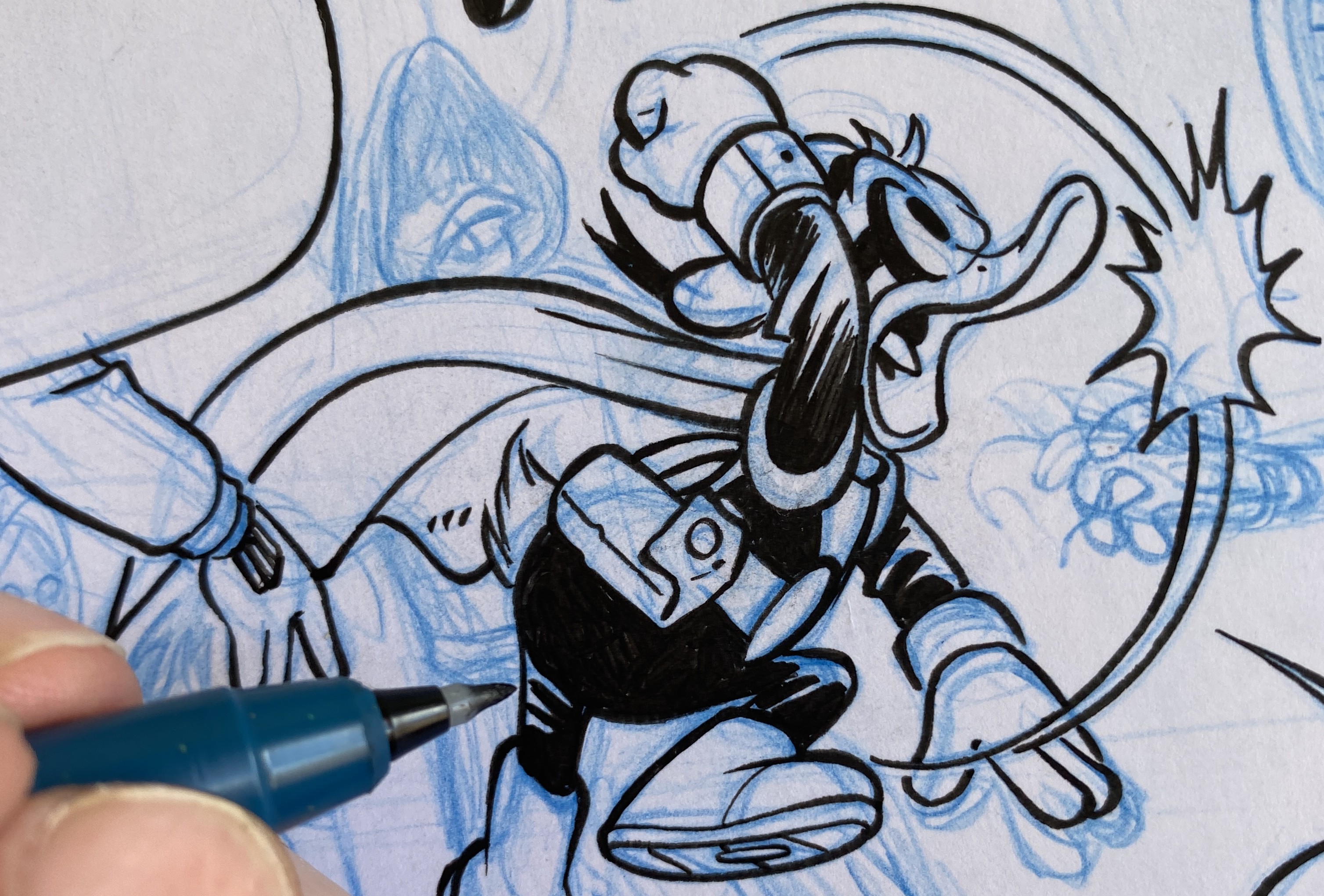
The Disney Universe is illustrated by Paco Rodríguez
Interviewer: Paul Halas (with Phil Hall)
Generations of children – and parents – have grown up reading the various Disney comics magazines, from the USA, to Europe, to Africa and to Asia. They’ve been a fondly-remembered part of childhood for many (for instance the famous underground cartoonist Robert Crumb was a fan), and an irritation for others (the travel writer/novelist Paul Theroux was appalled at finding Mickey Mouse staring at him from news-stands all around the Mediterranean), the magazine in all its guises was always highly visible in newsagents, kiosks and shops from Juno to Jakarta. Many of the traditional outlets may have gone, but the magazines endure.
Many counties and publishers produce Disney comics under licence from Disney USA, and in northern Europe in particular, comic books such as Anders And & Co (the Danish Donald Duck magazine) have been an institution for generations. The flavour of their stories was often subtly suited to European tastes, even although the comics started life set in Anytown, USA, in the 1930s. For many years the Egmont family of publishers has been the torchbearer for Donald Duck, Mickey Mouse and all their co-conspirators in the Scandinavian countries, Germany and The Netherlands, and one of their foremost illustrators is Paco Rodríguez. He will need no introduction for a large number of comics aficionados.

A native of Barcelona – a city with a great tradition of comics artists – Paco started work for the Disney magazine in 1989, and has been busy ever since. I, myself, worked as a story/script-writer for the Danish Disney magazine from the late 1970s until 2012, and we collaborated on a number of strips, notably a series about a fictional kids’ football team, which featured Mickey Mouse’s nephews. To create the comic we were housed in a Copenhagen hotel suite with our editor, a translator, a laptop and a sketchpad, and told to get on with it. We still look back on that job with great satisfaction.
It was a great pleasure for Phil and me to spend some time in Paco’s company, even at long distance, and to become reacquainted with the world of producing one of the most loved children’s comics since the 1930s.
Paul: To begin with Paco, maybe you can tell us something about the Disney Universe, and how it differs from the real world we live in. Disney’s Duckburg is populated by talking ducks and mice and other animals…but they all have familiar human characteristics.

Paco: Regarding how I see the difference between Disney characters and the real world, it’s a bit crazy because people have never worried about this. In Disney’s history, the editors have never worried much about this coherence. They’re in overall control of things, but every artist draws a different house where Donald Duck lives… everyone tells a story differently.
The Disney universe is like the fifties, or the sixties, depending on when you started working. If you started in the fifties, your drawing looks like the fifties. The buildings, the cars, the clothes, they’re all contemporary.
I’ve always tried to keep my work up to date, and introduce modern cars and gadgets etc., but there are other illustrators who try to stick to a retro style. Also, regarding the layout of the pages, I prefer a more modern, looser kind of composition, but many stick to a rigid, old-style template, and don’t vary it. I try to make mine dynamic and cinematic – close-ups, medium shots, etc… Rather like the American comics I’m fond of.

Our comics cannot ignore the modern world. Editors are quite relaxed about the inclusion of mobile phones and tablets etc., because they’re part of everyday life, but in spite of this many artists and writers still stick with a visual style – the buildings, the décor, the general look of things – that harks back to the 1950s.
One of the editors of a Dutch Disney publisher took me to task when I drew a classic telephone for some jokes. “You can’t draw this kind of telephone because young readers don’t know what it is. You can draw a phone but it has to be cordless, without a dial.” It was there that I learned that Disney publishers from different countries tend to apply different criteria. You have to adapt your work to suit the publisher you’re working for; some countries are stricter on certain issues than others.
Paul: So the Disney universe is different from our own, but essentially and recognisably the same. And it’s a paradox that worries nobody.
On another track, I guess it goes without saying that you grew up reading comics. Did you like Disney comics as a child, and were you into other comics as well?
Paco: I read comics from a very young age. It was my first hobby, my first passion. But I wasn’t especially a fan of the Disney comics because they didn’t have a very great presence in Spain. There were a few imports from Italy, the pocket sized Topolino comic book, so I read mainly other comics. There was a wide choice. I soon discovered French comics, and the American ones, such as Marvel and DC. And then Manga too. I read everything.
Phil: When you worked with Paul, was it different from working with other writers?
Paco: Working with Paul was a bit special because there’s usually no contact between the writer and the artist when making a comic. They write, it goes to the editor, the editor gives the story to the artist. Most of the time there’s no exchange of ideas or anything.
But when we created Riverside Rovers, we met for a week in Denmark. Paul is one of the few writers I know in person and with whom I’ve spent more time. For me it was a very good way to work, because we could speak directly, although we had a translator. The communication between artist and writer was much better, closer. I think we did a very good job.
Paul: When you receive a manuscript from a writer, how do you like to work? Do you prefer to work to very specific visual instructions, described to the last detail, or are you happier being given the freedom to interpret the story your own way?
Paco: Both ways have advantages and disadvantages. When I started out, I wanted to do exactly what the writer told me. However, as I’ve become more experienced I haven’t been afraid to change certain elements, especially in terms of storytelling, if I think it will improve the story overall – always respecting the writer’s idea, and in consultation with the editor of course. Also, when the scripts are less detailed and just contain the bare essentials, it gives the artist a great deal of freedom. It’s a joy to work that way.
In the 1990s Egmont started asking writers to make some little sketches, known as scribbles, to accompany the written description. Some were very good, some not so good, some writers didn’t do them at all. When you receive a very good drawing from a writer it’s hard not to follow it – if it works well why change it? – but in those cases the process does take away some of your creativity. On the other hand, sometimes you’re handed a script with very vague scribbles, and although that results in much more work for you, you achieve a much more personal result.
Paul: Have you ever submitted any stories of your own for the magazine?
Paco: A while back I wanted to write my own stories. I came up with three and they were fine, but I disliked the process. The editors demanded a synopsis, then when that was approved they wanted a separate synopsis for each individual page, then I had to write a full script… By the time they approved it I was bored with the story.
Paul: Backtracking once more, what took you from reading comics to actually drawing them professionally?

Paco: Although I loved comics from a very early age – to begin with just looking at the pictures – I never thought of making a living from them. But when I was 15 of 16 I had some friends who loved to draw and make comics. We created a fanzine. This led to contact with an agency that was looking for artists, and through them a test to make Disney comics… and they accepted me! I thought I’d only last six months because the work is very demanding, but I’ve been here thirty years.
Phil: Has your drawing evolved over the years? And do you include hidden jokes and surprises in your work?
Paco: Yes, I guess I’ve certainly improved, but I follow the rules. Sometimes I’ll add a little something extra, to give a second layer to the story, a little quirkiness, funny details, looking for a certain originality to enhance the work… such as poses or expressions; it’s like dressing it up, trying to give something extra to the writer’s story.
Paul: Many years ago, the Danish magazine used an American writer who managed to include a very overt socialist subtext to all his stories. Although the stories themselves were good, he didn’t last very long. Are there any writers who still manage to be a little bit subversive?
Paco: Well, there are certain frameworks to be followed, rules set by Disney that writers and editors must follow. These rules can be quite strict, and although one may not necessarily agree with them, they have to be adhered to. Disney wants to make magazines for a variety of audiences, regardless of background, which is why they make very “white” comics. Still, there are writers who are very good at navigating all these rules and producing wonderful stories, even stretching them as far as they think they can.
In one story I illustrated there was a school with little ducks. I drew a black duck. This was natural, I thought this duck is a black child. The editor questioned including a person of colour in a Disney comic, and, following an internal management debate, the character was removed.
Then, soon after this matter, Disney produced a guide, known as a bible, in which all major nationalities appeared as ducks, and they prescribed exactly how each nationality and race should be drawn. These were all stereotypes from many decades ago, and ignored all the multiculturalism of the modern age.
I also remember when I started, female characters couldn’t have breasts. I still drew some with discreet breasts, which seemed normal to me, and the matter was either not noticed or ignored. But one day a duck went to a bathroom in a story I was illustrating, and I drew the toilet. The art director told me that they couldn’t have toilets in Disney comics. After 30 years, those things still surprise me.

Paul: All of us who worked on the magazine had favourite and un-favourite characters. Many of the writers with similar sympathies to my own cared little for Scrooge McDuck, the ultimate capitalist family patriarch, but he remained a popular character. Is this still the case?

Paco: I’ve not come across this antipathy to Scrooge McDuck; he remains one of the favourite characters. Personally, my thoughts are more socialist and leftist, but I’m not very involved in politics.
I think the whole question is like a zombie movie. You have to suspend disbelief. There are characters who in the real world would be seen as hateful, but in comics they’re quirky and even loveable. It’s like when you read Marvel or DC. You enjoy them as fun. But if you analyse what those superheroes would be like in real life, many would be fascists! Think of old Westerns: the cowboys were good and the Indians bad. You grow up and you realise the opposite is true, however, you can still enjoy it. (But of course if the work purports to be about real history, or is making a statement about society, then this observation doesn’t apply!)

Paul: I remember Barcelona as being a centre for cartooning and comics creation. Many of the Disney artists lived there, but the market has contracted. Are you the only one still making Disney comics now?
Paco: No, but we are far fewer. There’s much less work and they fired many people. Barcelona was a centre for comics – all kinds of comics – since the 1950s. Most major publishers were there. Professional artists had to live there because there was no internet. Now, however, many people have left, because they can work online.
Paul: What would you say is the main reason for the decline in comics?
Paco: In Spain it’s complex. The kiosks where they sold newspapers and comics have practically disappeared. Now you can only buy comics in speciality bookshops, and only in big cities. When I was young you had few options – you went out and played football or you read comics. Now there’s the internet, video games, endless TV, almost unlimited choice. It’s the worst period for artists, very difficult to make a living from comics. Before they published 20-30 different magazines a month, now there’s four to five hundred different things to choose from, but the number of consumers hasn’t changed that much. It’s like the book industry: ever more titles, chasing fewer readers.
Paul: Do you think that reading comics can lead children to a love of books later on in life? Are comics an entry drug to literature?
Paco: In Spain when I was a child, comics were just for kids. If you were still reading them at 13 or 14 people thought you were a bit silly. Very different from France, where comics culture is so much more important. I think it’s a fantastic way to start reading, leading to a love of reading books and, hopefully, comics for adults too. There are so many fantastic graphic novels nowadays.

Phil: In Japan, comics creators are superstars. Are you famous there?
Paco: No. There’s not much of a tradition of reading Disney comics in Japan. And my work isn’t that well known in Spain, because not so many Disney comics are published here either. There are some of the Italian ones, plus a few of the classics by creators such as Carl Barks and Don Rosa. That’s all.
Regarding the fame issue, maybe because of social media’s wide reach, many younger comics creators are enjoying wide popularity, rather like actors and singers, and they seem to enjoy it. I come from a time when you often didn’t know who drew a comic and hardly knew what your favourite author looked like. Perhaps that’s why I’ve never tried to be recognised for myself but for my comics. But it’s natural that we all have our egos, and that in these times of mass social media many young authors can feel dazzled by the attention.
Paul: Many believe attention spans have reduced over the years. Have the Disney stories become any shorter?
Paco: They haven’t changed that much. Lead stories tend to be 10-12 pages long, with some in two parts of 8 pages each. In the Netherlands they still make stories of around 17-20 pages. Each country has its own preferences.
Paul: We were talking about some of the negative effects of technology and the digital world. Has technology been of any help to you in your artwork?
Paco: I do 99% of my artwork by hand, with pencil and paper. I use digital only for corrections, because I feel old! On Instagram and Facebook people tell me, “You should promote that you do it by hand!”
I remember when I was young and saw the first artists using computers to make comics. I was very surprised, but now I’m the eccentric one. Most artists work digitally. However, there’s still a handful of illustrators who remain in the resistance, even young ones. Sometimes I read how some young creators have gone back from digital to paper, and have gained great satisfaction from making the change.
I’m a comics artist because I love it. I didn’t choose this profession to make lots of money, because it’s not the right job for that. I do it for love, and I love feeling the paper, the pencil… When I tried inking digitally a couple of times there were some advantages, but I didn’t like it. I prefer inking by hand.

Paul: A man after my own heart. Keeping it real.
Paco: If you want a book or a comic but you’re not sure you’ll like it, you can read it digitally. But if you love it, it has to be the real thing. A physical object.
Paul: Thank you Paco for giving us your time and insights. It’s wonderful seeing you again, and knowing you’re absolutely on top of your game!
Paco: Me encantó verte. Quiero volver a compartir charlas, quiero verte otra vez.

Paul Halas, the Arts and Lifestyle Editor of Ars Notoria and co-founder of AN Editions, is a writer of Jewish heritage whose escape from 1970s hippidom was the discovery that he could invent stories. He spent forty years contributing to various Disney magazines and books, as well as a variety of non-Disney comics, books and animated films.
Discover more from Ars Notoria
Subscribe to get the latest posts sent to your email.

Comment
Comments are closed.