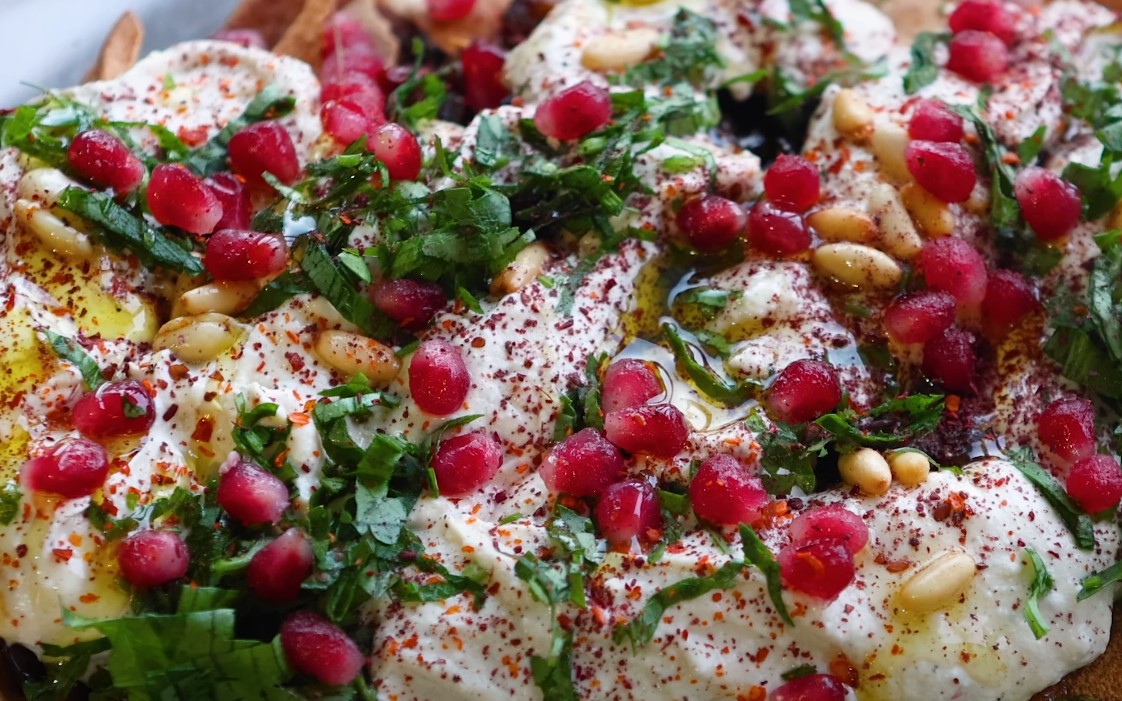
Fatteh, photo Imran Family Kitchen
by PHIL HALL
It feels wrong to talk of food when Palestinians are starving and being killed by people behaving like bloodthirsty demons. All talk of food is almost obscene in this context, and yet… my grandson is being introduced to the wider family today, so we are making a meal for them. I have chosen to make fatteh, a Levantine dish—a Palestinian dish.
Maybe we should all be on hunger strike; I don’t know. But anyway, my wife is making stuffed green peppers, and I am making fatteh, baba ganoush, and za’atar bread. We are also making tabbouleh and hummus. I argued for foul, adz, and kibbeh, but it’s too much.
In any case, this is not very authentic, as fatteh is really a breakfast dish. Of all the dishes I tried in the Gulf region over the ten years I lived there, I never had a proper fatteh. I told my friend about this, and he tried to make it. He is married to an Iranian woman and has a large, loving Iranian family. He made them fatteh (a coincidence) just two days ago.
He also has an allotment with twenty-six fruit trees and has so many apples and pears—all in good condition—that he said last year he ate the last piece of fruit the following June, nine months later. I didn’t realise fruit could last so long. I’ve been looking at ways of making cider and asked him why he didn’t. He said it was too much work. Is it worth it? After all, you can buy two litres of cider for a few pounds. Is the quality of the homemade cider that much better? You would have to make a batch to find out.
My partner likes flowers, and I like fruit trees, so it has been a struggle—one that I lost because she does all the work in the garden. As she said, “The land belongs to those who work it.” All the same, we do have a small pear tree, an apple tree, and an apricot tree.

When you live in Arab countries and you are not Arab, you are certainly an outsider—an intruder. I always remember the British correspondent, now in a wheelchair, who loved everything about Arab and Gulf culture. He had many friends in Saudi Arabia, spoke passable Arabic, and reported on the Gulf for the BBC. He was dragged out of his car, shot, and left for dead in the street.
But it is these lovers of Arabs who presaged colonialism and conquest by the Europeans. These Arabists were the soft point of insertion for the looters from the northern Mediterranean—the Gertrude Bells, Thesigers, Captain Shakespears, T.E. Lawrences, and Philbys. They are the worst of the worst, these Arab lovers, and so I am not surprised when people from the Levant, North Africa, and the Gulf region hate and detest Europeans, especially the ones who say they ‘love them’. The people of the Arabic speaking world have a right to be suspicious!
That young man, working as a teacher, trying to learn Arabic and make friends, applied to work in the State Department. And there he is now, aiding and abetting genocide. I met him—an unprepossessing chap
There was another one, secretly intelligent though taciturn. He sat right in the middle of all the teachers during the Arab Spring, always turning his head whenever a photo was taken. He admired Dawkins and Bostrom. He had worked in Sudan as a young man (where he was recruited by MI6—probably), and he spoke and understood Arabic, but never openly spoke it. He never flinched when the Jordanians, Palestinians, Egyptians, or Lebanese made obscene jokes about Americans, Europeans, and Australians. I knew him.

These are the people you need to watch out for: the befrienders, the ones who travel to Palestine to “help the Palestinians because they really care.” They might even marry an Arab. These are the dangerous ones because they have no scruples, but they have empathy. Any European, American, Australian, or Canadian who wants to learn Arabic and know more about Arab culture is immediately suspect because, like it or not, with proficiency comes opportunity—if they can pass the vetting process.
A Palestinian friend said to me, “You know, Phil, one thing you need to realise is that we Arabs hate each other, too.” In other words, you hate your brother for his betrayals more than you hate your enemy for his stratagems and attacks.
But I was talking about fatteh, not Fattah.
So, food is the imagination. Food feeds my childhood memories. Am I hungry now? No. I am often hungry only for the memory of food. It is baby James, my grandson, breastfeeding who really knows the love of food. Food from his mother, who he came from, transforms into life and growth and light and awakeness.
Pity the Palestinian and Sudanese children. Curse the demons who starve them and kill them, and the hellish ones who puppeteer these demons, the devils in Washington and New York and London.
I am trying to get back to talking about fatteh, but inevitably, it’s hard. It is a Palestinian dish.
In the Rainbow Nation, a white South African farmer of Dutch descent—tall, thick, wearing khaki shorts with a braaivleis beer belly—queued up for a boerewors hot dog at Nelly’s (the gateway to the Lowveld). Behind him stood a young, well-dressed black man who had pulled up in a mid-range white Toyota with his family. The farmer turned around to the South African (who was shorter, smarter, and wearing dark sunglasses) and said, “So you like our food now, hey!” If you are not South African and do not know its history, you have no idea how offensive this was. The young man just looked embarrassed and said nothing. The farmer didn’t get a rise out of him.
The crimes of the European settlers in the Levant are endless and horrifying. To understand them, perhaps you would need to read Blood Meridian by Cormac McCarthy. In his attempt to get to the bottom of things, McCarthy worked out that the bedrock of the USA was genocide, and that this wasn’t such a bad thing from the perspective of quantum nihilism and neo-Darwinism. The philosophy of the one percent is nihilism. It’s all a veneer; we merely imagine we are alive. God is dead.

“I know this steak doesn’t exist. I know that when I put it in my mouth, the Matrix is telling my brain that it is juicy and delicious. After nine years, you know what I realize? Ignorance is bliss.”
All the narratives about illumination in a godless world are about being okay with mass murder. This is why so many white Americans love Blood Meridian: because it is their bedrock. They finally reach a hard place to stand on, though the racism of the Glanton gang is so utterly vile that only a white American could find succour in such horror and call it literature.
And so we come to “Israeli falafel.” There is no such thing. There is Palestinian falafel. And there certainly is no “Israeli fatteh.”
Again, trying to come back to the subject at hand: the fatteh I am about to assemble. I believe it could very well be improved upon. First, one must understand that there are many different kinds of fatteh—lots and lots—and each family will have its own way of cooking it. When I asked my friend, with whom I spent so much time in the Gulf, what kind of fatteh he made, I discovered it is not the kind I am making.
My version of fatteh will be like this:
One layer of toasted flatbread, cut into strips.
One layer of a yoghurt-tahini, garlic, salt, and lemon juice mix.
One layer of grilled or fried chicken, marinated in a yoghurt-baharat mix for 24 hours.
One layer of boiled chickpeas, warmed and softened in a little chicken stock.
Another layer of the yoghurt-tahini mix.
Topped with toasted triangles of flatbread, sumac, chopped parsley, a few roasted chickpeas, pomegranate seeds, and pine nuts fried in butter.
Phil Hall was born into an ANC family in South Africa. The family was forced into exile in 1963 after his mother was imprisoned and his father banned. They relocated to East Africa, where his parents continued their activism and journalism. In 1975, after a period living in India, they journeyed overland back to the UK, eventually settling in Brighton.
Phil pursued a broad education, studying Russian, Spanish, politics, economics, literature, linguistics, and English grammar and phonology. His path led him to live and study in Spain, the USSR (in Ukraine), and later in Mexico, where he married and started a family. Over the next decade, Phil and his partner balanced activism with work before relocating to the UK—a move initially intended to be permanent.
However, professional opportunities took him to Saudi Arabia and then the UAE, where he spent ten years before returning to the UK during the COVID-19 pandemic. Back in Britain, he founded Ars Notoria Magazine and, alongside fellow humane socialist Paul Halas, launched AN Editions, a small venture dedicated to publishing thoughtful, progressive and exciting new books.
Discover more from Ars Notoria
Subscribe to get the latest posts sent to your email.
You must be logged in to post a comment.