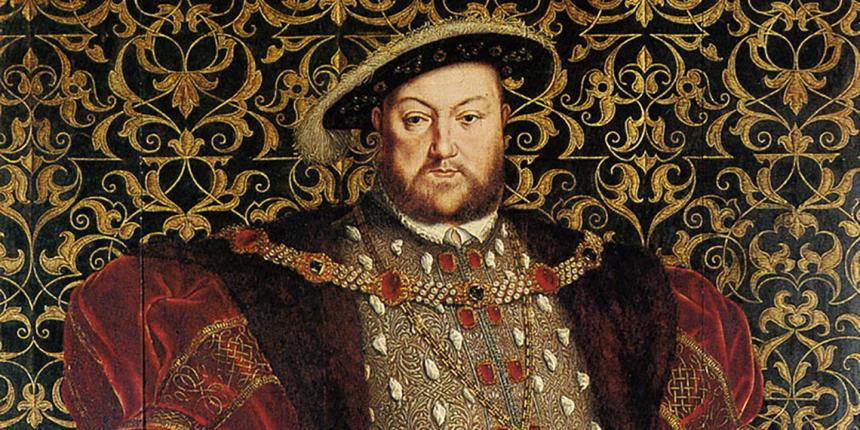
Bluebeard himself
By Phil Hall
A beloved and ailing aunt—a great artist, a generous and beautiful soul, someone loved by nearly all living things (from turtles, cats, and dogs to the husband of a favourite niece)—woke up in the middle of the night and called London with an urgent question from 9,000 kilometres away: “Did Henry VIII ever do anything good in his life?” she asked from her bed. “Well, did he?”
Year after year, my daughters would come home from school, and I would ask them what they learned about history. Did they learn about slavery? About British colonialism? About China, the Middle East, the Americas? No. It was the Tudors. Over and over again, for three years running, the main topic of their history lessons was the bloody Tudors. And always with a rosy, nationalistic glow. And always making excuses for Henry VIII.
He was an extravagant, self-indulgent, vain wastrel. He enclosed common lands, dispossessing peasants and fueling inequality. If British people have lost their intimate connection with the land, it began with policies like his. Henry ordered hundreds of executions—including those of wives, courtiers, and dissenters like Saint Thomas More—and oversaw brutal reprisals. During the Pilgrimage of Grace rebellion (1536–37), tens of thousands died opposing his dissolution of the monasteries. He was the original Bluebeard. He destroyed England’s monasteries, debased its currency, and chopped down its woods. As the salacious and unreliable History Channel recounts:
Under the Bill of Attainder, Catherine Howard was sentenced to death without a trial. It is rumoured that upon her arrest, she was dragged screaming down a corridor at Hampton Court. Incarcerated at Syon Abbey during a bitter winter, she was later beheaded on Tower Green.
When Henry dissolved the monasteries, he dismantled a critical source of charity—alms, healthcare, and shelter for the poor. Thousands of monks and nuns were cast out, and England’s cultural heritage suffered irreparably. Libraries were ransacked: Worcester Priory, for instance, lost nearly all its manuscripts. Over 800 religious buildings were seized, their lands handed to the crown and nobility. Beloved sites like Glastonbury stand as ruins today, their art lost or defaced. Measure the love of the English for these places by the scale of the loss.
In his arrogance, he broke with Rome to annul his marriage to Catherine of Aragon, declaring himself head of the Church of England. When dissenters like the monks of the London Charterhouse refused to acknowledge his supremacy, he had them hanged, drawn, and quartered. He relished blood sports—hunting, jousting, and the spectacle of public executions. He was a bully, a hypocrite, and a gambler who hoarded weapons and power. He wasn’t a jolly, portly chap who happened to love women. He was a tyrant who executed two of his wives and enabled a reign of terror.
Henry centralized royal authority, defying the spirit of the Magna Carta. He claimed a divine right to rule, igniting religious persecution that fractured England for centuries. Before him, England shared one faith; after, it lurched between Catholic and Protestant extremism.
He was also inept. Despite winning the Battle of Flodden (1513), his foreign campaigns drained the treasury and achieved little. In Ireland, he declared himself king but relied on coercion, not policy, to assert control. While his subjects starved, he squandered wealth on palaces like Hampton Court—a “gift” from Cardinal Wolsey, who fell from grace for failing to secure Henry’s divorce. The court’s kitchens burned day and night; for Henry, life was a gluttonous parade. What good did he do? He was rot. Britain’s most prolific serial killer, Harold Shipman, murdered 250 people. Henry’s legacy—executions, wars, and oppression—rivals history’s worst despots.
As Eddie Izzard said of Hitler—a sentiment that uncomfortably fits Henry:
“He was a mass-murdering f**khead… We can’t even deal with that. If you kill someone, it’s murder—you go to prison. Kill ten people, go to Texas, they hit you with a brick. Twenty people? They stare at you through a window forever. But kill 100,000? We’re almost like, ‘Well done! You must get up very early.’”
Tell me if Henry VIII did anything of worth, please, so I can pass it on to my aunt. And no, he didn’t compose Greensleeves—the song emerged decades after his death. He probably would’ve plagiarised it, executed the composer, and roasted him for dinner.
Discover more from Ars Notoria
Subscribe to get the latest posts sent to your email.