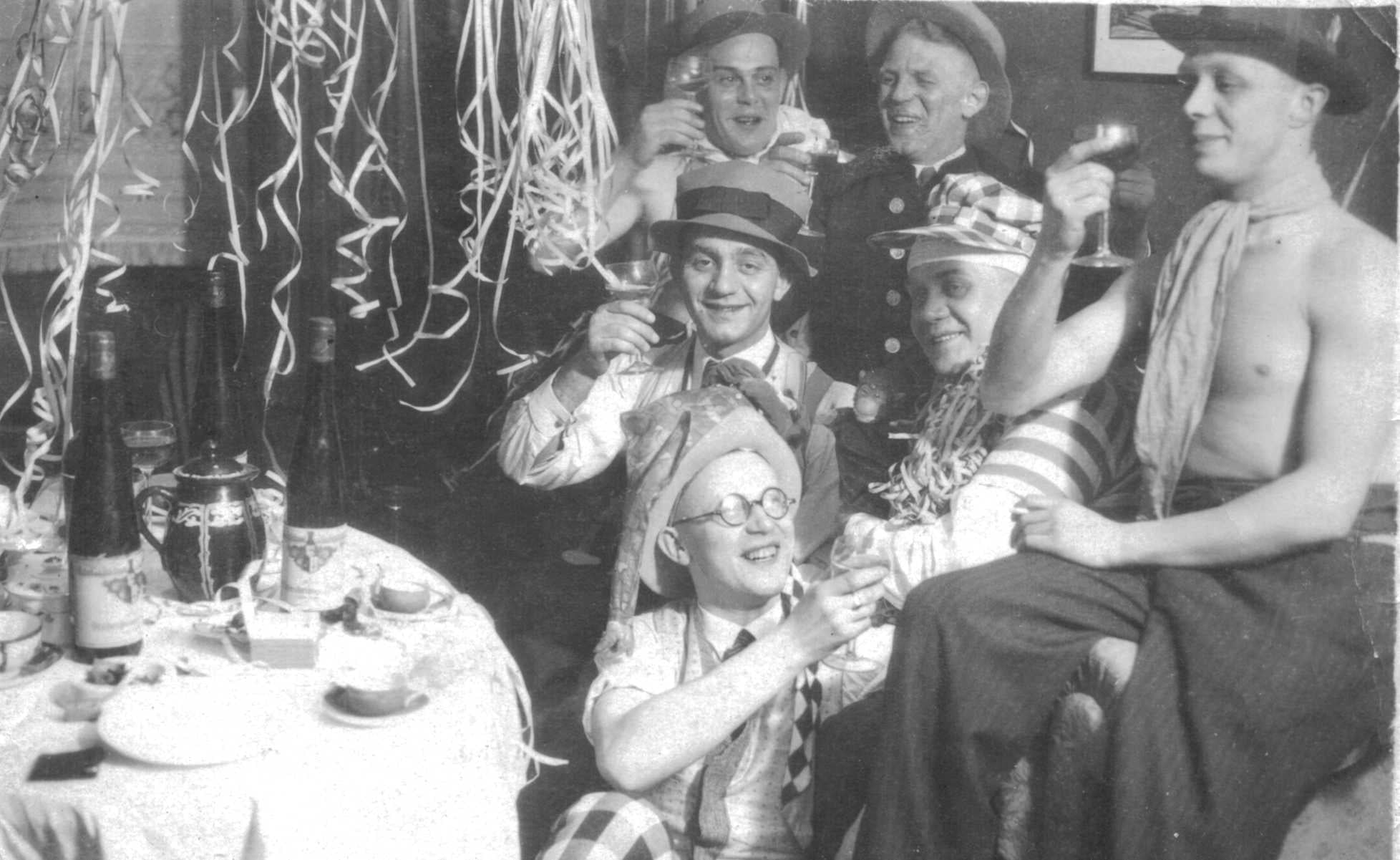
Grandpa Richard Steinhardt carousing with friends at the New Year, Vienna (1929)
by Phil Hall
.
Grandpa was an admirer of Napoleon, and this was partly why he chose to live in Golfe Juan in 1972. The other reason they both chose to live in Golfe was because they had gone on honeymoon to Cannes and Nice in 1935.
My grandfather, Richard Steinhardt, became a gourmet. How did it happen? I see a picture of him in Zemun in 1914, and he and his brother and sister look unhappy and hungry. Richard’s father, my great-grandfather, was consequential. He was the foreign editor of the famous Neue Freie Presse and used to go out into Vienna in the evenings dressed in furs to meet important Viennese people in expensive, brilliantly lit cafes and restaurants. There he ate plates of impossibly delicious food, drank wine, and sipped coffee. He left his little family at home to eat stew and dumplings. That’s where it started.

Richard married a beautiful young German girl, and they went to live in Paris. He met her after a play in Frankfurt. Her brother, my great-uncle Heini, an actor, was her twin.
Richard invited the whole cast to dinner. After a few weeks, he proposed to Lisa. He showered her with gifts and left for Paris. From Paris, he sent Lisa a ticket, and she got on the train. In Paris, they had a business-like wedding near the Pigalle, where Richard had a flat. He was very busy, and immediately after marrying her, he rushed off. It was 1935, and marriages between Jews and Germans had just been disallowed in Germany.

Lisa describes Paris between the wars as heaven on Earth—not the city of Down and Out in Paris and London; rather more like Hemingway’s A Movable Feast.
When Richard came back from his business trips, he would describe in minute detail all the dishes he had tried, and my grandmother would work hard to reconstruct them. This is how she became such a tremendously good cook.
Uncle Heini told me:
“When I came to Paris to visit Lisa and Richard and see little Eve, it was 1937. Richard met me at the station, and he asked me with his charming smile. He could be terribly charming. You know how charming he could be. He said:
‘Are you hungry? Would you like something to eat?’
I said, ‘Yes, thank you,’ and he took me to a little restaurant that he knew near the station that had just opened.
It was more like a bistro, really. It was very small, but very fashionable. The only table available had a pillar coming out of the middle of it, and so, as we ate, in order to talk, we had to lean over to one side of the pillar or the other.
The restaurant was famous for its hors d’oeuvres and had a long tasting menu. Richard ordered all 40 hors d’oeuvres. And I had to try each one.
After a while, I couldn’t continue. I was stuffed. But he gave me his thoughts on every dish and asked me for my opinion. In the end, I was completely exhausted and full. I couldn’t eat another thing. But Richard carried on. He ordered both main courses. Your grandfather loved food.
As he was travelling all over Europe for his company, as far as Russia, he knew where all the good restaurants were. Sometimes he made a special trip to another country to try a restaurant that had had a good review and that people were talking about.’”
We visited Richard and Lisa in Paris in 1966. But what created such a huge impression in my mind and my brothers’ minds was Christmas in Paris in 1969.

We were struggling in London. My mother was a French teacher in a secondary modern. Some of her female students were great brutes. Fights started every day, and she said all she could do was to pipe:
‘Stop it! Stop it!’ The girls ignored her, of course.
My father was working at Drum magazine for very little, commuting into London on the Northern line. My brothers and I were three soft little boys at a working-class school where the main form of entertainment seemed to be fighting.
We spent Christmas with Richard and Lisa in their little flat in Meudon-la-Forêt in 1969. We went over on a ferry. Lisa prepared roast goose stuffed with chestnuts and red cabbage. There were beautiful desserts. We were allowed to taste wine and liqueurs. There were walnuts and cheese. There were chocolates. After the dinner, Grandpa smoked a good cigar. It was a cold winter, but we were very cosy. The meal was colourful, fragrant, and memorable. Christmas 1969 still sparkles in my memory.

There was an old-fashioned civility and charm to the way Richard ate food at restaurants. Early on, he took my parents with him, and occasionally we would join them. There was so much more rigmarole about going to a restaurant with Richard. If the meal was good, he had to have a conversation with the chef to congratulate him.
In 1974, I was at a school in the north of England. The food was appalling, but, even so, I quite liked it. I liked the baked beans on toast. But what I liked most was teatime at 5 pm. In fact, it was the evening meal. I drank cup after cup after cup of hot, milky, sweet tea and ate lots of slices of white bread with margarine and strawberry jam.
In spring, I went down to Golfe Juan to stay with my grandparents. I have big hair in the picture because I never went to the barber’s at my Quaker boarding school in Great Ayton. I am 14, standing next to the stone commemorating the return of Napoleon from his exile in Elba.

My grandfather loved going early to the market in Cannes. Once, with a smile, he said:
‘Try this. Lean over the balcony when you bite into it.’
He gave me a heavy peach. When I bit into it, the peach water dripped down my chin onto the patios and balconies below.
‘Is it nice?’, he asked.
We never had bouillabaisse; we always had soupe de poisson. It is a powerful dish with its own ritual. Scrape the garlic onto the dry stale bread. Sit the bread in the soup plate, spoon the rouille onto the bread, sprinkle Gruyère over the rouille, and then ladle on the hot fish soup, which melts the cheese.
This, he said, is delicious, but wasted on you. It tastes of the sea. He cracked open a purple sea urchin and scooped out the little wet orange blob in the middle and ate it.

The thing about the apartment was that it was built right by a busy railway line, and so all conversation halted while trains rushed through at high speed, hooting. Grandpa had bought his flat on the strict promise from the local government that there would be no further construction to block the view. Of course, that promise was broken by the local mayor, a Communist. Grandpa said he hated Communists and liked the books of Don Camillo by Giovannino Guareschi.
The priest, in the books of Don Camillo, was based on a partisan Catholic priest, Don Camillo Valota. Don Camillo in the stories is involved in a comical war with the local Communist mayor in a small Italian town.
In the end, Richard took me to all his favourite restaurants along the coast. We went from Juan-les-Pins to Antibes, to Monaco, Nice to Ventimiglia, Cannes to St. Tropez. We walked up to Vallauris, up past all the villas, and ate buttery almond Picassos at a little café famous for them. Picasso, who had a house in Vallauris, had died there a year or so before. He was another Communist.
In those days, Graham Greene lived nearby in Juan-les-Pins. That was another walk. All along the coast, past the little restaurants, past the large, sharp, concrete tank traps on the shore, laid to prevent Allied landings. They were removed in the 1990s.
Grandpa exchanged letters with Graham Greene. He wrote proudly of Mom’s activism in South Africa. He boasted about his daughter’s courage. He was secretly very proud of her, though at the time he had expressed strong disapproval.
Richard disliked modern art, but he felt I should know about it, so Granny Lisa and I went inside the galleries to look at Picasso’s bold designs, at Giacometti’s pinched figures, at paintings by Léger and others.

The highlight for me was the Chapelle Matisse. I was moved by the chapel’s interior at 14 and felt the same emotion when I revisited it 40 years later. I can smell the concrete of the church, the damp grout. It was quiet, and the Provençal light penetrated through the stained glass, strong and sweet.
Best of all, perhaps, was to wake up, sit on the balcony with my grandfather and Granny Lisa, and eat pink grapefruit segments followed by lacy croissants spread with French butter and fruit conserve. Then to drink hot chocolate from wide-brimmed cups as the sun slowly warmed us all up. When we were older, we drank café au lait.

Discover more from Ars Notoria
Subscribe to get the latest posts sent to your email.