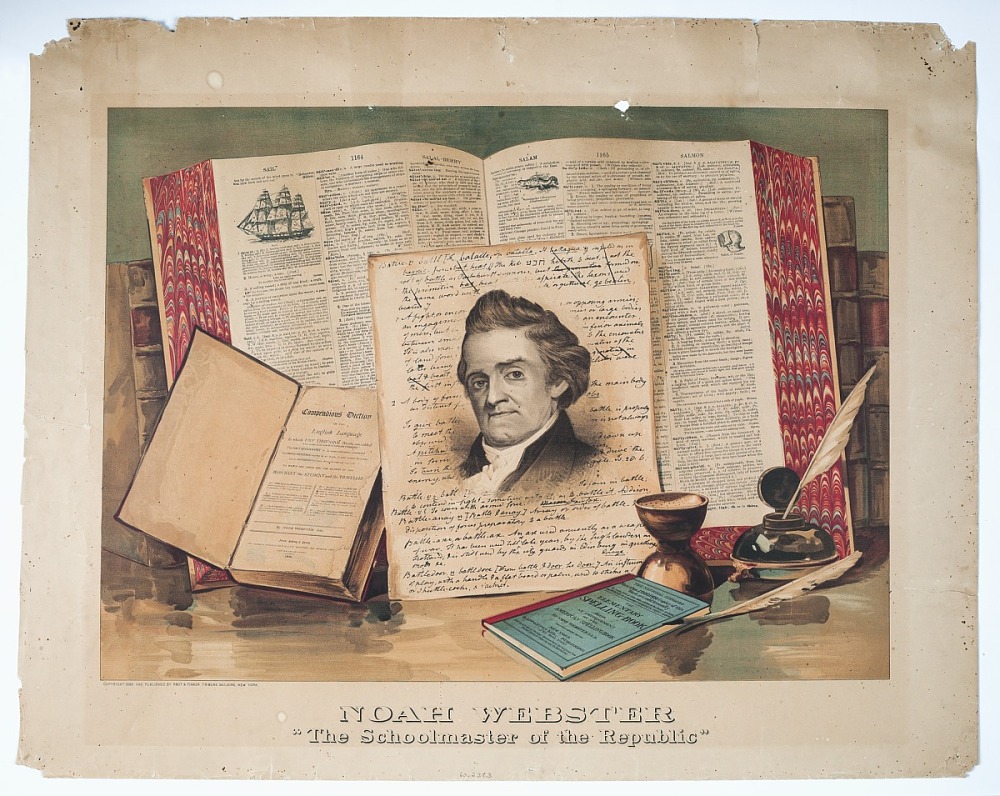
Was Noah Webster right to ‘rationalise’ the spelling of English?
by Phil Hall
“Now is the time and this the country in which we may expect success in attempting changes to language, science, and government. Let us then seize the present moment and establish a national language as well as a national government.”
Noah Webster
How terribly irritating it is to be forced into a decades long struggle (35 years and counting) with US English spell checkers! Some programmes enable you to select a preference for British English, but others do not. I hate to think how much time I have wasted adding English spellings to American spell checkers. The Microsoft Paperclip was extraordinarily irritating, but how much more irritating and oppressive are those phones, programmes and social media sites that try to force us into using US spellings. They get my goat.
Misunderstanding the systematicity of the English language, Noah Webster (1758-1843) tried to ‘rationalise’ the spelling of some English words. Not all of his suggestions were adopted, though some were: In the USA Colour was changed to color, defence to defense, centre to center. The unpronounced ‘u’ s were discarded and ‘s’ was substituted by ‘z’ for the voiced /z/.
For Noah Webster, these odd spellings were linguistic leftovers; they were the useless bits that remained, but Noah Webster too easily disregarded the broader question of dialect and accent. he was primarily concerned with standardisation. He was a lexicographer, an educationalist, a colonialist, a nationalist, and not a descriptive linguist.
If you stipulate that spelling should dictate pronunciation, or that there be an equivalence between the spelling and the pronunciation of a word, then you will tend to enshrine one variant of the language to the detriment of all others. What at first sight looks like a rational act quickly becomes an imposition. Noah Webster’s dialect of choice was the English they spoke in New England in the late 18th century.
For example: I pronounce daughter as /dɔːtə/, so it makes no sense for me to spell daughter as dawter. Webster would advocate the spelling of turnip as turnep which only makes sense in places where the unstressed /i:/ goes to a shwa – as it does in Australia, South Africa New Zealand and the USA. In British, Received Pronunciation (RP) the sound changes to /i/.
So, by tinkering around with the spelling system to make it seem more rational, Webster’s spelling system ends up by enshrining only one version of the way the language is pronounced. Of course, this is not surprising. Webster was, ultimately, an intolerant, elitist, settler colonist, an 18th century American nationalist – with all the unpleasant connotations that that entails.
Then you have inaccuracies and inconsistencies in the proposed spelling. For example, Webster proposed Iland instead of island. But the ‘i’ in ‘island’ is a dipthong and so, if there were a correspondence then the spelling would be ailand not Iland. Using the letter ‘I’ shows a lack of understanding of English pronunciation. ‘I’ is the sound of the letter, not the sound of a phoneme.
In the UK model becomes modelling, but in the USA model becomes modeling. A traveller for us is a traveler in the US. What is marvellous to us is simply marvelous to them. But should the Americans say super instead of supper? Are their hatters haters?
Noah Webster, and Bernard Shaw after him, railed against the seeming illogicality of English spelling. Clearly, this was partly because neither of them properly understood phonetics in general, or English phonology in particular. Shaw was a great writer, Webster an innovative lexicographer. They both had chutzpah.
Bernard Shaw knew Henry Sweet and modelled his character in Pygmalion on Sweet. I wonder if Sweet agreed with Shaw. Sweet defined standard Received Pronunciation in his A Handbook of Phonetics (1877).
There are reasons why English spelling is the way it is. In Accents of English, J. C. Wells (in my view the world’s greatest living English phonetician) has given an excellent, descriptive and explanatory account of the English pronunciation system. I doubt he would be against introducing innovations into the spelling system if it were necessary. He is an advocate and exponent of Esperanto. But Wells can give a good account of how the spelling in English regularly corresponds, in most cases, to the pronunciation.

Here’s an example of the inconsistencies that can arise when you make procrustean rules. There are rhotic accents across Great Britain and non-rhotic accents. This just means that in some accents of English you pronounce the /r/ sound when it isn’t in the first position in a stressed syllable and in other varieties you do. Which variety do you now choose to favour by formalising the spelling system in your ‘logical’ way?
Take the word ‘hard’. In RP varieties, and some other varieties, we don’t pronounce the /r/ sound after a vowel in an unstressed syllable. But in places in the West country, Ireland and Scotland they do. There is dialectal variation.
Then there is also the question of ‘r’ insertion, it’s a feature of connected speech in English. So, if you said Africa and Asia then the actual sound you made would probably be Africa /r/ and Asia. Should you make provision for that feature of connected speech in your spelling system?
When you take the decision to include the /r/ in your spelling in a ‘rational’ way – as if language were a formal system that could be streamlined like a computer programming language – then the /r/ would have to be pronounced every time you used it and included in the spelling. Zealand. Of course you don’t include the /r/ insertion rule in your spelling system – rationality has its limits
Spelling systems become more proscriptive and dictate pronunciation, in particular for wave after wave of non-English speaking immigrants to the United States, Canada, Australia and New Zealand. Spelling bees are important in the United States and irrelevant in the UK. That is because spelling correctly in the United States is really an exercise in acculturation and a cultural levelling policy.
The mistake Noah Webster made was to assume that where the spelling didn’t correspond to the sound this was exclusively the result of a vestigial letter, or a combination of letters that indicated the way people pronounced the language in the past, that the spelling had become inaccurate, misguided and that these were examples of redundancy.
Having said that, some of Noah Webster’s innovations were universally adopted by all of us. For example housbonde, mynde, ygone and montheth were transformed into husband, mind, gone and month. So some of the changes introduced in the Webster Dictionary did make good sense.
But while there is a case to be made for some reform and simplification of the English spelling system, Webster acted partly out of ignorance; his simplifications were pragmatic, but they were also bowdlerisations. Or, as the Americans now have it, bowdlerizations, and if you are English and have to constantly correct the automatic corrections the American spelling checkers make, the American English spelling system can become extremely tiresome.
Phil Hall is a university lecturer. He is a committed socialist and humanist. Phil was born in South Africa where his parents were in the ANC. There, his mother was imprisoned and his father was the first journalist from a national paper to be banned. Phil grew up in East Africa and settled in Kingston-upon-Thames. He has also lived and worked in the Ukraine, Spain and Mexico. Phil has blogged for the Guardian, the Morning Star and several other publications and he has written stories for The London Magazine.
Discover more from Ars Notoria
Subscribe to get the latest posts sent to your email.



To Shaw’s bemusement, you might just as well spell the word ‘fish’ as ‘ghoti’, with the ‘gh’ as in ‘enough’, the ‘o’ as in ‘women’ and the ‘ti’ as in ‘tradition’.