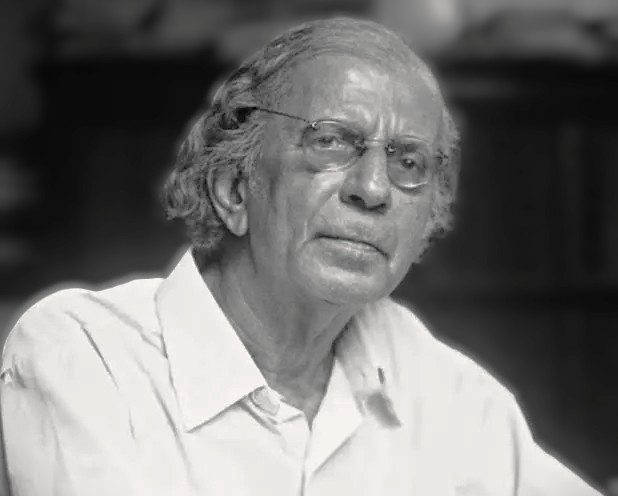
Nissim Ezekiel
On the birth centenary of Nissim Ezekiel and his impact on Indian poetry in English
by SUDEEP SEN
1.
I want to talk about Nissim Ezekiel, purely from a practising Indian poet’s point of view, and not as an academic or literary historian. I first met Nissim Ezekiel on the page through his poetry in the 1980s. I remember his iconic and much anthologized poem, ‘Night of the Scorpion’, which was part of our school curriculum and reader. As a young boy, I found the poem rather scare-inducing, but very effective in describing a particularised act. It was only much later, as an adult reader, did the poem take on a different meaning within the palette of Indian rituals in the area of Cultural Studies.
Let me open, with reading this eponymous poem:
I remember the night my mother
was stung by a scorpion. Ten hours
of steady rain had driven him
to crawl beneath a sack of rice.
Parting with his poison — flash
of diabolic tail in the dark room —
he risked the rain again.
The peasants came like swarms of flies
and buzzed the name of God a hundred times
to paralyse the Evil One.
With candles and with lanterns
throwing giant scorpion shadows
on the mud-baked walls
they searched for him: he was not found.
They clicked their tongues.
With every movement that the scorpion made
his poison moved in Mother’s blood, they said.
May he sit still, they said
May the sins of your previous birth
be burned away tonight, they said.
May your suffering decrease
the misfortunes of your next birth, they said.
May the sum of all evil
balanced in this unreal world
against the sum of good
become diminished by your pain.
May the poison purify your flesh
of desire, and your spirit of ambition,
they said, and they sat around
on the floor with my mother in the centre,
the peace of understanding on each face.
More candles, more lanterns, more neighbours,
more insects, and the endless rain.
My mother twisted through and through,
groaning on a mat.
My father, sceptic, rationalist,
trying every curse and blessing,
powder, mixture, herb and hybrid.
He even poured a little paraffin
upon the bitten toe and put a match to it.
I watched the flame feeding on my mother.
I watched the holy man perform his rites
to tame the poison with an incantation.
After twenty hours
it lost its sting.
My mother only said
Thank God the scorpion picked on me
And spared my children.
*
His other poems I remember from my childhood are ‘Goodbye Party for Miss Pushpa T S’ and ‘ Soap’ — on the surface, they are a humorous and mocking take on the Indian accent. I love the innocence and simple joy of a joke in the poems — though I suspect now they would be misinterpreted as pieces that take a jibe at a certain section of the Indian society. It is a pity that now, as Indians, we have lost our sense of humour — I am not talking about the “lowest common denominator” type slapstick humour or a Kapil Sharma Show, but humour that contains within its fold aspects of social commentary, satire and wit.
Let me read both these poems out aloud:
Goodbye Party For Miss Pushpa T.S.
Friends,
our dear sister
is departing for foreign
in two three days,
and
we are meeting today
to wish her bon voyage.
You are all knowing, friends,
What sweetness is in Miss Pushpa.
I don’t mean only external sweetness
but internal sweetness.
Miss Pushpa is smiling and smiling
even for no reason but simply because
she is feeling.
Miss Pushpa is coming
from very high family.
Her father was renowned advocate
in Bulsar or Surat,
I am not remembering now which place.
Surat? Ah, yes,
once only I stayed in Surat
with family members
of my uncle’s very old friend-
his wife was cooking nicely…
that was long time ago.
Coming back to Miss Pushpa
she is most popular lady
with men also and ladies also.
Whenever I asked her to do anything,
she was saying, ‘Just now only
I will do it.’ That is showing
good spirit. I am always
appreciating the good spirit.
Pushpa Miss is never saying no.
Whatever I or anybody is asking
she is always saying yes,
and today she is going
to improve her prospect
and we are wishing her bon voyage.
Now I ask other speakers to speak
and afterwards Miss Pushpa
will do summing up.
*
Some people are not having manners,
this I am always observing,
For example other day I find
I am needing soap
For ordinary washing myself purposes.
So I’m going to one small shop
nearby in my lane and I’m asking
for well-known brand soap.
That shopman he’s giving me soap
but I’m finding it defective version.
So I’m saying very politely — –
though in Hindi I’m saying it,
and my Hindi is not so good as my English,
Please to excuse me
but this is defective version of well-known brand soap.
That shopman is saying
and very rudely he is saying it,
What is wrong with soap?
Still I am keeping my temper
and repeating very smilingly
Please to note this defect in soap,
and still he is denying the truth.
So I’m getting very angry that time
and with loud voice I am saying
YOU ARE BLIND OR WHAT?
Now he is shouting
YOU ARE CALLING ME BLIND OR WHAT?
Come outside and I will show you
Then I am shouting
What you will show me
Which I haven’t got already?
It is vulgar thing to say
but I am saying it.
Now small crowd is collecting
and shopman is much bigger than me,
and I am not caring so much
for small defect in well-known brand soap.
So I’m saying
Alright OK Alright OK
this time I will take
but not next time.
2.
Jayanta Mahapatra was the first senior Indian poet to officially publish my poems in the national newspaper, The Telegraph, published from Kolkata when I was still an undergraduate at the University of Delhi. In fact, over the years, he published me there several times, and later in his famed journal, Chandrabhaga.
Nissim Ezekiel, however, was my first publishing editor. It was him who had signed on the American edition of my debut collection, The Lunar Visitations, for the newly established ‘New Poetry’ series at Rupa Books in India. A few of my colleagues who continue to actively write poetry now, were published under the same series — Ranjit Hoskote, Tabish Khair, Anna Sujatha Mathai, Bibhu Padhi and others. As an aside, Dom Moraes was editing the Penguin poetry series exactly at the same time — one that published Vijay Nambisan, C P Surendran, Jeet Thayil and others.
Later Nissim published me in the journal he edited, The Indian PEN, whose offices were in the famed Theosophy Hall in Mumbai. I was a regular visitor there and remember interviewing him for an article that came out in the Network magazine. He was always warm and gracious towards me and my poetry. I fact the Mumbai launch of The Lunar Visitations was held in the same hallowed halls with its creaking ceiling fans, wooden chairs and long tables, and walls surround by glass-cased teak bookshelves. I remember, too, the young faces of my fellow poets like Ranjit Hoskote, Arundhati Subramaniam, Jerry Pinto, Menka Shivdasani, R Raj Rao and so many other Mumbai poets. Also, Ezekiel’s own senior poet-colleagues were there in full attendance — Dom Moraes, Adil Jussawalla, Gieve Patel, Eunice D’Souza, and others. It was a very different time then — a time of collegiality, mutual support and intense criticism — one that has sadly waned over time now.
I remember visiting Nissim on so many occasions in his New Marine Lines office and his home in the ‘Kala Niketan’ building in Mumbai’s Pedder Road (now called Bhulabhai Desai Marg). Over chai and biscuits, we chatted about all things — poetry and life. There so no sense of competitiveness or agenda-driven ambition, just camaraderie and generousness of his mentorship. The same was the case when I would visit Adil in Cuffe Parade, or Dom (in Sargent House) in Colaba, or Gieve in his studio near the Hanging Gardens, or Kolatkar in the Jehangir Gallery Café.
The sense of creative camaraderie prevailed even across the arts — when poets, artists, singers, dancers, theatre practitioners — all interacted with each other. Jatin Das, a close friend of Ezekiel had done an oil painting on him, and Ezekiel wrote a poem to Das (as have Moraes, Mehrotra, and others). Those times have slowly waned now — that of reflection, conversation, writing letters to each other when our new books came out, and more.
Most contemporary poets largely operate in narrow silos, often not even reading each other’s works, let alone intelligently critiquing them. Nowadays, there is too much — ‘you scratch my back, I will scratch yours’ (exceptions aside, of course) — and the level of poetry criticism is abysmally low and shallow, and just skims on superficial praise. I hope I am wrong, or proven wrong in the future.
Let me read two more Ezekiel poems:
To force the pace and never to be still
Is not the way of those who study birds
Or women. The best poets wait for words.
The hunt is not an exercise of will
But patient love relaxing on a hill
To note the movement of a timid wing;
Until the one who knows that she is loved
No longer waits but risks surrendering.
In this the poet finds his moral proved
Who never spoke before his spirit moved.
The slow movement seems, somehow, to say much more.
To watch the rarer birds, you have to go
Along deserted lanes and where the rivers flow
In silence near the source, or by a shore
Remote and thorny like the heart’s dark floor.
And there the women slowly turn around,
Not only flesh and bone but myths of light
With darkness at the core, and sense is found
But poets lost in crooked, restless flight,
The deaf can hear, the blind recover sight.
*
In my room, I talk
to my invisible guests:
they do not argue, but wait
Till I am exhausted,
then they slip away
with inscrutable faces.
I lack the means to change
their amiable ways,
although I love their gods.
It’s the language really
separates, whatever else
is shared. On the other hand,
Everyone understands
Mother Theresa; her guests
die visibly in her arms.
It’s not the mythology
or the marriage customs
that you need to know,
It’s the will to pass
through the eye of a needle
to self-forgetfulness.
The guests depart, dissatisfied;
they will never give up
their mantras, old or new.
And you, uneasy
orphan of their racial
memories, merely
Polish up your alien
techniques of observation,
while the city burns.
This second poem is constructed in tercets, has wonderfully tightly-wrought short lines binding them and the various issues raised, all together.
3.
In the context of Indian poetry in English in 1990s and early 2000s, I had enjoyed and honed my own literary criticism skills by spending hours with the likes of Ezekiel, Moraes, Jussawalla, Kolatkar, Patel, D’ Souza, Mahapatra and others, over those decades. We read and critiqued each other’s poems, read out poems by others we liked, often memorised them to read aloud to others. It was difficult to publish poetry books by mainstream publishers, but at least it was possible then. Publishers like Oxford University Press, Rupa, Orient Longmans, Penguin and HarperCollins published a couple of volumes a year. Imagine having Ezekiel or Moraes as your poetry editor — what a boon it was for my generation who wanted that part of that process.
Now publishing poetry is as easy as sneezing — collectives are set up and once each member publishes each other’s works, these collectives die a swift death. Many of the small presses act as vanity presses requiring the poets to pay for their printing or buy back copies to cover publisher’s costs. In that scenario – the very creator and artist, i.e. the poet herself, suffers! They may have a glossy book printed in their hands — but there is little or no support with copy-editing, distribution or promotion. I understand that there is very little money in poetry — but that was always the case, and will continue to be.
At least the generation of the Ezekiel and ones soon after that, kept ‘rigour’ at the heart of writing — not just writing out of angst or “spontaneous overflow of powerful feelings”. ‘Feeling’ of course is at the core of one’s writing, but it is the ‘craft’ that finally makes what the poem it is. With desktop and online publishing – the avenues are wide open and democratic (which is good, at one level) — but I hasten to add, that in general, there is very little or no quality control. Of course, there are always exceptions again, but very few.
That aspect of ‘rigour’ which I was talking about, even though it is hinted at obliquely in his poem, ‘The Hill’, is at the soul of it:
This normative hill
like all others
is transparently accessible,
out there
and in the mind,
not to be missed
except in peril of one’s life.
Do not muse on it
from a distance:
it’s not remote
for the view only,
it’s for the sport
of climbing.
What the hill demands
is a man
with forces flowering
as from the crevices
of rocks and rough surfaces
wild flowers
force themselves towards the sun
and burn
for a moment.
How often must I
say to myself
what I say to others:
trust your nerves—
in conversation or in bed
the rhythm comes.
And once you begin
hang on for life.
What is survival?
What is existence?
I am not talking about
poetry. I am
talking about
perishing
outrageously
and calling it
activity.
I say: be done with it.
I say:
you’ve got to love that hill.
Be wrathful, be impatient
that you are not
on the hill. Do not forgive
yourself or other,
though charity
is all very well.
Do not rest
in irony or acceptance.
Man should not laugh
when he is dying.
In decent death
you flow into another kind of time
which is the hill
you always thought you knew.
*
4.
I can go on an on about Nissim, but time is short — and others I am sure will do a better justice. In conclusion, let me read a short poem-sequence that I have written dedicated to him (that appears in the new book, Nissim Ezekiel: Poet & Father, compiled by his daughter Kavita Ezekiel Mendonca (Pippa Rann, 2024):
for Nissim Ezekiel
Handwriting
three linked-haiku
fingers hold the pen
firmly, guiding the gold nib
in wild cursive scripts —
lines delicately
etched, perfectly pitched with the
stylised slant of a
fine and practised hand —
letterforms and words
bloom, come alive — spell.
*
Fountain Pen
tactile pleasure of
a nib slowly caressing
the skin of a page
*
Writing
phrases, words commune —
elliptical — moulding raw
imagination
*
Needless to say, ‘Nissim Ezekiel and His Impact on Indian Poetry in English’ has been “pioneering”. As a practising Indian English-language poet, I am thankful for his presence, inspiration, mentorship and enormous contribution to our literature — and for all that and more, I am deeply grateful.
Sudeep Sen’s [www.sudeepsen.org] prize-winning books include Postmarked India: New & Selected Poems (HarperCollins), Rain, Aria, The HarperCollins Book of English Poetry (editor), Fractals: New & Selected Poems | Translations 1980-2015 (London Magazine Editions), EroText (Vintage: Penguin Random House), Kaifi Azmi: Poems | Nazms (Bloomsbury), Anthropocene (Pippa Rann), and Red. The Government of India awarded him the senior fellowship for “outstanding persons in the field of culture/literature.” Sen is the first Asian honoured to speak and read at the Nobel Laureate Festival.
Discover more from Ars Notoria
Subscribe to get the latest posts sent to your email.