Carlos Katan
5th International Colloquium on Poetry and Philosophy
—with ULISES PANIAGUA
Hello, good day. Let’s begin this interview. The first thing I want to ask is: Do you have a defined concept of what poetry is? Have you managed to arrive at your own definition through reading and writing it?
Carlos: Sometimes, the poem seems to me like a textual-verbal-rhythmic-sonic-visual? object surrounded by layers of concepts. These concepts move between different syntactic multiplicities, generating flows of consciousness, deterritorializations, discomforts, affects and affections. The object detached from conceptual movement is nothing more than a pure artifact—which is not at all something to look down on—but it would be unfair to claim that a poem exists in a pure artifact without artifice. The poem is not free from the idea of artifice, as Verónica Forrest-Thomson and Charles Bernstein point out. Rather, I defend the anti-realist stance in which the poem itself is an artifice; the poem is the artifice—of absorption? Bernstein would say—a movement of concepts across syntactic multiplicities.
Without reducing the poem to the pure grace of syntax, it resides in that dance of concepts as an indivisible totality of rhythm, which does not refer solely to the lexical-sonic, the metric, or the merely phonetic, but to an internal rhythm arranged by the mind and materialized in what Eduardo Espina defines as tone. I mean to say that the poem is an indivisible object of language, and poetry an experimentum linguae, an experience at the limits of language, liberated from the framework of the merely communicative and signifying. The language of the poem appears as an experience of the outside of language as a historical object, and therefore as an experiment. The poem is immanent because, as artifice, its dynamism does not come from exteriority; rather, its movements are internal. The language of the poem refers to itself.
I like to think that all poetry that holds itself in esteem is experimental. In this sense, I subscribe to the definition made by the poet María Salgado when she says that poetry is thought by other means, or Mario Montalbetti who says something similar, like poetry is linguistics by other means—both de/(re)/forming Clausewitz.
Concretely, I believe every poet has the obligation to answer what poetry is, in the same way that every philosopher must confront the question of what philosophy is. Emerging victorious or not depends solely on the rigor with which one assumes this question, and on the number of times it is renewed. Thinking must continually face its own crisis and move forward.
I don’t know if this answers the question. I think not, but that’s fine; it’s heading in that direction.
Ulises: Do you believe there is a close, profound relationship between poetry and philosophy, or do you consider they have no connection at all?
Carlos: I think my previous answer implies the relationship between the two.
It would be curious to participate in a conference on philosophy and poetry and not believe that they are profoundly and intrinsically related.
I don’t want to focus on well-known examples from antiquity like Parmenides or Lucretius. I prefer to think about what they do, about what directly relates them. As I said before, they stem from the act of putting thought into crisis, while simultaneously being forced to define their own contours: philosophy through the analysis and creation of concepts, and poetry through syntax, continuous experimentation, and friction with the limits of language.
Both, like mathematics, appear at the two points on the frontier of thought.
Ulises: Do you think there are poets you have read who achieve a genuine philosophical proposition in any of their texts? In what way do they do it?
Carlos: Yes, several. Mario Montalbetti or Chus Pato, to name two.
I believe that both, through very different paths and styles, inquire into the boundary between language and the sayable. Montalbetti does it through analytical propositions that suddenly meet with moments of deep lyricism, as in his book Notas a seminario sobre Foucault (Notes on a Seminar on Foucault). Or Chus Pato, through a continuous breaking of the forms of poetic text, clashing at times between the lyrical, the conceptual, and the narrative, generating a discursive tension that activates thinking and reveals that dance of concepts I spoke of at the beginning of this interview. Although this occurs in almost all of her work, I would like to highlight her books: M-Talá and Sonora.
Of course, we could also mention Eduardo Lizalde, Reynaldo Pérez Só, Fernando Pessoa, María Auxiliadora Álvarez, and a very long etc.
Ulises: Do you consider there are philosophers you have studied who achieve a poetic degree in some of their paragraphs or ideas? In what way?
Carlos: Baruch Spinoza, without a doubt. No one like him, perhaps with the exception of Wittgenstein or Simón Rodríguez, has managed to posit thought in such a colossal way that the writing can only spill over, exceeding the limits of the form imposed by the context—in this case, the philosophical essay. The poetic in Spinoza is not in his use of language, or of a “poetic” or “poetizable” language, but in the potency of his writing, which cannot be contained in just one form of expression because his writing goes beyond mere expression, or the merely expressible. In this sense, Spinozian thought is a way of inhabiting the world, of traversing the real with the mind, thereby generating its own tone and demonstrating what language is capable of doing to the world. It is no coincidence that Henri Meschonnic writes Spinoza, poème de la pensée (Spinoza, Poem of Thought).
Ulises: Do you think poetry exists beyond the word, or is it an exclusively written matter?
Carlos: This is a difficult question because it implies asking in what sense the word appears. Poetry is a problem of language; it does not necessarily refer to language that becomes writing, but it does require words, rhythm, and syntax, even if that is not its entirety. At the same time, poetry has a capacity that I call metastatic—that is, it is capable of transferring itself to other registers of language without ceasing to be poetry. At least, this is one of the possibilities that the poem, thought of as artifice, allows.
Ulises: How do you view the current state of the world, and what does the future look like for your loved ones and the planet, in your eyes?
Carlos: And who are “my loved ones”?
I believe we are all in real danger today. The rise of totalitarianism we are experiencing in all our Western societies is an imminent threat to everyone’s life, but especially to women and minorities: migrants, sexual, racial; and to the working classes. We are facing an exponential increase in hate speech from all fronts, and this political and media machinery seems unstoppable. If we add to this the obvious and drastic consequences of climate change, we find ourselves before a future quite devoid of immediate alternatives.
For now, I like to believe that the response to all this madness lies in affection, in our capacity to care for one another, in building community. I believe this is the only way to resist the onslaught of irrationality to which this wave of individualistic egocentrism is leading us.
Ulises: Do you believe poets and philosophers should contribute to the construction of a better future, not as an obligation per se, or do they have no relation to it? If the answer is yes, how can they do it?
Carlos: I believe that right now, by freeing ourselves from any label. Contributing as people to the construction of a collective dialogue, to the reconstruction of the social fabric. It is time to remake a narrative that brings us closer and allows us to be together. And this is not a task solely for the philosopher or the poet; it is a collective task that concerns all of us who are interested in living in a world with, at the very least, a minimum of dignity and respect for human life.
Ulises: In your opinion, are poetry and philosophy present in everyday life? If so, in what way do they manifest?
Carlos: Without a doubt, they are. In fact, they are my way of inhabiting and moving in this world, although I cannot live as a poet all the time, as I have to cook, bathe, or work. Thought permeates all aspects of my life; the questioning of the given is a task I put into practice continuously and upon which I base my writing activity. Negativity, in a philosophical sense, is the way I approach the world, but also language, thought, and writing.
Ulises: Would you like to share a poetic or philosophical message for the near future? Thank you very much.
Carlos:
a boat is and is not
when it sinks
both disappear
—Ikkyu, in translation from English by Mario Montalbetti.
Carlos: Thank you, Ulises
Ulises: Thank you, Carlos
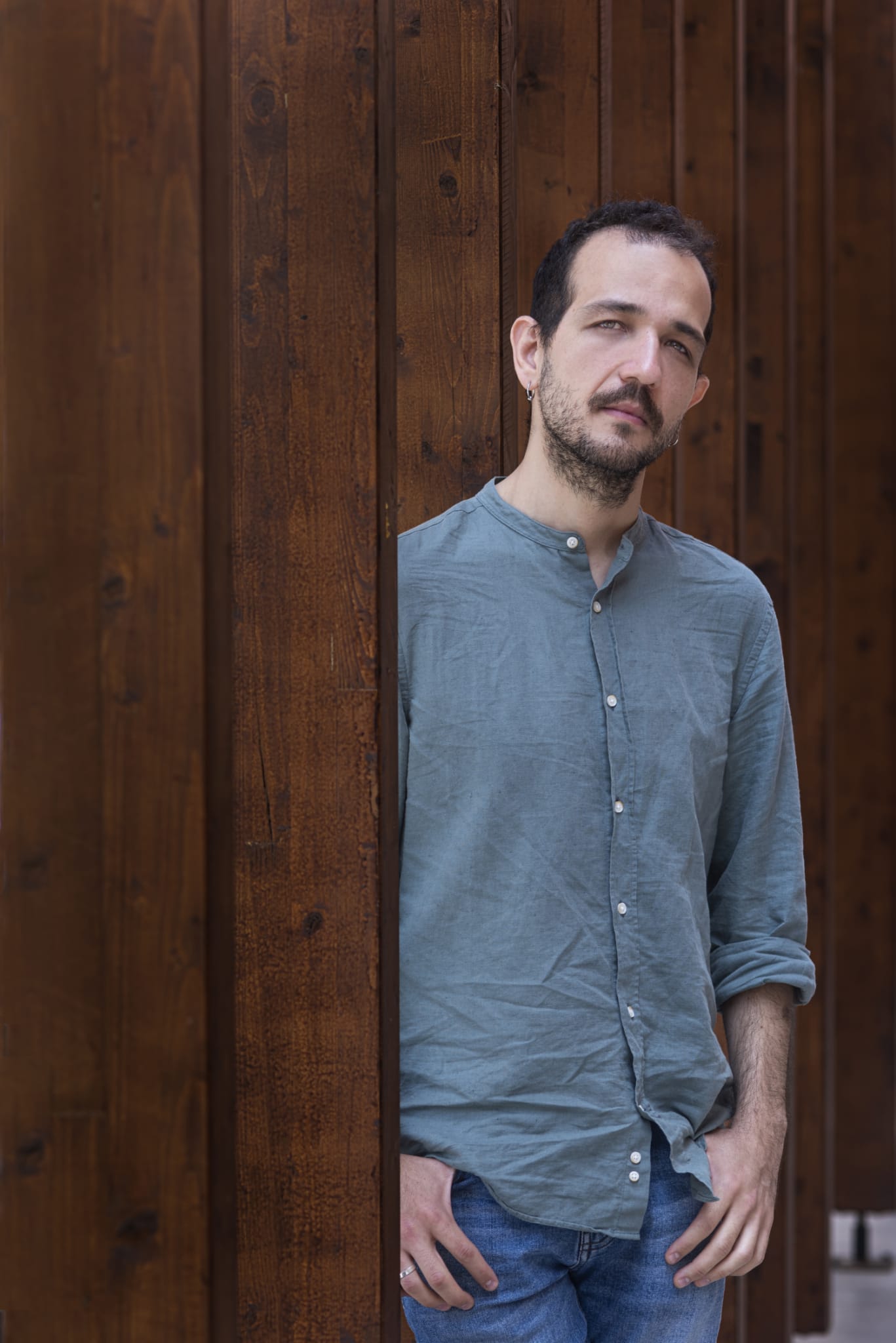
Carlos Katan (Caracas, Venezuela). Holds a degree in Philosophy from the Central University of Venezuela. Poet and editor. Winner of the 3rd Lugar Común Poetry Contest organized by the Italian Embassy (Venezuela – 2018). Author of the books: Formas de la Aridez (Alliteration – 2020) and El Libro de las Máquinas (Ultramarina – 2021).
Discover more from Ars Notoria
Subscribe to get the latest posts sent to your email.