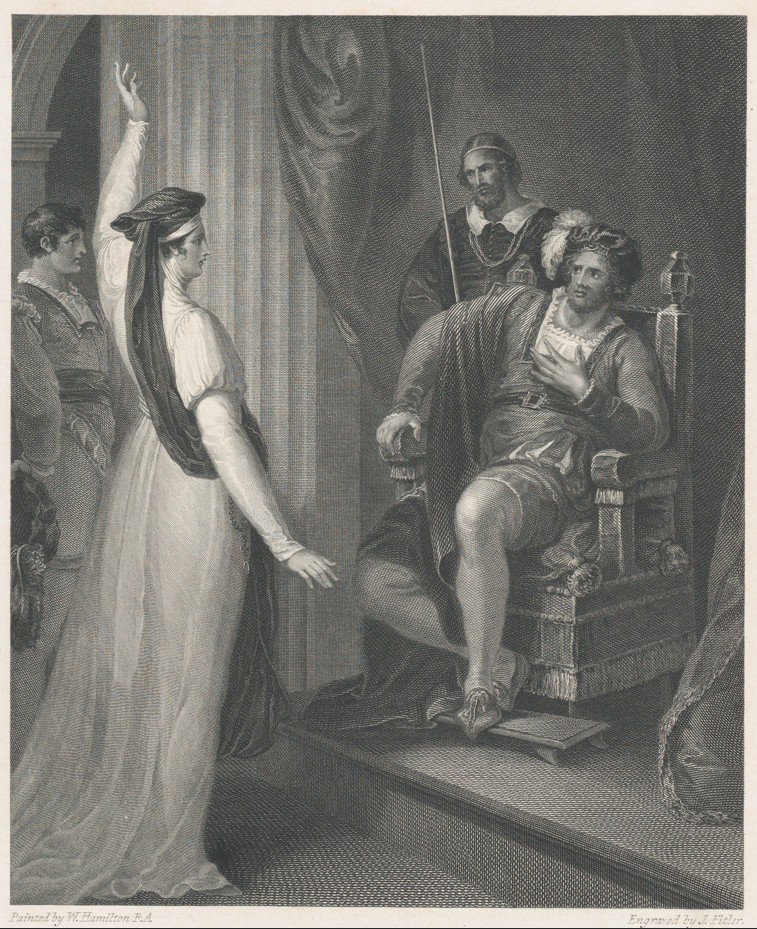
Isabella and Angelo (Shakespeare, Measure for Measure, Act 2, Scene 2). Illustration James Fittler, engraving William Hamilton 1994, Public Domain
This is perhaps the closest Shakespeare comes to presenting a dogma: “He who the sword of heaven would bear… should be as holy as severe.”
Interviewed by Phil Hall
Con Rider: I think my favourite Shakespearean play, even more so that Hamlet, is Measure for Measure. It embodied the phrase coined by the 19th-century British historian Lord Acton in a letter in 1887. Power corrupts, but absolute power corrupts absolutely.
“My absolute power to Lord Angelo” and “firm abstinence.” Lord Angelo is precise. Regarding the first quote, what are the lines?
“You may have roved down by my charity and my blessed order. I come to visit the afflicted spirits here in prison. Do me the common right to let me see them, and to make me know the nature of their crimes, so that I may minister to them accordingly.”
“Do not save me a word, young sister, but one word. That fast has made you good. Goodness that is chief in beauty makes beauty grieve in goodness, but grace, being the soul of your complexion, shall keep the body of it ever fair. A remedy presents itself. You may redeem your brother from the angry law. Virtue is bold, and goodness never fearful.”
Phil Hall: Now that you mention it, I recall the play. It is Measure for Measure. In a sense, although the characters are vivid individuals, each also functions as an expositor of philosophical discourse. For example, I remember reading Othello and challenging myself to understand Iago’s nature. Upon reflection, he seems terribly modern: a self-serving individual who feigns loyalty while ambitiously climbing a professional hierarchy. I believe Iago’s sadistic destruction of Othello and Desdemona is motivated by jealousy and vindictiveness. That such two-faced and hypocritical behaviour would not surprise us today is a testament to the character’s enduring relevance.
CR: Indeed, Angelo in Measure for Measure, is equally despicable. His actions are central: Isabella is poised to enter a nunnery, while her brother Claudio is imprisoned for impregnating a woman to whom he was only pre-contracted, not formally married. The Duke has departed, leaving his absolute power to Lord Angelo. Perceiving widespread immorality, Angelo seeks to rectify society by resurrecting long-dormant laws. The severity catches everyone by surprise; Claudio now faces execution for an act that was commonly tolerated. The theme concerns the retrospective application of law. Angelo claims “firm abstinence” and insists he is powerless, stating, “It is not I who condemn your brother, but the law.” He then hypocritically propositions Isabella, offering to spare Claudio if she will sleep with him. He is a monster, yet he is guilty of the very transgression for which he condemns Claudio—a similar incident exists in his own past.
The Duke, Vincentio, who is disguised as a friar, observes this and formulates a plan. He tells Isabella she can redeem her brother without compromising her virtue by arranging for Angelo’s former fiancée, Mariana—who remains in love with him—to take her place in the dark. Angelo believes he is with Isabella. However, he subsequently breaks his promise and does not spare Claudio’s life. Meanwhile, the Duke, still in disguise, orchestrates the execution of another prisoner and has the provost present the deceased man’s head as Claudio’s to satisfy Angelo’s demand for proof. Thus, Angelo is ultimately exposed as a monstrous hypocrite. The play serves as a discourse on power.
There is a poem recited in Measure for Measure: “He who the sword of heaven would bear / Should be as holy as severe; / Pattern in himself to know / Grace to stand, and virtue go; / More nor less to others paying / Than by self-offenses weighing. / He who the sword of heaven would bear / Should be as holy as severe.” It is a significant point. There is also the song: “Take, O, take those lips away, / That so sweetly were forsworn; / And those eyes, the break of day, / Lights that do mislead the morn; / But my kisses bring again, bring again, / Seals of love, but sealed in vain, sealed in vain.”
“He who the sword of heaven would bear… should be as holy as severe.” That is a crucial line. This is perhaps the closest Shakespeare comes to presenting a dogma. There is extensive debate regarding Shakespeare’s political leanings. Which faction did he support? Measure for Measure brings him closest to articulating a philosophical stance, to being didactic.
Yet his didacticism is inherently anti-dogmatic. His position is one of opposing dogma. However, from this play, we can infer something of Shakespeare’s politics. He could be described as… an anti-legalistic “Mercerian.”
PH: Was he a humanist?
CR: An anti-legalistic, Mercerian, permissive libertarian. “Mercerian” is my own coinage, meaning one who believes in mercy, modelled on “libertarian.” So, an anti-legalistic Mercerian. The term “permissive” is key; its first recorded use is in Measure for Measure. Originally, it simply meant “granting permission” or, by extension, being libertarian—not oppressive. It has since acquired a more derogatory connotation. I am attempting to describe Shakespeare’s political position in his own terms.
PH: I believe there is a tendency to overemphasise the man himself, a notion often promoted by those who question his authorship, like Mark Rylance. While Rylance is a fine actor, his views on authorship are frustrating. Shakespeare was the author. His uniqueness stemmed from an extraordinary receptivity. I imagine him walking through a forest, perceiving every flower and tree with profound clarity. In conversation, Shakespeare did not merely hear words; he perceived the essence of the speakers. He was deeply receptive to creation, and by being so intimately connected to the fabric of reality, his characters seemed to emanate from him as if from life itself.
CR: I agree. We are not discussing a formless creative force, but a distinct personality. That is why he is called the divine poet, as Milton suggested. The focus should be on what Shakespeare achieved, not merely on his process.
PH: Consider his biography: likely from a Catholic family, ambitious, intelligent, married young, and immersed in London’s society. He was a conduit through which experience flowed.
CR: I would not call him divine, but I recall an academic noting that Shakespeare was not merely a countryman but a “forest man,” shaped by the Forest of Arden. It is notable that, despite his profound knowledge of nature, he is not excessively descriptive in the manner of, say, Francis Bacon. His style is often sparing, though it can be bombastic when required. He is remarkably concise.
Is it not difficult to definitively categorise Shakespeare? He is a mercurial and elusive figure. This is why academics struggle to pin down his politics, often scrutinizing the sonnets for clues.
PH: My theory is that his mercurial nature stems from his being a force of nature, more profoundly plugged in to the world than most.
CR: That is an unsatisfactory metaphor, akin to the mechanistic terms Ted Hughes used in his critical work Shakespeare and the Goddess of Complete Being—he used terms like “wired in,” which are rather inelegant.
There were a series of talks given on Shakespeare at the Rose theatre organised by Richard Wilson, the Peter Hall Professor at Kingston University and he described a tradition he knew of about how a stone was passed around to give each person a chance to speak their mind. The lecture he gave was about Measure for Measure and, indeed, I was waiting for the stone to be passed to me so that I could give my views on the play and Shakespeare’s outlook, but the metaphorical stone never was passed to me.
“He who the sword of heaven would bear… should be as holy as severe.”
If you are going to invoke turn taking and free speech then you should hold by it.
PH: When it comes to Shakespeare, Con, you hold the stone here.
CR: Thank you.
PH: No, thank you, Con.

Con Rider is a multifaceted man: a musical savant and self-taught Shakespeare expert. The son of a Shakespearean actor, he continues the family tradition with periodic performances. His life has been uniquely split between the pastoral—managing a Surrey farm and running a stable of horses in Richmond Park for years—and the theatrical.
Discover more from Ars Notoria
Subscribe to get the latest posts sent to your email.


You must be logged in to post a comment.