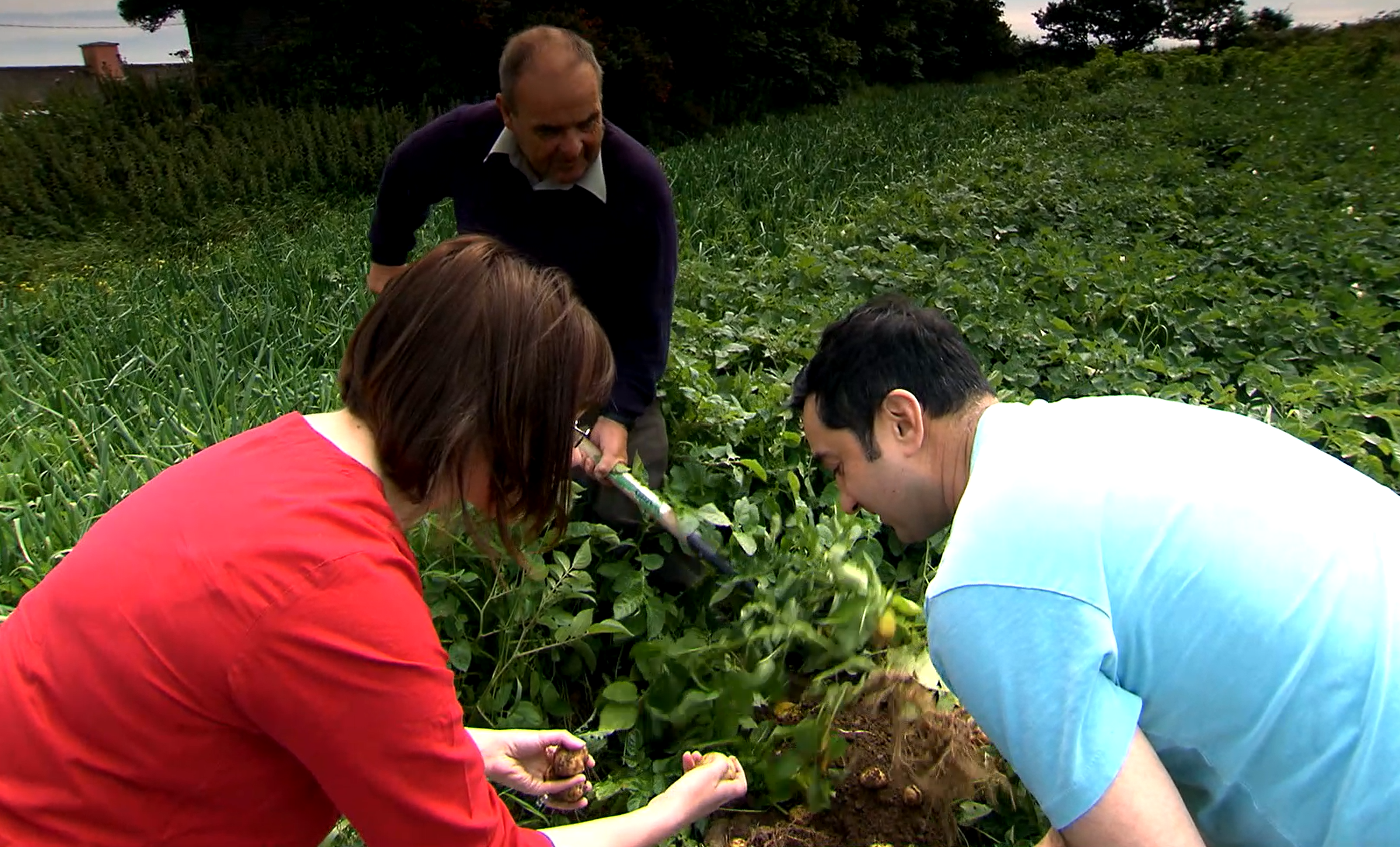
With potato grower Willie Scannell of Ballycotton
Enough lessons. Come to the table!
by Arun Kapil
I didn’t understand Irish food by reading about it. I came to understand it by standing still – week after week – watching what people bought, cooked, trusted.
For fifteen years – Dingle, Donegal, Dublin, Waterford, Kerry, Galway food festivals. Early winter mornings attending Irish Farmers Markets, Cork’s Mahon Point, Kinsale and Midleton, Limerick’s Milk Market – they all taught me more than any kitchen alone ever could.
Damp air hanging low, heavy with steam and breath. Crates scraped concrete. Voices echoed – shouted prices, laughter bouncing off taut canvas, greetings thrown across stalls like ropes. Hands stiffened in the cold, slowed by it, caffeine numbing sharp minds, fingers lagging behind, nicked and caught in cold metal frames. Bain-maries clanged open and shut. Lids lifted, closed again. The day finding its rhythm.
I was there as a trader, not a commentator. Spices, blends, chutneys, rice, hot food. A foreigner selling foreign things in a place deeply assured within itself. I watched what moved quickly and what didn’t. What people circled back to. What they ignored completely. No curiosity tax. No explanation required. If something earned its place, it stayed. If it didn’t, it disappeared quietly.

I was there as a trader, not a commentator. Photograph Olive Kapil
Standing there, you learned fast that Irish food culture doesn’t respond to persuasion. It responds to reliability. People weren’t chasing novelty. They were buying reassurance – food that made sense in the cold, that promised to hold its shape, to do its job without drama. Butter. Potatoes. Fish. Greens. Jams. Cakes. Relishes. The same patterns repeating week after week, the seasons revealing themselves more clearly than any calendar ever could.
Nobody asked me to explain myself. The welcome came not through enthusiasm, but through ease. Space was made. Time was allowed. If you showed up – and kept showing up – you were folded in.
That’s where the education began.
Not in theory.
In repetition.
Before I understood any of that, Myrtle Allen taught me something far harder to learn: restraint. At Ballymaloe, I was still clinging to ideas of perfection – the kind you arrive with when you’ve finished a course but haven’t yet learned how to listen. In the pastry section, one-on-one, Mrs A with her white kitchen coat buttoned-up, making crab apple jelly, I discarded fruit that looked wrong to me – blemished, misshapen, imperfect.
Myrtle stopped me. No ceremony. Use those too. They’re just as good. You’ll see. We halved them, quartered them, skins and seeds included straight into the pot. Later, when the fruit had cooked down and fluffed up, I poured it into the jelly bag to drip overnight. Impatient, I gave it a squeeze – just a little – to help things along.
She saw it immediately. No. Never squeeze. You’ll cloud it. Discard it. Start again. And she walked away. There was no cruelty. No drama either. Myrtle didn’t have time for sloppiness – especially the kind disguised as enthusiasm. She wasn’t being kind. She was being correct. The work mattered. The ingredient mattered. The process mattered. If you interfered unnecessarily, you started again.
That lesson never left me. Not everything needs improving. Not everything wants your cleverness. Some things ask only that you don’t get in the way. Ireland does that instinctively. You see that discipline echoed across the best Irish kitchens – not as a style, but as a shared instinct.
Ross Lewis understands this completely. His cooking, particularly whilst at Parnell Square, has always carried the mark of someone deeply aware of where he comes from – not in a nostalgic sense, but in the way restraint governs his decisions. Technique is precise, never nervous. Flavour is built carefully, then left alone. There is no scramble for attention on the plate. What arrives feels finished, not fussed over. Like Myrtle, he understands that doing something properly often means knowing exactly when to stop. A fellow Corkman deeply respectful of her legacy, he carries that same quiet authority.
Niall McKenna expresses the instinct differently, but no less clearly. His contribution hasn’t been about singular moments of brilliance, but about creating spaces where good food can exist consistently and generously. Restaurants, rooms, schools – places where excellence isn’t guarded, but shared. His food feeds people properly. The hospitality feels embedded, not performed. You leave satisfied, happy, not dazzled – which is far rarer.
Then there is Chris McGowan, whose cooking tells another vital Irish story: return. After years in serious London kitchens, he came home – not to a capital or a food quarter, but to Moira. At Wine & Brine, the work is thoughtful, modern and grounded. Brining, pickling and fermentation are tools, not signatures. Local produce is treated with skill, not spectacle. Plates arrive composed but generous. Knowledge is present, ambition kept in check. It’s food that respects the people eating it. Different kitchens. Different expressions. The same instinct underneath.
That same instinct is being carried forward now, quietly but confidently, by cooks like JP McMahon and Aishling Moore. JP’s work in the west of Ireland has been as much about connection as cooking – restaurants grounded in place, yes, but also a wider commitment to knowledge, collaboration and education. Through Food on the Edge, he has created a space where chefs, producers, writers and thinkers gather not to posture, but to listen, argue, learn and eat together.

In the Three Crowns with Lee Urchill. Photograph Arun Kapil
Aishling’s cooking at Goldie speaks a similar language through fish. Her approach – from grill to fin – is informed by deep knowledge and respect for her produce, balancing innovation with tradition. There are echoes of Fergus Henderson and Josh Niland in the way she handles fire and flesh, but her sense of place gives the food its own authority. It belongs exactly where it is.
There is also Richard Corrigan – a cook whose work has carried Irish produce outward with rare confidence and skill. From Bentley’s to Corrigan’s of Mayfair and Daffodil Mulligan, his kitchens have never softened their accent to travel. They cook Irish food with authority, intelligence and edge – proudly rooted, technically exacting and occasionally provocative in the best possible way.
Corrigan’s advocacy has never been nostalgic. It’s muscular, modern and unapologetic, grounded in deep respect for ingredients and the people who produce them. Watching Irish food hold its own on London tables – not translated, not explained – is a reminder that confidence travels well when it’s earned.
If Irish cooking has a backbone, it’s built long before a pan is heated. Sally Barnes understands this at a cultural level. Her work with fish and smoke is rooted in continuity, sustainability and restraint – not as slogans, but as practice. Nothing rushed. Nothing wasted. Depth without heaviness. Food that nourishes more than mere appetite.
Jane Murphy’s goats at Ardsallagh produce milk that behaves properly. That phrase matters. The animals aren’t pushed. The cheese isn’t forced to perform. What emerges is characterful, balanced, and confident in its own skin. Gentle lactic bite, undertone of earthy sweet creaminess – generous, joyful.
Take a walk across fields with growers like Willie Scannell of Ballycotton or the Barrys of Carrigtwohill and the logic becomes even clearer. Potatoes and onions grown for reliability, not novelty. Vegetables cultivated to be cooked, not photographed. Carrots, leeks, greens – sturdy, sweet, dependable. “When all the others were away at Mass, I was all hers as we peeled potatoes”. Seamus Heaney, reflecting on a morning spent peeling spuds with his mother, wrote of “cold comforts set between us, things to share, gleaming in a bucket of clean water…”, a quiet act made profound through shared labour and attention.

Take a walk across fields with growers like Willie Scannell of Ballycotton. Photograph Arun Kapil
In Irish culture, potatoes carry more than starch – they carry stories. Here, as in that poem, food and memory are inseparable: labour and nourishment mark the same ground. That sense of shared labour and deliberate attention – to land, to ingredient, to ritual – is a current running under every kitchen and field in this country. Sobering satiety.
And then there is scale – and no shame in it. Dawn Dunbia’s systems show what happens when the same discipline is applied to volume. Grass-fed, traceable, sustainable, collaborative, consistent. Meats that taste of the land, not antibiotics, speed or falsehoods – time as sweet flesh. Ireland doesn’t collapse when it scales. It steadies. The land still leads. Ireland’s confidence exists at both ends of the spectrum – in the smallest handmade cheese and the largest processing plant. The same rules apply. Do the work properly. Don’t interfere unnecessarily.
Ireland has never been bland. It has always been selective. Long before curry or chilli, Irish port towns traded in saffron, pepper, ginger, cloves, nutmeg, cumin and cinnamon – spices carried in chests, valued not for drama but for nuance. At first as medicines, poultices, preservatives and fragrance when Apothecaries carried them in pharmaceutical mode, before Spicers’ shops and the innovators carried them forward into food culture, combined with the local wild herbs and seaweeds to help understanding and cross (mind) barriers.

At CUSH. Photograph Arun Kapil
These flavours arrived quietly and were used where they made sense. Butter, mentioned in early European texts, was prized not just for richness, but for its ability to preserve, clarify, deepen and combine. And combinations of blended flavours, brought further sense and understanding to spice. Ireland didn’t decorate food with spice. It absorbed it. This instinct matters. It’s what allows new flavours to belong without fanfare – not as novelty, not as rebellion, but as seasoning. Familiarity, not fusion.
You don’t learn a place by entering its kitchens once. You learn it by returning to it, to its markets again and again. At Irish Farmers Markets, as a foreigner and a purveyor of foreign produce, I learned that welcome isn’t granted through explanation. It comes through repetition, commitment, trust. I learned through endless winter afternoons, working with Mrs A in her study, writing notices, letters and helping with her Local Producers of Good Food in Cork. Nobody needed persuading. If you showed up, did your work properly, space was made.
What I observed at the markets – week after week – was humility paired with abundance. Food bought with purpose. Meals cooked to feed, not to perform. Questions asked with genuine curiosity. A culture confident enough to absorb without disappearing.
That’s where this story lives.

Arun in the Imogeely Tavern, Co Cork
What makes this moment in Irish food culture feel particularly alive is not just how it’s produced and cooked, but how it is talked about. In its telling. Across print, radio, kitchens and tables, a group of writers, broadcasters and cooks have helped shape a language around Irish food that values integrity over hype, knowledge over trend and generosity over performance.
They’ve written and spoken about produce, seasonality, home cooking and hospitality with care and curiosity – asking better questions, making more room for nuance, and allowing food to be understood on its own terms. In doing so, they’ve helped create a culture where food doesn’t need to shout to be heard. It only needs to be cooked, eaten and understood.
So where does spice really sit in all of this? Not as interruption. Not as correction. Spice has always entered Irish kitchens quietly, used to deepen, to heal rather than dominate. The masaalchi’s role here isn’t to impose heat or spectacle, but to apply judgment. To listen first. To know when flavour should be audible and when it should barely whisper. Beef doesn’t want distraction. Butter already carries complexity. Potatoes respond to care, not cleverness. When spice earns its place – fennel with pork, nutmeg with dairy, smoke meeting black cardamom – it feels inevitable, not foreign. That’s what Ireland taught me.
Not how to add – but how to stop.
In the end, it always comes back to a table. Not a styled one. Not a table that needs explaining. Just a table where people sit long enough to finish what’s in front of them. Bread torn, not sliced. Butter softening without being asked. Steam rising, then fading into conversation. You see it in the way dishes arrive. Generous, glistening joints of meat set down without ceremony. Caramelised, gnarly edges. Cooking juices pooled and unapologetic. Roast potatoes and mash – both present, both buttered properly. Carrots and turnips cut into honest chunks, roasted until sweet and peppery, edges caught just short of collapse.

Breakfast in Shanagarry. Photograph Arun kapil
Joyce knew of it. Leopold Bloom frying a pork kidney is not culinary theatre, it’s attention. Butter, heat, smell, appetite. A man feeding himself before the day begins. That instinct runs through Irish writing. Bread and tea. Stout and oysters – “…my palate hung with starlight” reflected Heaney. Stew eaten slowly, talked around, returned to. Indeed, Roddy Doyle’s kitchens are never about cuisine. They’re about food, about tea poured again because no one knows what else to say. Chips eaten standing up. Food appears not to impress, but to anchor, doing its oldest job – keeping people steady long enough to talk.
“Mr Leopold Bloom ate with relish the inner organs of beasts and fowls. He liked thick giblet soup, nutty gizzards, a stuffed roast heart, liverslices fried with crustcrumbs, fried hencods’ roes. Most of all he liked grilled mutton kidneys which gave to his palate a fine tang of faintly scented urine.”
James Joyce, In Ulysses
Nothing loud. Nothing that needs credit. The food doesn’t ask for attention. It assumes it. People eat. They talk. They reach back in. Someone wipes the table with a sleeve. Someone tops up a glass without asking. Time loosens. Plates empty. Nobody rushes to replace them. Ireland’s food, Ireland’s bia doesn’t need defending or rebranding. It doesn’t need rescuing from itself. It works because it always has. It feeds people properly. It knows when enough is enough – its mammy’s generous to a fault. There’s no grand conclusion to draw from any of this. You don’t need a plan or a pledge. So, just sit down,
eat what’s good.
Don’t interfere unnecessarily.
Everything else is just noise.
And for my recipe this month: Mussels. This is modern Irish cooking, masaalchi style – not spice as spectacle, but spice as seasoning. Not fusion. Familiarity. Cook it once and you’ll understand. Cook it often and you won’t need to explain it again.
Mussels, Butter, Leeks & Proper Potatoes
Seaweed, saffron, nutmeg & black cardamom

Mussels from Killary Fjord, Leenane, Connemara, Ireland. Photograph Arun kapil
Cook properly. Sit down. Everything else can wait.
You start with mussels – scrubbed, bearded, alive – because nothing dead deserves butter. A wide pot goes on first, heavy-bottomed, no fear. Butter in. Not a polite amount. Enough to mean it. Leeks follow, washed well, sliced thick, allowed to slump rather than colour. Salt early. Let them soften until they smell sweet and round, not sharp. This is not the moment for impatience.
Now the masaalchi step – subtle, deliberate. Fennel seed, lightly crushed between your fingers so it knows it’s been invited. Saffron, generous pinch. Just enough to lift the butter, not perfume the room. In they go. A breath later, the mussels. Lid on. Heat up. The pot rattles. Steam builds. You don’t interfere. You listen. When the shells open – most of them, not all – you’re done. Anything that refuses stays closed and stays behind.
Kill the heat. Another knob of butter if you’re feeling generous (you should be). A grind of black pepper. Nothing else. No herbs auditioning for attention. Ladle the mussels and their juices into deep bowls. Leeks everywhere. Butter pooling unapologetically at the bottom.
On the side: potatoes. The right ones. Floury Golden Wonders, boiled whole in well-salted water until they surrender easily to a knife. Drain properly. Steam off. Then split, not mashed. Butter again – cultured this time, sharp and alive – melting straight into the cracks. A good pinch or two of dried seaweed, crushed fine. Nutmeg, freshly grated, just enough to make you wonder if it’s there. And one quiet, grounding note of black cardamom – cracked, seeds only, ground to powder. Smoke without fire. Depth without drama. That’s it.
No garnish. No explanation. Crusty bread on the table because butter demands it. A shared bowl. A shared spoon if you’re civilised, none if you’re not in the mood. Eat while it’s hot. Talk while it cools. Reach back in. Enjoy!
Arun Kapil, Food Editor of Ars Notoria, and punk food poet, founded and owns a spice company, Green Saffron Spices. He works sustainably direct with partner farms mainly to the west and north of India and some in the south. He works directly from source. He owns total chain of custody, depleting links in the chain, bringing direct line of sight to fields of cultivation. Arun and his partner Olive began by selling one or two sachets a week of bespoke blends with accompanying recipes at a farmers market stall in Mahon Point, Cork. They now sell spices and seasonings to globally based blue chips, onward food processors and are just in the throes of re-launching their brand, based on Modern India meal solutions, sauces, spice blends, naan, condiments and basmati. They started the business boot-strapping from the bottom up, managed with a good deal of jugaard. He considers himself to be a masaalchi and at best a khansama supported by a strong network of Irish, Indian and British agri-experts and businessmen.
Discover more from Ars Notoria
Subscribe to get the latest posts sent to your email.
You must be logged in to post a comment.