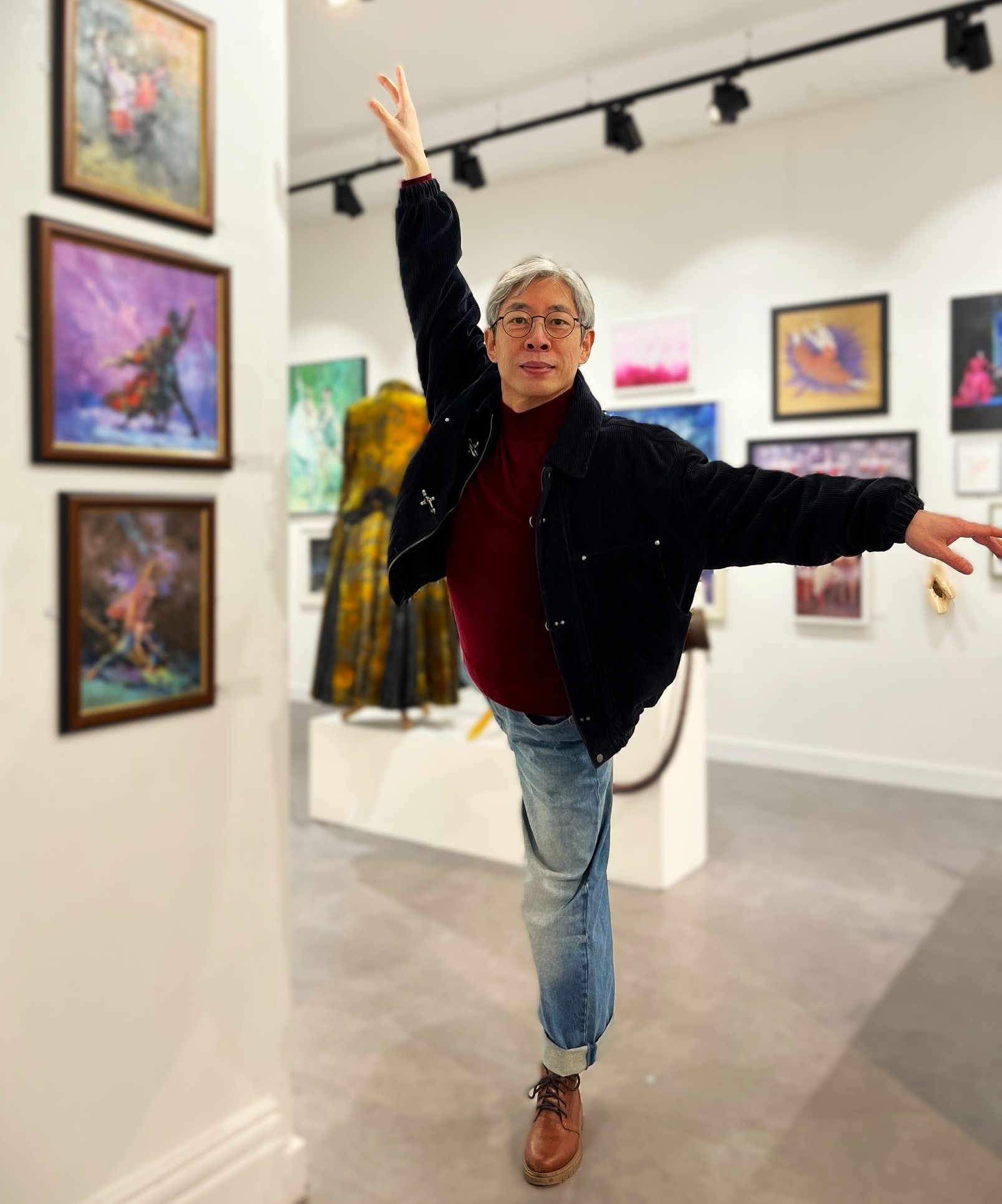
Bing Shi at the Drawn to Dance Exhibition in the Gallery of Royal Birmingham Society of Artists (RBSA) Gallery
The artist Bing Shi in conversation with Paul Halas, Ars Notoria’s Art & Lifestyle Editor, and Phil Hall
Paul Halas: This is our second meeting. Our first was two years ago, and I remember you talked at some length about your love of ballet. Naturally we’ve been following your progress over the past period, and ballet has been a theme of much of your recent work. Can you tell us a bit about your love of ballet; where it comes from?
Bing Shi: That’s a big question! I think it goes back to when I was about five years old, in China, when the Cultural Revolution was still in progress. There were what we called “model operas” – and I think they may have been some of the very few art films you could see in the cinemas. They included two ballets, one of which was called The White-Haired Girl and the other The Red Detachment of Women, which were the first ballets I ever saw. All of them were essentially propaganda pieces, but people loved them. There were not many cinemas at the time; most people saw them in outdoor settings: a white fabric hung between two poles, in some situations between trees. I still have the posters on my wall.
The White-Haired Girl was about the daughter of a peasant family who are in debt to an evil landlord. The landlord takes the girl as payment of the debt, but she escapes to a cave in the mountains, and as years pass a legend grows about a white-haired fairy living in a mountain cave, so the local peasants worship her and bring her offerings which help her survive. Finally the Liberation Army frees the village from the grip of the Nationalists, and the commanding officer happens to be the White-Haired Girl’s fiancé from way back. Happy ending.
At the age of five I’d fallen in love with ballet. The dancers all had pointed shoes, and it just so happened my grandmother also had small shoes with points that fitted me, even though they were not the right pointed shoes, so that gave me something to practise with. Even at primary school my artistic talent was showing, and my teachers helped me with my art and dancing. But in China back then, being in the arts was not well regarded, and certainly was not considered a suitable future.
But as well as art, ballet was always a part of me. When I wanted to practise I would watch ballet on TV, or even take my cue from pictures. And when I went to university there were dance and art groups that I took part in, so I was able to keep up with those passions.
In my Beijing days I never missed any important ballet performance by the Chinese Central Ballet or any visiting foreign company, such as the Royal Ballet from the UK. So my deep connection with ballet continued.
My passion for ballet is lifelong. I am always ready to learn new techniques. Once after watching a video on how to do fouettés on Youtube, I immediately tried it and succeeded, in my 50s, in my kitchen! I danced ballet in my dreams so often; in those dreams my flexibility was marvellous, and I could turn endlessly.
Phil Hall: A while back we interviewed the New Yorker Magazine artist Tom Batchell. He’s an aficionado of Swing, and when he draws or paints he puts on swing music and dances, so when you see his work, a lot of it is full of the movements of the dance. I wonder if you put on music when you draw or paint? Do you do it sitting down quietly like a traditional artist, or do you do it with movement like Tom Batchell?
Bing: I’d never thought of that. Most of the time, though, I listen to music – mostly classical – or listen to audiobooks.
Paul: There’s a fascinating relationship between drawing and painting, which are both essentially static art forms, and dance, which is all about movement. Your dance paintings convey a great feeling of movement, at the same time as retaining an almost classical sense of composition.
Bing: We had this collaboration with the Birmingham Royal Ballet. They arranged several events for us where we went to their studios and drew their rehearsals, and live events, and although I had teaching commitments, I tried to attend as many of them as I could.
Because of my lifelong passion for ballet, I know ballet so well. I understand the choreography and techniques. For instance why two dancers in a duet are in a particular position and what kind of movement and relationship there is between them. Therefore, I follow two principles in my works. First, it must be ballet; it must be authentic to any ballet fans and dancers. Second, the anatomy must be correct. I noticed some ballet drawings, paintings and sculptures in representative style don’t have the correct anatomy that wouldn’t convince the viewers. Of course, if you’re doing abstract art or other forms that can be all right. But if you’re making representative art, you can even exaggerate things, but it must all be based on sound anatomy: the body structure, the bones, the muscles. A ballet dancer from the Birmingham Royal Ballet, after seeing my works in the exhibition, sent me a message expressing his appreciation of my works. He told me that I captured the dancers’ line perfectly and that I had brilliant eye for dance. I was so pleased: my drawings and paintings gained approval from the professional dancers themselves.

Paul: Some art forms – I’m thinking of film animation in particular here – exaggerate the human form grotesquely to achieve an effect, but there has to be a basis of real anatomy. Some art falls down on bad anatomy. Sacrilege here, but with certain of Degas’s dancers the anatomy is disturbingly off. However, in some of your paintings you appear to give most prominence to movement, colour and light, and the human form appears more as an impression.
Bing: Some artists, collectors and viewers may not be so concerned about anatomy, art takes various forms. To me, good anatomy doesn’t stop me from exaggerating or abstracting things – the extension, the relationship between the dancers.
Phil: Your dancing paintings are impressionistic, yet they appear to follow the anatomy very well. That’s true of many of your other paintings too, of street scenes, the canals, of other people; while they’re very impressionistic, they all have a great sense of verisimilitude. That’s there’s a great feeling of reality behind them. There’s one ballet painting in particular that I like…

Trepak Dance. Painting by Bing Shi
Bing: Russian dance, or Trepak dance. From the last year I changed. With landscapes, portrait, and movement, I am not copying the reality, I’m interpreting what I see according to my feeling. I may draw or paint from life, or use photos, all are references to me. For this painting, I want to show my joy with a ballet itself; I don’t want to be painting a particular dancer. I like the wildness and passion in the Trepak dance. The scarlet costumes and the energy give me a very strong feeling of fire. when I painted it, the idea of fire and the movement was always in my mind. I wanted it up and burning. I needed to show that.
I did the same in my Spanish Radiation painting. What I expressed was love passion and death.
Phil: I notice you use the colour purple a lot in your ballet pictures, just as you did in many of your earlier paintings. Is it simply because you like the colour, or is there another reason?

Spanish Radiation. painting by Bing Shi
Bing: It can be flexible: with more red it goes warm, and with a slight change it goes cool. When you get very passionate, very warm, you have orange, you have red, and then you go very cool, French ultramarine, or Prussian blue. And this purple in the middle is quite mild. I just keep using it.
Paul: The movement in the paintings and drawings is striking, and in a way more successful at conveying a sense of movement than many actual moving images. I think back to Fantasia (Disney, 1940) and The Magic Canvas (Halas and Batchelor, 1950), both animated films that exhibit a very fluid sense of design, and have sequences that combine dance and music. They were both ground-breaking, and yet for all the excellence of their animation there’s an even greater sense of movement in your ballet artworks. How is that alchemy achieved?

Bing: In the past year my understanding of the nature of space and colour, have all improved. I want to interpret what I see with variation of brushworks and lines. I just push certain things, not necessarily with good likenesses. Sometime when I paint from life and see some objects in the ‘wrong’ place, I just remove them, because they don’t fit my interpretation. So that’s how I’m working now, using my understanding of ballet, its movement, in order to interpret it with my pencil line or brushworks .
Phil: Your pencil drawing is very fine. How did you start…?
Bing: I started drawing before I went to school. In schools and universities, I didn’t listen very well in class and always drew in my notebooks, so I wasn’t the kind of child the teachers liked. Naturally I was very much influenced by Chinese traditional figure drawings, which uses a lot of lines, especially when drawing ancient figures’ clothes and dresses which look like Greek or Roman’s drapery. I’ve always had this approach in the back of my mind. I hadn’t done any drawing for ages but started again last year. And during the last year, my drawing has changed, and something linked it to my past. Ballet had much to do with this, and these works come out very naturally, which surprises even me.

A Ballerina. Pencil drawing by Bing Shi
Paul: As we’ve said, your drawing is very fine. Although you weren’t drawing for many years, would you say that ability is the bedrock of all your work?
Bing: Whether I’m doing watercolour, or painting, or even pencil drawings, it’s all about my understanding and interpretation of my subjects. I would say this is my bedrock. I have done lots of drawings in the latest year. I have this little drawing book that I take on my regular commute to London, about an hour’s trip. I usually do one or two small drawings.
Paul: I’ve seen some of them. They’re great interpretations. They remind me of studies, or cartoons, by Dürer and DaVinci. It’s almost a sculpted form of drawing, very exacting.
Bing: They’re quite small and quickly done. I concentrate on certain aspects in the drawing, such as large areas of mass, or shadow, and then focus on the key parts to show the characters.
Phil: Some have a French kind of feel to them. Again, tending towards impressionist. But you haven’t stopped creating the other subjects you’re known for: the Birmingham cityscapes, the canals, the landscapes…
Bing: No, not at all. I recently did a series of works based on a trip to the Jurassic Coast of Dorset, Lyme Regis. I saw some impressive landscapes and magnificent clouds.

Jurassic Coast. Painting by Bing Shi
Paul: During one sunny day, in amongst these gloomy, monochrome weeks, my wife and I remarked that the world had come back into colour. The Dorset coast can give that feeling. Yet your cityscapes of Birmingham in the rain imparts a similar feeling of vibrancy.
Bing: It’s down to interpretation. This is the big change in me: not to honestly copy what I see, but to integrate it in my interpretation. It’s now very subjective. My feeling for ballet, and my love of Birmingham.
Phil: I once knew a Chinese poet and artist, who knew a lot about Chinese culture and medicine, who gave me a set of Chinese brushes. She said if I wanted to make my dreams come true, to draw something with them and they would become real. When you were young there was a lot of repression in China and a lot of hurt, and your teachers told you to be quiet, and you only got to see two ballets… Did a seed start to grow inside you? Through your art, what was only in your mind has now become real to many people. Do you enjoy that?
Bing: It was hard then. But after the Cultural Revolution, when I was around eight, China decided to open out, and we got more information flowing in. I remember once people rushed into bookshops buying English dictionaries. I even bought one when I was only eight. It was a time of great excitement that continued through my university time. So many foreign books translated into Chinese. So much new thinking, taboos were lifted, such as talking about sex or the Chinese political system. Much of what happened would certainly be banned today. It has gone back to 1984.
I feel lucky. I have more freedom here.
Phil: Another question… In London we’re very cosmopolitan, and if you come from China, ten minutes later you’re a Londoner, because we’re all Londoners here. But living in Swindon, do you feel very Chinese Do you feel different?
Bing: Swindon’s home. I live and paint here, but I don’t have time to do other things… although I do go to the gym and swim. I now spend lots of time in Birmingham through exhibiting there. I do like London.
Phil: And your direction going on from here? You’re exploring new directions; are you listening to your spirit guide?
Bing: You’re right. New interpretation, new thinking, new method… I carry on with it, where my drawing and painting are taking me. That certainly won’t stop.
Paul: Artists never retire. Impossible.
Bing: True. No return.
Phil and Paul: Thanks for your insights Bing. We must do this again in another two years, meanwhile we’ll follow your developments eagerly.
Discover more from Ars Notoria
Subscribe to get the latest posts sent to your email.
Comment
Comments are closed.