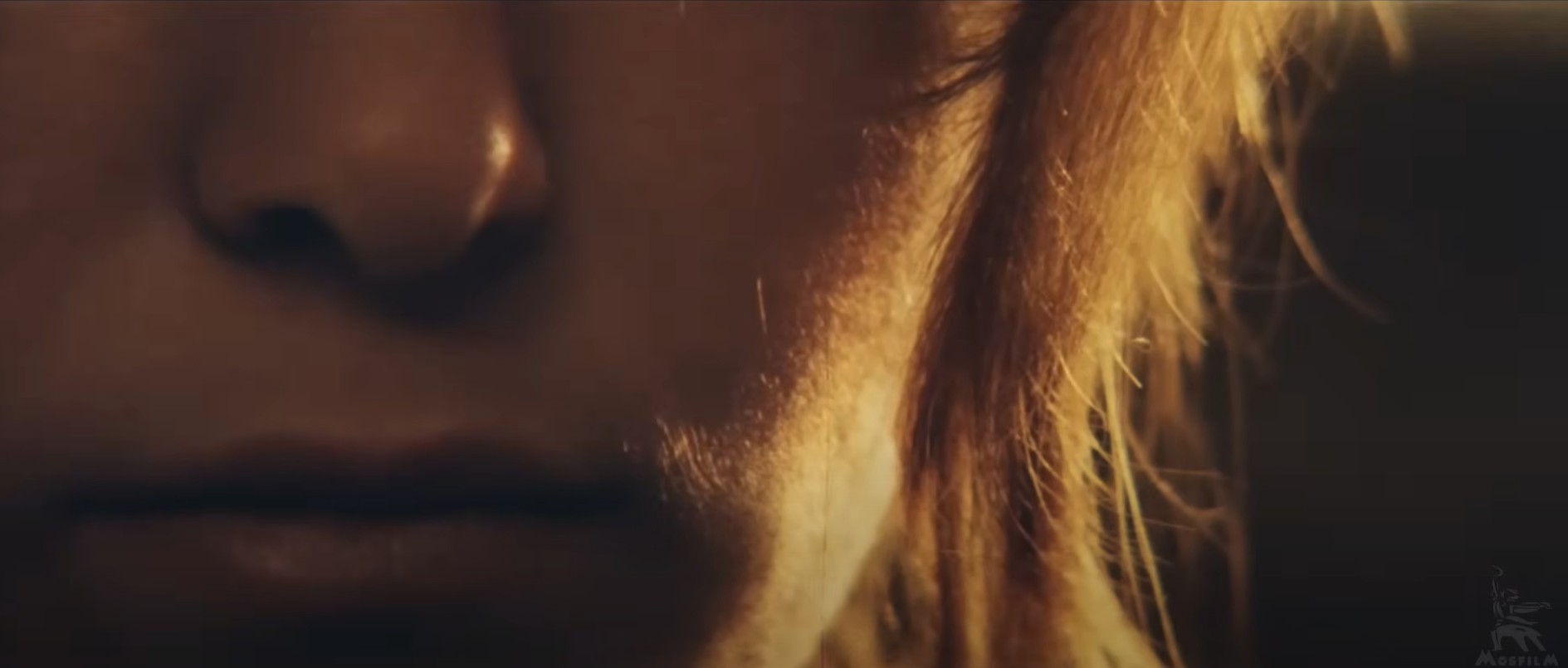
Close up of Hari, Solaris. Screen capture Mosfilm, Fair Use
It leaves you almost speechless. Certainly readers have been bombarded. Every article, interview, story, every exhibition of paintings is worthy of being examined with close attention.
In particular, we had wonderful contributions from the Art Editor, Paul Halas; the Food Editor, Arun Kapil; the International and Poetry Editor, Sudeep Sen; and the Editor for Latin America, Ulises Olivares Paniagua.
This month we exhibited the work of the wonderful artists: Bing Shi and Gordon Lidl. Bing Shi has just had an exhibition of drawings and paintings, “Drawn to Dance,” at the Royal Birmingham Society of Artists (RBSA) Gallery. Paul Halas and Phil Hall interviewed him.
Gordon Lidl wrote a masterful exposition on the Jevons Paradox, which he relates to Marxist ideas of overproduction to illustrate his ideas. He has produced a large painting titled The Jevons Paradox from his series The Sixth Extinction. His painting is both moving and illuminating.
Within the scope of Ulises Paniagua’s upcoming colloquium on philosophy and poetry, we publish an essay by the well-known Mexican author Óscar de la Borbolla on his relationship with language and his love of photography. He dedicates the essay to Beatriz Escalante.
We also publish in this issue two short stories by Beatriz Escalante that stay with you, that linger.
Sudeep Sen opens with his reflections from the Himalayas, “Mountain Wedding.” He was invited to a wedding in Almora and sent us a photo essay that finishes with a view of the mountains. Mont Blanc, filled with burgundy ink, Sudeep writes down his thoughts for us.
Presented by Sudeep, Ananya Vajpeyi contributes an essay from her work-in-progress, Place: Intimate Encounters with Cities.
We publish also a translation of prose poems by the great Bulgarian poet Geo Milev, translated carefully and effectively by Tom Phillips. And I’m sure we’re grateful for his introduction to the poet, and for filling this gap for those who have not encountered him.
Sudeep Sen has also provided Ars Notoria with an excerpt from Beena Kamlani’s debut novel, The English Problem: the first impressions of a young man arriving in London in 1931.
The valiant Ajay Jain gives us an extract from his book Charlie’s Boys, his memoir of his time at St. Columba’s School in New Delhi in the 1970s and 80s, a school famous throughout India.
S.B. Easwaran writes five poems, two of which are dedicated to David Lynch.
Yogesh Patel, the former literary editor of Ars Notoria, contributes a mind-expanding story called “A Spinning Coin of Dhūrtākhyāna.” This isn’t magical realism; it’s more like the experience of magical symbolism. Reading it is to experience elevation.
Arun Kapil fires us off—he writes about the high-voltage combination of fruit and spice so beloved of countries like Mexico, India, and Thailand, in “The Voltage of Fresh: Why Fruit Needs Fire“.
Adele Darwish, veteran reporter at Number 10 and lover of old Alexandria, argues that the Ramleh Tram carries the lifeblood of Alexandria and that it shouldn’t be abolished.
This month we met and interviewed the veteran political activist and speaker at Hyde Park Corner, known to everyone on the left, Heiko Khoo, who tells us what he thinks of Palantir and imperialism. The interview was conducted by Phil Hall, Paul Halas and Gordon Lidl.
As usual, Richard Steinhardt sails close to the edge. In one article, “The Road to Greater Khorasan,” he argues that the likely outcome of the war against Iran by Israel and the United States is a greater Khorasan, a united Persian sphere. He contends in another article, “Hassabis and DeepMind are Gaming out the Iran War for the US Epstein Class,” that in the war against Iran, the USA is allowing computers to trump decisions made by human beings: Reliably provocative, he also writes on “The Continuing US Attack on Indian Non-Alignment” and about “The Mysterious Death Wish of the Western Ruling Class“.
Norman Schwartz gives a masterful description of the life of Charlie Chaplin in “Little Tramp / Rich Man,” examining his behaviour and his politics, illuminating a great man alongside the contrasting career of Stan Laurel.
Phil Hall discusses the work of science fiction writers, and in particular the work of Stanislaw Lem and Andrei Tarkovsky and the film Solaris, arguing that Lem and Tarkovsky’s vision was warm and human. He also critiques, as a linguist and political activist, the legacy of Noam Chomsky. In another article, “Lebanon Envy,” he writes of Israel’s ‘ersatz’ Semitism and Lebanon as it was, and as we hope it will be again.
We are also very pleased to publish the inspiring Chilean poet Gustavo Gac-Artigas, affectionately and professionally translated by his wife, the respected academic, Priscilla Gac-Artigas.
And an astoundingly insightful article about the current state of the USA by Dustin Pickering, titled “The Racial Resentment of the White Caliban“.
The affecting, mastery of two prose poems by Ewa Lipska, have been translated by Richard Reisner and are gloriously illustrated by Sebastian Kudas.
From the perspective of the humane socialist, Phil Hall writes “A Letter to the Apolitical You, Rudi“.
David Yip contributes the continuation of his memoirs of growing up and becoming an accomplished chef: “7. Never Again!”.
And finally, we are delighted to include the New Malden Writers in this issue. Every Friday at 11am, Wesley’s Café at the Methodist Church in New Malden fills with the sound of conversation and recitation. Pages turn. The New Malden Writers’ Group, established in 2023, has no entry requirements, no gatekeepers, no hierarchy. They sit in a circle and take turns reading. They listen. This is how writing begins for most of us: not with publication, not with acclaim, but with the terrifying act of offering words to another person and waiting for their response. The group meets for two hours. Tea is drunk. Encouragement is given. The work continues.
We include the poems of Patrick McManus, John Grant, Tom Frank, Karl Rutlidge and Phil Hall. If you are in New Malden on a Friday, the door is open. Bring something to read. Or just bring yourself. The New Malden Writers will be there:
March 2026
Discover more from Ars Notoria
Subscribe to get the latest posts sent to your email.


