
Beatriz Escalante. Photograph courtesy of Beatriz Escalante
We are delighted to present two captivating short stories by the acclaimed Mexican writer, Beatriz Escalante. A prolific author of over thirty books, Escalante’s work has been recognised and celebrated internationally. Noteworthy books include: Fábula de la inmortalidad and Cómo ser mujer y no vivir en el infierno. They have been reissued by Editorial Porrúa, and her place is cemented into contemporary Latin American literature. Beyond her fiction, she is a highly respected educator, having created the renowned Escalante Method for writing and orthography. An Ambassador of Peace and a recipient of an honorary doctorate for her distinguished career, Escalante is considered by international critics to be one of the most interesting novelists in Latin America. It is an honour for us at Ars Notoria to be able present two glimpses into her narrative world translated into English: Last Minute Shopping and The Painter and His Model.
Ulises Paniagua Olivares
Last Minute Shopping

SuperShopper. Photograph Ellie Burgin on Pexels.com
It was with more of a desire for vengeance than pleasure that Señora Velazquez approached the SuperShopper. She left her People Carrier in the public parking lot, certain now that she was heading towards somewhere even more public. But when, awkwardly, she had slipped inside the promised ‘palace of pleasure’, all she saw inside were shelves full of tins, fresh groceries at the counter, and a cash register, behind which was a large mirror that reflected a resentful, mature woman from Puebla. She saw herself.
She looked at her face. Drops of sweat fought to escape the thick make-up. And her stomach – which she had never rewarded with plastic surgery despite seven pregnancies – looked larger than her bum, once upon a time so firm and pretty. Not to mention her breasts, which had fallen as low as her spirits. That was the worst.
The angry gesture of going to Mexico City – in Puebla there were no businesses where you could get this kind of revenge – was the result of finding out that her husband (much older and more decrepit than she) had a mistress. The girl hadn’t even been born when she began forgiving Mr Velazquez for his ‘weaknesses of the flesh’.
Ashamed, but uncomplaining, she had washed away the different coloured traces of other lips from his shirts so that Lupe, the maid servant, wouldn’t see them. She had pretended to be short-sighted and idiotic in the vain hope that this would bring her the decent tranquillity that she so longed for; but it was precisely the ageing process that caused her husband to find it too tiring to travel to and fro from Mexico City, so he set up a little love nest for his bit-on-the-side, on the outskirts of Puebla.
“Is there anything particular you are looking for? If there is anything you want you don’t see, just say so,” said the cashier, with the unctuousness of a Father Christmas for adults.
“Well, yes, actually,” Señora Velazquez said in embarrassment. “They told me that…”
“Normal service? We have massages and Roman baths. Credit card or cash?”
“Don’t ask so many questions. I’ll change my mind.”
“Of course not! Come with me,” said the cashier, taking her by the arm in a gesture so reassuring that it she could have been a granddaughter.
Behind the shop, it looked like a sports club. There was a steam bath and a waiting room with a TV and parabolic antenna. The first thing Señora Velazquez saw was a photo album serving as a catalogue. Then there was a room decorated in a modern style, like a luxury hotel; décor as welcoming as you could hope for in your own home.
At least there are no mirrors, she thought, staring at the bed, which was inexplicably respectable; as if it were really there just to welcome tired bodies in to rest and sleep. To her relief, the boy in the photo wasn’t lying there naked in the bed, wriggling his tongue, his finger beckoning, inviting her to come closer.
“Hello,” a man’s voice sounded. “Would you like to join me in the bath?” It sounded sensual, pleading.
Señora Velazquez shot him a glance, quick and full of curiosity. The voice didn’t match the picture. The boy didn’t match the picture. He didn’t have muscles and he wasn’t good-looking. He didn’t even have the same skin colour as the photo. He was very white. So pale, in fact, that it was clear that the only beach-bronzing sunlight he ever encountered was in a cinema.
“We can start when you want,” he said impatiently.
“First of all, a little more respect. Don’t use that familiar tone with me,” Señora Velazquez said, daringly. “And second. My God, you’re the age of my youngest son. You should be at school. Why are you doing this?”
“For the money,” he said dryly.
Señora Velazquez found the answer, exact and truthful as it was, hurtful. While she thought through her feelings in silence, he took off his shoes, his trousers and his shirt and, wearing a minuscule thong, he stretched out on the bed and began to smoke.
“Do you want me to undress you? Shall I turn out the light? I am here to please you.”
Without lifting up her blushing face to look at him, Señora Velazquez grabbed a chair and sat at the foot of the bed in the attitude of someone visiting a patient.
“Cover yourself up with the sheet,” she said.
“Would you like to undress me? Just say. Did you want to undress me? Shall I get dressed? It’s all the same to me.”
With the same condescending sweetness she used when volunteering to teach religion to indigenous women recently arrived in Puebla, Señora Velazquez lectured him on good and evil and on the dangers that lay on the path ahead, and on the pain he would cause his poor mother if she ever found out.
Fastidiously, without being impatient, he pretended to listen. First he remembered the words to a song. Then he visualised his girlfriend’s body. Then he thought of the law exam he had to sit the next day.
Señora Velazquez’s voice, which he considered senile and monotonous, wandered down the passages of his mind until it seemed to meld with other voices that – it felt to him – were all paid to give advice.
Earning money wasn’t easy. Some women, instead of talking, preferred to hear a thousand times how beautiful they were, how loved and irreplaceable. Others just demanded immediate satisfaction and the completion of the service they had purchased.
On leaving, Señora Velazquez was disconcerted when the cashier handed her bags full of shopping and suggested that she bring a list of what she wanted next time so that they could make sure her she got all she needed.
No one looking at it would ever suspect what was going on at the Super. The world was full of mysteries. Most incomprehensible of all, Señora Velazquez couldn’t understand how it was that her husband resisted the redeeming instinct every time he found himself in similar circumstances; how he resisted the desire to rescue one’s fellow man. In his case, one’s fellow woman.
The Painter and his Model

She was one of those women who have their anus ─not their mouth─ under their nose. Photo by Alexander Krivitskiy on Pexels.com
She was one of those women who have their anus ─not their mouth─ under their nose, judging by her permanent expression of displeasure. She wasn’t a person: she was a kind of consequence: the product of cosmetology, plastic surgery, and the latest innovations in liposuction. She didn’t measure her time in years of life but in hours of massage. And, except for her tonsils and appendix, every centimeter of her body had known some type of repair with a scalpel and medical science. She had no moles, freckles, spots, or hairs. Nor the last floating ribs. She was as artificial as the blue face of one of Picasso’s Las Meninas. Her gaze was empty and transparent, like an unused glass bottle. It never occurred to her that beyond the tips of her silky hair there might be another person, because, no matter where she was: in a bank line, or in the center of a full elevator, she would toss her little head with the same unconsciousness with which dogs shake off rainwater.
Apparently, she was of a solitary temperament, as she showed no pleasure in encountering anyone. I came to think that only encounters with herself made her happy. Every time she passed in front of a mirror, she performed the exceptional task of relaxing her lips to produce that same gesture of approval and pride that we imagine Michelangelo made upon finishing his monumental Moses.
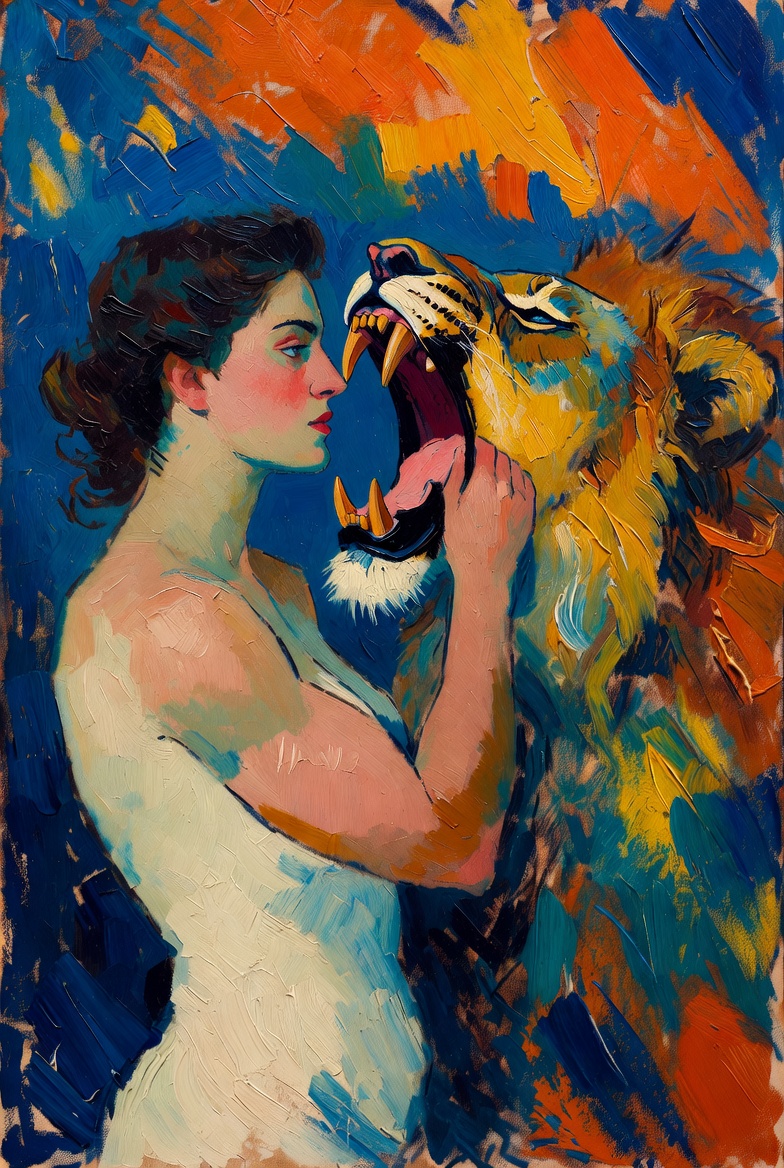
I, I must confess, was captivated by her. Admiration for that kind of specimen in whom unreality and beauty mix is one of my weaknesses. Just to watch her, I started coming to the club. I, who have hated exercise almost as much as bureaucratic procedures or dentists’ waiting rooms; I, who was going to sell the share with which that damned restaurateur paid me for my best still life instead of giving me the cash, spend my time here, dressed in a sweatshirt and sweatpants, every day. As the weeks went by ─so as not to draw the attention of members or trainers─ I started running. Really, I haven’t always been the type of person who attracts glances: I have moved through the world with the discretion of the plants and pots in public offices. But, since it’s part of the trainers’ job to inform new members about how all those cardiovascular and aerobic machines work, I couldn’t escape. With the pleasure that comes from treating an adult like an idiot, they explained to me how to turn on a stair climber, how to set my weight in pounds, how to obsess over calories. Without realizing it, it happened: one morning I found myself throwing one after another of all my pants onto the sofa in my apartment: the concentration of fat on my stomach, buttocks, and legs had disappeared. I looked at myself in the mirror: I was no longer one of Botero’s fat women; I wasn’t yet like Dali’s most beautiful Gala; but, for the first time in my life, my body was something that could well be exhibited without shame, so I dedicated myself to showing it off naked in the steam room or in very tight leotards and bodysuits all around the club.
She spent the entire day at the gym: when she wasn’t playing squash, or in the massage room, she was climbing a rope or lifting weights. I also started spending the entire day there. I had finished the covers for the books the publisher had commissioned and, except for a seascape painting that a psychologist wanted to decorate the waiting room of his new office with, I had no work. It was then that I began making sketches: outlines of her on the stationary bike, or rowing on a machine. Since my idea for this series of drawings had nothing to do with sports, but with the female nude, I preferred to take brief, quick sketches of her body when she lay down in the sauna. What amazed me most about her was her texture: she had managed to eradicate from her appearance the last vestige of the errors and irregularities with which nature had sent her into the world.
I was going through a stage of dehydration of ideas, a drop in inspiration mixed with that kind of economic need that forces a painter to think more about the price of charcoals and canvas than about the subject they wish to capture. I ate less and also worked with less enthusiasm. Sometimes, to stay close to her, I feigned interest in what the other women were saying. I learned about treatments to make hair silky; I replaced the razor with wax; I learned about the properties of mother-of-pearl and tepezcohuite for eliminating sunspots: my skin began to acquire the smoothness and pallor of the phantasmagorical women painted by Delvaux.
The instructors have become very friendly with me: they teach me routines and even accompany me while I do the exercises; they help me lift my legs and tell me they like the figure I’m developing. I’m not sure, but I suppose because we were always in the same area, one of the towel girls once confused me with her. Really, I don’t follow her anymore. Lately I spend many hours in the studio and the gallery. I have decided not to paint seascapes or still lifes anymore. Finally, tonight the exhibition of my drawings opens, female nudes, which I unexpectedly decided to call Self-Portraits.
Discover more from Ars Notoria
Subscribe to get the latest posts sent to your email.


Comment
Comments are closed.