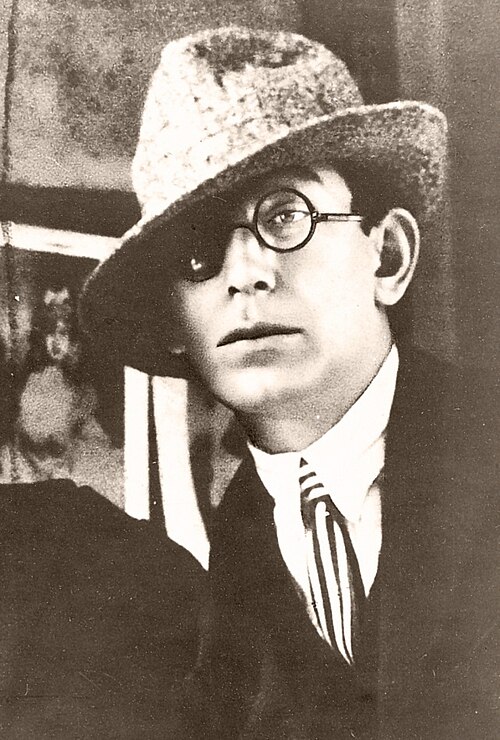
Bulgarian poet Geo Milev (1895-1925). Photographer unknown
Introduced & Translated from the Bulgarian into English by Tom Phillips
Geo Milev (1895-1925) was a poet, translator, critic, editor and activist who introduced a radical modernist strain into Bulgarian literature. Equally radical in his politics, he was extra-judicially executed during a round-up of communist and anarchist revolutionaries that followed a failed attempt to assassinate Tsar Boris III of Bulgaria in which he was not involved.
Tom Edward Phillips is a UK-born poet and translator living in Bulgaria where he teaches creative writing and translation at Sofia University St Kliment Ohridski. In addition to Once There Was Spring, Worple Press’s collection of his translations of Geo Milev, he has translated and published a wide range of contemporary Bulgarian poetry and is about to publish his second book of poetry written in Bulgarian, Self-portrait with Tobacco Moustache, with DA Poetry publishing house.
Sudeep Sen
Geo Milev: Symbolism, Expressionism, Politics
Tom Phillips introduces excerpts from his translations of the Bulgarian writer and cultural activist Geo Milev who was extra-judicially executed in 1925
Despite its brevity, Geo Milev’s life was an extraordinarily productive one. The translations of all his mature poems and prose poems published in the 2025 Worple Press volume Once There Was Spring may only run to 125 pages, but the Bulgarian poet, translator, critic, editor and artist produced a huge body of other work, including essays, prologues, profiles, literary criticism, reviews, translations, letters, poems for children and paintings. In all, his writings fill five generous volumes in a collected works published by Sofia’s Zahary Stoyanov publishing house, many of them produced in a period of frenetic creative activity that began with his return to Bulgaria after the First World War and ended with his ‘disappearance’ at the age of 30.
Even from an early age, Milev instinctively rebelled against social and cultural conservatism, on the one hand, and political injustice and oppression, on the other. A satirical anti-monarchical cartoon preserved on the back of a wardrobe door in his former family home in Stara Zagora – now the Geo Milev House-Museum – exemplifies a youthful desire to kick against the pricks.
As a young writer, he directed much of his scorn at what he considered to be the tedious naturalism of most of his immediate predecessors and peers in Bulgaria. For Milev, these writers – with a few notable exceptions such as Peyo Yavorov – misunderstood art’s true purpose and failed to explore what he referred to as ‘the modern soul’. For him, the French, Belgian and German poets identified with Symbolism were the only ones to get close to doing so, although, as his own writing developed, the branch of Modernism known as Expressionism came to have a greater influence. Everyone else was not so much barking up the wrong tree as not even barking at all, merely whimpering through ironic half-smiles.
Milev’s first volume of poetry, The Cruel Ring, appeared in 1920 and travels across recognisably Symbolist terrain. Bracketed by poems concerning Wagnerian heroes – Parsifal and Lohengrin, respectively – it documents the emotional and psychological symptoms of the repression and hypocrisy that Milev identifies with bourgeois social convention and self-censorship or the eponymous ‘ring – with you a ring inside it’. These are poems of ‘long-drawn-out despair’, of a ‘reality savage, absurd, supreme’ that ‘passes judgement with haughty gentility’, of rain beating down on ‘the city’s black sepulchre’ and of a moon ‘deathly green’. At the same time, however, they are poems of wild imaginings: conquistadors sail off on colonialist escapades; the ‘wrathful Earth’ threatens to devour the ashes of religious ascetics who ignore the ‘feast, all guests invited’ the natural world offers; there’s a late-night meeting with the Devil and a ‘Fabulous Interlude’ in an equally fabulous China which culminates in a vision of a ‘murderous Diamond’ and a burning palace. The book seethes with Baudelairean spleen – one poem even ends with that very word – but also with desire, yearning and sexual repression.
The Cruel Ring also includes the only poem – other than the prose poem sequence ‘By Doiran Lake’ – that directly refers to Milev’s experiences on the Macedonian front in the First World War. It was here, in April 1917, that he was severely wounded during a British artillery bombardment of Bulgarian lines and was sent to Berlin for a series of complicated operations to reconstruct his shattered skull. Milev lost an eye as a result and would not return to Bulgaria for nearly two years, witnessing both the defeat of Germany – which, despite having fought on the German side, he wasn’t sorry to see – and the 1919 Spartacus uprising while he underwent treatment to restore, in the words of the poem, ‘My head/a bloody lantern with broken glass/lost on midnight fields/in wind and rain and fog’.
The publication of The Cruel Ring heralded the beginning of an astonishingly prolific five-year period during which saw him move away from Symbolism towards Expressionism and outspoken political wrath. Two long poems, ‘The Icons are Sleeping’ and ‘Requiem for the poet P.K. Yavarov’, are emblematic of the transition. Both take conventional sources – Bulgarian folk songs in the first instance and the traditional Bulgarian Orthodox panikhida or funeral liturgy in the second – but invest them with a distinctively Modernist Milevian energy. The fifth and final part of ‘The Icons are Sleeping’ ends:
Oh, gentle milk of the suckling earth
– water unfeeling –
my heart’s
only blood
my blood’s own mad flood
unleashed
– and –
how serenely it’ll freeze
in burning wastes
of souls by bitter passion burnt
each
crystal-clear dispassionate
drop:
oh, gentle pearl of peace,
cold alabaster of reconciliation.
The requiem, likewise, incorporates rhythmic and sonic effects that stray some distance from the solemnities of the Old Church Slavonic liturgy used in the Bulgarian Orthodox church:
And here
behind dark veils
purls your voice again.
– Ready, Lord: here: ready – my heart:
I glorify and sing!
(The green poison’s drunk that’s hidden in the breast
and within it –
lead.)
But the word was God.
And they fell
to the left of you thousands
to the right of you – countless:
unassailable as thou art.
– Holy Ghost!
Thy elect
Come!
Grant them rest! –
Two other major poems followed. Written in 1922, ‘Hell’ is the first section of a putative nine-part reimagining of Dante’s Inferno for the modern age that Milev didn’t complete, while the much longer ‘September’ from 1924 tells the story of the 1923 Bulgarian uprising against a right-wing military government that was violently suppressed. In both, Milev’s anarcho-communist sympathies are more than clear, but so too is his interest in radical aesthetics. These are poems that deploy unconventional rhythmic patterns and sound sequences that give them an unusual and to English-language readers unfamiliarly harsh vigour. The third part of Milev’s ‘Hell’ begins:
Dark powers,
deep powers –
there:
force;
moral powers,
mortal powers –
flare:
maw.
Curses, muttering
and through the torment gleams
a righteous faith at peace.
and culminates in a vertical line of the letter ‘r’ repeated down the entire left-hand margin of the page.
The episodic narrative of ‘September’, meanwhile, concludes with a lengthy allusion to the Trojan war and a passionate cri de coeur that enfolds the basic tenet of anarchism – No gods! No masters! – within an essentially Utopian hope of Heaven on earth:
Everything poets, philosophers wrote
will come true!
– No gods! No masters!
September will be May.
Human life
will be an endless ascent
– higher and higher!
E a r t h s h a l l b e H e a v e n –
it shall!
Although some of Milev’s prose poems map similar emotional and psychological landscapes to the poems in The Cruel Ring, others document – albeit in a fragmentary and occasionally hallucinatory style – the social and political upheavals across Europe in the early twentieth century, beginning with the First World War (‘By Doiran Lake’) and then into its aftermath (‘Ugly Prose’, ‘Expressionist Calendar for 1921’, ‘May’, ‘Apocalypse’).
With its unsparing descriptions of life and death on the Macedonian front, ‘By Doiran Lake’ nevertheless presents moments of humanity that are all the more stark for their appearance alongside murderous shock troops, equally murderous artillery and machine gun fire, the devastation and grim realities of war. The subsequent pieces focus on leftwing workers’ uprisings and their bloody repression and, as such, could be seen as forerunners to or even trial runs for the epic wrath at the Bulgarian military government’s brutal suppression of a popular uprising expressed in ‘September’. They could also be seen as mere rhetoric or anarchist propaganda were it not that even Milev’s most engagé works are imbued with his essentially adventurous poetic sensibility as well as with his ongoing formal and linguistic experimentation. The Symbolist excess of his early writings is repurposed via Expressionism in the service of his increasingly firm and outspoken leftwing convictions – the final section of ‘Ugly Prose’, in which a wounded worker substitutes for Christ crucified, being a case in point. Unlike other notable Modernists – D’Annunzio, Wyndham Lewis, Ezra Pound and so on – Milev was not drawn towards the political right and, although not an orthodox Marxist, he remains among the few (outside the USSR, at least) who explored ways in which to pursue a furious radicalism in politics and aesthetics alike.
It was, however, Milev’s vociferous critique of Bulgaria’s increasingly right-wing governments that finally led to his ‘disappearance’. This occurred during the widespread reprisals that followed a failed communist attempt to assassinate the Bulgarian Tsar Boris III by blowing up Sofia’s St Nedelya Church during the funeral of general Konstantin Georgiev in 1925 (an attempt that failed because the tsar was elsewhere, attending the funeral of the victims of another communist attack). As it happens, Milev had nothing to do with the bombing of St Nedelya and his ‘crime’ appears to have been both the publication of his rousing anti-authoritarian poem ‘September’ the year before and his agreement to meet a delegation of the British Labour Party investigating allegations of atrocities committed by the fascistic Bulgarian regime. As documents appended to his collected works indicate, his whereabouts after his having been taken from his home in May 1925 remain unknown, but it seems likely that he was interrogated, tortured and then garrotted along with hundreds of other suspected left-wing sympathisers. Nearly thirty years later, his remains were identified – thanks to his glass eye – among those of others who’d been buried in a mass grave on the outskirts of Sofia.
The texts below include excerpts from my translations of three of Milev’s key prose poem sequences that appear in Once There Was Spring and are republished here with the kind permission of Worple Press as well as four newly translated texts: an extract from a letter to the Belgian Symbolist poet Émile Verhaeren concerning German militarism and Milev’s arrest in Hamburg on charges of espionage shortly after the start of the First World War; an extract from a letter regarding the putative collectivisation of the radical publishing house Libra; an article from Flame, the outspoken anti-establishment literary journal he edited during the last years of his life, about Labour Day and working class solidarity that may or may not have contributed to his subsequent arrest and extrajudicial execution; and part of the written defence of his poem ‘September’ that he submitted to the Sofia District Court in response to a charge of criminal activity on the day before his ‘disappearance’.
From By Doiran Lake
14
Drumfire. Ceaseless all day. The concrete vault above our heads trembles. All day. Right up until the sun disappears somewhere beneath the clouds looming over the Vardar river. Surely the enemy will advance on our positions during the night. The soldiers were already in the trenches, us still with the commander in the passageway, when suddenly the enemy renewed their drumfire with an even greater wrath. Only for a few minutes, and then through the universal rumbling came the ragged clamour of rifles and machine-guns. Here it comes. And suddenly the reserves are plunging through the passageway. Red-faced and noisy. Cheerful, fearless. Any timidity in the face of whatever unknown fate awaits us disappears. You feel that each and every one of these tough, grim people who push roughly past you is a knife, is many knives, is entirely covered in knives, that in a moment all of them would become a wall of knives that no enemy could break through. Men of the knife. Who, like a powerful wave, lift up the frontline troops and carry them forward in a headlong attack. The knife: cold and gleaming like the gaze of a snake. To make foes afraid.
15
One time the night was suddenly lit up by a bloody midnight glow. The sky was red glowing copper, throwing bloody glints onto the surrounding peaks. Doiran was burning. Set alight by enemy shells. Innumerable flames raised high their clamorous tongues: ‘Us! Us! Us!’ – over and over. Now the town is perfectly dead. It resembles a pile of white skulls with hollow, yawning black eyes. And when, after their long, involuntary wandering, the now exiled people of this town – the fishermen – one day return to their native ash heap – yes, ash heap – it will be as a procession of broken-hearted crying women and impotent men. We were! … It was! … Fuimus Troes, fuit Troia! Dignified human grief at all this desolation. It will be like that. Just as on my native ash heap forty years ago.
From Ugly Prose
Marseillaise
The end. Crushed revolution. In the last district the last soldiers are surrounded. Barricaded inside the great building of the newspaper Red Flag.
A large red flag, raised above the roof, still shows and proudly sways in the howling winter air. The last flag. High above the last struggle.
Then, in other parts of the city, the old life flows once again through the old streets, squares and markets, with its dull, variegated sounds: omnibuses, trams, carriages, merchants forever rushing and sweaty stock market traders, perfumed women with lapdogs, servants with hampers, pen-pushers, pram-pushers, postmen laden with letters.
Here comes the dreadful finale. The final end. In the final district.
Overnight soldiers from the National Guard surrounded the Red Flag’s editorial office. The fusillade started at dawn. A few machine guns rattled desperately into the streets and courtyards from the red building’s windows.
Chr –
chchchch – –
RRRRR – – –
The National Guard’s mortars and grenade-launchers unleashed an unending barrage of shells onto the building. Tiles, bricks and cement blocks fell with a crash. The windows of neighbouring houses jangled in alarm. The whole great building of the Red Flag newspaper was bursting open, rocked by the endlessly exploding shells. The machine guns fell silent. Everything fell silent.
The smoke from the fusillade mixed with the greenish smoke of choking gas that floated in a dense cloud above the collapsing building. Now those left alive would have to start jumping out through the smashed windows on the upper floors and run across the rooftops of neighbouring houses.
Crushed revolution. Total silence.
And in that moment of stifling silence – somewhere from a nearby park – came the sound of a barrel-organ (with parakeets and white mice, surrounded by a throng of curious children) – the wafting sound of a barrel-organ playing the fearless beat of The Marseillaise.
Machine guns rattled furiously after the last revolutionaries fleeing across the rooftops. In the other – already calm – parts of the city, the government’s latest announcement – cruel and soothing – was being pasted up, pronouncing the end of the revolution.
But – in its defiant ignorance – the barrel-organ played its usual tune – The Marseillaise.
From Expressionist Calendar for 1921
October
The wide boulevard shoots deep into the endless suburbs.
The noisy boulevard dies in a moment – deserted – stupefied deep in the foggy, endless suburbs. One after another, dark men with guns slowly advance along both sides of the distant boulevard. Abandoned trams and cars stand, petrified, on the deserted boulevard and watch with wide, blank eyes. And, with a thunderclap, the heavy shutters rapidly fall over the big shop doorways. The curious faces of sweet servant-girls timidly peer from the windows of the upper storeys.
Far off, on the foggy endless wide boulevard, a huge wave of dark figures runs – lit by the golden radiance of autumn trees.
Somewhere the teeth of the dreadful machine guns clatter.
Somewhere monocles and binoculars watch the gaudy jockeys in a race; bitter curiosity; Bucephalus or Adler? The sky begins to weep. By the racetrack entrance, destitute women and blind men sell matches, cigarettes, pencils and chestnuts. Among them one blind man in faded soldier’s uniform proffers a straw hat with a frozen broken hand.
Somewhere shots are heard.
The wide boulevard is lost in the foggy endless suburbs that send in their dark figures.
Autumn gilds them.
Extract from a letter to Émile Verhaeren in Paris, sent from Stara Zagora on 3 February 1915:
Four months ago when I was with you in London, I didn’t realise, so to speak, the immeasurable misery that has overwhelmed Belgium: and I needed to be in Germany, in Berlin etc to see without doubt, with sure eyes, that in this country there are truly hellish forces that are capable or are at least ready to throw the whole world into misery, a misery similar to that of Flanders. Yes, at the present moment, in time of war, anyone in Germany can understand much better, exceptionally – what’s called ‘German militarism’. During a three-year stay in Germany, I heard it being spoken of, I saw its not especially pleasant stamp, but only after a certain time did I see it in its own image, only after a certain time did I see that the difference between the ‘two Germanies’ is greater than can be believed; the two Germanies, that is Germany – this one, and Germany – that one; the Germany of the three or four poets, three or four artists that we love, and Germany – that one, yes, that one in the smokescreen of patriotism, monarchism, militarism, Schutsmanism, kaiser fetishism etc. This Germany – it can be seen, recognised (and I sensed it, as I had to, when I was held for eleven days in the police prison in Hamburg, suspected – in a typically Prussian and barbaric fashion – as having been …. an English spy etc.) – As I say: this Germany can be seen and – without doubt – she should be hated, she should be crushed! We believe – of course – in the words of Jesus Christ, we always lived with his love, with divine stupidity, the divinity of Christ, the greatest madman the world has seen (I always call him that) – and because of all that: we tremble in the nobility of raw hatred, wild loathing. Us – the Bulgarians, us – me and our Bulgarian friends, poets, artists and many, many others.
Extract from a letter to Kiril Kractev in Yambol, sent from Sofia 25 June 1922
The idea of transforming the existing Libra publishing house with its base in Sofia into the Libra cooperative association with a base in Sofia is bearing fruit among the existing group of Libra collaborators. The immediate goal of this transformation is:
1. To increase publishing capital.
2. To make closer connections between writer, reader and publisher by creating a common organisation of those people in Bulgaria who cherish and care about beautiful and meaningful Bulgarian books.
In this way we are aiming to organise a book-publishing business which will enable the all good intentions that until now have been and remain only intentions because of the greater resources needed: so that, for example, it will make possible for Libra magazine to be relaunched for the first time, in the style of its first year, but even more beautiful (with monochrome and colour illustrations), something which – as has been ascertained – is a deeply held and living desire of serious Bulgarian writers. Along with the magazine, the publication of valued and exquisite-looking books (translations and originals) will be made possible with the collaboration pf everyone who has taken part in Libra over the course of three years so far. These are the common guiding motives in the development and implementation of the idea for Libra cooperative association.
The founding meeting to lay out official statutes is forthcoming, after which the subscription list to sign up for shares will be opened.
Shares will be 50 leva. For the subscription list for shares, we will appeal to all Libra’s writers and like-minded people because, as is said above, the goal is to create an organisation of readers, writers and publishers, i.e. by readers becoming their own publishers, we will appeal to everyone who sympathises with this idea to contribute as much as they can and like to – one share (of 50 leva) will be both useful and give right of membership to the cooperative. The members will be entitled to a special right – a discount on publications.
The First of May
Labour Day, when working people throughout the world wave their red celebratory flags – the one and only holiday for those who spend the whole year in mundane toil; those who do the whole world’s dirty work; those who feed and heat the world, who beat the iron, turn the machines, dig up black coal, hew the hard stone of thought.
The first of May celebrates belief in humanity and in the future of humanity. The first of May celebrates the passion for justice and happiness in the world, beneath labour’s sun. The first of May is a holiday against indolence. The first of May is a holiday against theft. The first of May is freedom’s holiday. The first of May celebrates heightened consciousness of the will. The first of May celebrates the unity and fraternity between all peoples – the whole of humanity.
The first of May is a universal celebration of humanity.
Labour Day is the people’s holiday. Because the people is everyone who toils, who works. The people – and consequently humanity. And so it is with the Bulgarian people: the people is that entire mass who stand oppressed by the yoke of toil; those who are not the people, who stand outside the people are all those – avariciously set on gaining wealth by legitimised theft – reserve for themselves the privilege of representing the Bulgarian nation; those few hundred who, through the power of capital and power, oppress five million Bulgarian people, the masses, beneath the yoke of toil; those who steal every right, freedom and wealth for themselves, those who select and maintain on the throne of power their own ministers and rulers – rulers of the Bulgarian nation which means: zealous defenders of the few hundred and the ever more zealous upholders of the oppression of the people beneath the yoke of toil.
This state of things is clear – today’s social position. Even today, when the tyranny of toil legislates with regard to the people with all the bloody impudence of the new fascist practices.
But this cannot kill our belief in the future of humanity, kill the consciousness of the will of the working masses – the will for universal freedom, lit up by the nobility of labour.
Everyone who believes in the nobility of labour and in the true correct path of the people stands beneath the red flags of the Mayday holiday.
Flame stands beneath these flags, the flags of labour.
Because we believe only in one truth – the truth of the people. The rugged working people. Because there is only one truth – and it is in the people, the masses, the majority. The minority, the exception – they’re not entered on the roll of life. Humanity is collective. Humanity’s truth is in humanity itself, because life is lived by humanity. And the truth is a truth of life. And it means: freedom for the nobility of labour.
Flame – a journal of art and culture – knows that, above all, art and culture are labour; that art and culture, like all labour, will acquire their noble zenith only in the future century of freedom.
We stand beneath the flags on the Mayday holiday: the holiday of Labour, of Freedom, of the Future.
Extract from Milev’s written defence submitted to the Sofia District Court in response to the accusation that he had committed a criminal offence by publishing the poem ‘September’.
Independently of the above, my poem does not contain elements of a crime according to neither the old part 5 nor the new parts 7 and 19 (not applicable because new) of the Law for the Defence of the Nation. Not a word, a line, a passage of it justifies the creation of illegal organisations, glorifies terrorist activities, it merely describes, paints a picture of events that happened before the creation of this law – deplorable and tragic events which cannot be kept hidden from the gaze of a writer-artist and not attract his pen. And how this famous event is described depends on the artistic skill and capabilities of the author and falls outside the assessment of the courts and authorities. It is not possible to require an author, no matter how objective he is, to completely conceal his own feelings when painting a picture. One sees the things he is depicting in one light, another in a slightly different colour or nuance. Once described, the events cannot but evoke emotion in the writer. With my poem, however, I have nonetheless striven to and managed to not invest it with my feelings or ideas, but to describe, to depict the constituent elements of the conflict, the bloody cruelty of the struggles that developed, without having any other aim of passing judgement on events. The most that my pen might be charged with as a ‘sin’ is that it described a picture which might arouse sympathy in the reader for the victims of these bloody constituent elements and indignation at the cruel methods of combat. In a time of rancour, of fury, I described the events that happened, without pursuing specific goals. All that the account given should do is strike a chord of human sympathy in the reader; arouse disgust at the blood (‘Death and murder and blood! How long? How long?’); awaken hope that bloodshed will come to an end and that humanity and prosperity will set in (the end of the poem). But the fact that the picture stirs such feelings cannot be blamed on me, nor is it to my credit – this poem and the picture it depicts will not arouse identical feelings in everyone. It depends on the psychology, culture and character of the reader. Therefore ‘the goal’ that moved my pen is the normal ‘goal’ of every artistic production – to depict events, actions, feelings, thoughts (which aren’t the thoughts and feelings of the author, but of the characters), without worrying about the way in which this depiction will be perceived by different readers. Again the assessment of specific words, terms, images is subject to consideration, not by the criminal court, but only by literary criticism. The law shouldn’t and surely doesn’t want to involve itself in this ‘holy of holies’ of literary creativity, and would be a sorry curiosity in the history of national art, if it incriminates images such as those I have used in my poem. To a great extent, the selection of words happens unconsciously, in the process of creation, under the influence of the poet’s subconscious suggestions in the moment of inspiration. Can we speak then of intent in the judicial sense and also impute criminality to the selection of the words, images, methods, forms of description? In this case we have a poem which isn’t even lyrical and doesn’t express the feelings of the author, and much less his thoughts, ideas, judgements, approval or praise.
Your honours,
For the honour of Bulgarian justice, do not pronounce a guilty verdict because, with it, you would be striking a blow, a wound, a stain on national art and its development. Art flourishes only in the soil of freedom. Do not restrict a writer in order to kill art!
With respect,
14/5/1925
Discover more from Ars Notoria
Subscribe to get the latest posts sent to your email.


Comment
Comments are closed.