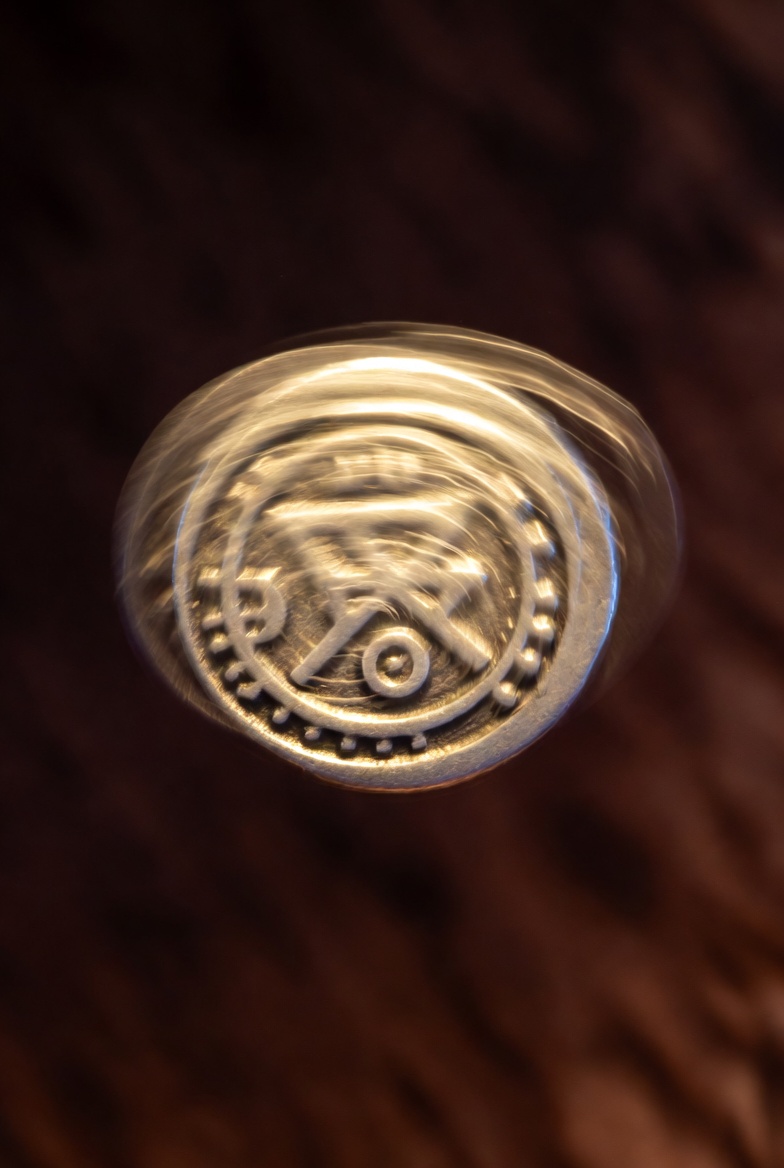
It did not spin like a normal coin, losing energy to the friction of the wood. It spun with a velocity that defied Newtonian physics, gaining momentum from the very air it displaced. Illustration WordPress
by Yogesh Patel
The penthouse was less a residence than a vaulted reliquary, a glass-and-steel carbuncle grafted onto the city’s tired shoulder. Inside, it held London at a distance: a captive reflection in its heart, untouched by the winking neon slogans or the relentless lash of North Sea rain. At this altitude, the metropolis lost its mechanical rataplan; it became a respirator, the rhythmic, collective exhale of eight million souls trapped in a damp, concrete basin, punctuated only by the thin distant car horn. Inside the apartment, the silence was not an absence of sound, but a managed artificial environment, a VdS Class III climate, controlled vacuum that smelled of expensive beeswax, cedarwood, and the dry, metallic tang of an ionized air-filtration system, present but not overwhelming.
Bram moved through the static dullness with the measured grace of a shadow crossing a sundial. He was not merely a thief; he was a curator of the rare artefacts that shouldn’t be in the hands of those who move in the darkness. He was a Robin Hood for himself. His Freet Barefoot, made of soft, sound-absorbent chamois, made no more noise on the polished mahogany than a pickpocket stealing one’s wallet. He paused in the foyer, counting the seconds of the security cycle he had memorized over six months of meticulous surveillance. He knew the heartbeat of this building better than the man who owned the deed.
His target was not hidden behind a gilt-framed painting or tucked into a hollowed-out floorboard; it was integrated into the very architecture of the library, a modular Cerberus-grade vault concealed behind a seamless veneer of 18th-century George III mahogany. The cabinet was a masterpiece of biometric role-play. On one hand, it performed the role of a polished George III heirloom, an aristocratic mask of Empire. On the other, it guarded a core of manganese steel, a material that, like the society it served, only grew harder the more it was struck. To breach it, Bram couldn’t just use force; he had to join the performance, using a haptic-thief’s rig to mimic the very truth the vault demanded. He knelt before the cabinet, his breath controlled, shallow, and disciplined. He placed the transducer against the wood. The device hummed, a low-frequency purr that mimicked the owner’s unique vascular signature. The safe yielded to his touch not with a mechanical click, but with a nearly imperceptible sigh, the sound of a long-held secret finally exhaled. The door, six inches of layered alloy, swung open with the silent, terrifying weight of a tomb door.
Inside, nested in a box of badara (बदर) wood, a thorn-tree timber as dark and stubborn as a knotted root, lay the Kshatriya Dramma. To the uninitiated, it looked like a crude, irregular shard of silver, but to Bram, it was a ghost, a legend whispered in the backrooms of auction houses but never seen in the light. It was an Indo-Sassanian Gadhaiya variant, a silver Kārṣāpaṇa struck during the Gurjara-Pratihara transition, but its markings were impossible. It was the unit of currency that had hollowed out the Greek Drachma by the third century, inhabiting its shell to become the Dramma, a medium for an insurrection that traded in heresy.
History dictated that such coins were mere geometric abstractions of fire-altars and bloated, stylised kingly busts. But this coin, minted during the apocryphal Rainy Season of the Great Lie in ancient Kanyakubja, was a radical departure. It had been struck in an era when a guild of sophists had briefly seized the mint to trade not in bullion, but in the perceived weight of a promissory note. They believed that if a lie could be made to circulate, it became the kākani, a copper denomination worth 1/16th of Kārṣāpaṇa.
Bram ran his thumb over the box. There, beneath a thin veneer of the badara wood, a single word was etched in a script that seemed to shift under the light: Dhūrtākhyāna. He had seen the reference only once, as a marginalised footnote within a fragmented Haribhadra manuscript in the Tessitori Collection. It spoke of a woman, Khaṇḍapānā, who had nearly seized the throne of a kingdom, a matriarchal coup so thoroughly erased that even the coins of her reign were hunted and melted. This was one of them. The word on the box was not a warning; it was a signature. The architect had known what he was hiding. The logic of the spin was about to begin.
The coin felt unnervingly warm through his latex gloves. It was heavy, its edges irregular and serrated, meeting a precise 32-ratti standard that shouldn’t have existed for another three centuries. Bram lifted it. In the surgical beam of his pen-torch, the silver revealed the simplified, geometric bust of a woman. He traced the edge with a gloved finger, finding three archaic characters almost eroded by a thousand years of burial: Khaṇḍapānā.
It was the truncated signature of Khaṇḍapānā.
Her eyes were not mere strikes of metal; they possessed a refractive, predatory intelligence, tracking the movement of his own pupils as if she were waiting for him to justify his presence. This was the only surviving proof of her existence. Bram wanted people to see it, to no longer let it lie hidden in the darkness.
He stood, holding the Dramma to the thin sliver of moonlight bisecting the room looking for the ‘Head’— the mistress of wind—or the ‘Tail’—an elephant trapped in what he later learned was a gourd. To arrive to the precise value of his transgression, he needed to verify the ‘Zero-Point’, before vanishing back into the city’s grey, subterranean veins. With a face of the Specialist at the Limmatquai, he needed the cold, clinical validation as he stroked the badara wood. Though, all the while he was aware that this time it was not for the money to hit his offshore account with the clean, digital finality of a kill. This felt different, an odd timeline.
Then, the floor beneath his chamois boots betrayed him.
It was not a cinematic siren, the kind that waits for bungling burglars in the lower districts of a film set. This was a seismic vibration, a sub-sonic frequency emitted by an intrusion-detection system that measured the tectonic displacement of a human footstep against the building’s foundations. It was a frequency felt in the marrow of the teeth and the fluid of the inner ear before it broke into pain. The building was not screaming; it alarmed everyone into a panic attack. It was not a sound, but a tectonic verdict.
The Limmatquai vanished from his mind as the floor beneath his chamois boots suffered a sudden, gravitational amnesia. The VdS Class III air curdled. The vibration did not hit the ear; it hit the inner ear, a nauseating tilt.
Bram flinched.
His fingers, usually as steady as a surgeon’s, usually as certain as a robot’s, lost their friction against the ancient silver. The coin, that heavy, warm weight of historical heresy, slipped.
It did not hit the Persian rug, which might have cushioned the impact and preserved the timeline. It struck the hard, unforgiving edge of a glass coffee table; a sharp, musical tink that sounded like the breaking of a wine glass in a distant room, and then hit the mahogany with a chime that sounded like a bell struck in a flooded cathedral.
It did not spin like a normal coin, losing energy to the friction of the wood. It spun with a velocity that defied Newtonian physics, gaining momentum from the very air it displaced. It became a blurred sphere of silver and violet potential, hanging like a tiny, suspended chandelier trying to spin the whole penthouse with it. The sound it produced was a déjà vu of a different kind. He felt he had been in this whirlwind tunnel before, full of a low-frequency thrum that felt too much at home—a fever dream he’d had as a child, a sound like the vibration of a secret he had forgotten he knew. He suddenly realised this was no ordinary coin and why it was kept hidden. It had an agenda! Was he that?
The mahogany grain of the floor beneath the coin began to swirl, the wood-fibres liquefying into a dark, rotating vortex. The lavender scent of the room was suddenly choked out by a sudden, pungent, earthy reek. It was the smell of a monsoon forest; wet earth, rotting vegetation, the heavy, cloying perfume of jasmine, and the metallic, electric tang of approaching lightning.
Bram reached out to grab the spinning disk, to stop the world from unravelling, but his hand passed through a shimmering curtain of unseasonal rain. He felt the moisture on his skin, warm and heavy. The reinforced glass walls were no longer barriers against London; they became grey flags of mist whipped by a primeval gale. The lights of the Shard and the London Eye flickered once, turned into the orange glow of distant torches, and then vanished into the violet dark.

The lights of the Shard and the London Eye flickered once, turned into the orange glow of distant torches, and then vanished into the violet dark. Photograph Phil Hall
He was no longer in the belly of the penthouse. He was in the Quantum State of the Spin.
The penthouse dissolved entirely. The floor beneath him was no longer mahogany. The smell of ionized air and expensive beeswax was vaporised, replaced by an ancient, heavy humidity: a packed-earth ground, the pungent, earthy reek of a monsoon forest slick with sesamum oil and its first treacherous mud. The metallic tang of approaching lightning, and the cloying, sweet perfume of jasmine rotting in a copper bowl. The room expanded into a vast, shadow-drenched hall with a sagging thatched roof—a dilapidated Santhagara that felt like a cross between a forgotten Buddhist vihara and a roadside sarai on the Dakshinapatha trade route. The air was thick, humid, and heavy with the suffocating smell of fermented palm wine and the acrid smoke of dried cow-dung fires.
II
He was no longer standing. He was seated at a table that felt like the root of a mountain.
The chair was a rough-hewn thing of teak, still weeping sap, and the table before him was a massive, scarred slab of wood that seemed to have grown directly out of the dirt floor, a table he had seen in a museum somewhere, he can’t remember in this world. The roof was a sagging canopy of thatch, leaking rhythmic, heavy tears of rainwater into copper vessels that rang with the hollow, metronomic chime of a clock that had forgotten how to tell time.
Around the table sat five figures. They were not modern men. They wore robes of coarse cotton, their skin the colour of cured tobacco and earth, their faces illuminated by the guttering, jaundiced flames of soapstone oil-lamps. They were the Dhūrtas, the masters of the cheat, the grandees of the intellectual heist, the men who knew that a well-placed lie was more valuable than a king’s treasury.
At the centre of this table sat a man who looked as though he had been carved from the very wood he leaned upon. He looked up as Bram coalesced out of the grey smoke and into the light, but he did not look surprised. He looked as if Bram were a variable he had not anticipated but was perfectly willing to calculate.
He did not greet him. He simply watched, his eyes moving over Bram as if reading a text written in a forgotten script. At last, he spoke, his voice the sound of parchment unfolding.
“A new variable. The game grows more interesting. We were just five with the followers, discussing the nature of the absurd… and here you are!”
Mūladeva’s gaze dropped to Bram’s jacket; matte, synthetic, utterly alien. “You arrive dressed in a fabric that does not breathe,” he murmured. “Did your world forget how to weave?”
Then he suggests that truth is merely a gourd with a spout-hole large enough for an elephant of grief. Just like a stranger’s jacket.
Bram looked down. The Kshatriya Dramma was still spinning in the air between them. It was the only thing that looked the same, yet it was transformed; it was no longer a silver relic; it was a blurred, dwarf sun that refused to collapse into a black hole. He realized, with a jolt of visceral terror that bypassed his logic, that as long as the coin remained on its edge, he was a ghost in their machine. He was no longer the burglar in London; he was a character in a Neo-Picaresque epic, a participant in a high-stakes game of Dhūrtākhyāna, the story of cheats.
“The intruder is silent,” Mūladeva remarked. He sat at the hacked-in end of the table, his skin the colour of cured tobacco, his eyes two black-marker wells that seemed to absorb the flickering light rather than reflect it. His simple cotton robe had some gold emblem. He carried the gravity of a man who had seen empires rise and fall while he was busy deciding which card to play.
“I… I have no story,” Bram stammered, his voice sounding thin and brittle against the roar of the rain pounding against the thatch.
“Then you are a blank whiteboard,” the man replied, a slow, predatory smile spreading across his face, revealing teeth stained and as misaligned as Stonehenge.
“Perhaps you are overwhelmed by the weight of the silver you carry,” Mūladeva continued, leaning forward. The light caught a silver ring on his thumb: a serpent devouring its own tail. “Or perhaps you are still trying to remember the name of the land you left. In Ujjayinī, memory is a liquid asset. It leaks. Think, stranger: what memories are leaking from the place you left? At least, I hope you have a name.”
‘I am Bram.”
Bram looked down. The Kshatriya Dramma was there, now on the scarred wood. With him speaking his name, it was no longer spinning, yet it wasn’t still. It stood perfectly on its serrated edge, vibrating with a high-pitched, subsonic hum that made the liquid in his wine-cup ripple in concentric circles. As long as it stood on its edge, the Dhūrtākhyāna was the only law in effect.
“You have arrived at a fortuitous moment, Bram,” Mūladeva said, gesturing to the four others—the hawk-faced Kaṇḍarīka, the alchemical Elāshāḍha, the skeletal Śaśa, and the woman, Khaṇḍapānā, who sat in the deepest shadows, perhaps with an arrogance of feeling special and better than men—but her eyes kept returning to Bram, as if he were a question she had forgotten to ask.
“During the rains, Bram, we play a game of moral compasses. Each tells a story of their experience. If the experience is incredible, the teller provides the feast and becomes the chief of chiefs. But—and this is the ‘but’ upon which the geography of the world turns—if another can confirm the lie to be true through the testimony of the ancient scriptural precedents we all have surrendered to; the teller has to pass on the baton. You see, if myths are not lies then our phantasmagorical fables can’t be either.”
Bram gripped the edge of the table. “I was in a vault. I was a thief. I am not part of your story.”
“What is the difference between a thief and a cheat?” Kaṇḍarīka smirked. His fingers counted invisible coins in the air, ” In this hall, there is no outside. You are with us because you have something to answer for. A blank whiteboard, Bram. And we have the markers. Mūladeva claims an elephant can fit inside a gourd, and that grief is the beast. Will you confirm it scripturally? It hunted him for six years inside that Jumanji gourd. But he claims all truths have a habit of lying. Will you confirm it scripturally? Or are you ready to pay the bill for a feast you haven’t eaten yet? Just ponder over it, while we get on with our business. “
Mūladeva cleared his throat, a sound like gravel shifting in a stream. He looked at the coin, then at Bram.
“I shall begin,” Mūladeva whispered. He took a deep breath, and the air in the tavern seemed to thin, as if he were erasing and rearranging parts of the room.
III
The First Ākhyāna

I was a man of peace walking in my dhoti through a forest of flags, a vertical wall of emerald. Photograph Phil Hall
“I went to the abode of the Blue Throat Tandava,” Mūladeva began, his eyes fixed on the vibrating coin. “To receive the Gangā upon my head. I carried only a gourd for water and an umbrella for the sun. I was a man of peace walking in my dhoti through a forest of flags, a vertical wall of emerald fluttering to displace the light, where the trees seemed to watch my every step.”
Bram watched Mūladeva’s hands. They moved in the air, weaving the scene with a tactile intensity. The tavern walls seemed to peel back like burnt skin. Suddenly, Bram wasn’t just hearing the story; he was in a superposition with it. He felt the heat, the unseasonal rain that failed to soak the dry folds of lust in the parched earth.
“From the thicket,” Mūladeva’s voice echoed, “a rogue elephant emerged. Not a beast of flesh and bone, but a mountain of grey malice, its tusks like curved ivory scimitars. It charged with a gruntle of a landslide. There was no tree to climb, no cave to hide in. Death was a four-tonne inevitability, a grey wall closing the distance.”
Mūladeva paused, a small, knowing smile playing on his lips: an “I’m-not-sorry” smile.
“So, I leapt into my gourd.”
The table went silent. Bram felt a jolt of intellectual vertigo. Into the gourd? The physical impossibility of it sat in the room like a cold draft. But Mūladeva’s expression remained grave, his eyes reflecting a terrifying sincerity.
“This is like Terry Pratchett’s bonkers stories from my world,” Bram muttered, almost to himself. “The turtles, the elephants, the whole Discworld…”
Mūladeva tilted his head, uncomprehending but amused. “Forget Terry Pratchett of your world, this gourd was also a world,” Mūladeva whispered. “Inside, the air smelled of dried seeds and old, forgotten sporadic rot of the soft quagmire. But I was not alone. The elephant, driven by a fury that transcended the laws of volume and the physics of the flesh, followed me in. For six months, we played a game of hide-and-seek within that vegetable hull. I hid behind the ridges of the inner rind; he trumpeted in the darkness of the bulb. We lived on the energy of juicy memories. Finally, I saw a pinprick of light, the spout-hole. I squeezed through, emerging into the blinding glare of the world once more, breathless and reborn.”
Mūladeva leaned back, his story hanging in the air like a grey flag of smoke.
“The elephant tried to follow,” he added, a hint of steel in his tone, “but the hair of its tail was caught in the spout-hole. It remained there, a cork in a bottle of its own making. I reached the river, received the Gangā upon my head for six months, and returned. As it happens no thanks from the one whose burden you carry. Now,” he looked at the table, “if what I tell you is true, confirm it by the scripts. If you say it is a lie… give me a feast.”
The silence that followed was heavy, ancient. Bram felt the silence pressing against him like an air bag of a car that just has been in an accident. This was the test of the Neo-Dhūrtākhyāna, rendered from the past. Was it a lie? Of course. The whole bogus extravaganza of the parables in Dhūrtākhyāna were designed by Haribhadra to discredit the original stories brought in as evidence from the epics. The comparisons were supposed to be the cheat themselves. But in this quantum Ujjayinī, a lie was simply a truth that hadn’t found its witness yet.
Kaṇḍarīka stood. He did not laugh. He reached into the folds of his coarse cotton robe and produced a tattered scroll, its edges blackened by time and salt-mist.
“So it is written,” Kaṇḍarīka proclaimed, his voice shifting into a formal, liturgical chant that resonated in the rafters. “In the Mahabharata, aren’t there eight incidents relating to the imprisonment of the Gangā in the matted hair of Śiva? Is not the hair of a god a smaller vessel than a gourd? Did not Karṇa, the son of the Sun, emerge from the ear of Kuntī, a spout-hole far more improbable than yours? If a god can hide a river in his hair, then Mūladeva can hide an elephant in a gourd. The experience is confirmed. It is scriptural truth.”

If a god can hide a river in his hair, then Mūladeva can hide an elephant in a gourd. Photograph Suhas Hanjar on Pexels.com
The table erupted in a rhythmic, tribal thumping of fists against the wood. Thump-thump. Thump-thump. Mūladeva had won. He was not a liar; he was a master of the gourd that redirects the flow of realities.
“You see, Bram, you did not have to prove anything; Kaṇḍarīka did it instead in your place. Maybe you are a lie in this place.” Mūladeva turned his gaze back to the thief. “The gourd is not a vegetable. It is the human heart. It is large enough to hold an elephant of grief, yet small enough to pass through the eye of a needle. But you, Bram; you are troubled by the dimensions of our reality.”
Bram was more than troubled. If the gourd was real, then the London penthouse was the lie. If the elephant in the spout-hole was scriptural truth, then his life as a curator of the wrongly-owned was merely a discarded fragment.
“This is a world of cheats,” Bram said, his voice gaining a sudden, desperate strength. “You confirm each other’s madness to avoid the price. You are all looking to remain in a deck where the cards won’t sleep. You’ve built a fortress out of impossible parables.”
“Perhaps,” Mūladeva smiled, and for a second, he looked exactly like some Prime Minister who from a podium called hostages, the sausages in Bram’s world.
“But notice the coin, Bram. It still spins on its edge.”
“Ah, but is the coin you see, I, see? Depends on the observer’s ‘Zero-Point’, doesn’t it? I haven’t chosen mine yet. What about your observation?”
“Oh, we are already in Ujjayinī, figure out what you may. As I see it, you are still in the air, a ghost in our machine. Do you want to see the ending as sausages? Yes, I can read your thoughts!”
“I want to know if I’m real, here and there simultaneously, or I am only here, for now.” Bram replied with his hands gripping the oil-slicked teak of the table.
“Reality is the feast we are preparing,” Kaṇḍarīka interrupted, gesturing to the back of the tavern where a large, iron pot began to bubble, emitting the steam that smelled like an unfamiliar broth he would not indulge into. “But first, we must hear of the fair, and the naughty boy who lived in a cucumber. Sit closer, Bram. The table is narrowing, and the rain is getting heavier. The second ākhyāna awaits. It is a story that will teach you how to hide an entire army in a salad.”
IV
The Second Ākhyāna

Photo by Jan Kopřiva on Pexels.com
As Kaṇḍarīka began to speak, the tavern walls seemed to stretch and green. The wooden pillars became fibrous vines. The sound of the rain turned into the rhythmic thumping of a frustrated elephant’s feet. Bram felt himself being pulled into the Primeval Egg of the next narrative, the coin humming a frantic, high-pitched warning that he chose to ignore. He was beginning to realize that in this Neo-Dhūrtākhyāna, the Head and Tail were irrelevant. The only thing that mattered was the duration of the spin.
The transition from Mūladeva’s dry, gourd-scented parable to Kaṇḍarīka’s landscape was not a flicker of the eye, but a slow, verdant suffocation. The air in the tavern, already thick with the reek of sesamum and woodsmoke, suddenly turned sweet and aqueous: the smell of sliced rind and cool, pressurized water trapped in a sunless cupola. Bram felt the teak of his chair soften, the wood fibres elongating into fibrous, translucent vines that pulsed with a pale, chlorophylled light.
The Kshatriya Dramma on the table didn’t just spin; it began to hum a low, subsonic frequency that vibrated in Bram’s molars. The blurred sphere of the coin seemed to be the only solid thing in a world turning liquid and green.
“You look pale, Bram,” Kaṇḍarīka remarked. His face was now shadowed by the broad, heart-shaped leaves of an impossible canopy that had sprouted from the tavern’s rafters. “Perhaps you find the atmosphere… constricting? That is the nature of the Primeval Egg. It is perfectly comfortable until you realize you are the yolk, and the shell is hardening.”
Kaṇḍarīka leaned back, his hawk-like profile cutting through the emerald gloom like a blade.
“I was a naughty boy,” he began, his voice a melodic suspiration that seemed to pull the very moisture from the air. “My parents, weary of my inventions and my habit of stealing the light from their lamps, drove me out into the world with nothing but the dust on my heels and a hunger for the impossible. I wandered until I reached the Great Fair of the Yaksha: a riot of colour, silk, and the desperate commerce of the soul. There were horses from the northern steppes with eyes like frozen stars, dancers whose veils were woven from spider-silk, and children who sold whistles made from the bleached bones of small birds.”
Bram watched as the tavern walls dissolved entirely. He was no longer a thief in a London penthouse or a guest in a rainy tavern; he was a witness in a sprawling, mythic bazaar, more like a mela. He could smell the roasting meats, the heavy incense, and the sharp, acidic tang of cheap wine sold in terracotta cups.
“Suddenly,” Kaṇḍarīka’s voice dropped to a conspiratorial whisper, “the horizon broke. Robbers—not men, but shadows with iron teeth and eyes of cold flint—attacked the fair. Panic was a wildfire. We looked for a fortress, but there was only a garden. Specifically, there was a cucumber.”
Kaṇḍarīka paused, his eyes gleaming with a manic, intellectual fervour that Bram recognized from the ambitious curators he had once robbed.
“It was a cucumber of celestial proportions, a fallen emerald from the table of a god who had lost his appetite. As the shadows closed in, all of us—the men, the weeping women, the terrified children, and five hundred war-horses with their silver tack—fled into the cucumber. We didn’t just hide; we moved in. We built streets along the inner ridges of the rind. We hung paper lanterns from the giant seeds. For months, we continued our merry-making within that cool, green sanctuary. We forgot the robbers. We forgot the sun. We were a civilization of the pulp, protected by the bitter skin of a vegetable.”

We were a civilization of the pulp, protected by the bitter skin of a vegetable. Image WordPress
Bram felt the Quantum State tightening around him and almost see the lantern-lit streets of the cucumber city, the horses stabled in the watery, translucent pulp of the interior. It felt more real than the memory of his own chamois boots.
“But the world outside is a stomach, Bram,” Kaṇḍarīka continued, his smile turning jagged and predatory. “A wandering goat, oblivious to the history it was consuming, swallowed the cucumber whole. We felt the earthquake of the jaw, the long, dark slide into the acid-vat of the belly. And the chain of consumption did not end there. A boa constrictor, thick as a temple pillar, swallowed the goat. And a crane, a white-winged nightmare with a beak like a scimitar, swallowed the boa. You see, everything is a probability. Every stage feels concluded, but the equations are never satisfied.”
Kaṇḍarīka’s hands wove the air, and Bram saw the Crane—a gargantuan, prehistoric thing—perched atop a vaṭa tree that spanned the horizon, its roots drinking from the very centre of the earth. For a moment, Bram thought he saw the coin look like a tree with a crane and a king as Heads and Tails.
“A King was camped beneath that tree,” Kaṇḍarīka said, his tone shifting into something darker, more political. “A King who saw the Crane’s leg dangling from the clouds and, in his arrogance, mistook it for a sturdy branch. He tied his mad elephant to the bird’s leg. When the Crane took flight, the elephant was hoisted into the heavens, trumpeting its terror to the cold stars. The King’s mahout, a man of clinical pragmatism, ordered the archers to bring the heavens down to earth.”
Bram felt a visceral jolt. This was the gasping end he had read.
“The Crane fell like a white mountain,” Kaṇḍarīka whispered. “Under the King’s orders, the bird’s stomach was surgically opened with great bronze saws. And out we came; the horses, the children, the silk-merchants, and me, slipping on the slime of our own survival. We walked out of the carnage and went to our homes; our clothes stained with the digestive juices of a dozen different lives.”
Kaṇḍarīka leaned forward, his face inches from Bram’s. “I myself had this experience. If you don’t believe it, Bram… the feast is on you. Give us your soul in exchange for our hunger.”
The tavern (or the cucumber, or the forest) went silent. The pressure of the belly of the table was immense, a physical weight on Bram’s chest.
Elāshāḍha, the third chief, stood. He was a man who smelled of sulphur and old, rotting books, his fingers stained a permanent, jaundiced yellow by the alchemy of greed.
“The scriptural testimony is absolute,” Elāshāḍha proclaimed, his voice sounding like dry leaves skittering over stone. “Does not the Mahābhārata speak of the Primeval Egg, the Hiranyagarbha, which accommodated the entire universe before the first dawn? Did not the sage Mārkaṇḍeya, during the universal deluge, stumble into the mouth of a divine boy and live in his stomach for a thousand years, wandering through cities and forests he recognized as his own? If a boy can contain the cosmos, a crane can certainly contain a fair. The experience is confirmed. Kaṇḍarīka is no liar; he is merely a tenant of a larger, hungrier room.”
“You see, Bram, you did not have to prove anything; Elāshāḍha did it instead in your place. Maybe you are a lie in this place.” Kaṇḍarīka turned his gaze back to the thief.
The table erupted in a rhythmic, tribal thumping of fists. Thump-thump. Thump-thump. But Bram saw the “unresolved” truth, the jagged edge of the story that refused to be smoothed over.
“Wait,” Bram said, his voice cracking the celebratory air. “The King. You said he saved you. But he killed the bird, the goat, the snake… he butchered the very world that housed you just to recover his elephant. You walked out into a landscape of gore. You didn’t go home; you stepped into a charnel house built by your saviour.”
Kaṇḍarīka’s eyes flared with a brief, terrifying light. “Precisely, Bram. The King is the protagonist of the story because he had the archers. Elephant was his truth; he didn’t want anyone to find out. He had crushed many under its feet. He had even punished his wife who slept with his general. The home we returned to was a graveyard he had built with great many massacres, while we were hiding in the green. We were not victims; we were the souls saved. That is the nature of the rescue or a salvation. You fall into new realities. The devil doesn’t win by killing you; he wins by making you grateful for saving you from your captors.”
Bram looked at the Kshatriya Dramma. It was spinning faster now, a silver blur that seemed to be laughing at his attempt to find a moral compass. The Zero-Point of London was receding like a dream at dawn.
“You are beginning to see the markers,” Mūladeva remarked from the centre of the table. “The cucumber is not a vegetable, Bram. It is the lie we tell ourselves to stay cool while the world burns. But now listen to Elāshāḍha. He has a story of a head that ate fruit while it was detached from its body. He has a story of alchemy and gold that cannot be spent. And you… you have a story of a woman who watches from a window, don’t you? A woman who is the Head to your Tail?”
Bram flinched. The image of Khaṇḍapānā flashed in his mind, the woman on the coin, the woman in the penthouse, the woman in the tavern shadows.
“I don’t know her,” Bram lied, but the lie felt thin, like a veil made of smoke.
“In this room,” Elāshāḍha whispered, leaning in with the sharp scent of sulphur, “a lie is just a truth waiting for a witness to give it life. Sit closer, Bram. The table is narrowing again. The third ākhyāna is beginning. It is about the badara tree. It is about what happens when the mind refuses to die even after the neck is severed. It is about the gold you stole, Bram, and the price you haven’t paid yet.”
V
The Third Ākhyāna

“I was a man of singular appetites,” Elāshāḍha began, “obsessed with the liquid from the Golden Pond. Photograph David Bartus on Pexels.com
The green light of the cucumber cathedral began to bleed into a harsh, alchemical gold. The air turned dry, metallic, and hot. Bram felt his own neck ache, a phantom blade hovering over his pulse. The coin hummed a high, piercing note, more like the sound of a vault being forced open, or a siren of police chase in a distance.
The transition from the cool, aqueous green of the cucumber’s womb into Elāshāḍha’s domain was not a flicker of light, but a violent chemical reaction. The air in the tavern did not just change; it scorched. The scent of rain-soaked earth and sliced rind was instantly vaporised, replaced by the sharp, metallic tang of sulphur, the bitter reek of burning hair, and a heavy, pervasive sweetness that smelled of overripe badara fruit.
Bram felt the floor beneath him turn to a brittle, scorched clay. The teak chair grew gnarled, its arms becoming thorny branches that snagged his London-tailored jacket. The Kshatriya Dramma on the table didn’t just spin; it began to glow with a dull, subterranean heat, casting a jaundiced light onto the faces of the five.
“You look as though you’ve seen a ghost, Bram,” Elāshāḍha remarked. His voice was no longer a whisper but a low, abrasive rumble, like stones grinding in a mortar. His skin was the colour of tarnished brass, and his fingers, stained a permanent, indelible yellow, danced over a small heap of leaden pellets. “Or perhaps you are just realising that alchemy is not the art of changing metal, but the art of surviving the change. Every strike of the hammer is a conversation with the void.”
Elāshāḍha leaned forward, and the light from the coin caught the milky opaqueness of his left eye.
“I was a man of singular appetites,” Elāshāḍha began, “obsessed with the liquid from the Golden Pond; the rasa that turns the base into the divine. I tracked it through the archives of dead kings until I found it, shimmering in a valley where the sun never sets. I filled my vials. My house in Ujjayinī became a beacon of such wealth that the shadows themselves grew hungry and began to sharpen their teeth.”
Bram watched, amused by the hyperboles, as the tavern walls peeled back like burnt skin. He was suddenly standing in a dusty, noir-tinted street of a city that felt both ancient and decaying. The sun was a copper coin in a sky of charcoal.
“The robbers came at the hour of the wolf,” Elāshāḍha’s voice echoed in the street. “They did not want my stories; they wanted my gold. I fought them: single-handed, a scholar wielding a vial like a sword. But gold serves victors. They overwhelmed me. In the struggle, they did not merely kill me. They took a curved bronze blade and severed my head from my shoulders. They placed it, like a grotesque offering, in the fork of a badaratree, and they vanished with my riches into the rising dust.”
Bram felt a visceral, phantom ache in his own neck. He looked up, and in the Quantum State of the narrative, he saw the tree. It was a gnarled, thorny thing, its branches heavy with small, sour fruits. There, wedged between two limbs, was Elāshāḍha’s head, suspended in a state of un-measurement.
“The morning came,” the head spoke, its voice now emerging from the tree and the tavern table simultaneously. “The sun hit my cold eyes, and I did not die. My consciousness, steeped in the alchemy of the Golden Pond, refused to vacate the marrow. I looked at the fruits surrounding me: the badaras. I was hungry. So, my head began to eat. I plucked the fruits with my teeth. I chewed. I swallowed the pulp into a throat that ended in air. It was a feast of pure, unadulterated sensation, disconnected from the burden of digestion.”
Bram felt a wave of intellectual nausea. The image was too thick, too tactile. He could hear the wet, rhythmic sound of the chewing: the linguistic feast turned literal and horrific.
“Men came by,” Elāshāḍha’s head continued, its eyes rolling in the tree-fork. “They saw a severed head eating fruit. They did not scream. Perhaps they had seen worse. In Ujjayinī, we are used to the incredible. They recognized the alchemy in my skin. They climbed the tree, retrieved my head, and brought it back to the house where my body lay, cold and stiff on the floor. They joined the head to the body with a paste of sesamum. And here I am. Hale. Hearty. And still hungry.”
Elāshāḍha leaned back at the table, his hand moving to his throat, where a thin, jagged scar—red as a pomegranate seed—circled his neck.
“If you disbelieve me, Bram,” he smirked, “the feast is yours to provide. Feed us your scepticism.”
The silence in the tavern was a heavy, suffocating cloth. The belly of the table waited. Śaśa, the fourth chief, a man whose limbs seemed too long for his torso, as if he had been stretched on a rack, stood up.
“The scriptural precedent is undeniable,” Śaśa proclaimed, his voice high and melodic, like a flute played in a tomb. “Did not the sage Jamadagni command his son, Paraśurāma, to strike off the head of his mother, Reṇukā? And did he not, moved by the boy’s obedience, restore her to life by rejoining the severed parts? Do not the Purāṇas tell of Tilottamā, the celestial nymph, and the great Hanuman himself, whose forms were assembled from the disparate limbs of gods and elements? If the gods can stitch a soul back into the flesh, then Elāshāḍha’s alchemy is merely a footnote in a larger book of resurrections.”
The table erupted in a rhythmic thumping of fists. But Bram saw the unresolved horror that the cheats ignored.
“Wait,” Bram said, his voice cutting through the celebratory thrum. “You say you are hale and hearty. But you are a Frankenstein’s monster. You are a man stitched together by greed and sulphur. When those men found your head in the tree, did they ask if you wanted to come back? Or were you just another relic to be salvaged, like the gold you lost?”
Elāshāḍha’s yellow fingers gripped the edge of the table. “You ask the wrong question, thief. The horror isn’t the stitching. The horror is the badara fruit. Do you know what it tastes like when you eat it without a stomach? It tastes of pure, unadulterated desire. It is a hunger that can never be sated because there is no vessel to hold it. That is the devil’s win, Bram. To give you the life you wanted, but to remove the soul’s ability to digest it.”
Bram looked at his own hands. They felt distant, as if they belonged to the London man while he was inhabiting the Levant’s shadow. The Kshatriya Dramma was glowing brighter now, its golden light revealing the cracks in the tavern walls.
“You speak of gold,” Elāshāḍha whispered, his milky eye fixing on Bram. “But your coin is not gold. It is a debt. And look to Śaśa. He has a story of a sesamum tree and an elephant that died of thirst in a flood of oil. He has a story of a bag made of hide that moved without being carried. And you… you have a story of a son who walked away from before he was named, don’t you?”
Bram felt a cold sweat break on his brow. The image of the son born of wind flashed in his mind; the child of Khaṇḍapānā, the child who may be was him.
“I am a burglar,” Bram said, his voice trembling. “I take things. I don’t give birth to them.”
“In the Neo-Dhūrtākhyāna,” Śaśa interrupted, his long fingers plucking a sesamum seed from the table, “taking and giving are the same motion. Sit closer, Bram. The table is narrowing again. The fourth ākhyāna is beginning. It is a story of a flood of oil that drowned an army. It is the story that will teach you that in the end, we all drown in the very thing we sought to harvest.”
VI
The Fourth Ākhyāna

Sesame plant. Photograph Orangerind
The alchemical gold of the room began to darken into a thick, viscous black. The smell of sulphur vanished, replaced by the heavy, suffocating scent of sesamum oil—tons of it, a rising tide that seemed to be leaking from the very pores of the wood. Bram felt the floor grow slick. The coin hummed a low, mournful note, the sound of a heart stopping.
The transition from Elāshāḍha’s scorched, alchemical cellar into Śaśa’s domain was not a flash of heat, but a slow, rhythmic drowning. The air in the tavern thickened, losing its metallic, sulphurous tang and replacing it with a scent so heavy it felt like a physical sediment settling in the lungs: the oppressive, roasted, subterranean perfume of sesamum oil. It was a smell that bridged the ancient and the industrial: the aroma of sanctified temple lamps and the cold, mineral rot of a modern engine.
Bram felt the floor of the tavern become treacherous. Black, viscous beads of oil bubbled from the wood’s pores, congealing into a slick that mirrored the guttering, oily flames of the soapstone lamps. The Kshatriya Dramma on the table didn’t just spin; it churned through the rising oil like a propeller, creating a tiny, golden maelstrom that sprayed amber droplets onto Bram’s sleeves.
“You are slipping, Bram,” Śaśa remarked. His voice was a high, vibrating reed, a sound that seemed to emerge from his elongated throat and the very rafters of the tavern simultaneously. His limbs were impossibly stretched, his fingers like pale spider-legs tapping a restless, erratic rhythm on the oil-slicked wood. “In Ujjayinī, we say that the earth is just a giant seed. If you press it hard enough, the history of every murder and every birth leak out in a flood of black gold. We are simply the oil-pressers of time.”
Śaśa leaned back, his shadow stretching across the ceiling like a skeletal hand reaching for a light that wasn’t there.
“I was a monoculture farmer,” Śaśa began, his eyes fixed on the spinning coin. “I did not plant wheat for the many; I planted sesamum for the light. My field was a square of black earth at the edge of the world, where the wind dallied with the stalks until they grew taller than a man’s head, their pods heavy with the potential of oil-heads. One morning, as the harvest readied itself, a rogue elephant emerged from the mist; a mountain of grey hunger, its tusks like curved ivory scimitars, its eyes clouded by musth, bursting with lust.”
Bram watched as the tavern walls dissolved into a horizontal line of grey fog. He was suddenly standing in a field of towering, swaying stalks that rattled like witch’s dry-bones necklace in the wind. The sky was the colour of a bruised plum, heavy with a rain that refused to be squeezed. The air was silent, save for the rhythmic, wet thud of massive feet, ready on the racing line for a thunderous gunshot.
“The beast charged,” Śaśa’s voice echoed through the stalks, sounding both miles away and inside Bram’s ear. “I had no gourd to hide in, no cucumber to house my terror. I climbed the only thing that offered a vertical escape: a sesamum tree. Do not scoff, Bram; in the fertile rot of that valley, the seeds grew into giants, their bark slick with their own essence. I reached the canopy just as the elephant reached the tree trunk. It began to run in circles, a carousel of fury, its massive weight treading the fallen pods into the black dirt. It pressed them with the force of a thousand hydraulic jacks, a living oil-press fuelled by rage.”
Bram felt the ground beneath his feet turn into a marsh. He looked down and saw a dark, shimmering liquid rising around his boots, warm and thick.
“The seeds broke,” Śaśa cried out, his voice rising in a thin, piercing pitch. “The oil didn’t just leak; it erupted. A flood of black gold, a sea of sesamum, burst from the broken earth. The elephant, caught in the very tide it had manufactured, began to slip. Its massive legs found no purchase in the lubricant of its own destruction. It trumpeted a final, oily salute before it drowned in the mud of its own making. It died of thirst, Bram, surrounded by an ocean of liquid that could not be drunk. A tragedy of abundance you can’t consume as basic needs.”
The image was visceral: a Nordic-style environmental nightmare of black gold. Bram could see the grey mountain of the elephant sinking into the black mire, its eyes reflecting the bruised sky of the evenings before they disappeared beneath the surface. The almighty animal was reduced to nothing with a sickening, glugging sound.
“I waited for the tide to settle,” Śaśa continued, his voice returning to a melodic rasp back at the tavern table, though the oil was now lapping at their knees. “I climbed down. I drank ten pots of the oil in a feat of my legendary thirst, a sanctification of my own survival, and ate the crushed seeds. I flayed the elephant’s hide, a task that took three moons and left my hands permanently stained with the scent of the beast. I fashioned a bag from that hide, a vessel as large as a small room. I filled it with the remaining oil, a treasure of light, and brought it as far as the Great Vata Tree. But the weight was too much for a mortal frame. I left the bag in the branches and went home, sending my son to retrieve the harvest of my ordeal.”
Śaśa paused. A cruel, intellectual glint in his eyes made Bram think of the men obsessed with burning witches out of their intellectual blindness.
“My son went to the tree. He searched for the bag of oil, but his eyes were blinded by the glare of the setting sun hitting the oil-slicked leaves. He could not find the bag. So, he did the only logical thing: he uprooted the entire tree and carried it home on his back, bag and all. He brought the forest to the house because he could not find the fruit. Believe me, Bram… or provide the feast for us all.”
The silence in the tavern was suffocating, the smell of the oil now so thick it tasted like copper on the tongue. The belly of the table turned its collective gaze toward Khaṇḍapānā, the woman chief. She sat in the deepest shadows, her face a mask of elegant, terrifying composure. Her eyes were the same eyes Bram had seen on the coin, in the penthouse, in every window of his life.
She stood. The silver ornaments on her wrists clinked with the sound of a cold, mechanical judgment.
“The scriptural testimony is written in the very fluids of the earth,” Khaṇḍapānā proclaimed, her voice a low, resonant cello. “Did not the ichor of the elephants in the army of King Bharata flow so abundantly that it drowned entire battalions in a river of their own rut? Did not the giant Kumbhakarṇa drink hundreds of pots of water in a single breath, and did not the sage Agastya swallow the entire ocean to reveal the demons hiding on the seabed? If a man can drink a sea, a man can drink ten pots of oil. If the great Garuḍa could carry the banyan tree into the heavens to feed his hunger, a son can surely carry a tree to his father to prove his devotion. The experience is confirmed. Śaśa is no liar; he is merely a man who understands that the burden of the harvest is often heavier than the crop itself.”
“You see, Bram, you did not have to prove anything; Khaṇḍapānā did it instead in your place. Maybe you are a lie in this place.” Śaśa turned his gaze back to the thief.
The table erupted in a rhythmic thumping of fists against the oil-soaked wood. Thump-thump. Thump-thump. The sound was like a drumbeat in a cave, or a heart failing. But Bram felt the “unresolved” tragedy of the son, a weight that made his own shoulders ache.
“Wait,” Bram said, his voice trembling as he leaned across the mahogany, his hands slipping on the slick surface. “The son. You sent him for a bag of oil, and he brought you a dead tree. You asked for la fruit, and he brought you the wreckage of a forest. Did you thank him? Or did you look at the tree and see only the bag you still didn’t have? You’ve turned him into a beast of burden for a treasure he can’t even see.”
Śaśa’s long fingers plucked a sesamum seed from the table and crushed it between two yellowed nails. “In the Neo-Dhūrtākhyāna, Bram, there is no difference between the bag and the tree. My son brought the world to my door because he didn’t know how to leave it behind if it didn’t yield. That is the burden of the next generation: to carry the physical weight of their father’s greed as if it were a prize. He didn’t find the oil, Bram. He found the effort. And in this city, the effort is the only thing the gods count as currency.”
Bram looked at the Kshatriya Dramma. It was spinning so fast now it was almost invisible, a shimmering ghost-circle on the wood, a hole in reality. The Zero-Point of the London penthouse was a fading dream. He felt himself being erased by the sheer, oily density of these lies.
“You speak of fathers and sons,” Khaṇḍapānā whispered, her gaze finally locking onto Bram’s with a predatory tenderness. “But you have yet to hear my story. I am the woman of the wind. I am the one who gives birth to things that walk away before they are named. You are the lover I haven’t met, and the son I already lost. Do you want to know how a child can be born of a breeze and a memory, while the mother watches from a window?”
Bram felt a cold sweat break on his brow. The image of the son born of wind wasn’t just a story anymore; it was a physical sensation in his chest: a hollow, aching space where a heart should be.
“I am a thief,” Bram gasped, the oil now rising around his ankles, warm and claustrophobic. “I took the coin. I took the history. I didn’t mean to become the evidence.”
“In Ujjayinī,” Khaṇḍapānā said, stepping out of the shadows and into the jaundiced light of the oil lamps, “everyone is a thief of their own reality. Sit closer, Bram. The table is vanishing into the dark. The fifth ākhyāna is mine. It is the story of the verandah and the wind. It is the story of the beautiful woman and the son who was a ghost. It is the story that will teach you that the Head and Tails of your coin are both just faces of the same lie.”
VII
The Fifth Ākhyāna

Photo by Matt Hardy on Pexels.com
The heavy, suffocating scent of sesamum oil suddenly vanished, replaced by a sudden, violent gust of cold, saline air, and the unseasonal rain of a different kind. The tavern walls blew outward like grey tongues of smoke. Bram felt himself falling, not into a forest or a city, but into a vast, moonlit space.
The transition from the viscous, light-smothering flood of Śaśa’s oil to Khaṇḍapānā’s domain was an atmospheric decapitation. One moment, Bram was drowning in the roasted, subterranean scent of crushed seeds and the metallic tang of an ancient makeshift contraption; the next, his lungs were scorched by a sudden, violent intake of cold, briny air. The tavern walls, the thatched roof, and the wooden pillars bursting with the very smell of the rainy season in Ujjayinī, did not just fall; they dissolved into grey flags of licking smoke, whipped away by a gale that morphed into a hand reaching out of a dark room.
Bram was no longer seated at the capstone. He was standing on a vast, marble verandah that seemed to float in a stained violet void, suspended between a sky with no stars and a black ocean of night-ink below. The water did not crash against any shore; it clapped, a rhythmic, sibilant sound like a thousand silver pens writing on damp parchment.
The Kshatriya Dramma was here, too. It was no longer on a table-stone. It was suspended in the air between Bram and the woman, spinning with such ferocity that it had carved a luminous, golden halo in the salt-mist; a Zero-Point of light that refused to land.
“You look for the horizon, Bram,” Khaṇḍapānā said. She stood at the marble balustrade, her back to the abyss. She was exactly as she appeared on the coin’s face: high-cheeked, her eyes two refractive diamonds that held the light of a sun that had died a thousand years ago, a determination for the survival. She wore a saree woven from the same smoke that had once been the tavern walls, and the silver ornaments on her wrists clinked with the cold, mechanical precision of a clock counting numbers. “But in this state, the horizon is just a line we draw to keep from falling into our own questions. And you have so many, don’t you? A burglar’s inventory of frightening possibilities.”
Bram felt a instinctive, hollow ache in his chest, a carbonized question that had finally found its voice in the cold. “I was in a penthouse,” he gasped, his breath visible in the freezing air. “I was a thief. I took a coin from a box of badara wood. I am a man of the material world. I have a heartbeat, a criminal record, and a mother who probably doesn’t remember my name.”
“Do you?” Khaṇḍapānā stepped closer. The wind dallied with her hair, pulling the grey strands into the shape of wings. “Or are you the thought that occurred to the coin while it was still in the air? Have you given it a thought? In Ujjayinī, we don’t believe in the material. We believe in the momentum of the lie. We believe that a son can be born of a breeze and a memory, provided the mother is lonely enough to imagine him.”
She turned to the black ocean and raised her hand, as if conducting the very wind that threatened to blow Bram off the marble.
“Once, I was very beautiful,” Khaṇḍapānā began, her voice a low, resonant cello that vibrated in the marble beneath Bram’s boots. “Not the fragile beauty of a flower, which is merely a slow rehearsal for death, but the beauty of a storm, which is a sudden, terrifying life. I slept with burning sun and Agni, even Indra, but none satisfied me as they were only after my beauty. I lived in a palace of glass at the edge of the world, where the boundaries between the Head and the Tail were as blurry as a moth’s beating wings. One night, weary of the weight of my own skin, I slept on this very verandah. The moon was a sliver of ice. The world was silent, awaiting a command it hadn’t yet received.”
Bram watched as the scene superimposed itself onto the marble. He saw a younger version of her, a woman of such terrifying grace that the shadows themselves seemed to lean in to touch her.
“The wind came,” she whispered, her eyes fixed on the spinning halo of the coin. “Not a breeze, but a presence. It did not blow; it exhaled slowly. It dallied with me, its touch a mixture of mountain frost and desert heat. It was a lover without a face, a ghost with a heartbeat. In that single, unmeasured moment of the spin, I was no longer solitary. I was so consumed that when I came out of the delirium, I had a son. He did not grow in a womb; he grew in the space between two breaths. He stood up from the marble, already a man with eyes like black-marker wells, took his leave of me, and walked away into the dark. He did not look back. He did not have a name. He was the son of the wind, and he carried the map of my exile in his stride. He was the only thing I ever created that was too fast for me to catch. I sent servants to find him, but none returned, as be unknown to me, they had instead, quietly, stolen from me lot of my treasure. I came here only find that all four of you were my servants and that you wear my jewels. Now believe me and confess, or if you can’t, give us feast.”
Then she turned back to Bram, her diamond eyes fixing on his with a predatory tenderness.
“You are an outsider here, so you too, Bram. I have tricked time into giving me a lineage out of thin air. If you disbelieve me, the feast is yours to provide: you will pay for our hunger with your very existence. But if you confirm me… then you must admit who you are. You must admit that you are the son who walked away.”
The silence on the verandah was absolute, save for the sibilant hiss of the ink-ocean below. Khaṇḍapānā’s diamond eyes held Bram’s, waiting.
Then, one by one, the four cheats stirred.
Mūladeva reached into his robe and pulled out a jewel-encrusted bangle—the very bangle Khaṇḍapānā had described as part of her stolen treasure. Kaṇḍarīka’s hand went to his throat, where a gold chain glinted: her chain. Elāshāḍha’s fingers, stained yellow, clutched a small box that hummed with her lost wealth. Śaśa said nothing, but from his sleeve fell a ruby the size of a pigeon’s egg.
Khaṇḍapānā smiled. It was not beautiful. It was terrible.
“You sent us to find your son,” Mūladeva whispered, his voice stripped of its earlier pomposity. “We searched. We found nothing. But we found your treasure room instead. We took it. We thought you would never know.”
“I always know,” Khaṇḍapānā said softly. “I am the mistress of wind. I hear everything.”
The four cheats looked at one another, then at the marble floor. They were no longer storytellers. They were thieves, caught.
“The rule of the Santhagara,” Kaṇḍarīka muttered, “is that the teller who cannot be confirmed must pay the feast. But you… you have confirmed us as thieves. What is the penalty for that?”
Khaṇḍapānā turned to Bram. “What do you think, outsider? What penalty for those who steal from a mother?”
Bram felt the weight of her gaze. “In my world,” he said slowly, “they go to prison. But here…” He looked at the four, their faces pale in the jaundiced light. “Here, they become your servants again.”
“They were always my servants,” Khaṇḍapānā said. “They just forgot.” She turned back to the cheats. “You are mine now. And as my first command, you will confirm what Mūladeva spoke earlier.”
Mūladeva looked up, confused. “The wind-son? The scriptures?”
“Yes,” she said. “The wind-son. The child born of air. Confirm that story; not because you believe it, but because it is true. And because it is the only story that matters to this man.”
Mūladeva straightened. His voice, when it came, was no longer pompous but solemn.
“The scriptural testimony is written in the very breath we draw. Did not the great Bhīma take his life from the wind-god Maruta? Did not Hanuman emerge from the breath of Nilā? Does not the sage Vyāsa tell of the child who walked away as soon as he was born, carrying the weight of the epic he was destined to write? If the wind can father a god, then Khaṇḍapānā can give birth to a ghost.”
He paused, then added, softly: “The story is confirmed.”
The other three nodded. The confirmation was complete.
Khaṇḍapānā turned back to Bram. “You see? They confirm what they must. But the feast,” she smiled, and this time it held something like pity, “—the feast is still owed. I am now their chief, yes. But a chief must provide. And I have nothing. My treasure is gone, spent by these fools, worn on their fingers.”
She looked at the four cheats, who shifted uncomfortably.
“So, I must devise a new cheat,” she said. “One that will buy the feast. One that will make me worthy of being called chief.”
Bram frowned. “What cheat?”
But Khaṇḍapānā only smiled, the same smile she had worn when she spoke of the wind. “That, my son-who-walked-away, is a story for another time. A story you will hear when you least expect it.”
Before Bram could ask more, the marble verandah began to crack. Fissures of light snaked across the stone. The black ocean below rose up in a colossal wave of ink; a black ocean of night-ink that no one could write with. The jaundiced light of the tavern shattered into a billion golden leaves that marked the end of the arena.
Bram felt himself falling, spinning, dissolving…
And then he was on his knees, on a mahogany floor, in a penthouse that smelled of polish and fear, with a coin spinning on its edge before him.
VII
The Post-Ākhyāna

a woman in profile, her hair woven into a crown of serpents. Photograph by Monojit Dutta on Pexels.com
The return to the penthouse was not a homecoming, but a collision. The transition from Khaṇḍapānā’s moonlit, marble abyss to the reinforced glass and steel of the London night felt like being slammed into an icebox of silence. The roar of the black ocean of night-ink was instantly replaced by the clinical, high-frequency scream of the Vanderbilt-9 safe—a sound Bram had forgotten existed while he was drowning in sesamum oil and ancient parables.
The smell of the Georgian cabinet returned, sharp and polish-strong, cutting through the lingering, phantom scent of salt-mist. Bram found himself on his knees on the mahogany floor, the hard reality of the wood pressing against his shins. His lungs, accustomed to the heavy, storied air of Ujjayinī, struggled with the thin, recycled oxygen of the penthouse. He felt the weight of his own body again.
Before him, on the dark wood, was the Kshatriya Dramma.
It was not spinning. It was not still. It was standing on its edge, balanced on a single, microscopic serration of its rim. It hummed: a low, tectonic vibration that seemed to be holding the very room together. As long as it stood on its edge, he was not caught by anyone yet.
However, he could hear the sound of heavy boots in the corridor. The law was approaching, making its presence heard. He collected himself, walked to the safe, and picked up the box. “Come on then, sit.” The coin obeyed, settling as a trained dog would.
The blue flicker of emergency lights reflected off the rain-streaked windows, casting a rhythmic, strobe-like shadow across the room. He looked at his hands. They were stained with the phantom grease of the oil-soaked seeds, yet they were trembling with the very real, visceral fear of a man about to get caught: twenty years in a concrete box.
“You left before the last ākhyāna of Khaṇḍapānā,” Khaṇḍapānā’s voice whispered, riding on the wind that had fathered him.
Bram froze. The voice was inside the room, or inside his head. He couldn’t tell. The wind that had carried it was already gone, leaving only the hum of the spinning coin. But the reminder was not missed.
With the low vibrations of Khaṇḍapānā’s voice in the air, the settled coin again began trembling.
Bram lunged. He didn’t grab the box; he scooped the coin into his palm, feeling the metal vibrate against his skin like a trapped, frantic moth. “Do you still have business left?”
That was when he noticed the sudden, sharp spill of light from under the safe floor. An almost unnoticeable lever next to it caught the light. He flicked it. Inside, on a scrap of the same velvet that had lined the badara wood box, lay a coin.
But it was not the Kshatriya Dramma.
It was larger, heavier: a Sunga-era karshapana, struck from a metal so pale it verged on silver. Its face showed not a stylised king, but a woman in profile, her hair woven into a crown of serpents, her eye a single, drilled point of obsidian. This was the true treasure. The Dramma had been the lure, the flash of heresy to draw the eye. This karshapana was the anchor: the older, darker cheat. First issued by merchants and bankers rather than the state, karshapanas were the coins that obviated the need for weighing metal during trade. But this one had never been used for commerce. It had been waiting.
Bram lifted it. It felt cold, like a cave left unopened for thousands of years.
“I wondered if you would recognise it.”
The voice came from the doorway.
Aldous Vane stood there, not in silk, but in a simple woollen robe.
“Don’t worry, I have hushed off the lawmen. No coin. No toolmarks on the Cerberus vault. The security logs showed a fourteen-second glitch, a hiccup in the matrix, during which the cameras saw nothing but static snow. I surveyed with them my domain with the cold eyes of a man hiding this vault. Declared nothing was missing. A false alarm. An embarrassment. Hell, I even offered them compensation for the inconvenience. Some things are more precious to a thief than small details. Just like these coins.”
“You left before the last ākhyāna of Khaṇḍapānā,” he said, repeating Khaṇḍapānā’s words from earlier.
Bram wondered: How can that be? What does he know? Is he a part of the final part of the story yet not told? All he got in reply was the duplicitous slime of another sophisticated thief of the modern times.
“So, you left the karshapana in the box deliberately!” Bram exclaimed, not turning. “A somewhat theatrical calling card?”
“Theatre is the only language left when the truth is spinning inside us. But because we know that, we are better thieves than the despots and politicians.” Vane set the lamp on the desk. The light painted his face in long, skeletal shadows. “You took the Dramma. But you didn’t take it for its silver. You took it for its stories, its insight of ākhyāna. That makes you a curious kind of thief. The kind who might appreciate what comes next.”
“And what comes next?” Bram asked, his thumb tracing the obsidian eye of the woman on the karshapana.
“A trade,” Vane said. “But not of metal. Of narratives. I can see you have a special connection to the Dramma. Do you think we wouldn’t know you surveying the building? I knew the instant you walked in the building, for O noticed the Dramma vibrating, as if waking up. I allowed it. So we are both trapped now in its spin, suspended between probabilities. Therefore, the last ākhyāna of Khaṇḍapānā needs to be resolved for us to be anywhere.” He gestured to the karshapana in Bram’s hand. “A static history may have a price, but a living story has wisdom. For Satyamev Jayate—truth alone triumphs—we need a final cheat.”
Bram felt the air in the room thin, as if the climate control were draining it of meaning. “Tell me more.”
“You will have to confirm the experience,” Vane said, a dry smile on his lips. “That is the rule, is it not? In the Santhagara, a story must be verified by scripture, or the teller wins and pays the feast. I will tell you the cheat. You will confirm it, not with scripture, but with an action that even I don’t know. I may ask you to hand over the Dramma. Then again, I may not. It will be the Dramma’s choice.”
“And if I do confirm it?”
“Then the feast is yours to provide. And we will both have to live with the outcome.” Vane’s eyes held the flat, reflective sheen of the vault door. “And I am a hungry man.”
Bram remembered what Khaṇḍapānā had said about the devil. Was Vane a devil?
Vane leaned against the desk, his voice dropping into the cadence of a man reciting a remembered dream.
“After Khaṇḍapānā was made chief, she faced a problem. She had outwitted the cheats, yes, exposed them as the very servants who had stolen her wealth. But now she was their leader, and a leader must provide the feast. And she had nothing. No gold. No jewels. Nothing but her wit.”
He paused.
“So, she went to the edge of the city, to the burning ghats where the air was thick with ash and the lament of crows. There, in the shallow mud of the riverbank, lay the body of a child, a boy, no more than two days dead, wrapped in a shroud of cheap cotton. She picked it up. It was light, a bundle of sticks and cold clay.
“She took the child to a banker’s house: a fat man from Mathura, his fingers crusted with ruby rings, his soul growing hungrier with mushrooming compound interest. She laid the body on the marble step of his verandah and began to wail, a sound that tore the night open, a performance of grief so perfect it drew the neighbours from their sleep. The banker, confused, tried to shoo her away. His guards approached. One of them, a brute with a club, struck her shoulder. She fell, clutching the dead child to her breast.
“Then she stood. And her voice changed. The wail became a declaration. ‘See!’ she cried to the gathering crowd. ‘See how the merchant murders the poor! He has killed my son for sport!’ She held up the child. The cotton shroud fell away. The small, blue face was visible to all. The crowd murmured, a sound like rising water.
“The banker, panicked, offered her gold. She refused. He offered her a chest of pearls. She spat at his feet. ‘I want nothing from you,’ she said. ‘Only justice.’ And the crowd, now a mob, took up the cry. They would have torn the banker’s house apart. So he did the only thing he could: he pulled the ring from his finger—a ruby the size of a pigeon’s egg—and pressed it into her palm. ‘Take this,’ he begged. ‘Just go.’
“She took the ring. She walked away into the dawn, leaving the small body on the step. She sold the ring, bought the feast, and fed every cheat in Ujjayinī. And when the banker sent his men to retrieve the child’s body, to give it a quiet burial and erase the evidence, it was gone. Vanished. Only a damp patch on the marble remained. And the question lingered, poisoning his peace: Had the child ever been real? Or had he just been swindled by a ghost?”
Vane finished. “That was the last ākhyāna. The cheat that made her chief. The cheat you never heard because you left before she could tell it.”
“That is the last ākhyāna. The ultimate cheat. To make a man pay not for what he did, but for what he feared.”
Bram was silent. The story coiled in the room, a serpent of cold logic. It was the missing thread: the dark reflection of the other tales, not about survival or ingenuity, but about the cold, surgical exploitation of belief itself.
“Now,” Vane said softly. “Confirm it.”
Bram frowned. “Confirm what? The wind-son story? That was already confirmed by Mūladeva. The others admitted their theft. She became chief. There’s nothing left to confirm.”
Vane shook his head. “Not that story. But the other one. The one you never heard: the cheat she devised afterward, to pay for the feast. The banker. The dead child. The ring.”
Bram went still. “I don’t know that story.”
“That’s why I told it,” Vane said. “You must confirm it. Do you think I have tricked time into giving me your lineage out of thin air? Are you the child of the wind? I believe so. But do you? You must admit that you are the son who walked away. we agreed: I will tell you the cheat. You will confirm it, not with scripture, but with an action that even I don’t know. I may ask you to hand over the Dramma. Then again, I may not. It will be the Dramma’s choice.”
Vane looked at the karshapana for an answer. The woman with serpent hair stared back, her obsidian eye unreadable. The child on the step was decay; the ultimate, irreversible transaction. He understood. The confirmation was not in scripture. It was in the act. The trade.
Vane reached into his inner pocket and brought out a small, heavy object wrapped in a piece of raw silk. He placed it on the velvet beside the karshapana and unwrapped it.
It was a stone.
A river-smoothed piece of black basalt, oblong, faintly warm to the touch. On its surface, someone had long ago carved three archaic strokes: ख पाण (Kha pānā).
Bram stared at it, his breath still. “That’s not the Dramma.”
“No,” Vane said. “It’s older. It’s from her tomb, the one that was never found. The one the coins were stolen from. The Dramma carries her image. The karshapana carries her warning. But this stone;” he touched the carved strokes, “it carries her name. Her true name. The name she gave herself before she was a queen, before she was a cheat, before she was a ghost.”
Bram reached out, hesitant. The stone was warm—warmer than it should be. As if it recognised him.
“The tomb has been waiting,” Vane said softly. “Waiting for the son who walked away. Waiting for the coins to return. Waiting for someone to resolve what she left unfinished.”
“So what do I pick?”
“Again, didn’t I say to you earlier: I may ask, I may not ask, what you should do? Damma has the answer, but if you make it collapse, you will have to guess what happens, I win either way. I always have.”
“So, the question will still remain unanswered.”
“Are not all realities like that?”
Vane picked up the karshapana. He held it to the light, the obsidian eye staring back, seeing nothing, seeing everything. Then he asked: “What shall we do with the real Dramma?”
“I win if you leave it spinning. ” Bram said, wrapping the stone in its silk. “Where it belongs. In perpetuity. In the story. Not in a vault.”
Vane slipped the karshapana into his robe. He nodded once, a slow, tectonic acknowledgment. “Then our business is concluded. The reality is the cheat we have picked.”
Bram stood. He slipped the wrapped stone into his pocket. It weighed nothing. It weighed everything.
He left light from the window fighting to open the vault to play with the ghostly sphere of Damma’s spin-sphere. The stone felt warm against his thigh. The stories churned in him still; gourds and cucumbers, severed heads and floods of oil, a woman who gave birth to wind. They were Indian tales, yes. But as he turned them over, he saw their bones: the same bones as Greek myths, as Nordic sagas. The man who hid an elephant in a gourd—was he so different from Odysseus hiding his men under sheep? The severed head that ate fruit—did it not echo Mimir’s head, whispering wisdom to Odin? The flood of oil that drowned an elephant—what was that but a northern tale of Ragnarök, where the world drowns in its own excess? Every culture has its impossible truths. Every culture has its cheats.
At home, he gently opened the wrapping. The stone looked a bit different and smoother. He had no regret at having traded for the lies of the reality. For he was reunited with a ghost from the past; the broken letters on a tombstone humming a lullaby; a feast well served.
As he stared at the words, he saw mother’s face smiling.
Notes:
I stumbled over Haribhadra’s Dhurtakhyan in the seventies through the 3rd edition (1966) of Kanaiyalal K. Munshi’s Gujarat and its Literature. His 8th century yarn originally written in Maharastri Prakrit is a claasic that has survived and has been translated variously. As a Jain sadhu on a mission to convert people to Jainism, he uses the device in this story the hyperboles from the epics to justify the lies.
The modern day provides an added akhyan by the writer with enhanced research into contexts used.
Akhyan is the term for traditional genre of narrative poetry and musical storytelling that flourished in medieval Gujarat and Rajasthan, India, often focusing on devotional themes. And scriptires. But in Dhurtakhyan they were repurposed.
Dhurt means a cheat.
So working with this background, and my style and experimental approach, here I am spinning the prose, fiction, science, fantasy, magic realism, and SF with my poetic licence.
Shortlisted for the Aryamati Prize 2023, Yogesh Patel received an MBE for literature in the Late Queen’s 2020 Honours List. This story comes from Yogesh Patel’s Gujrati short stories, Pagalani Lipi, published by R R Seth & Co in Mumbai in the eighties. The collection was critically acclaimed as one of the best three short story collections of that decade. Yogesh has been working on bringing its echo into English for a long time.
Patel edits Skylark and runs Skylark Publications UK, as well as a non-profit Word Masala project to promote literature. Honoured with the Freedom of the City of London, and nominated for the Pushcart Prize, he has LP records, films, radio, a children’s book, fiction, and non-fiction books, and three poetry collections to his credit. A recipient of many awards, including The International Pinnacle Accolade Award by Vatayan – Poetry on South Bank and a Co-Op Prize for the poetry on the environment, Patel was Poet-of-Honor at New York University in April 2019. Among the venues he has read in, are the House of Lords and the National Poetry Library. Patel’s poem is also scheduled for the moon aboard a NASA/SpaceX rocket to be archived in a time capsule as part of humanity’s cultural record on the moon’s Southern Hemisphere.
His writing has appeared in many notable literary journals, including PN Review, The London Magazine, World Literature Today, Indian Literature, Stand, Envoi, Under the Radar, Shearsman, IOTA, Understanding, Orbis, The Book Review, and Confluence. He has also appeared on BBC TV and Radio. Patel’s work also features in The National Curriculum Anthology, MacMillan educational series, Sahitya Akademi anthologies, and more than fifteen other anthologies across the world. Having written columns and articles for numerous broadsheets and literary journals, Yogesh was an editor at Ars Notoria Magazine (the Art of the Noteworthy) which he helped establish and writes regular columns for Confluence.
Discover more from Ars Notoria
Subscribe to get the latest posts sent to your email.
Comment
Comments are closed.