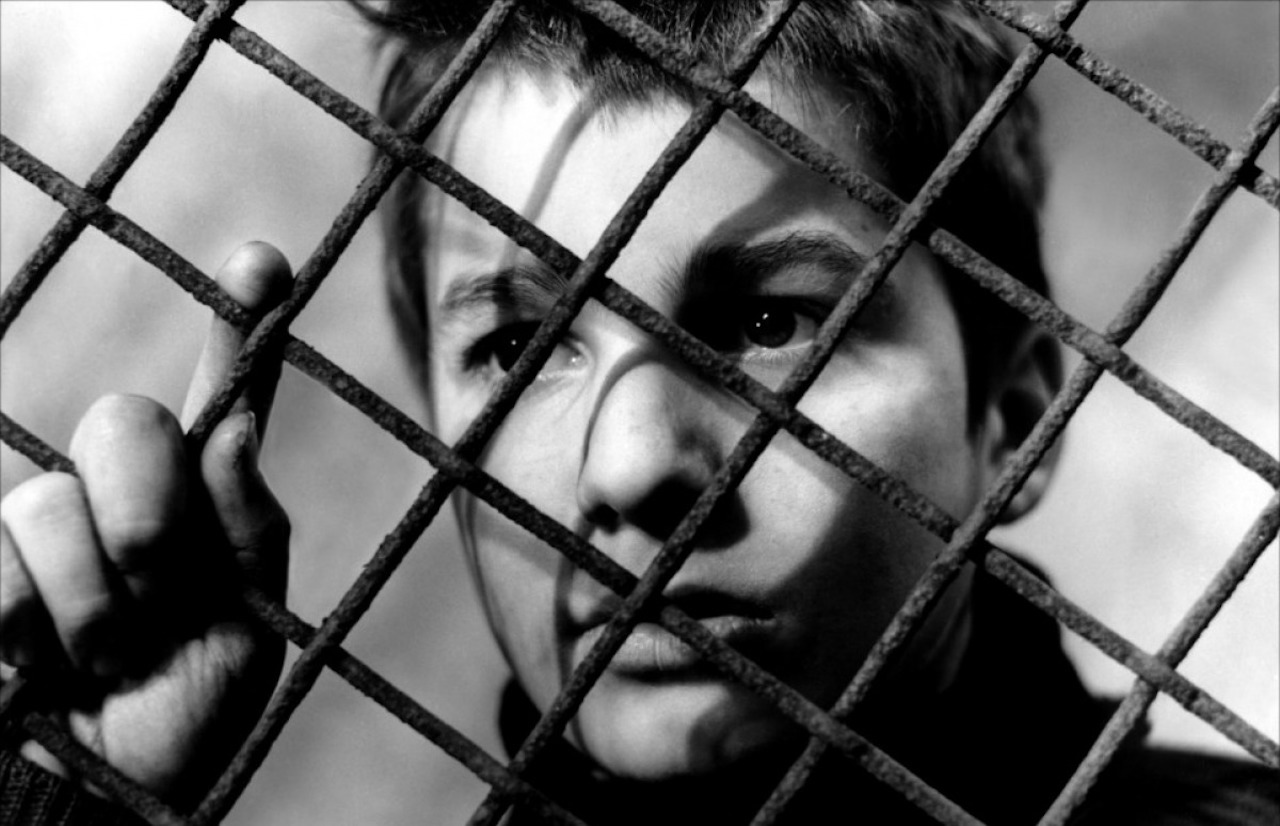
Les Quatre Cents Coups (1959) Screenshot Public Domain
by Ulises Paniagua
One of the films that has had the greatest impact on me, both as a person and as a cinephile, is the one made by François Truffaut in 1959 under the title “The 400 Blows” (Les Quatre Cents Coups). The film—a product of the newly inaugurated Nouvelle Vague (French New Wave) movement—addresses a period in the life of Antoine Doinel, a twelve-year-old boy (the alter ego of the French director) who faces severe family problems amidst an absurd, strict educational system. The film allows us to observe Antoine, in the midst of the naivety and vulnerability of his recent puberty, befriending a new classmate, who will initiate him into transgressive paths—which are not precisely paths of evil. The boys carry out some mischief that, when discovered, is judged by Antoine’s mother and society as unforgivable, shameful acts. At the climax of the story, we see how the adolescent Doinel, rightfully enraged by the prejudice of his family in particular, and of society in general, runs away from home. Gradually, Antoine transforms from a true innocent into an incipient figure of juvenile delinquency, due to social pressure. Finally, he ends up in a reform school, from which he escapes only to reach the sea, the beach, in a brilliant metaphor about freedom (so often imitated in later films).
The story of Antoine Doinel brings to mind a phrase expressed by an inmate in the documentary “Presumed Guilty” (Se presume culpable), by Roberto Hernández and Geoffrey Smith (2005). During an interview, the Mexican prisoner comments: “We are the reflection of a society. I am the reflection of a society; and they are frightened of me…” A stupendous phrase that summarizes the thesis of “The 400 Blows” (1959), and that works perfectly to illustrate the hypothesis of the article “Marking the Offender: Stigmatization, Punishment, and Compliance with the Law” (Marcando al delincuente: estigmatización, castigo y cumplimiento del derecho), by Catalina Pérez Correa (2013), a text where Pérez Correa addresses “how the application of criminal penalties in Mexico disproportionately affects a specific sector of society: young men from marginalized sectors”; “and suggests that by stigmatizing and excluding offenders (or alleged offenders) from a particular social group, prison sentences generate greater conditions of non-compliance.”
It happens that one of the great failures of the judicial and penitentiary system, not only in Mexico (it occurs, for example, in the United States), is to stigmatize the criminal without addressing the causes, that is, the origin of the behavior. Some specialists often wonder if the criminal is “born or made.” A detail that goes unnoticed in this regard is that not only are they “made,” but under a critical gaze—in the style of Michael Foucault’s clarity—we can affirm that in many cases the criminal is not made, but rather is created by society itself.
For Foucault, madness, and in some way the illegal or marginal, are not seen as a natural entity or a mental illness, but as a social and historical construction. The society we live in (and sometimes suffer from) makes us sick. How does this phenomenon occur? Through lack of employment, lack of opportunities, based on discriminatory, racial, or economic behaviors, and constant humiliations regarding living conditions; that is, under patterns of violence that are not only familial but also economic and social, collectively. When society violates the individual, the individual, cornered, responds. In my novel “The Toad’s Wrath” (La ira del sapo, 2016) I dared to expose the issue. The novel begins with a scientific quote that summarizes the behavior of some young offenders: “Bufo is the name of a large genus of anuran amphibians. The best-known species is Bufo bufo, called the common toad. They can inflate their bodies when they feel threatened. They secrete a white, greasy, and poisonous substance, which acts as a deterrent to predators…”

The myth of Jesus Christ, who is always associated with the path of virtue, also shows a man who is a friend of sex workers, lepers, and who understands or tries to understand the motives of criminals. That is, he delves into those, “The Motives of the Wolf” (Los motivos del lobo), in the style of that celebrated and famous poem by Rubén Darío that describes the words of the Wolf of Gubbio before St. Francis of Assisi:
“In the name of the Father of the sacred universe, / I conjure you, he said, oh perverse wolf!, / to answer me: Why have you returned to evil? / Answer. I am listening. / As in a mute struggle, the animal spoke, / his mouth foaming and his eye fatal: / Brother Francis, do not come too close… / I was tranquil there in the convent; / I would go out to the town, / and if they gave me something I was content / and ate meekly. / But I began to see that in all the houses / were Envy, Spite, Wrath, / and in all faces the embers burned / of hatred, lust, infamy and lies. / Brothers made war on brothers, / the weak lost, the wicked won, / female and male were like dog and bitch, / and one fine day they all gave me a beating. / They saw me humble, I licked their hands / and feet. I followed your sacred laws, / all creatures were my brothers: / the human brothers, the oxen brothers, / sister stars and brother worms. / And so, they beat me and threw me out. / And their laughter was like boiling water, / and within my entrails the beast revived…”
Universal literature, for its part, provides concrete models in this background. It is enough to review the novel by writer Roberto Arlt, “Mad Toy” (El juguete rabioso, 1926), which leads us by the hand to the criminal beginnings of an adolescent born into poverty, right in the 1920s of the last century. There, Silvio Astier, the protagonist, is a young lower-class man from Buenos Aires, who dreams of being a hero and a bandit, influenced by adventure novels and serials, seeking to escape the reality of his environment. We see Astier, within the story, enter the world of street crime in a natural way, far from clichés or prejudices. Roberto Arlt provides a perfect portrait of social conflict, in a literary and uninhibited way. Astier comments: “Back then I dreamed of being a bandit and strangling lecherous magistrates; I would right wrongs, protect widows, and singular maidens would love me. I needed a comrade in the adventures of early youth, and this was Enrique Irzubeta. He was a good-for-nothing whom I always heard called by the edifying nickname of ‘the Forger.’ This is how a reputation is established and how prestige aids the beginner in the laudable art of swindling the uninitiated. Enrique was fourteen years old when he deceived the owner of a candy factory, which is evident proof that the gods had traced what the friend Enrique’s future destiny would be. But as the gods are treacherous at heart, it does not surprise me, while writing my memoirs, to learn that Enrique is a guest in one of those hotels that the State provides for the audacious and scoundrels.” The heart of criminality exposed by the criminal himself. Profoundity in abundance, that of Arlt.

Years later, another Latin American story appears that shows a similar approach. It is the novel by Paulo Lins, “City of God” (Cidade de Deus, 2003), which has the famous film adaptation by Fernando Meirelles from 2002. Within the story, in the “city of God,” a group of kids transforms into a gang of robbers and murderers, largely due to the sociocultural, even urban, context in which they find themselves, which blatantly contradicts the utopia of St. Augustine of Hippo. Some dialogues from the film, taken from the novel of the same name, summarize the chiaroscuro of the lives of Rocket (Buscapé) and Li’l Zé (Zé Pequeño), the protagonists of the story: “To be a bandit you need more than a gun. You need ideas,” it is said at one point; and it is commented: “Why stay in the City of God where God has abandoned you?” Poverty and criminality are, for the characters, a complex binomial.
Stories like those of Lins or Arlt invite us to admit, even to admire, reality from within, far from moral stereotypes. Thus, it becomes clear that the system judges the criminal as an effect, without attending to the cause. This leads us to recall the terrible campaign undertaken by Porfirio Díaz in Mexico City at the beginning of the 20th century, where in an effort of supposed “hygienization,” the ruler ordered the arrest of criminals, the mentally ill, alcoholics, and the poor alike, to place them behind the bars of the newly opened Lecumberri prison (the horrifying black palace described by José Revueltas in his novel “The Hole” (El Apando), from 1969), or in the then gleaming “La Castañeda,” a mental sanatorium of dubious medical ethics, which gained a dark fame and which today has disappeared from its original location (a neighborhood south of the city). The problem with Díaz was that he tried to eradicate “the shame of the streets” without considering that his regime, by generating terrible inequalities, was the cause of the crisis. The dictator refused to recognize the disorder provoked by himself (in the way that the current administration of Donald Trump proceeds, for example, at a national and international level in the midst of 2025).

Social inventions that seek to blame whoever is convenient. That, without considering that criminality is, by no means, an exclusive matter of the poor. I invite you to see, as an example, the film “Savage Princes” (Príncipes salvajes), by Humberto Hinojosa Oscáriz (2024), a violent and acid social critique, where a group of privileged young millionaires use their position to commit crimes and get away with them; and where the plans they devise, which by the way begin under the premise of leisure and excessive comfort, spiral out of control.
Although perhaps the plot that best summarizes how a murderer is born, confronted with economic pressure and the socio-historical context, is the classic by Fyodor Dostoevsky, written between 1866 and 1887, “Crime and Punishment.” This novel narrates the way in which Rodion Raskolnikov, desperate in his misery, the need to escape it, and the humiliations from his landlady, Alyona Ivanovna, decides to kill her with an axe to steal her money (the crime scene is truly raw). Although the act is reprehensible, the context proposed by Dostoevsky invites reflection on the complexity of each character’s actions. There are no completely guilty nor completely innocent parties, the Russian author seems to indicate within this literary parable… One of the phrases from the novel may seem relevant in this regard: “I submit to ethics, but I do not understand in any way why it is more glorious to bombard a besieged city than to murder someone with an axe.”
If, on the other hand, we wanted to know, through universal literature, the degree of injustice hidden behind the supposed application of the law; or, in another order of ideas, the dreadful effects of a supposed prison rehabilitation, we can turn to certain magnificent classics that have called the legal system into question for centuries. I cite here the famous tale “The Count of Monte Cristo,” by Alexandre Dumas -in collaboration with Auguste Maquet (1845-1846)-, and the case of the celebrated character Jean Valjean within the novel “Les Misérables,” by Victor Hugo (1862)…
What happens, returning to more current examples, with Pedro, a character played by Mario Ramírez in the film “Los olvidados“, by Luis Buñuel (1950), or with Ruth Slater from “The Unforgivable” (Lo imperdonable), a woman played by Sandra Bullock in the 2021 film by Nora Fingscheidt? These are two individuals who try to change their lives, their destiny, confronted by a world that holds them under suspicion. It is the struggle of the human being against the machinery that works against them.

This forces us to formulate four questions of interest: Who writes the laws, and under what logic? Is it not true that the criminal is condemned because they are associated with otherness and poverty almost always from a position of patriarchal and “white” privilege? Is that not the complaint of many migrants, people of African descent, and Latin Americans in the United States or Europe? Should we not learn to establish laws with the participation of certain social sectors that provide their version of the cultural and economic facts they endure or enjoy?
In this way, if we want to address the growing criminality in Latin America, we must link it unquestionably to the socioeconomic context. Every action has a reaction. The lack of opportunities for the working class can be, to a large extent, the factor that promotes the search for new routes, under the severe, rigid eyes of a conservative gaze. Unfortunately, and as incredible as it may seem, it is possible that the criminal state approaches, ambiguously, a strange class struggle; for only through involvement in drug trafficking, small-scale drug dealing (narcomenudeo), or illegality, can the proletarian class often insert itself into positions of wealth and power, even of socio-economic protection for their families, surpassing, in their ascent and sometimes, the reach of the political and privileged classes that grant them access to an affluent social sector (to achieve profitable businesses, such as money laundering).
That is to say, poor young criminals are judged for engaging in delinquency, but they are not provided with truly well-paid jobs. If they are poor, it is thought that they do not deserve them. They also do not have access to a competitive education, as this is favored in private universities and schools. Thus, young people without resources are subjected to a kind of subjugation, a Kafkaesque condemnation to perform minor, endless jobs, every day of their lives without the possibility of improvement. Unfortunately or fortunately, at least in this country, humble young people, like millionaires, yearn for a big house or a car. They turn the quest of Tony Montana from “Scarface” (Brian de Palma, 1983) into their own quest. And the most direct way to obtain wealth, objects, cars, or motorcycles (because their families cannot give them these things) is, in many circumstances, through crime, individual or organized. In addition, today the children of those peasant drug traffickers of the eighties or nineties have already transformed into executives in suits and ties who launder money through companies and false invoicing, as narrated within the emergence and ascent of a new socio-economic species in the Colombian novel by Laura Restrepo, “Leopard in the Sun” (Leopardo al sol, 1993).

Today’s world is a complex world. Far from trying to easily and sacrificially blame the “rebels without a cause”—as was done in the mid-last century—what remains is a critical, introspective, exhaustive analysis of the effects of economic and social policies, at a global level, which seem out of control. Justice must not be blind. That is known, like an old cliché. It is enough to remember, as Raskolnikov points out in “Crime and Punishment” (1866), that “the hunt for man is like the hunt for a wild beast; you risk returning empty-handed.”
Hopefully, the judicial and penitentiary system will not continue stigmatizing the figure of the criminal without first attempting to understand it, that it not be a ghost chasing ghosts. Perhaps, at the beginning of this 21st century, it is time to reformulate the generation and application of laws. This time from a more horizontal, interdisciplinary, inclusive structure. Literature and cinema, under these circumstances, constitute superb tools for the analysis of such complexity.
Bibliography:
Arlt, R. (2001). El juguete rabioso. Ed. Nora Catelli. Barcelona: Cátedra.
Dostoevsky, F. (1866). Crime and Punishment. Translation and critical edition by Jesús García Gabaldón. Madrid: Cátedra, 2015.
Dumas, A. (1845) The Count of Monte Cristo. Editores Mexicanos Unidos, S.A., Mexico.
Lins, P. (2003), City of God. Translation by María de Fátima de la Fuente Pajuelo. Mondadori. Madrid, Spain.
Paniagua, U. (2016). La ira del sapo. Fridaura, Mexico.
Pérez Correa, C. (2013). Marcando al delincuente: estigmatización, castigo y cumplimiento del derecho. Revista Mexicana De Sociología, 75(2).
Restrepo, Laura (1993). Leopardo al sol. Alfaguara.
Revueltas, J. (1969). El apando. Editorial Era, Mexico.
Hugo, V. (1862). Les Misérables. Editores Mexicanos Unidos, S.A., Mexico.
Filmography:
Buñuel, L. (1950). Los olvidados (The Young and the Damned). Óscar Dancigers, Mexico.
De Palma, B. (1983). Scarface. Martin Bregman, USA.
Hernández, R. & Smith, G. (2005). Se presume culpable (Presumed Guilty). Layda Negrete / Roberto Hernández / Martha Sosa. Mexico.
Hinojosa Oscáriz, H. (2022). Príncipes salvajes (Savage Princes). Mexico.
Meirelles, F., & Lund K. (2002). Cidade de Deus (City of God). O2 Filmes / VideoFilmes / Globo Filmes / Lumière, Brazil, 130 mins.
Truffaut, F., & Moussy, M. (1959). Les Quatre Cents Coups (The 400 Blows). Les Films du Carrosse, France, 99 mins.
Literatura y Cine ante el estigma de lo criminal
Ulises Paniagua
Una de las películas que mayor impacto ha ejercido en mí, como persona y como cinéfilo, es la realizada por François Truffaut en 1959 bajo el título de “Los cuatrocientos golpes”. La cinta -producto del recién inaugurado movimiento de la Nouvelle Vague-, aborda un periodo de la vida de Antoine Doinel, un niño de doce años (alter ego del director francés) que enfrenta fuertes problemas familiares en medio de un sistema educativo absurdo, estricto. El film nos permite contemplar a Antoine, en medio de la ingenuidad y el desamparo de su reciente pubertad, acercándose a un nuevo compañero de clase, quien lo iniciará en caminos transgresores -que no son precisamente senderos del mal-. Los chicos realizan algunas travesuras que, al ser descubiertas, son juzgadas por la madre de Antoine y la sociedad como actos imperdonables, oprobiosos. En el clímax de la historia podemos ver cómo el adolescente Doinel, enfurecido (con motivo) ante el prejuicio de su familia en particular, y de la sociedad en general, huye de casa. De forma gradual, Antoine se transforma de verdadero inocente hasta una figura incipiente de delincuencia juvenil, a causa de la presión social. Finalmente, va a parar a un reformatorio, del cual escapa sólo para llegar al mar, a la playa, en una metáfora brillante acerca de la libertad (tantas veces imitada en películas posteriores).
La historia de Antoine Doinel remite a una frase que expone un preso dentro del documental “Se presume culpable”, de Roberto Hernández y Geoffrey Smith (2005). En medio de una entrevista, el presidiario mexicano comenta: “Somos el reflejo de una sociedad. Yo soy el reflejo de una sociedad; y de mí se asustan…”. Una frase estupenda que resume la tesis de “Los cuatrocientos golpes” (1959), y que funciona de manera perfecta para ilustrar la hipótesis del artículo “Marcando al delincuente: estigmatización, castigo y cumplimiento del derecho”, de Catalina Pérez Correa (2013), texto donde Pérez Correa aborda “cómo la aplicación de castigos penales en México afecta de manera desproporcionada a un sector específico de la sociedad: hombres jóvenes provenientes de sectores marginados”; “y sugiere que al estigmatizar y excluir a ofensores (o presuntos ofensores) provenientes de un determinado grupo social, las penas de prisión generan mayores condiciones de incumplimiento”.
Sucede que una de las grandes fallas en el sistema judicial y penitenciario, no sólo en México (ocurre por ejemplo en Estados Unidos), es estigmatizar al criminal sin atender las causas, es decir, el origen de la conducta. Con frecuencia algunos especialistas se preguntan si el criminal “nace o se hace”. Un detalle que pasa inadvertido al respecto, es que no sólo “se hace”, sino que bajo una mirada crítica -al estilo de la preclaridad de Michael Focault-podemos afirmar que en muchos casos el criminal no se hace, sino que es la propia sociedad quien lo crea.
Para Focault la locura, y de algún modo lo ilegal o marginal, no son vistos como una entidad natural o una enfermedad mental, sino como una construcción social e histórica. La sociedad que vivimos (y en ocasiones padecemos) nos enferma ¿Cómo ocurre tal fenómeno? Por la falta de empleo, por falta de oportunidades, a base de conductas discriminatorias, raciales o económicas, y humillaciones constantes con respecto a las condiciones en que se vive; esto es, bajo patrones de violencia no sólo familiar, sino económica y social, de forma colectiva. Cuando la sociedad violenta al individuo éste responde, acorralado. En mi novela “La ira del sapo” (2016) me atreví a exponer el asunto. La novela inicia con una cita científica que compendia el proceder de algunos jóvenes delincuentes: “Bufo es el nombre de un gran género de anfibios anuros. La especie más conocida es el Bufo bufo, llamado sapo común. Pueden inflar su cuerpo cuando se sienten amenazados. Segregan una sustancia blanca, grasosa y venenosa, que actúa como elemento disuasorio ante los predadores…”.
El mito de Jesucristo, a quien por cierto se asocia siempre al camino de la virtud, muestra también a un hombre que es amigo de sexoservidoras, de leprosos, y que comprende o intenta comprender los motivos de los delincuentes. Es decir, que se adentra a aquellos, “Los motivos del lobo”, al estilo de aquel célebre y famoso poema de Rubén Darío que describe las palabras del lobo de Gubbio ante San Francisco de Asís: “En nombre del Padre del sacro universo, / conjúrote, dijo, ¡oh lobo perverso!, / a que me respondas: ¿Por qué has vuelto al mal? / Contesta. Te escucho. / Como en sorda lucha, habló el animal, / la boca espumosa y el ojo fatal: / Hermano Francisco, no te acerques mucho… / Yo estaba tranquilo allá en el convento; / al pueblo salía, / y si algo me daban estaba contento / y manso comía. / Mas empecé a ver que en todas las casas / estaban la Envidia, la Saña, la Ira, / y en todos los rostros ardían las brasas / de odio, de lujuria, de infamia y mentira. / Hermanos a hermanos hacían la guerra, / perdían los débiles, ganaban los malos, / hembra y macho eran como perro y perra, / y un buen día todos me dieron de palos. / Me vieron humilde, lamía las manos / y los pies. Seguía tus sagradas leyes, / todas las criaturas eran mis hermanos: / los hermanos hombres, los hermanos bueyes, / hermanas estrellas y hermanos gusanos. / Y así, me apalearon y me echaron fuera. / Y su risa fue como un agua hirviente, / y entre mis entrañas revivió la fiera...”[1]
La literatura universal, por su parte, brinda modelos concretos en este trasfondo. Basta revisar la novela del escritor Roberto Arlt, “Juguete rabioso” (1926), que nos conduce de la mano a los inicios delictivos de un adolescente nacido en la pobreza, justo en los años veinte del siglo pasado. Allí, Silvio Astier, el protagonista, es un joven de clase baja de Buenos Aires, quien sueña con ser un héroe y un bandido, influenciado por novelas de aventuras y folletines, buscando escapar de la realidad de su entorno[2]. Vemos a Astier, dentro de la historia, internarse al mundo del hampa callejera de una forma natural, lejos de clichés o prejuicios. Roberto Arlt brinda un retrato perfecto del conflicto social, de forma literaria y desenvuelta. Comenta Astier: “Entonces yo soñaba con ser bandido y estrangular corregidores libidinosos; enderezaría entuertos, protegería a las viudas y me amarían singulares doncellas. Necesitaba un camarada en las aventuras de la primera edad, y éste fue Enrique Irzubeta. Era el tal un pelafustán a quien siempre oí llamar por el edificante apodo de «el Falsificador». He aquí cómo se establece una reputación y cómo el prestigio secunda al principiante en el laudable arte de embaucar al profano. Enrique tenía catorce años cuando engañó al fabricante de una fábrica de caramelos, lo que es una evidente prueba de que los dioses habían trazado cuál sería en el futuro el destino del amigo Enrique. Pero como los dioses son arteros de corazón, no me sorprende al escribir mis memorias enterarme de que Enrique se hospeda en uno de esos hoteles que el Estado dispone para los audaces y bribones”. El corazón de la criminalidad expuesto por el propio criminal. Profundidad a mansalva, la de Arlt.
Años más tarde, aparece otra historia latinoamericana que muestra un planteamiento similar. Se trata de la novela de Paulo Lins, “Ciudad de Dios” (2003), que cuenta con la célebre adaptación cinematográfica de Fernando Meirelles, del 2002. Dentro de la historia, en “la ciudad de Dios” un grupo de chicos se transforma en un hatillo de asaltantes y homicidas, en gran medida por culpa del contexto sociocultural, incluso urbano, en el que se hallan, y que contradice de forma evidente la utopía de San Agustín de Hipona. Algunos diálogos de la película, extraídos de la novela homónima, resumen el claroscuro de la vida de Buscapé y Zé Pequeño, protagonistas de la historia: “Para ser un bandido necesitas tener más que una pistola. Necesitas ideas”, se dice en algún punto; y se comenta: “¿Por qué quedarte en la Ciudad de Dios donde Dios te ha abandonado?”. Pobreza y criminalidad son, para los personajes, un binomio complejo.
Relatos como los de Lins o Arlt nos invitan a admitir, incluso a admirar, la realidad desde dentro, lejos de los estereotipos morales. Así, queda claro que el sistema juzga al criminal como efecto, sin atender la causa. Ello nos conduce a recordar la terrible campaña que emprendió Porfirio Díaz en la Ciudad de México, a principios del siglo XX, donde en un afán de supuesta “higienización” el mandatario ordenó arrestar tanto a criminales como a enfermos mentales, alcohólicos y pobres por igual, para colocarlos tras los barrotes de la recién estrenada cárcel de Lecumberri (el horroroso palacio negro que describe José Revueltas en su novela “El Apando”, de 1969), o en la entonces reluciente “La Castañeda”, sanatorio mental de dudosa ética médica, que cobró una oscura fama y que hoy se haya desaparecido de su punto original (una colonia al sur de la ciudad). El problema con Díaz era que intentaba erradicar “la vergüenza de las calles” sin tomar en cuenta que su régimen, al generar terribles desigualdades, era el causante de la crisis. El dictador se negaba a reconocer el desorden provocado por él mismo (a la manera en que la actual administración de Donald Trump procede, por ejemplo, a nivel nacional e internacional en pleno 2025).
Invenciones sociales que buscan culpabilizar a quien conviene. Ello, sin contar que la criminalidad no es, de ningún modo, un asunto exclusivo de los pobres. Les invito a ver, como muestra, la película “Príncipes salvajes”, de Humberto Hinojosa Oscáriz (2024), una crítica violenta y ácida, de carácter social, donde un grupo de jóvenes millonarios y privilegiados utilizan su posición para cometer delitos y salir impunes; y donde los planes que elaboran, que por cierto inician bajo la premisa del ocio y el exceso de comodidad, se salen de control.
Aunque quizá la trama que resuma mejor cómo nace un asesino, confrontado ante la presión económica y el contexto socio-histórico, sea el clásico de Fiodor Dostoievski, escrito entre 1866 y 1887, “Crimen y castigo”. Esta novela narra la manera en que Rodión Raskólnikov, desesperado ante su miseria, la necesidad de salir de ella y las humillaciones de su casera, Aliona Ivánovna, decide matarla a hachazos para robarle su dinero (la escena del crimen es verdaderamente cruda). Aunque el acto es reprobable, el contexto que propone Dostoievski invita a reflexionar en la complejidad de las acciones de cada personaje. No hay culpables del todo ni inocentes por completo, eso parece indicar, dentro de esta parábola literaria, el autor ruso… Una de las frases de la novela puede parecer vigente al respecto: “Me someto a la ética, pero no comprendo en modo alguno por qué es más glorioso bombardear una ciudad sitiada que asesinar a alguien a hachazos.”
Si, por otra parte quisiéramos saber, a través de la literatura universal, el grado de injusticia que se oculta tras la supuesta aplicación de la ley; o en otro orden de ideas, los efectos espantosos de una supuesta rehabilitación carcelaria, podemos llegar a ciertos clásicos magníficos que ponen en entredicho el sistema legal desde hace siglos. Cito aquí al famoso relato “El conde de Montecristo”, de Alejandro Dumas -en colaboración con Auguste Maquet (1845-1846)-, y el caso del célebre personaje Jean Valjean dentro de la novela “Los miserables”, de Víctor Hugo (1769)…
¿Qué ocurre, volviendo a ejemplos más actuales, con Pedro, personaje interpretado por Mario Ramírez en la cinta “Los olvidados”, de Luis Buñuel (1950), o con Ruth Slater de “Lo imperdonable”, mujer interpretada por Sandra Bullock en el film de Nora Fingscheidt del 2021? Se trata de dos individualidades que intentan cambiar su vida, su destino, confrontadas a un mundo que les tiene bajo sospecha. Es la lucha del ser humano contra la maquinaria que le juega en contra.
Ello nos obliga a formular cuatro preguntas de interés: ¿quién escribe las leyes, y bajo qué lógica?, ¿no es verdad que se condena al criminal porque se asocia a la otredad y la pobreza casi siempre desde una posición de privilegio patriarcal y “blanco”? ¿No es esa la queja de muchos migrantes, afrodescendientes, y latinoamericanos en Estados Unidos o Europa? ¿No deberíamos aprender a establecer leyes bajo la participación de ciertos sectores sociales que brinden su versión de los hechos culturales y económicos que padecen o disfrutan?
De este modo, si quisiéramos atender a la creciente criminalidad en Latinoamérica, debemos ligarla de manera inobjetable al contexto socioeconómico. A toda acción corresponde una reacción. La falta de oportunidades para la clase trabajadora puede ser, en gran medida, el factor que promueve la búsqueda de nuevas rutas, bajo los ojos severos, rígidos de una mirada conservadora. Por desgracia, y por increíble que parezca, es posible que el estado criminal se acerque, de forma ambigua, a una extraña lucha de clases; pues sólo a través de la incursión en el narcotráfico, el narcomenudeo o la ilegalidad, puede la clase proletaria en muchas ocasiones insertarse en posiciones de riqueza y poder, incluso de protección socio-económica para sus familias, superando, en su ascenso y algunas veces, los alcances de las clases políticas y privilegiadas que les brindan acceso a un sector social acomodado (para lograr negocios redituables, como es el lavado de dinero).
Es decir, se juzga a los jóvenes criminales pobres por ejercer la delincuencia, pero no se les brinda empleos verdaderamente bien remunerados. Si son pobres, se piensa que no se los merecen. Tampoco tienen acceso a una educación competitiva, pues ésta se ve favorecida en universidades y colegios de paga. Así, a los jóvenes sin recursos se les somete a una especie de doblegamiento, de condena kafkiana para ejercer oficios menores, interminables, cada día de su vida y sin posibilidad de mejora. Por desgracia o por fortuna, al menos en este país los jóvenes humildes, al igual que los millonarios, anhelan una casa grande o un auto. Convierten la búsqueda de Tony Montana, de “Scarface” (Brian de Palma, 1983), en su propia búsqueda. Y la forma más directa de conseguir riquezas, objetos, autos o motos (porque sus familias no se los pueden obsequiar) es, en muchas circunstancias, a través del crimen, individual u organizado. En adición, hoy en día los hijos de aquellos narcotraficantes campesinos de los años ochentas o noventas se han transformado, ya, en ejecutivos de traje y corbata que blanquean el dinero a través de empresas y seudofacturaciones, tal como se narra dentro del surgimiento y ascenso de una nueva especie socio-económic, en la novela colombiana de Laura Restrepo, “Leopardo al sol” (1993).
El mundo de hoy es un mundo complejo. Lejos de intentar culpabilizar, de forma fácil, expiatoria, a los “rebeldes sin causa” -como se hizo a mediados del siglo pasado-, lo que resta es un análisis crítico, introspectivo, exhaustivo, de los efectos de las políticas económicas y sociales, a nivel global, y que parecen fuera de control. La justicia no debe ser ciega. Eso se sabe, cual viejo cliché. Basta recordar, como lo hace saber Raskólnikov en “Crimen y castigo” (1866), que “la caza del hombre es como la caza de la fiera, te arriesgas a regresar con las manos vacías”.
Ojalá que el sistema judicial y penitenciario no continúe estigmatizando la figura del criminal sin antes intentar comprenderla, que no sea un fantasma persiguiendo fantasmas. Quizá, a principios de este siglo XXI, sea hora de reformular la generación y aplicación de las leyes. Esta ocasión desde una estructura más horizontal, interdisciplinaria, inclusiva. La literatura y el cine, en estas circunstancias, constituyen herramientas estupendas para el análisis de dicha complejidad.
Bibliografía:
Arlt, R. (2001). El juguete rabioso. Ed. Nora Catelli. Barcelona: Cátedra.
Dostoievski, F. (1866). Crimen y castigo. Traducción y edición crítica de Jesús García Gabaldón. Madrid: Cátedra, 2015.
Dumas, A. (1845) El conde de Montecristo. Editores Mexicanos Unidos, S.A., México.
Lins, P. (2003), Ciudad de Dios. Traducción de María de Fátima de la Fuente Pajuelo. Mondadori. Madrid, España.
Paniagua, U. (2016). La ira del sapo. Fridaura, México.
Pérez Correa, C. (2013). Marcando al delincuente: estigmatización, castigo y cumplimiento del derecho. Revista Mexicana De Sociología, 75(2).
Restrepo, Laura (1993). Leopardo al sol. Alfaguara.
Revueltas, J. (1969). El apando. Editorial Era, México.
Víctor Hugo (1769). Los miserables. Editores Mexicanos Unidos, S.A., México.
Filmografía:
Buñuel, L. (1950). Los olvidados. Óscar Dancigers, México.
De Palma, B. (1983). Scarface. Martin Bregman, USA.
Hernández, R. y Smith, G. (2005). Se presume culpable. Layda Negrete / Roberto Hernández / Martha Sosa. México.
Hinojosa Oscáriz, H. (2022). Príncipes salvajes. México.
Meirelles, F., y Lund K. (2002). Cidade de Deus. O2 Filmes / VideoFilmes / Globo Filmes / Lumière, Brasil, 130 mins. Truffaut, F., y Moussy, M. (1959). Les Quatre Cents Coups. Les Films du Carrosse, Francia, 99 mins.
[1] Fuente: Poemas del alma. Los motivos del lobo – Poemas de Rubén Darío
[2] Fuente: Wikipedia.

Ulises Paniagua is a writer and poet. Winner of the Gabriel García Márquez International Short Story Contest in Colombia (2019). He was interviewed by Silvia Lemus on the program “Tratos y retratos” on Canal 22 (2022). In 2023, he was featured in an episode of the series “La ciudad es mi letra” on Capital 21 TV. Included in the anthology Puente y Precipicio in Russia (2019). He is the author of two novels, nine short story collections, two books of chronicles, and seven poetry collections. His work has been featured in Nocturnario, Círculo de poesía, Punto en línea, Ígitur, Nueva York Poetry, Altazor, Algarabía, and Periódico de Poesía. He publishes a column titled “Los textos del náufrago” in Revista Anestesia. Director of the International Colloquium on Poetry and Philosophy (supported by the FCE). Former director of the Digital Horror Collection at Editora BGR (Spain). His work has been translated into English, Russian, Greek, Serbian, Czech, and Italian.
Ulises Paniagua es narrador y poeta. Ganador del Concurso Internacional de Cuento Gabriel García Márquez, Colombia (2019). Entrevistado por Silvia Lemus en el programa “Tratos y retratos” de Canal 22 (2022). En 2023 fue entrevistado en un capítulo de la serie “La ciudad es mi letra”, de Capital 21 TV. Incluido en la antología Puente y Precipicio, en Rusia (2019). Autor de dos novelas, nueve libros de cuentos, dos de crónica y siete poemarios. Ha sido divulgado en Nocturnario, Círculo de poesía, Punto en línea, Ígitur, Nueva York Poetry, Altazor, Algarabía y Peródico de Poesía. Publicado en Revista Anestesia a través de su columna “Los textos del náufrago”. Director del Coloquio Internacional de Poesía y Filosofía (respaldado por el FCE). Ex-director de la Colección Digital de Terror en Editora BGR (España). Ha sido traducido al inglés, ruso, griego, serbio, checo e italiano.
Discover more from Ars Notoria
Subscribe to get the latest posts sent to your email.


You must be logged in to post a comment.