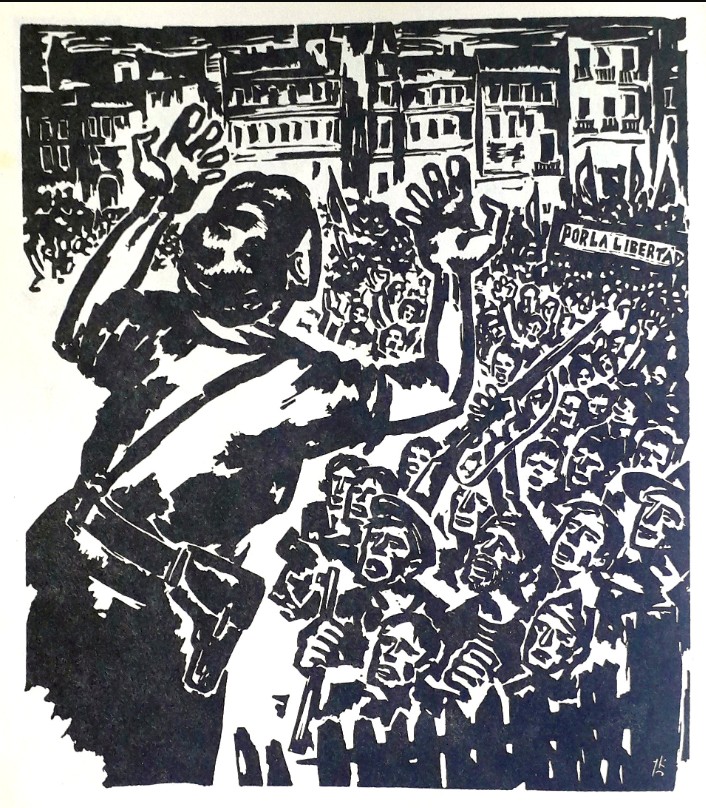
Đorđe Andrejević Kun – Pasionaria speaks to the fighters before going to the front. Wikimedia Commons
A response to a friend’s remark that ‘Lots of people have an aversion to politics.’
By Phil Hall
First, we need to define the word politics. It is a set of activities associated with making decisions in groups, realised in law and government policy at different levels of governance. Politics differs from society to society; there are different systems.
Aristotle coined the term, referring to the ‘philosophy of human affairs’—the study of communities. For him, politics was something higher than personal ethics concerning individuals. The word politics comes from the polis. It is related to rights. A fully-fledged citizen has political rights, and the implication is one of equality before the law. Therefore, one who does not engage in politics is not a fully-fledged citizen.
Aristotle separated politics from the notion of the household and the master-slave relationship. Under oligarchic capitalism, we can reframe this separation of the slave from politics as the separation of the employee from politics; the slave (or employee) enters only in a symbolic and tokenistic way into politics, not into a direct political relationship with the functioning of society and government. His or her constant, everyday, searing experience is one of subjection—of being an object of policy and decision-making, not the subject, the decider.
If an artist is the subject and not the object, the artist must be political and insurrectionary by definition. Certainly, many states see real artists this way and will jail, torture, and kill them at the drop of a hat.
Many people don’t relate to the word politics positively because, classically, as members of a household, as slaves, as worker bees (sometimes itinerant), from within their everyday lives they do not have enough agency to have a full sense of fully participating. In fact, they deny themselves their own power to act.
Which is why, of course, when revolution and social change come, it is so terribly and unexpectedly intoxicating for the masses of people—like chanting at football matches for your team, like a rock concert, only much, much, much better. Ask Keats, Shelley, and Wordsworth, all desperately and excitedly political at the time of the French Revolution.
BLISS WAS IT IN THAT DAWN TO BE ALIVE.
The etymology of the word ‘politics’ excludes the hoi polloi.
Essential to the idea of politics is that Aristotle regards the emergent polis as a natural thing—that it is there to secure the good life of citizens, to the exclusion of the others, or incorporating the others as subjects. Enjoy the cold trickles of eggy custard as they dribble down from the spoons of the rich.
In addition, in an echo of Darwinism (and extrapolated by Hobbes in his Leviathan), some people, according to Aristotle, may be slaves by nature. The working classes. The ordinary people who know their place. The oiks and plebs. The villagers who live around the private school and send their daughters in to be maidservants at the school, only to have them molested by upper-class schoolboys.
Then someone writes a bad conscience play called An Inspector Calls. Victorian boys raped and seduced underage maids. Your great-great-granny! Doesn’t that piss you off? Have you no memory?
Some are born to serve? In which case, they have fewer rights. So, in a sense, they are made to believe—to not believe in politics and their own power, in unions and collective action. They too believe that they are slaves/workers by nature because they have no direct observational evidence of their direct relationship to the polis and decision-making.
That’s for the oligarchs, not the plebs. So now you say you are apolitical.
As for women, because the bourgeois household is ruled over by a full property-owning citizen and member of the polis, none of the children or women in it need apply. The women of the ordinary people are mere slaves of slaves; this direct relationship of subjection to a full citizen has nothing to do with these adelitas.
OH, COME THE REVOLUTION AND THE WOMEN LEAD THE CHARGE!
So, again, you can see that idea working itself down through the ages. The full bourgeois property-owning citizen, member of the oligarchic class, is now conferred with the status of a full citizen. They are someone political who decides for the community. For example: you don’t decide whether or not we will allow the USA to send nuclear bombers to Iran. No, not you, you schmuck. Sit down and shut up. Let your betters do their work. Sit down and think up a ditty!
Stewardship and guardianship are desired by the polis—desired of the people who have a direct relationship with power. Unlike the employees, and the wives, and the children, and rootless geldings like you.
Family relations and relations to production and money and power are reproduced through time—through teachers, curriculums, textbooks, bullying, through the media, through literature, through art. What is right and natural and normal is what is. You are taught that.
In other words, there are also those people who are not the guardians or the stewards of the status quo, and who don’t have a direct and easy access to power, and to the polis, and to politics, and whose every experience is of helplessness and being subject to the whims of employers without ever being agents of their own destiny, except as free-floating troubadours or artists, or rebels or criminals, or whatever lumpen migrant human what-have-you.
These ‘apolitical’ people have had their balls cut off. Have had their ovaries extracted. Inevitably, naturally, they see the polis and politics as far off, distant from them. They have never been involved in making decisions that affect even their own lives, because they never make decisions, are never asked to make decisions. And certainly, they aren’t entitled to or invited to participate in politics.
There is no easy access to the law for them—to become barristers. No easy access to representative deliberative democracy. No access for them to the fifth estate.
The workers know their place. Even when they think they don’t know their place, politics is not for them—in the sense that politics is not for the hoi polloi. This is what they feel because they have been taught to feel it.
And if you think of a meeting of the great and the good—this isn’t the wisdom of the crowd or the mob. This is a meeting of minds. This is the white-haired brotherhood. Parliaments of owls. The ideas that come from parliament are deliberated on and sage. Before they get to parliament, they are pondered over in Wellington’s clubs. Over brandy and cigars.
To sit together and talk, to have a parliament, and work things out, and listen to each other respectfully (debate if you must) with a certain respect, having understood what the other person has said and responded, produces good results. But you are excluded—just as the Greek slaves were excluded. From public schools and great houses and Ascot and grouse shooting and clubs at Cambridge and Oxford and the club of the polis itself. Participating in decision making is not for you, Richard, or Jeremy Corbyn. God forbid!
The crowd takes for itself, in the revolution, its own form of parliaments, its own soviets, its own gatherings for worship, for wisdom, for insight—whether or not these people are experts is by the by, because certainly the powerful are not experts; they are just simply the people who hire and manage experts.
What they are is guardians of the state. Knights of the Order of the Bath, Gartered Holders of the Stool. The elders, using Quaker terminology, are basically the House of Lords.
The Quakers, by all rights, should be a form of soviet, but because they are of the people, a little removed from power, they are distanced, separated from deliberating as part of the polis. If they were closer to it, society would be healthier and Quaker Meetings would be governing bodies. Had the Quakers, and not the Puritans, been more prevalent in the New Model Army, the King would still have had his head, but lost all his palaces.
That’s the problem with parliaments. A parliament full of fascists will ennoble fascists. A parliament full of the wealthy, who guard that property and wealth, will glorify the wealthy.
We live in oligarchies with levels of power, with layers, ceilings, and barriers to entry.
Democracy is a leveller, people thought! But it isn’t. The Quakers were born out of revolution, not democracy. Democracy is the icing on the cake of equality.
Not to be political is to be an infant, is to be a slave, is to be a subject, is to be a criminal, is to be a shaman, is to be a parasite, is to be a saint, is to be irresponsible, is to be despicable—because, in the end, one can be all these things and still be political. Not in an Aristotelian sense, but in a much deeper, invigorating, enlivening, joyful, participative sense.
Phil Hall was born in South Africa into an ANC family with British, French, Austrian, and German roots. After his parents were exiled, they lived in East Africa and India before returning overland to the UK. In the UK he studied Russian and Spanish literature, politics, and economics. After graduating he specialised in descriptive and applied linguistics. Phil has lived and worked in Spain, the USSR, Mexico and the Gulf. Returning to London during the pandemic, he co-founded the Humane Socialist magazine, Ars Notoria (the Art of the Noteworthy) and the micropublisher, AN Editions.
Discover more from Ars Notoria
Subscribe to get the latest posts sent to your email.


Comment
Comments are closed.