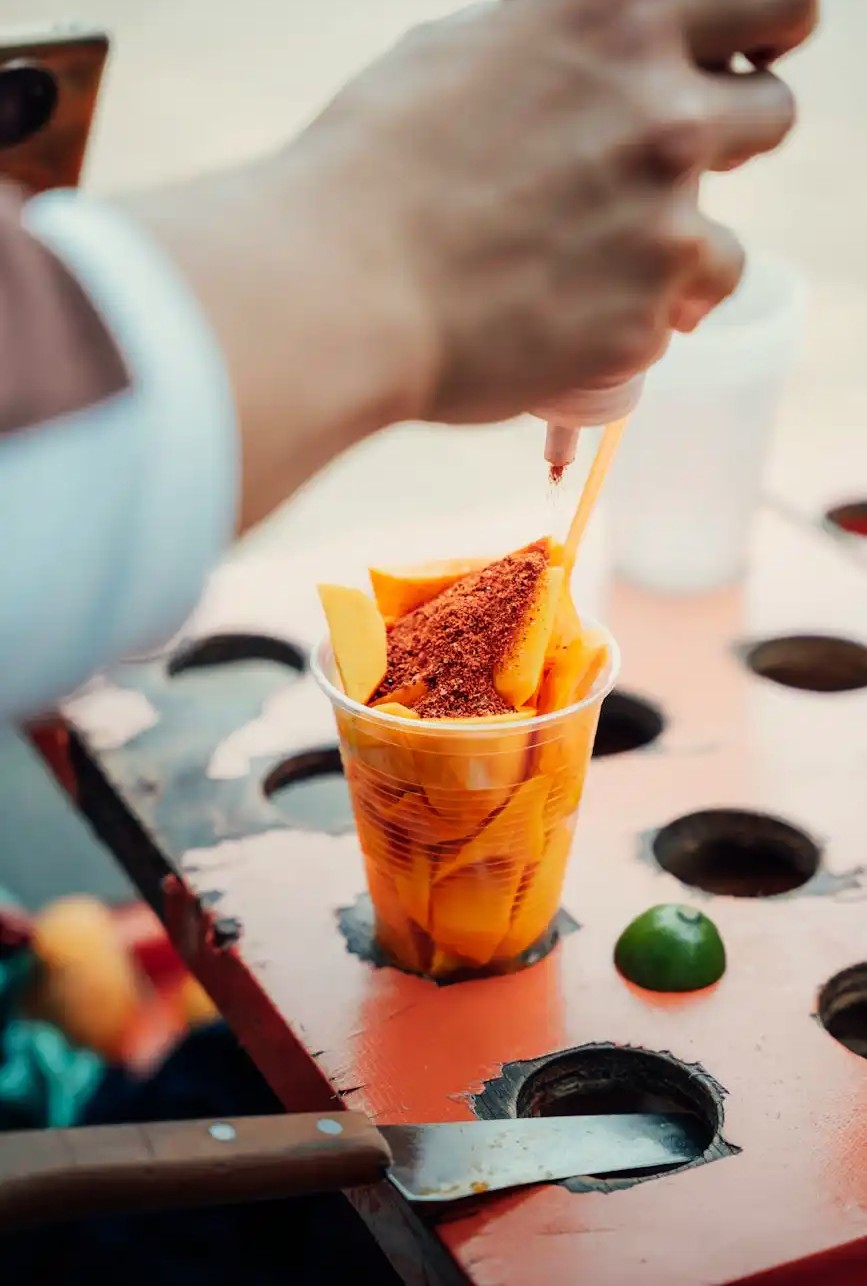
Roadside mango Snack in Mexico. Photograph Miguel González
Freshness without friction is boring
by Arun Kapil
Manek Chowk doesn’t ease into the day. It detonates. Heat rises off cobbled stone. Diesel coughs. Metal shutters slam open. Somewhere behind you, something is already frying. In front of you, fruit – piled high, bruised, perfect, sweating under Gujarat’s glare. The fruit man stands behind his table like he owns time itself. Shirt loose. Collar defeated. Forearms moving with mechanical certainty. His aluminium shaker dented from a thousand mornings. His knife is not poetic. It is efficient. Grab. Slice. Slice. Grab.
He doesn’t ask what you want. He knows what you need. Guava first. Then pineapple. Then mango. Bare hands slick with juice. Then the move – the real move. A pinch of kala namak. Sulphurous, dark, almost indecent. A scatter of chaat masala: roasted cumin bass, amchoor tang, chilli prickle, cardamom whisp. A determined squeeze of lime. Shake. Toss. Fold into a paper cone. No ceremony. You bite. The fruit doesn’t taste sweet. It tastes alive. The black salt doesn’t make it salty – it makes it electric. The amchoor drags sweetness forward. Chilli hums at the back of the throat. Saliva floods. Eyes widen. Something switches on. That’s the lesson. Freshness without friction is boring.

The salt doesn’t make it salty – it makes it electric. Photograph Arun Kapil
Somewhere along the way, fruit got gentrified. In well-lit Western kitchens it became a moral accessory – blended into smoothies, arranged into açai bowls, discussed in the anxious language of fructose and glycaemic load, protected from salt as if salt were scandalous. Sweetness behaving itself. Outside that superimposed bubble, across cultures that never confused food with virtue signalling, fruit has always been provoked.
In India, guava meets kala namak, meets chaat masala. In Mexico, it’s dragged through Tajín and lime before it reaches your mouth. On the Swahili coast, pineapple stands upright under pili pili and tamarind. In the Levant, pomegranate tightens beneath sumac’s citric pull. In Sicily, figs meet balsamic and cracked fennel seed – perfume and depth sharpening flesh into clarity. Different languages. Same instinct. Sweetness plus resistance. This isn’t fusion. It’s pattern recognition. Humans separated by oceans keep arriving at the same conclusion: fruit on its own is unfinished.
Salt suppresses bitterness and rounds acid, allowing sweetness to register more clearly on our palates. Acid increases salivation, carrying flavour further. Chilli stimulates heat receptors, sharpening perception. Contrast multiplies experience. It’s not culinary theatre. It’s circuitry. The fruit seller in Ahmedabad isn’t thinking about ion channels. The vendor in Oaxaca isn’t discussing trigeminal nerves. They are cooking to taste to the wiring – wiring I learnt slowly, deeply.
I grew up with bananas and custard. Seventies comfort. Safe sweetness. Nothing arguing with anything. It was food that behaved. Thirty years later, in my first week at Ballymaloe, green and clinging to rules, I was handed sliced bananas in lime syrup with cloves. Cloves. I thought it bizarre. Unnecessary, almost. Had Mrs A lost it? Fruit doesn’t need drama. Then I tasted it. Lime struck first – bright and unapologetic. Clove followed – dark, steady. The banana didn’t collapse under it. It straightened its back. Later I swapped cloves for torn basil. Same volatile backbone. Softer accent. When basil hit lime and banana, the air changed. Not garnish. Structure.

When basil hit lime and banana, the air changed. Photograph RDNE Pexels.com
Back then I didn’t know the chemistry. Now I do. Eugenol – the volatile compound running through clove, basil, cinnamon, nutmeg. It doesn’t sweeten fruit. It stabilises it. Draws a line through it. Sweetness is not sacred. It’s structural. As curiosity of my experimentation grew, I’ve tested this thesis publicly. I cooked pot-roast partridge with orange and green cardamom on television. On another show, I gently poached cherries with fresh Karnataka MG1 black pepper and a whisper of clove in a simple syrup for a Black Forest trifle. Eyebrows raised. Then silence. Then approval. The host loved it – surprising himself as much as the crew. Spice doesn’t bully fruit. It frames it.
And yes, there’s science here. The literal voltage of taste. Salt heightens sweetness. Capsaicin from chillies binds to receptors in our bodies – the same ones that help us register atmospheric heat. A closely related receptor responds to salt. Acid flicks awake the trigeminal nerve. Sweet, sour and umami share the same channel. These pathways don’t work alone. When the moment is right, they fire together. They amplify each other. This is that pop. That sharp, satisfying electric ping we experience when salt and spice hit fruit. That’s when all receptors fire at once, in harmony. The combination creates the moment. Monotony dulls it. Contrast ignites it. We are wired for friction.
I felt this most viscerally in Kerala in April, in a heat that didn’t shimmer – it pressed. Forty-eight degrees. Humidity that made your shirt irrelevant within minutes. A man shaved the outer green husk of a young coconut with three clean flicks of his blade, pierced it, slid in a straw and handed it to me. It steadied me. It did not revive me. What revived me came later.

A man shaved the outer green husk of a young coconut with three clean flicks of his blade, pierced it, slid in a straw and handed it to me. Photograph Arun Kapil
A mango, cut hedgehog-style in its skin, cubes pushed outward like a golden sea urchin. Almost indecently ripe. Over it went a generous sprinkle of chaat masala, a scatter of chilli, a liberal dousing of tamarind and a squeeze of a small Indian lemon – those sweet-edged, lime-bright fruits, nothing like the waxed supermarket versions. Juice ran down my wrist. I didn’t care. I bit. Sweetness detonated, then acid, then salt, then heat. My mouth flooded, slathered in sticky mango mayhem. My body woke up. I was handed the stone and I chewed it like survival depended on it, scraping every fibre with my teeth, sucking it dry in full view of strangers.
Plain mango would have been pleasant. This was restorative. Salt replacing what sweat had taken. Acid cutting through sugar that in that heat might otherwise cloy. Chilli forcing breath, circulation, alertness. Not style. Not theatre. Survival disguised as snack. In hot climates, sweetness alone can feel oppressive. Add resistance and it becomes relief.
Tamarind travelled on trade winds long before lifestyle culture discovered it. Citrus moved from Southeast Asia through the Middle East into Europe, carried by traders who valued its brightness and health preserving powers. Pepper, saffron, cardamom, fennel, cloves, nutmeg, cumin, coriander – these ingredients crossed oceans and outlasted empires. Fruit and spice have been meeting each other at ports and market edges for centuries, not as novelty but as necessity. Fusion evolved as adaptation long before it became expression.
Back home, the voltage is quieter but no less real. Here in Ireland, each season we await the windfall apples from Olive’s family farm to drop hard into the grass – tart and unapologetic, tasting unmistakably of Irish sunshine. We gather them bruised and imperfectly honest and turn them into crumble. Just enough sugar to temper their bite, never enough to erase it. Real Irish cream poured cold over hot fruit, steam rising, sweetness held upright by acid.

Cherry Fool with Irish cream. Photograph Arun Kapil
In the UK, I used to look forward to Yorkshire’s forced rhubarb arriving like a blush in late winter – sharp, almost aggressive. I’d fold orange zest and a pinch of sea salt through the crumb and quietly grind fresh cumin into the sugared fruit. Not enough to announce itself. Just enough to deepen the red, to give the sweetness somewhere to land. Custard this time. Creamy, warm, forgiving. Fire doesn’t always mean chilli. Sometimes it means spice. Sometimes salt. Sometimes simply contrast.
Of course, enthusiasm can outrun judgement. I once misread a Peter Gordon recipe calling for one anchovy fillet in a hollandaise to coat tenderstem broccoli. I used an entire (one) tin. The extended family tried to be brave. They failed. I can still see their faces hovering somewhere between loyalty and alarm. My mother, wonderfully encouraging in those early days, let me own it without humiliation. The lesson wasn’t retreat. It was calibration. Voltage uncontrolled is just noise.
Years later, I whisked a pinch of black salt into a basil and lime sugar syrup for an event. Rory O’Connell walked through the kitchen checking things. I offered him the tub to smell and watched his reaction carefully. Black salt can be pungent, sulphurous, startling. He paused – attentive, thoughtful. He tasted the syrup before and after. Then he smiled, slow and considered. It added depth, he said. A note that made the sweetness less obvious and more interesting. Respect in cooking is not about shock. It is about coherence.
We grow into contrast. Babies reject bitterness; adults learn to chase it. The palate matures towards complexity because complexity rewards attention. Sweetness alone is immediate and fleeting. Sweetness held against salt, acid, heat or spice lingers. It holds shape. Modern food culture occasionally forgets this. Fruit gets infantilised. Frozen into smoothie sachets. Bowled up with granola and self-approval. Treated like a delicate health pet.

Fruit gets infantilised. Frozen into smoothie sachets. Bowled up with granola and self-approval. Treated like a delicate health pet. Photograph Arun Kapil
But fruit is not fragile. It grew under sun, wind, rain and resistance. Why should it be eaten without any? The fruit seller in Manek Chowk never explained any of this. He didn’t need to. He shook that dented powder tin over my mango and handed it back like a quiet dare. Freshness is not purity. It is energy. It is tension. It is voltage.
So hit your strawberries with a grain of sea salt. Let gooseberries meet chilli, better yet – add a scraping of vanilla seeds. Try fresh black pepper on cherries. Stir cumin through rhubarb. Sprinkle black salt over melon and see what wakes up. Not to shock. Not to posture. But to listen. Because behaving sweetness is pleasant. Yet fruit with fire – fruit given edge, friction, resistance – reminds you that flavour, like life, is better when it pushes back.
Eat bravely.
Masale bolte hain.
Recipe: ‘Chaat’ Salad
Melon, Peach, Grapes, Mint, Cucumber, Radish, Green Chilli & Lime Juice

This isn’t your sad café fruit salad. No syrupy cubes, no limp mint. This is chaat-style – crunchy, juicy, fiery. Photograph Arun Kapil
Sweet, sharp, cooling, cheeky. The desi salad that throws shade on all others. This isn’t your sad café fruit salad. No syrupy cubes, no limp mint. This is chaat-style – crunchy, juicy, fiery – here every bite flips between sweet and sour, soft and sharp. You’re not slicing for symmetry here, you’re sculpting a vibe. Start with your fruit and veg and have fun with the shapes: melon scooped into balls, cucumber in thick, crisp moons, peaches cut into elegant wedges, seedless green grapes halved (no peeling — we don’t have that kind of time), radishes thinly sliced for bite. Add torn mint, and one finely chopped green chilli if you’re brave. You want contrast, drama, play. Now for the dressing — if you can call it that. Just fresh lime juice and your best Chaat Masala from your store cupboard. No oil. No nonsense. Just squeeze and dust. Toss it all just before serving so it hits fresh — the black salt wakes things up, the acid brightens, the masala brings the punch. Serve cold, but with heat. On a platter, on a banana leaf, or straight from the bowl standing barefoot in your kitchen. It’s a salad with a sneer. The radish will bite, the peach will flirt, the grape will pop, the mint will rescue you. This is fruit but make it mas Fruit ala.
Masala Note: Chaat Masala Isn’t Subtle
It doesn’t whisper. It shouts. Sulphury, salty, tangy, a little wrong in the best way – chaat masala doesn’t blend in, it crashes the party. On fruit, it’s pure chaos: makes melon taste like mischief, grapes like candy with attitude. It’s got black salt, dry mango, and enough funk to start a band. Use sparingly or not at all. But once you start, there’s no going back.
Arun Kapil, Food Editor of Ars Notoria, and punk food poet, founded and owns a spice company, Green Saffron Spices. He works sustainably direct with partner farms mainly to the west and north of India and some in the south. He works directly from source. He owns total chain of custody, depleting links in the chain, bringing direct line of sight to fields of cultivation. Arun and his partner Olive began by selling one or two sachets a week of bespoke blends with accompanying recipes at a farmers market stall in Mahon Point, Cork. They now sell spices and seasonings to globally based blue chips, onward food processors and are just in the throes of re-launching their brand, based on Modern India meal solutions, sauces, spice blends, naan, condiments and basmati. They started the business boot-strapping from the bottom up, managed with a good deal of jugaard. He considers himself to be a masaalchi and at best a khansama supported by a strong network of Irish, Indian and British agri-experts and businessmen.
Discover more from Ars Notoria
Subscribe to get the latest posts sent to your email.
You must be logged in to post a comment.