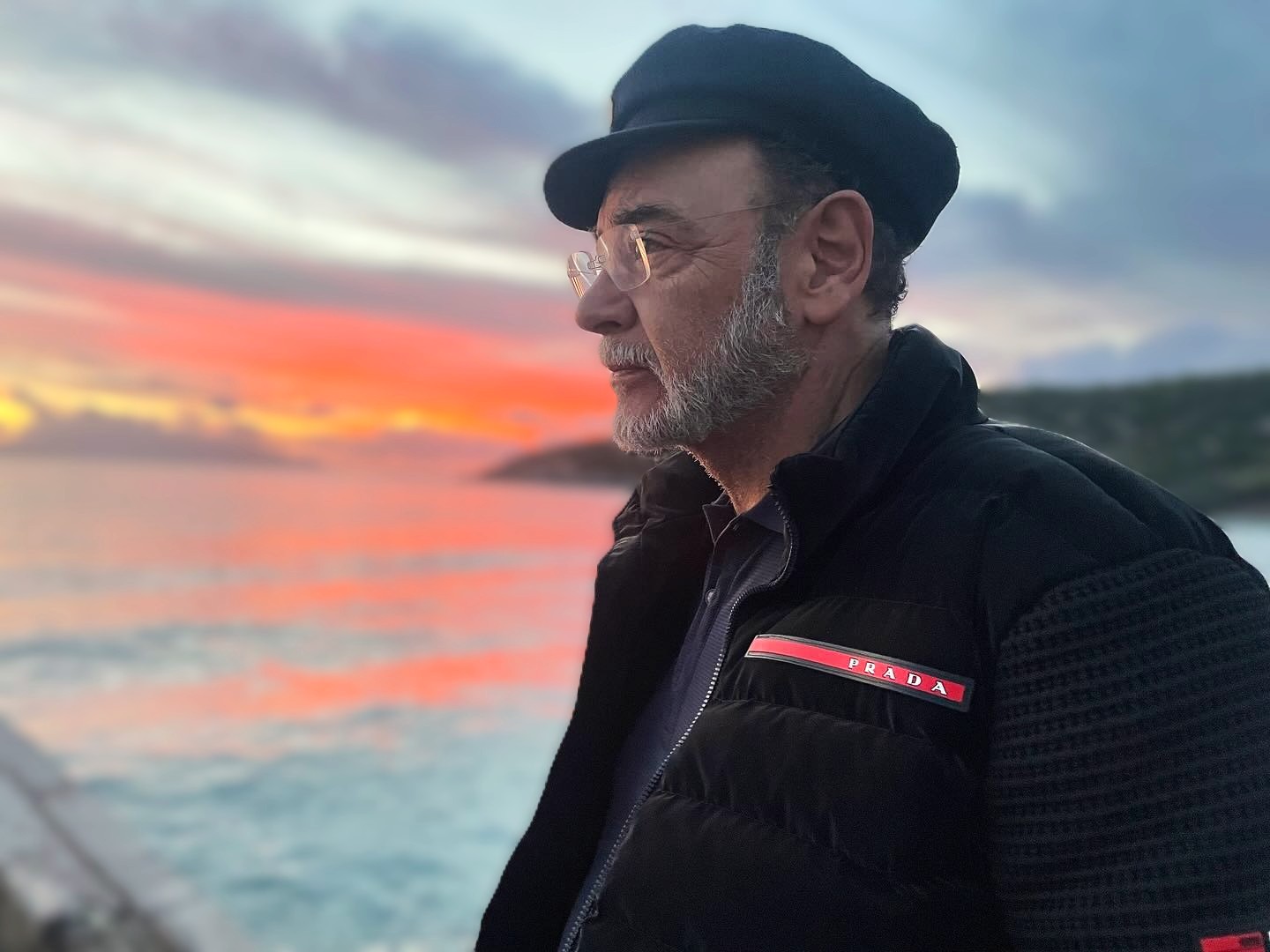
Óscar de la Borbolla. Courtesy of Óscar de la Borbolla
Óscar de la Borbolla, writer and philosopher, was born in Mexico City in 1949, although, as the poet Fargue said: he has dreamed so much! He has dreamed so much that he no longer belongs here. Among his notable books are: Las vocales malditas (The Accursed Vowels), Filosofía para inconformes (Philosophy for the Nonconformist), La libertad de ser distinto (The Freedom to Be Different), El futuro no será de nadie (The Future Will Belong to No One), La rebeldía de pensar (The Rebellion of Thinking), Instrucciones para destruir la realidad (Instructions for Destroying Reality), La vida de un muerto (The Life of a Dead Man), Asalto al infierno (Assault on Hell), Nada es para tanto (Nothing Is So Important), Todo está permitido (Everything Is Permitted), El arte de dudar (The Art of Doubting), and Pasado cero (Past Zero) (published by Penguin Random House and El Fondo de Cultura Económica). He was a professor of Ontology at the FES Acatlán, UNAM for 50 years and, occasionally, he can be seen giving talks at book fairs or on cultural television programs where he engages in lively debates. For the past 10 years, he has been sharing his ideas weekly through various media: on Wednesdays, a video column of philosophical reflections in the virtual newspaper SinEmbargo.mx or on YouTube on SinEmbargo al Aire, and on Tuesdays, his program Las Esquinas del Azar (The Corners of Chance) on Radio UNAM at 10 in the morning. His emblematic phrase is: “We crazy folk are not the morbid, we are merely the unorthodox… We crazy folk are another cosmos.”
Ulises Paniagua Olivares
To Beatriz Escalante
I can’t remember what the first impression this world provoked in me when I was born, but I suppose it wasn’t pleasant because they told me that I announced my arrival with a cry of pain, followed by many tears. I always value first impressions because, in addition to being original, they aren’t contaminated by that constant familiarity that wraps itself around things.
I am interested in deciphering this first impression because I suspect it could hold a very important secret. To resort to memory is useless because we humans only start to formulate memories not months but years after birth.
That first impression everyone gets becomes as irretrievable and inaccessible as they say God is. But I haven’t desisted in my search and have come across some theories that offer acceptable clues to help understand that original impression: one suggestion comes from Freud with his concept of “oceanic sentiments” and the other is Ernest Cassirer, when he spoke of the chaos of sensible impressions. The first case alludes to the experience of being at one with everything; in the other case it is suggested that we have a clump of sensations where everything gets confused. In both cases the reference is to unity.
Today, this Unity is too distant from me. These days I feel perfectly divorced and disaggregated from the world, and, although I continue to confuse things, I possess a certain analytic way of looking at things that allows me to assume that the world is intelligible. On the whole, all things considered, I have a degree of discernment and can separate things out from each other. I perceive them.
How did I get here? What was it that made me go from feeling at one with everything to feeling separate and capable of discernment? What change was produced in me? Some simple fact that relates to the passage of time? The fact that the first impression was followed by a second and a third and fourth and a number of experiences to the power of n, as if they were layers of paint accumulating in me and permitting that first impression to be perceived and even qualified in certain instances.
The passage of time is an important factor, but it’s not decisive: I know animals who as they aged were only capable of making out a few things; I mean, that they could recognise their owners and know just by the tone of voice what they were being required to do. Why do I insist on asking the question? What was it that I acquired that defined who I became? To be more precise, what was it that allowed us to move away from our original “oceanic feelings” or the chaos of impressions that we experienced at the beginning?

On the whole, all things considered, I have a degree of discernment and can separate things out from each other. I perceive them. Photograph Óscar de la Borbolla
The decisive acquisition was language. On learning the word “mother” I separated myself from my mother permanently and separated her out from everything else. The frontiers of Unity arrived with language and started to mark it out. Because when I used “mother” and “wall” I separated my mother out from a wall, and when I said “roof” I could differentiate between the wall and the roof. Little by little things took on their contours and I could refer to them, marking them out from other things. My world became analytical and intelligible and I understood that, literally, the world was in-formed by words; that it was words that gave shape to the world; that they made it intelligible and that I had become intelligent. I am not referring to my IQ, but to the mere fact of being able to separate concepts and inter-legere, thanks to words. For this reason I say I wasn’t born into the world but into a world of words.
In the world of language there were those who moved like fish in water or birds in air; for just as in water there are waterfalls and whirlpools, and in air there are also hurricanes, and cold winds, and currents that rise and fall according to their temperature, the same happens in language; and I was clumsy in the world to which, in the strictest sense, I belonged.
I had to learn to navigate its difficulties: to manage to swim against the current of fluent discourse so as not to be persuaded by the foolishness that is thrown about. I had to learn to fall into the cascades of words or to fly through their hurricanes; but, above all, I understood that I had to learn to use handy monosyllables to glide over the din of useless arguments in which words, when all is said and done, say nothing. I discovered that language was my element when I was a child, and from then on, I wanted to be a writer, to eventually glide through language with ease.

I had to learn to use handy monosyllables to glide over the din of useless arguments in which words, when all is said and done, say nothing. Photograph Óscar de la Borbolla
But there was a problem with words: they were at once too many and too few: an unencompassable lexical world which, nevertheless, lacked terms. For as extensive as it was, it didn’t quite cover the real world: there were a great many words, but not as many as the nameless details, nor as many as all those realities that escaped me for not knowing how to name them, for I would see “trees” without being able to distinguish them: to me, pine trees and silk-cotton trees were the same; walnut trees and Mexican cypresses were the same. Only slowly did these terms appear and those species become differentiated: the first tree I could recognise was the colorín, for the beans that appeared under its shade on the sidewalks or in the grass were very important to me. Then I learned “araucaria”: I was fascinated by the pentagonal geometry of its branches and, when I finally had a distinguished world thanks to being able to name its elements, I asked myself how that was possible, what were words? This enigma remained within me, unanswered for a long time.
It wasn’t until I read Kant that I found an answer: I possessed a reason that functioned by making syntheses: synthesising experiences: I had seen my mother over and over and over again until I had abstracted her essence and that is what had crystallised into the concept “mamá”. The word “mamá” encapsulated her, regardless of the details of whether she was in a good mood or a bad one, dressed in yellow or black, sitting or standing; the word “mamá” was my mother quintessentialised. And the same occurred with the concepts “silla”, “mesa”, “laberinto”: experiences rich in details which, through abstraction, I had managed to synthesise, to grasp what they were beyond how they appeared, and that is why I, by possessing the word “silla,” recognised the particular chairs I came across.
And only then did I understand that words, which I loved so much, were not as innocent as I had believed them to be, for they were at least to blame for my having lost my first impression, my “oceanic feeling.” Because of them, I had lost real things, the in-itself, the noumenon as Kant calls it. Because of language, I was imprisoned, forever, in the world of abstraction of words. For I see with language, I smell with language, I touch with language… all my senses are filtered by words, all my experiences are masked or, what amounts to the same thing: they only exist if they are verbalised.

Because of language, I was imprisoned, forever, in the world of abstraction of words. Photograph Óscar de la Borbolla
It’s not a loss, I thought. It’s a great advantage that places me, as an animal, above animals and, furthermore, I can access other worlds, other languages, not just other idioms, but other languages: the mathematical language (even more abstract), or the musical language (which confronts me with a world in itself, since music does not re-present anything, but is in itself what it is), or the cinematic language and an endless number of languages and, consequently, an endless number of worlds.
Becoming a writer, therefore, hadn’t been a bad choice; it would allow me to move fluently in the world of words, in the world I shared with my fellow beings: the verbal animals; to be where all of us who live in words dwell. So I gradually became a writer, and with words I have constructed scenes, I have provoked feelings, I have had adventures… in short, I ended up assembling my own world, a world that I shared with others by publishing it, a world made, obviously, with words, with my words. Today, I can state: I have my sub-world in the world of words.
I don’t know how many times I have circled back to the matter of words, because for me, they always had a problem or, better yet, they always seemed suspicious to me. I still remember — I must have been almost four years old — when I was surprised that my friends also called their mothers “mamá.” I know it sounds strange, perhaps very strange, but it will be easily understood if I say that at that time I believed the word “mamá” was my mother’s proper name.
For me, it was a revelation to realise that it was a concept, a noun usable not only to quintessentialise my mother, but to refer to all women who fulfilled the universal function of being mothers, that is, with the definition of “mother.” And I understood that the same happened with the rest of the words: “silla” was not the name of my chair, nor was “mesa” only for my table, nor was anything for anything in particular. Upon understanding this obvious fact, I realised that language was indeed an advantage that placed me above non-verbal animals, but that it deprived me not only of my first impression (that oceanic feeling), but of experiencing reality directly: of being able to touch my chair, see my table, hear my mother… Because of language, I had become a King Midas who turned what he touched not into gold, but into abstraction, into universality: the world of language from which I could no longer desert was an impersonal world.
So impersonal that, deep down, it made me see, through the word “silla,” an abstraction of all chairs, and the same with the word “araucaria”: I didn’t capture each individual araucaria, but the abstraction “araucaria,” inducing me to perceive all araucarias as equal and, what was worse, that the word “mujer” made me believe that all women were a stereotype, because language prevented me from coming into contact with my concrete experiences. This decided me completely to become a writer, for I supposed that by mastering words I would manage to speak with them about my world.
I don’t know if I have achieved it; but at one point in this search that has taken me a lifetime, I came across photography. For decades I have contemplated photographs: landscapes, faces, chairs, nudes, trees… and I have been left stupefied, because, in photographic language, concreteness occurs. The artists of the camera capture not only the unique in a precise instant, but what only they see: their most personal world. Photographic language possesses the privilege of showing what has been the purpose that has animated my life: to capture what is mine, what is singular.

Photographic language possesses the privilege of showing what has been the purpose that has animated my life: to capture what is mine, what is singular. Photograph Óscar de la Borbolla
Photographers do it in a splendid way: in their images and, above all, in the spirit that animates each one’s style, remains the record of what each person sees from the exact angle from which they decide to capture it. Photographic language communicates its message not with those abstract skeletons that are words, but with images that confront the spectator with the irreducible singularity of what exists. Photography gives us back what the universality of words has snatched from us: singularity. When one contemplates a series of photos in an exhibition, what one has before oneself is the message that tells us: what is truly real is unique; but, since we cannot escape the world of words to which we belong, we are once again subjected by it, and far from having an ecstatic experience, we see verbalised and, although we remain silent, we know that our vision is filtered by words and that our experience of the concrete is lost.
Even so, I like to see photographs, for in the ones I keep of my mother or of my first bookshelf I know, in some way, that in them there is a little more of my mother than in the cold and generic word “mamá,” and more pine, paper, and letters than in the mere expression: “my first bookshelf.” If only I could find the language that would allow me to recover that first impression, before words, when I was one with the world.
Discover more from Ars Notoria
Subscribe to get the latest posts sent to your email.
You must be logged in to post a comment.