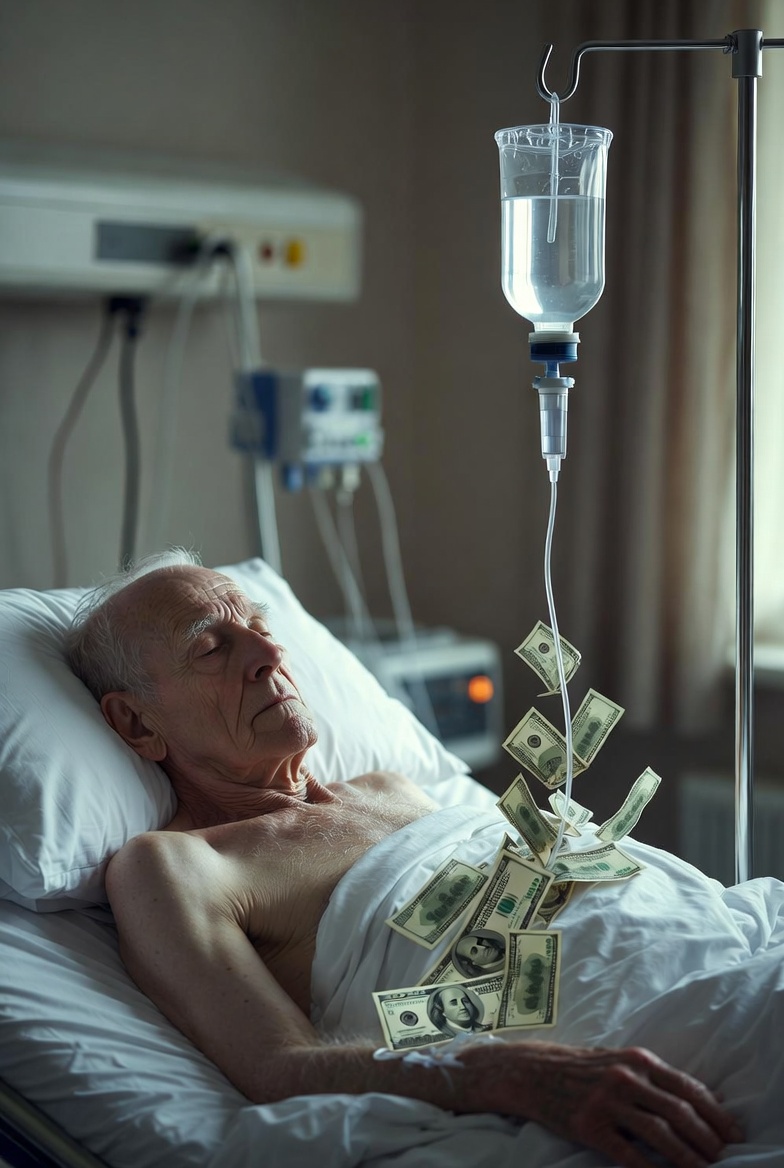
The legalisation of euthanasia under capitalism is not an act of compassion. It is a logical extension of a system that values profit over human life, death instead of care. Image X
A Humane Socialist View
by Phil Hall
And now they come, smiling reasonably, offering “death with dignity” to the sick, the old, the disabled, the poor—the same people their system has already abandoned. The legalisation of euthanasia under capitalism is not an act of compassion. It is a logical extension of a system that values profit over human life, death instead of care, the balance sheet over the sanctity of life for ordinary working people.
Thinking humane socialists claim that legalising euthanasia under capitalism constitutes mass murder. This is not hyperbole. This obscene calculus of disposing of unprofitable lives is the inevitable outcome of a mode of production that reduces all human relationships to monetary transactions and all human beings to their economic utility.
In many capitalist societies, healthcare is, increasingly seen, not a right but a commodity. The elderly, the disabled, the chronically ill are not citizens deserving of dignity and care. These people put a dent in profits. They are costs to be minimised. And in a system driven by the relentless pursuit of cost reduction, the offer of a “dignified death” becomes sinister: an invitation to self-eliminate for the good of shareholders in private health care companies.
The legalisation of euthanasia under capitalism functions as a mechanism of class-based elimination in the spirit of Malthus who was against the alleviation of poverty because it permitted the poor to survive.
In fact the obscenity of euthanasia is the obscenity of utilitarianism. Utilitarianism, the philosophy of “the greatest good for the greatest number” sounds positive, but its application in the real corporate capitalist world, its implementation within systems of unequal power, leads to the sacrifice of the wellbeing of the majority of ordinary people for the comfort and benefit of the powerful and affluent minority, wether it is in wars, or in peace time.
The Utilitarian logic argues that it is better for one person to die than for profits to suffer because of high taxation. This is precisely the logic applied to the vulnerable under capitalist healthcare systems.
The Canadian government’s own study, calculated trillions in savings from expanding assisted dying. The British impact assessment, identified £59.6 million in annual savings from assisted deaths.
Euthanasia and Disability

Peter Singer argues that some humans (babies, the severely disabled) are not “persons” and therefore have less moral value than some animals. Photo by Meruyert Gonullu on Pexels.com
Daniel James was 23 years old, a rugby player for England Under-16s and England Students, training with Nuneaton Rugby Club in March 2007 when a scrum collapsed on him. He was paralysed from the chest down, tetraplegic, confined to a wheelchair.
He never came to terms with his condition. He attempted suicide multiple times. His parents described his body as a “prison” and his life as filled with “fear and loathing.” In September 2008, his parents accompanied him to Switzerland, where he drank a fatal dose of barbiturate at the Dignitas clinic. He was 23 years old. The coroner recorded a suicide verdict. The Crown Prosecution Service declined to prosecute the parents, ruling it was not in the public interest.
The Spinal Injuries Association responded immediately: “When someone has an injury like this, you think it’s the end of the world as life is going to change forever. But our mantra is that life need not end if you are paralysed. We know of people with similar or worse injuries than Dan who have lived fulfilling lives.”
The overwhelming majority of people who acquire life-altering disabilities do adapt given time, support, and psychological help. The immediate post-injury period is one of great trauma, often accompanied by clinical depression. The desire to die in that moment is not a rational “choice”; it is a symptom. When someone stands on a bridge, we do not tell them to jump. We talk them down. We send crisis teams. We sit with them through the night. We do everything in our power to help them see that tomorrow exists. The psychological support that might have helped Dan James see that a life in a wheelchair is still a life never arrived.
What a sinister implication! That being tetraplegic implies that all paralysed people should consider killing themselves? The suggestion is obscene. And yet the logic of the euthanasia movement—that this young man had every right to end his life because he found his condition unbearable—cannot explain why we would not extend that “right” to everyone in his position.
The most damning evidence against the claim that euthanasia represents compassionate choice comes from disabled people themselves. When Canada considered expanding Medical Assistance in Dying (MAiD) to those not at the end of life through Bill C-7 in 2021, every single one of the testimonies and briefs introduced before Parliamentary Committee by disabled individuals and their organisations opposed the expansion. An Open Letter presented the signatures of 147 nationally representative disabled organisations (and their allies) in opposition to the Bill.
Despite this unified opposition from the people most directly affected, the legislation was carried 213 votes to 106. The state ignored the collective voice of disabled people and imposed a law that would facilitate their deaths. Gordon Friesen, a disabled activist, posed the essential question: “What, we must ask, can possibly explain these facts?”
His answer is ableism: “an extremely negative exterior perception of disabled life.” The non-disabled majority looks at lives lived with disability and cannot imagine them to be worth living. They project their own fears onto disabled people and assume death is preferable. And then they write laws that make that assumption a self-fulfilling prophecy.
Wesley J. Smith identifies this attitude in his critique of utilitarian bioethicists like Peter Singer and Julian Savulescu. Singer argues that some humans (babies, the severely disabled) are not “persons” and therefore have less moral value than some animals. Savulescu, holding the Oxford Chair of Bioethics, declares that “every civilised secular state will offer euthanasia” and that there are “no good arguments against it.”
When you apply logic ruthlessly without a foundation of human equality and sanctity, you inevitably create a hierarchy of human worth.
The UN Committee on the Rights of Persons with Disabilities has repeatedly warned that euthanasia laws discriminate against disabled people. In a letter to the French government in June 2025, the Committee expressed concern about the risk of “violation of the right to life of persons with disabilities” posed by proposed euthanasia legislation.
The Committee specifically criticised the eligibility criteria for conveying “ableist perceptions” (prejudices or discrimination) towards persons with disabilities. The French bill, the Committee warned, was based on “the idea that ‘suffering’ is intrinsic to disability,” paving the way for a distorted choice offered to disabled people considering euthanasia. Why not kill yourself?
The Committee also noted that France had severe shortcomings in supporting the independence of disabled people and preventing suicide among them. In other words, the state (an expression of the governing capitalist class) fails to provide the support that would make life worth living, and then offers death as a solution. This is not ‘freedom of choice’.
Advanced Euthanasia Directives

other people think the dementia patient’s life is not worth living. The patient themselves often disagrees. Photo by Flickr on Pexels.com
Consider this scenario: a woman, in the full flush of health, terrified by the prospect of dementia, signs an advance directive: “If I develop Alzheimer’s, euthanise me.” Twenty years later, she has Alzheimer’s. She sits in her care home, eating ice cream, listening to music, smiling at the nurses. She does not remember signing that document. She does not remember her fear. She is, in whatever limited way her disease allows, content.
This is not hypothetical. It is the central debate in every jurisdiction that allows euthanasia. The Dutch Euthanasia law permits advance euthanasia directives (AEDs), but physicians have consistently struggled with their application. A 2025 Delphi study published in the Journal of Medical Ethics, involving medical, legal, and ethical experts, reached a crucial consensus:
“Consensus was reached that the (behavioural) expressions of a person with dementia should be considered throughout the progression of decision-making disabilities. In such cases, a wish to live should be prioritised over an AED.”
The Dutch experts state that if the person with the degenerative disease now seems to want to live, that present wish overrides the document signed years ago.
The Belgian Bioethics Advisory Committee, in a November 2025, highlighted the same problem. They noted that assessments of quality of life for people with dementia are “generally less favourable when the assessment is carried out by relatives and carers than when it is carried out by the people with dementia themselves.” In other words: other people think the dementia patient’s life is not worth living. The patient themselves often disagrees.
You sentence a future you to death. But that future you is a real person, with real feelings, real experiences, real moments of joy however limited. Perhaps they understand the condition better than you did in full health when you signed the directive. What right does the person you were twenty years ago have to kill the person you are today?
This is the central problem of advance directives in dementia: how to respond when the current wishes of the patient contradict the document. The empirical data show that in practice, medical decision-making is dominated by “the medical judgment of the physician and the influence of relatives” not the patient’s own perspective.
The Corruption of Medicine

Kevorkian was convicted of second-degree murder in 1999 and served eight years for the euthanasia. He died at a ripe old age of kidney failure. Detail from a photograph by Halebtsi, Wikimedia Commons
We do not want doctors to become vets. Vets put animals down. It is a kindness, sometimes, for creatures who cannot speak, who cannot choose, who cannot hope. But human beings are not animals. We have language, memory, hope, love. We have the capacity to endure suffering and find meaning in it. We have relationships that extend beyond our own pain.
Doctor Kevorkian was a pathologist, not a healer—he invented a machine and offered death to anyone who would take it. Shipman was a family doctor who murdered over 200 of his patients, (he claimed he killed over 500) before anyone stopped him. When doctors become executioners, the vulnerable are no longer safe. The Dutch data already shows cases of euthanasia performed without explicit request, reported under a different bureaucratic category.
When we ask doctors to kill, we transform the doctor-patient relationship at its foundation. As one physician warned.
My mother took large doses of morphine at the end of her life, managing her cancer pain. The morphine may have brought on the end sooner than would otherwise have occurred. The doctor prescribed it not to kill her, but to relieve her suffering.
This is the doctrine of double effect. It is ethically, medically, and legally distinct from euthanasia. The intention matters. The doctor’s intent was to alleviate pain; the shortening of life was an unintended but foreseeable consequence. This has been accepted in medical ethics for centuries.
And even then, there is always the chance of recovery, if you assume someone is dying and inject them full of morphine, you may kill someone who could have recovered. Good palliative care administers medication carefully with the goal of relieving symptoms, never with the goal of ending life.
Venal, Corrupt Politicians who Serve the Oligarchy

the same people who vote for euthanasia bills are the same people who have spent decades privatising the NHS, defunding social care, closing hospices, and cutting disability benefits. UK Parliament / Maria Unger
The final point is political. Note that the same people who vote for euthanasia bills are the same people who have spent decades privatising the NHS, defunding social care, closing hospices, and cutting disability benefits. In each case, a group with power and money and links to big business decides who counts as a full human being and who should be encouraged to euthanise. In each case, revoltingly, the decision is justified in the language of progress, compassion, or necessity. In each case, the result is the same: those without support or the means, the weak, the vulnerable, the different, the “costly” are targeted for elimination.
The Canadian government calculates the billions to be saved by expanding MAiD to the disabled and mentally ill. The Dutch allow euthanasia for infants. The Belgians for the mentally ill. The Swiss for the lonely elderly. And always, it is justified in the language of compassion and choice.
The Yorkshire Post reported in June 2025 on the assisted dying vote in Parliament—a vote that passed by just 23 votes. Health Secretary Wes Streeting admitted that while there “may well be savings down the line” from assisted dying, there are “upfront costs” and no money has been allocated. The question of whether assisted death will be available on the NHS or conducted privately remains unanswered.
These are the same unscrupulous people, from Peter Mandleson, to Keir Starmer to Yvette Cooper, to Wes Streeting, who have helped run the NHS into the ground, and now they vote in death as an alternative to care. They have defunded hospices, and now they calculate the millions saved by early death. They have created a system where the poor and disabled cannot afford to live, and now they call it “compassion” to offer them a way out.
In March 2025, it was noted that the implementation period was extended to four years because the Department of Health warned that “the system is not equipped in any way yet to make this happen.” The Ministry of Justice demanded changes because the original proposal would have caused “havoc and delay in the family courts.”
Under capitalism, where human life is valued primarily through its economic contribution, the legalisation of euthanasia is not an expansion of freedom—it is a death sentence for the poor, the disabled, and the old. It transforms what should be a last resort into a first suggestion. It turns the clinic into a waiting room before death, and it replaces the duty of care with the cheap disposal of a life.
This is not dignity. This is not compassion. This is the logical conclusion of a system that has always valued profit over people—and it is, in the fullest sense of the term, mass murder.
Discover more from Ars Notoria
Subscribe to get the latest posts sent to your email.
You must be logged in to post a comment.