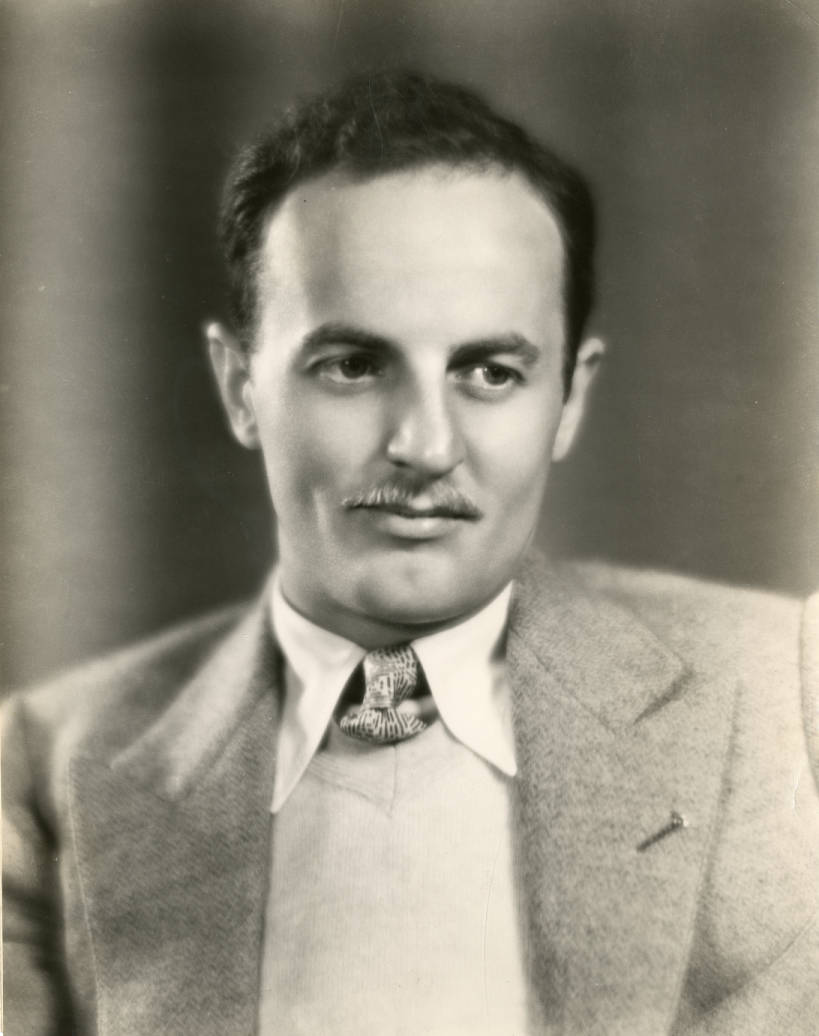
Darryl F. Zanuck. J. (1943) Willis Sayre Collection of Theatrical Photographs, Public Domain
Darryl Zanuck and Fox
by Norman B. Schwartz
Thomas Alva Edison (1847–1931) was not only the Wizard of Menlo Park, the inventor supreme of the incandescent light bulb and the phonograph. He was also the quintessential capitalist. Not only could he think up things that people wanted or thought they did, but he also made certain they could not get them unless they paid him.
Two of the gadgets he and his associates had fooled around with as early as 1888 were the kinetograph, today better known as the motion picture camera, and the kinetoscope, a peep-hole viewer, the baby brother of the projector. Once Edison figured out how to enlarge these tiny images on to a big screen, Edison went on to make any number of silent films. He was a scientist at heart rather than producer – producing he left to immigrants or sons of immigrants. Adolph Zukor, Carl Laemmle, the Williams Fox (né Fuchs), Selig, Louis B. Mayer, Harry Warner (Wonskolaser), and the former glove salesmen Samuel Goldfish (later Goldwyn) rented stores called Nickelodeons where for a few pennies the poor could watch these mindless entertainments. It didn’t take these born entrepreneurs long to realize the big bucks were not in showing flickers in tiny rooms but in making them.
Their big problem was that whenever they needed cameras and negative film, they could rent or buy them only through the Edison Trust, whose namesake put pressure on producers who were using gear or film stock other than Edison’s own. According to The Saturday Evening Post—
“Edison’s intimidation techniques even wandered outside the law on some occasions, according to Steven Bach’s book, Final Cut. The MPPC would hire mobsters to rough up film makers that were violating their patents.”1

1 3/8–inch (35 mm) filmstrip of the Edison production Butterfly Dance (c. 1894–95)
One way to avoid such retribution, they soon learned, was to follow Horace Greeley’s recommendation, “Go West,” which they did, to discover, much to their delight, that California had any number of advantages other than their personal safety: eternal sunshine, nearby beaches, deserts and mountains. And, of course, the girls – lots of pretty girls.
The brothers Warner (Harry, Albert, Sam and Jack) who had begun in Show Business by acquiring a movie projector they transported from mining town to town, eventually moved their operations to the flourishing City of Los Angeles.
By the early 1920s they had built their own movie studio on Sunset Boulevard in Old Hollywood – their most successful product a series of adventure films starring a photogenic German shepherd, born in France. Although their prize dog, Rin Tin Tin (né Rinty), could be rented for $1,000 a week, what could not be rented were stories about him. In 1924, good luck smiled again; they met a bright bucktoothed young man who told them he knew how.
Darryl Francis Zanuck (1902–79) was originally from Nebraska. He was not the son of Jewish immigrants from Eastern Europe. His parents were Protestants who ran a hotel in Wahoo where English was the language. Young Darryl began his association with the brothers by selling them story ideas, plots, then scripts, as many as nineteen a year. So successful were they that by 1929, when he was only twenty-three, the Warners made him Head of Production, a reign that lasted for almost ten years.
Because they did not have the money Metro-Goldwyn-Mayer had, nor the inclination to compete with Louis B. Mayer and Irving Thalberg in making costume spectacle films – films with “More stars than in Heaven” – Zanuck, out of necessity, went looking into the daily newspapers for stories to film quickly in everyday clothes and contemporary settings. He established an almost documentary style of moviemaking that has often been attributed to the studio owners but was really his own.
If we examine the long list of black and white films made during Zanuck’s Warner Brothers years, we see among them an astonishing modernity: The Jazz Singer (1927) is now remembered as a silent film interspersed with Jolson singing and talking, but it was also a contemporary story about the immigrant son of a cantor who preferred jazz to the synagogue. Little Caesar (1931) and The Public Enemy (1931) were the first films to humanize, even glamorize, the Italian American gangsters who had come out of Prohibition. Forty-second Street (1933) was a musical that was more than a photographic reproduction of a conventional Broadway show. Zanuck had the courage to hire directors like Busby Berkeley, who could not dance but knew how to stage elaborate numbers that moved the camera away from the proscenium into closeups or kaleidoscopic overhead shots of the entire dancing ensemble.

Theatrical release poster of the 1931 American film Little Caesar. Wikimedia Commons
These innovations were enormously popular in the Depression, and Zanuck knew it. His success led to his first dispute with the brothers. When Zanuck refused to lower his salary as Jack Warner wished, Zanuck quit and formed Twentieth Century Pictures with United Artists as its distributor. In one year, after Zanuck produced nineteen films, all but one hits, a stock dispute with little Mary Pickford, one of UA’s founders, made him quit again – this time to merge his studio with one of the oldest production facilities in Hollywood, William Fox’s bankrupt Fox Film Corporation. Success and failure married. 20th Century Fox was born.
From 1935 to 1956, an uninterrupted reign of almost twenty years, Zanuck ran 20th Century Fox from his office on its Pico Boulevard lot in West Los Angeles. What the Warners had done with Rin Tin Tin, Zanuck managed to do as well with the adorable moppet Shirley Temple, whose early films were so popular at the box office that Zanuck could risk writing or commissioning others to do something his Jewish competitors feared.
Afraid of being called ungrateful and anti-American, these immigrant producers had always avoided social commentary and criticism of their country. Zanuck was not. He exposed the nation’s poverty in The Grapes of Wrath (1940), exploitation of the poor in How Green Was My Valley (1941), antisemitism in Gentleman’s Agreement (1947), the abuse of the mentally ill in The Snake Pit (1948) and racism in Pinky (1949). These films seem tame today, but they were enormously controversial in their time.

Trailer for the 1940 black and white film The Grapes of Wrath. Henry Fonda. Public Domain
With the advent of television, people stopped going to the movies many times a week as they did during the profitable war years. To lure them back into the empty cinemas, Zanuck introduced CinemaScope and stereophonic sound, which his directors hated. Widescreen made closeups impossible, prompting one of Zanuck’s employees to say, “Cinemascope is a wonderful format if you’re making a film about snakes.” By 1957, after twenty years at the helm, Zanuck and his wife Virginia separated. Exhausted by all the years of infighting and interference by the stockholders, he announced he would withdraw from day-to-day operations of the Hollywood studio to become an independent producer in Europe.
It was there that Zanuck was free to pursue an admitted weakness – an attraction to younger, foreign girls, many of them French. He insisted on starring them in his films. Except for the chanteuse Juliette Gréco, few of them could either sing or act. The names Irina Demick, Genevieve Gilles and Bella Darvi, and the flops they made, are now forgotten – but not at the time, not by his board of directors.
In Zanuck’s absence, the Greek American Spyros Skouras (1893–1971), who had started as a Nickelodeon owner in Saint Louis and invested in Zanuck’s 20th Century film company, took charge of the studio. By the ’50s he was also instrumental in promoting the CinemaScope process and signing such young stars as Marilyn Monroe, who liked to call him Papa Skouras.
In the early 1960s, Papa Skouras was in trouble with the board of directors. With Zanuck faraway with his paramours, Skouras and the yes men who had surrounded the missing Darryl had made an amazing number of flops. Skouras remembered that the Eady Levy in the United Kingdom taxed box-office receipts and put aside large sums of money to be used to encourage film production with the condition that most of the film had to be shot in the UK or Commonwealth using British actors and technicians.
Desperate for a hit, Skouras took advantage of the beneficence to green-light a production of Cleopatra, to be directed by Rouben Mamoulian and starring Elizabeth Taylor, to begin no later than September 1960 at the Pinewood Studios at Iver Heath. Although Skouras had been warned by his British associates that late-fall-to-early-winter was not the best time to begin a production of a film that required building many outdoor scenes, he seemed in denial and insisted they begin as soon as possible.

Freedman, Alan E., with Spyros Skouras (1960). Photograph by Mbarrach Wikimedia Commons
From its start, the English production was beset with problems, foremost the star’s unpredictable health, and the predicted dreadful weather that made it impossible to shoot outdoors. There was even a hairdressers’ strike at the studio when the ladies on the lot refused to work with an American, Elizabeth’s favorite hairdresser, MGM’s Sidney Guilaroff. By November that year, with little footage shot, production having reached $5 million, Skouras halted production to reconnoiter, and Mamoulian resigned as director. Production did not pick up again until 1961, this time with Elizabeth’s insistence that Joseph Mankiewicz take over. Mankiewicz, who didn’t like the previous script, agreed with the proviso he direct during the day and rewrite at night. This time, the sets were built on the sunnier Cinecittà lot in Rome. Rex “Sexy Rexy” Harrison was cast as the elderly emperor and a young West End actor, Richard Burton, as young Mark Antony. Liz, then married to the singing star Eddie Fisher, took one look at her Welsh co-star and instantly fell in love. So did Richard. The rest is history or hysteria.
By the time production ended in March 1963, the film had cost $31 million to make, not counting the cost of the London fiasco. Mankiewicz returned to Hollywood with over 530,000 feet of film, approximately 5,888 minutes, almost a hundred hours of film to be cut to a releasable size. Mankiewicz and his editor made a first assembly that ran to five hours and twenty minutes. When he showed his cut to Zanuck, the producer was appalled. Mankiewicz suggested showing the film in two parts, the first, Cleopatra with Caesar, the second with Antony, but Zanuck refused. Still a major stockholder and force in the company despite his absence from America, he issued a nine-page response. “In exchange for top compensation and a considerable expense account, Mr. Joseph Mankiewicz has for two years spent his time, talent, and $35,000,000 of 20th Century Fox’s shareholders’ money to direct and complete the first cut of the film Cleopatra. He has earned a well-deserved rest.”

Richard Burton as Mark Antony with Taylor as Cleopatra. Courier-Gazette, McKinney, TX Photo from 20th Century Fox. Public Domain (no evidence of renewal)
Mankiewicz was fired. In October the director held a press conference, insisting he had “never demanded control” or disputed the studio’s right to the final cut. In December, he and Zanuck met again. Both men agreed that the film as now cut needed less dialogue and more action. Mankiewicz was rehired. In February 1963, 1,500 extras under his direction were called to reshoot the Battle of Pharsalus in Spain.
On 5 March 1963, two and half years after production had begun in England (in September 1960), filming, editing, and scoring were finally completed.
Cleopatra premiered at the Rivoli Theatre in New York City on 12 June 1963, and earned $725,000 in a few short weeks. By the end of the year, it had become the highest-grossing film in America. However, because the film still carried production and marketing costs totaling $44 million ($438 million now), it remained in the red. It was only after Fox sold the television broadcast rights to ABC in 1966 for $5 million, then a record amount paid for a single film, that Cleopatra finally recouped its initial costs.
Zanuck, who had replaced Spyros Skouras as president of the Fox corporation, appointed his son Richard as head of production. Richard teamed up with David Brown, once Zanuck’s head of the story department. While Zanuck Jr and Brown ran the studio, they green-lighted a series of studio-saving hits, which they had very little to do with making: Rodgers and Hammerstein’s The Sound of Music (1965), Planet of the Apes (1968), and the antiwar comedy M*A*S*H (1970).
That same year Darryl went off to Japan to produce a World War Two epic Tora! Tora! Tora!, the story of the Pearl Harbor attack told from both an American and a Japanese point of view. The film was plagued with production problems that copied Cleopatra’s – tropical storms rather than a milder English variety destroyed expensive sets; and the great but uncredited Japanese co-director Akira Kurosawa suffered a nervous breakdown.

USS Yorktown during the filming of Tora! Tora! Tora!, 1968. US Navy Public Domain
When the film was finally released, it did not prove to be the box-office blockbuster that the studio so desperately needed, while back in America, son Richard, like father Darryl, also seemed to be losing his Midas touch. Despite its stars, Richard Zanuck’s production of Rex Harrison’s Doctor Dolittle (1967), Julie Andrews’ Star! (1968), and Barbra Streisand’s Hello Dolly (1969) all lost money.
By the end of the decade, 20th Century Fox was in serious financial trouble. Zanuck returned to Paris, making more and more projects with his discoveries. Fox’s board of directors reappointed Richard its president and kicked Darryl upstairs as its chairman. When one of his father’s girlfriend’s contract came up for renewal, son Richard, exercising his board-granted power, cancelled it, causing Daddy to accuse the son of incompetence and fire him.
The one person who neither man envisioned entering the struggle was Richard’s outraged mother, Darryl’s wife. She held 100,000 shares of company stock, rushed to defend her boy and forced the board to oust her errant husband from command. Jobless but talented, Richard soon found work as Executive Vice President of Warner Brothers, the studio where his father had begun his career. Richard eventually forgave his errant father, who promised to give up his European pursuits if he could return to the family fold.
In 1973 Darryl resettled in California and moved back in with Virginia. They celebrated their fiftieth wedding anniversary together in Palm Springs. Although he had agreed to give up his mistresses, Darryl F. Zanuck continued to deny that cigars were injurious to his health.
In 1979, aged seventy-seven, the last Hollywood tycoon, Rin Tin Tin’s writer, died of pneumonia.
Notes
1 See “Thomas Edison: The Unintentional Founder of Hollywood” in The Saturday Evening Post, 29 March 2021, https://www.saturdayeveningpost.com/2021/03/thomas-edison-the-unintentional-founderof-hollywood/ (retrieved 26 June 2025). See also Bach, Steven, Final Cut: Art, Money, and Ego in the Making of Heaven’s Gate, the Film that Sank United Artists, Newmarket Press, U. S., 1999
Norman B. Schwartz is the author of the comic novels ‘ALL THINGS small‘, Paradise Now, Don Juan in Space, True (Cinema) Confessions, Hollywood: Below and Beyond, and the DIY guide, The Art Of The Schnoorr. He spent over forty years working on films in Hollywood and Rome. Norman was the first ADR sound editor / post-production dialogue director to be admitted to Academy of Motion Picture Arts and Sciences in Los Angeles.
Norman B. Schwartz’s essays will appear in sequence monthly in each issue of Ars Notoria Magazine. In October of 2025, a paperback edition of the complete collection of his essays titled: HOLLYOOD Actors & Politicos/ a Shared Profession was published and is available for purchase from Centre House Press and Amazon.
Discover more from Ars Notoria
Subscribe to get the latest posts sent to your email.
You must be logged in to post a comment.