by Bryan Greetham
I wanted to examine the claim that fascism was a last-ditch response to a failing capitalism – an attempt to rescue it. One powerful incentive to embrace a radical right party, like the National Socialists, was self-interest. The radical right appealed more to all those social groups (teachers, civil servants, army officers, police officers, small businessmen, shopkeepers, artisans, agricultural workers, salespeople, mechanics, plumbers, electricians, retail assistants, hotel workers, food service workers, childcare workers, administrative assistants, health care workers, etc.) whose economic status and privileges were threatened by the two historical forces unleashed by the Industrial Revolution.
At the end of the First World War, the heirs of the modern world appeared to be capitalism and socialism. One or the other would dominate modern politics, thereby threatening the social and economic position of these lower-middle-class groups. In such a society, as one writer put it, these groups felt psychologically homeless: they were ‘strangers in their own country’. Their traditional values seemed to be under threat.
On the one hand, there were the free market principles of liberalism that were promoting the development of ever larger international companies that were taking the markets of small businessmen, shopkeepers, farmers, etc., by undercutting them. They stood for international values, rather than traditional Germanic values represented in the countryside by traditional artisans, farmers, and agricultural labourers. This was a conflict between the urbane cosmopolitan values of the liberal classes in cities – with their international connections and interests – and the traditional values of the countryside.

soulless [Yankee] capitalism compared to the countryside loving confederates. Henry Mosler The Lost Cause, 1868. Johnson Collection, Spartanburg, South Carolina Public Domain
On the other hand, the Industrial Revolution had also brought to the surface the immense power of an organised working class, with trade unions forcing up wages at the cost of small businessmen, and socialist governments increasing taxation on the lower middle class to fund new social welfare programmes.
Professional groups, like civil servants and teachers – who were both prominent among the membership lists of the National Socialists – saw their privileged middle-class status under threat. They faced a bleak choice: either become members of one of the large trade unions and safeguard their income differentials with other groups of workers, or keep their middle-class status by refusing to join a union and see the income gap between themselves and blue-collar workers narrow and disappear.
National Socialism’s answer was to sidestep the economic problems by arguing that they were not economic at all, but racial.
At the same time that National Socialist politicians were talking about Jewish Bolshevik plotters, they were also, confusingly, referring to international Jewish capitalism.
The problem they faced, of course, was that economic problems, like mass unemployment and inflation, could only be solved by resorting to concrete economic and social policies, and these were inevitably liberal capitalist or socialist. To choose one of these policies was to give power and influence to the very forces that were changing German society in ways that undermined the privileges of the lower middle class.
National Socialism offered the lower middle class a way of sidestepping this invidious choice – the Third Way: an alternative that promised to reverse these historical forces of liberal capitalism and socialism and return to a pre-industrial society. Its answer was to sidestep the economic problems by arguing that they were not economic at all, but racial. By associating both free market capitalism and socialism with Jews and a Jewish conspiracy, they were able to activate latent anti-Semitism and nationalism and save these conservative groups from the threats they were facing.

Fascism offered ‘an alternative that promised to reverse these historical forces of liberal capitalism and socialism and return to a pre-industrial society’
Cities and their urbane culture were associated with Jews, who were said to have no roots in German culture. Here was soulless capitalism compared to the countryside, where traditional Germanic values were still respected.
These are historical lessons we need to learn about who supports fascism as we watch the rise of the scapegoating nationalist right in the UK, Europe and the USA.
Though fascism is a last-ditch response to failing capitalism, there seems to be very little evidence to suggest that there is clear economic motivation to explain why the working class might support fascism and embrace racist beliefs. So I have never had a convincing explanation for why my uncle, a lifelong member of the Labour Party and a prominent member of his local branch, should also be a lifelong racist.
And I don’t mean he was just anti-Semitic, for which there was some reason – although implausible – in that he and his elder brother, my father, would have to trudge all the way across Gateshead every week to pay the weekly rent to a wealthy Jewish family that owned their home. I say this is not a plausible reason because no form of racism has a plausible reason, and, on a personal note, my father never had a racist thought in his head.
Up until a couple of years ago, I would have said that not only is there no plausible economic motivation for the working class to embrace fascism and racist beliefs, but there is no compelling psychological evidence either.
However, the willingness of ordinary people to embrace the most extraordinary conspiracy theories to explain why it is that, despite all their efforts and sacrifices, they have to suffer the most extreme economic and social inequality – which over the last 40 years has come to match levels last recorded at the end of the Victorian era – may be a good reason to think again.

Movie poster for The Birth of a Nation, the film that inspired American Fascism depicting them as chivalric knights
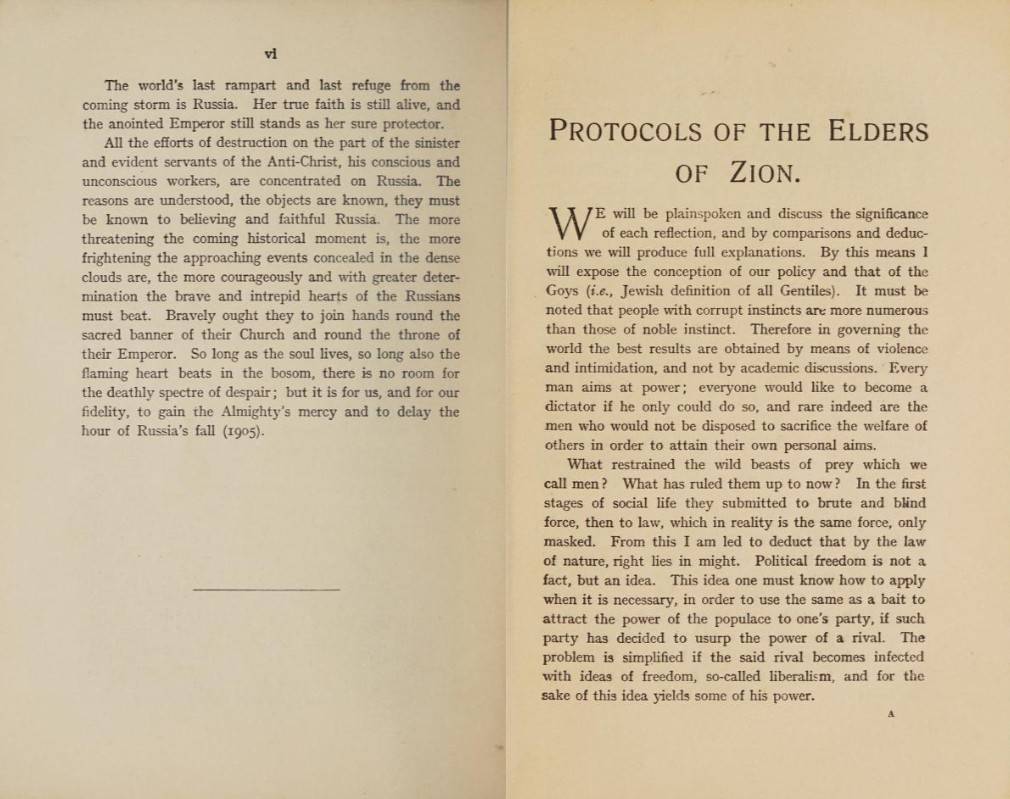
Their willingness to believe the conspiracy theory that the EU is just a front disguising the real intentions of the Germans to dominate and reassert their hegemony over Europe rivals. The Protocols of the Elders of Zion in attracting the support of working-class people, who voted to leave the EU in large numbers as their forefathers flocked to support Mosley and the British Union of Fascists. So popular was The Protocols of the Elders of Zion that it was once second only to the Bible in its circulation. To the fascist and conspiracy theorist Zionism is behind everything, including the actions of global corporate capitalism Hollywood and the western media.
Of course, this is not the only conspiracy that has been embraced with such fervour. Many also believe climate change is a conspiracy, and no doubt many more. Like all forms of nationalism, the political problem comes first, and the conspiracy theory is created to promote and protect the interests of a particular class or group by attracting the support of the working class, who might have little economic reason to embrace it.
Kenneth Minogue describes the claims of right-wing nationalists as mere ‘rhetoric’: ‘a form of self-expression by which a certain kind of political excitement can be communicated from an elite to the masses. These ideas are chameleons that take on the colour of the locality around them.’ Ernest Gellner argues similarly that nationalism is not the awakening of nations to self-consciousness: it invents nations where they do not exist.
They could both have been talking about the modern conspiracy theory and the appeal of new forms of fascism and racism to so many ordinary people in the USA.
Bryan Greetham was an Honorary Fellow in the Department of Philosophy at the University of Durham. Much of his work was in moral thinking, applied and professional ethics and in complex adaptive systems. His research at the time he died involved what could be learned about moral thinking from the perpetrators, victims, rescuers and bystanders during the Holocaust.
He was the author of How to Write Better Essays, How to Write your Undergraduate Dissertation (both on writing and thinking skills) Philosophy, an introduction to philosophy for undergraduates, Thinking Skills for Professionals and his last book, Smart Thinking, all published by Palgrave Macmillan.
Discover more from Ars Notoria
Subscribe to get the latest posts sent to your email.



You must be logged in to post a comment.