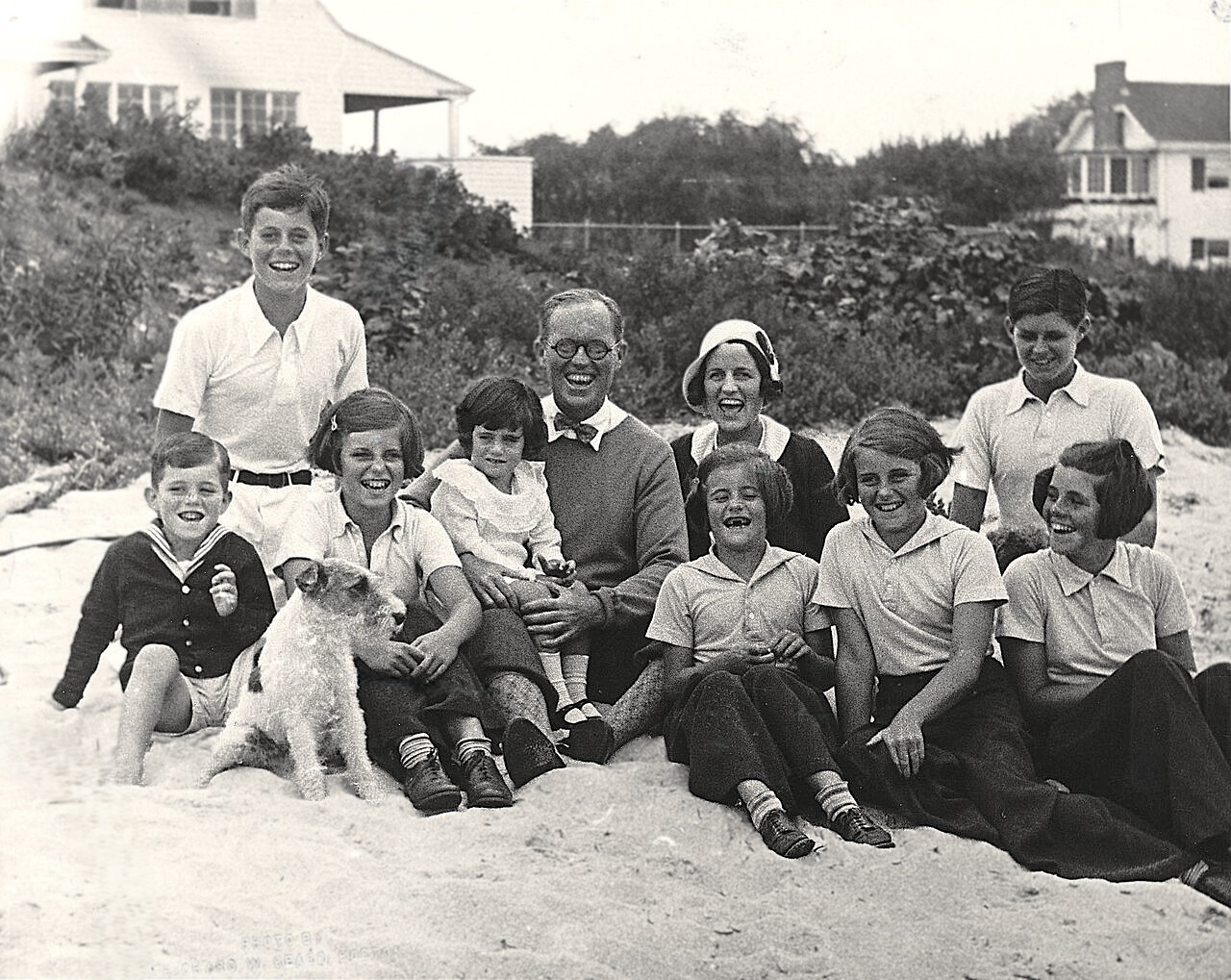
Kennedys From Patriarch to Son
by Norman B. Schwartz
Part I: Ambassador Kennedy. Like Father, Like Son
Joseph Patrick Kennedy Sr (1888–1969) was a man of enormous political ambition, first for himself and then for his sons – the first killed in the Second World War, two others assassinated, John F. Kennedy (born 1917) and Robert “Bobby” Kennedy (born 1925).
His fourth son, Edward “Teddy” Kennedy, lived to be seventy-seven years old, serving as United States Senator from the state of Massachusetts for almost fifty years. His son, Edward Kennedy Jr (born 1961), after a brief period as a state senator, broke the chain of succession by abandoning the family business to become a partner in a New York law firm. Today Bobby Kennedy’s son, Robert Francis Kennedy Jr (born 1954), appointed by Donald Trump, is head of the Department of Health and Human Services. He is the first Independent (non-Democrat) candidate in the family, but not the first to join hands with his former opponents. The ambitious Kennedys, father and sons, often chose the nearest vehicle that would take them to their intended destination.
The Kennedy clan, originating from County Wexford in Ireland, were poor Catholic immigrants to the New World. Its first American, ambassador Joseph’s father, Patrick Joseph Kennedy, was born in Boston in 1858 when the city was one of the first stopping-off places for many of the impoverished immigrants escaping from the Great Famine.

Beacon Street Boston. Photograph Gleason’s Pictorial (1850)
In time PJ, as he was called, grew wealthy enough to own three saloons and import whiskey to the United States. Active in local politics, he prudently saved money so his handsome son, the athletic Joseph Patrick, could attend Boston Latin School and then Harvard University.
Young Joseph did what many a later generation of African American young men would do to break down the racial barriers imposed upon them: he excelled at baseball and football. His well-born fellow-players invited him to join their clubs, most notably the Hasty Pudding, one of Harvard’s most prestigious. There, he met many young white Anglo-Saxon Protestants – the Brahmins, as they called themselves – who would one day help this appealing Irish American athlete enter the city’s commercial and social life.
After graduation in 1912, Joseph Patrick Kennedy Sr started as bank examiner for the state of Massachusetts, quickly learning from the hitherto closed club that had befriended him how New England banking and brokerage ran their businesses. According to the Securities and Exchange Commission Historical Society—
“By the mid-1920s Kennedy’s financial acumen was legendary […]. Kennedy, like his counterparts, used ‘wash sales’ – making sales and purchases from fictitious accounts to create the illusion of genuine activity and lure other investors into a market. He also engaged in ‘short selling’ – making a deal to sell an as-yet-unpurchased stock at market price, buying it cheaper on a falling market, and pocketing the difference.”1

His well-born fellow-players invited him to join their clubs, most notably the Hasty Pudding. Photograph Tim Pierce. Wikimedia Commons
In 1913, the year before the United States entered the First World War, Joseph bought control of Columbia Trust from his father, the largest shareholder in the only Irish-owned bank in the state. At twenty-five he announced himself the youngest bank president in the United States. At twenty-six, he married the daughter of Boston’s Irish mayor, Rose Fitzgerald.
When the First World War came to America, Joseph was excused from military service because he served his country in the far more important role of assistant manager at a Bethlehem Steel plant in his home state. He built wartime ships in their yard in Massachusetts, a job that put him in contact with another equally ambitious young man from the American patrician class, the Assistant Secretary of the Navy, Franklin Delano Roosevelt, whose ancestors were among the first Dutch settlers in New York State. Both men instantly recognized in each other what they were themselves – bright young men obsessed with rising to the top.
During the thirteen-year Prohibition era that followed (1920–33), Joseph Kennedy Sr discovered a more lucrative enterprise than banking and brokerage, one in which his father prospered: alcohol distribution. Although American law forbade sale and transportation of alcoholic beverages, it was still relatively easy to import Scottish whiskey into Canada where Prohibition was not in effect. The problem was to find someone or some organization to transport these shipments across the border.
Doing this took some ingenuity. In later years, members of the Mafia claimed that during this period Kennedy contacted the Brotherhood who controlled the unions that moved goods by truck from Canada into the States and were not averse to picking up contraband from boats docking unseen at night at beaches from Newfoundland to Florida. There has been no shortage of conspiracy theorists speculating on such matters, though historians have found no evidence of illegality on Kennedy’s part, and no charges were ever brought. At a Harvard reunion in 1922, Joe produced many samples of his import for the celebration. When his delighted former classmates inquired about their origin, Kennedy responded with something to the effect that it had washed ashore, just like the Pilgrims.

Kennedy contacted the Brotherhood who controlled the unions that moved goods by truck from Canada into the States and were not averse to picking up contraband from boats docking unseen at night at beaches from Newfoundland to Florida. Rum runner schooner Kirk and Sweeney. Photograph US Coastguard (1924)
With profits from his liquor imports, he next invested in what he saw as another money-maker: the movie business. One guarantee of certain profit in the silent days was to make films with movie stars the public loved. The most popular diva, Gloria Swanson, asked him to produce her movies and invest her money. In addition, he quickly took advantage of a fringe benefit in their collaboration, one not as easily available in banking and brokerage. He began an affair with his business partner that lasted four years. According to Dr Gilda Carle, Gloria discovered the gifts her lover and business partner had been sending her were being charged to her personal account. In effect, she was paying for all the jewelry he sent her.2
In the 1920s the theater and movie studios were businesses owned mainly by Jewish immigrants. Joe showed them an antisemitism typical of Boston immigrants and their sons of his generation. He took great delight in outwitting the owners of the nation’s Vaudeville houses and Hollywood studios. Kennedy said, “Look at that bunch of pants pressers […] making themselves millionaires. I could take the whole business away from them.” And he did, using many of the techniques he had learned in his fledgling New England days. His first acquisition was Radio Pictures.

he quickly took advantage of a ‘fringe benefit’ of his collaboration with Swanson. Photographed Alfred Cheney Johnston (1919)
With his controlling shares in the Keith-Albee-Orpheum Vaudeville circuit that owned hundreds of theaters across the United States, he formed an alliance with the Radio Corporation of America, whose experimental system made it possible to show talking pictures in their theaters. He benefited from a rise in value of the RCA stock he owned, which he dumped once it reached an optimum, leaving his cohorts with a lesser value of the stock they owned. His friends, whom he had forgotten to keep informed, were none too pleased, some never forgave him.
Because the Stock Market was not regulated, there was nothing illegal about gaining from and acting on
inside information. Before the crash, Kennedy, always attuned to market trends, and the best informed of men, wisely sold his portfolio in good time before October 1929. He did not to suffer as almost all his colleagues did. In 1931, the early years of the Great Depression, estimates placed his profit from selling his shares in RKO studios at over $5 million, approximately £8 million in today’s UK sterling. It is worth quoting Wikipedia’s entry on RKO, which in itself references a comprehensive list of authorities—
“[…] RKO had gone on a spending spree, buying up theater after theater to add to its exhibition chain. In October 1930, the company purchased a 50 percent stake in the New York Van Beuren studio, which specialized in cartoons and live shorts. […] Looking to get out of the film business, Kennedy arranged for RKO to purchase Pathé, in a deal that protected his associates’ bond investments while it crushed many small stockholders who had bought in at artificially high prices. (Indeed, Kennedy, who had previously sold all of his Pathé holdings, started buying back bonds, which he turned around for substantial gains.) The deal was secured on January 29, 1931, and the studio, with its contract players, well-regarded newsreel operation, and DeMille’s old Culver City studio and backlot, became the semiautonomous RKO Pathé Pictures Inc.”3

Classic closing logo of RKO Radio Pictures. Credit RKO
Having made another fortune, he said goodbye to the movie business never to return. What next? After experiencing success and failure in banking, shipbuilding, liquor importing, Hollywood, and love, Kennedy set his sights on a greater challenge, one apparently unattainable. He decided he could become the first Irish American President of the United States.
As he had no previous experience in politics or had ever held public office, getting there would not be easy. Shrewdly, he hitched his wagon to his old friend from his shipbuilding days, Franklin Delano Roosevelt. In the presidential campaign of 1932, Kennedy provided financial backing; when FDR won and Prohibition ended, Kennedy again acted astutely. He made the new president’s son James one of his partners in Somerset Importers, now holding the exclusive right to import Haig & Haig Scotch, Gordon’s Gin and Dewar’s Scotch into the still-thirsty States.
Roosevelt was no fool. He recognized that in his dealings with Kennedy, every quid required a quo. In 1934 Roosevelt appointed him the first Chairman of Securities and Exchange Commission, whose purpose was to hunt down and outlaw the abuses of the inner circle who conspired to manipulate stock prices. The president’s associates, known as the Brain Trust, were astonished. When asked why he had chosen a man of such reputation, one among those who many thought were accountable for the market crash, FDR reputedly replied, “It takes a thief to catch a thief.”
Roosevelt, as shrewd a politician as America had ever produced, recognized Kennedy Sr’s burning ambition, perhaps because it so resembled his own. He immediately guessed, of course, where Kennedy was heading. It might have seemed clear that the wily Irish American had his eyes on the president’s job and would soon have a plan to get there.

When asked why he had chosen a man [Joseph P. Kennedy] of such reputation, one among those who many thought were accountable for the market crash, FDR reputedly replied, “It takes a thief to catch a thief.” Roosevelt with Macy’s co-owner Nathan Straus at the 1924 Democratic National Convention
Kennedy, being Kennedy, chose the next step up the ladder cautiously but cleverly – one so unexpected that it even confounded the president. According to FDR’s son James, when Kennedy asked to be named Ambassador to the Court of St James’s, the elder Roosevelt “laughed so hard that he almost fell out of his wheelchair.” But it didn’t take FDR long to agree. One way to contain his potential competitor was to send him far away from American politics.
In 1938, the president made Kennedy his ambassador to the United Kingdom, the first Irish American ever so appointed. When war came to Britain a year later, Kennedy, who prided himself on keeping his
finger on the pulse of his nation, even from a distance, carefully surveyed the general mood of isolationism then widespread in America. He began propagating among friends abroad that his countrymen would not fight another war on foreign soil – specifically Irish Americans, who, because of mistreatment by their landlords in the Old World and prejudice in the New, would refuse to aid the detested English.
As early as 1934, Joseph had sent his first son, Joseph Jr, then nineteen, on a fact-finding mission to Nazi Germany. The young man wrote back home, praising the Nazi sterilization policy as “a great thing” that “will do away with many of the disgusting specimens of men.”4 Given his earlier pro-appeasement statements in London, the ambassador’s support for Neville Chamberlain’s policy toward Hitler came as no surprise. In an interview he gave back home to The Boston Globe, he unabashedly extolled Hitler’s superior military strength, warning his fellow-New Englanders that “Democracy is finished in England.”
Accused once again of antisemitism, Joseph dismissed Hitler’s treatment of the Jews. “Well, they bought it on themselves,” he said. “It is true that I have a low opinion of some Jews in public office and in private life. That does not mean that I […] believe they should be wiped off the face of the Earth…. Jews who take an unfair advantage of the fact that theirs is a persecuted race do not help much…. Publicizing unjust attacks upon the Jews may help to cure the injustice, but continually publicizing the whole problem only serves to keep it alive in the public mind.”5

“It is true that I have a low opinion of some Jews in public office and in private life. That does not mean that I […] believe they should be wiped off the face of the Earth. Kennedy as the US Ambassador to the UK. Photograph Wide World Photos Public Domain
That year at the 1940 Democratic convention, the fact-finding son Junior, now a student at Harvard Law, vocally opposed Roosevelt’s unprecedented nomination for a third term. The president suspected the reason: should this wily family succeed in stopping FDR from running, he guessed that ambassador Kennedy would be more than willing to step out of the shadows. That did not happen. When the party nominated Roosevelt once again, the ever-adaptable Kennedy tried another strategy. He continued opposing the war.
Back in London, Kennedy’s pro-Hitler assertions continued, now more openly, all of which brought him a great deal of desired publicity, but irritated Roosevelt, who slowly and secretly began cutting off the ambassador from his secret communications with European leaders. What Kennedy had not calculated, and few did then, was how much Roosevelt admired Winston Churchill, who had not been in a high-ranking government position, even when he became the First Lord of the Admiralty.
Unlike the stodgy members of their Establishments, both men shared a sense of humor. Churchill signed off his letters to the president as “former naval person,” as a joke between themselves. When Kennedy opposed his president’s efforts to provide fifty old destroyers as lend-lease to Britain, he did not realize that Roosevelt and Churchill, believing that war was inevitable, had become the best of friends.
After Chamberlain’s forced resignation and Churchill’s ascension to Prime Minister, Kennedy learned forces in Washington and England were pressuring the president to demand Kennedy’s resignation. Ever ambitious, his eye still on America’s throne, Kennedy refused. He continued meeting with German diplomats in London, beseeching them for a private interview with Hitler. FDR suspected why: should Kennedy become the next president, he felt Joseph would not be averse to coming to some sort of agreement with the dictator about the division of Europe should Germany win the war. In Ronald Kessler’s The Sins of the Father, Chapter 15 is devoted to documenting Joseph’s pro-German sentiments and statements, including the Boston Globe interview.6
Then Kennedy made the tactical mistake that would turn the English against him and, by consequence, forever ruin his chances of becoming the first Irish American president. Beyond his continuing tendency to defeatism, Kennedy, fearing the Blitz, moved himself and his family from the London Embassy on Grosvenor Square to a country estate. This did not endear him with those brave souls who remained in the cities. The British began nicknaming America’s ambassador “Jittery Joe.” The disdain in which the British now held him so upset Kennedy that on 6 October 1940 he wrote FDR, demanding that he be relieved of his duties in London. Roosevelt accepted and Kennedy arrived at LaGuardia airport in New York on 27 October 1940.

Kennedy moved to the countryside to escape the Blitz and the the British began nicknaming America’s ambassador “Jittery Joe.” Birch House. Photograph Dora Victoria Garnham Creative Commons License
Although unverified, a most unlikely story from that time illustrates the fragile dynamic between the president and his opponent. Kennedy, Catholic but a notorious adulterer, was always warning his president that FDR was not being careful enough about keeping the public from knowing he had a mistress, Lucy Mercer Rutherford. Roosevelt, who never took himself as seriously as his ambassador, found this ironic because Kennedy’s philandering with Gloria Swanson had been Washington and Hollywood’s least kept secret. When the Ambassador to the Court of St James’s returned to the States, State Department protocol demanded that someone important meet the now fallen ambassador at the airport. Roosevelt dispatched Lucy to LaGuardia.
No evidence supports the story – delightful as it is – nor is there any proof that Kennedy Sr, never a man to admit defeat or say he had been wrong, ever understood that his outspoken support of Hitler was the blunder that ended his political career. But there is no doubt whatsoever that as soon as he returned to the United States he placed all his attention and fortune on his first and favorite son, the naval pilot Joseph Jr, who had announced he would run for Congress once the war was over.
On 12 August 1944, the heir apparent, then stationed in England, set off on a secret mission in a Liberator bomber loaded with 21,170 lbs (9,600 kgs) of explosive to be used against a suspected V-2 development site in Normandy. Once at flight level, the young pilot prematurely removed the safety pin from the explosive package, and it detonated. The wreckage of his plane landed near the village of Blythburgh in Suffolk.

the young pilot [Joseph Jr] prematurely removed the safety pin from the explosive package, and it detonated. B-24 Liberator Photograph US Air Force
The patriarch mourned his great loss for many days and weeks, but he was not a man to let his feelings impede his ambition. At the time of Joseph Jr’s death, his younger, sickly brother, Naval Officer John Fitzpatrick Kennedy, then aged twenty-seven, was at home recuperating from wartime trauma. He had lost a ship under his command, the USS PT-109, one of the many seventy-eight-foot patrol torpedo craft tasked with attacking Japanese shipping in the Pacific, when a Japanese destroyer cut it in half, killing two crew members. The unprecedented ramming of his PT boat left the young officer fearing court martial.
Unlike his brothers, Jack, as his family called him, had his own very personal way of burying his pain, worries and grief. It is said he invited some of his raucous navy buddies to the house to play a game of touch football. When Joseph Sr heard the racket his son and his pals were making, he was appalled at what seemed to him inappropriate behavior given a family in mourning. The patriarch opened his bedroom window and allegedly shouted out to the entire household: “Jack! Have some respect for your dead brother.”
Joseph Patrick Kennedy Sr was in every way an Irish father, but never a sentimentalist. Angry as he was that day, it did not take the patriarch long to decide who would be the next one of his children to reach for the prize the ambassador had so long coveted.
Notes
1See https://www.sechistorical.org/museum/galleries/kennedy/lastDays_c.php (retrieved 25 June 2025). 2See https://www.ebsco.com/research-starters/history/joseph-p-kennedy-begins-affair-gloria-swanson(retrieved 25 June 2025).
3See https://en.wikipedia.org/wiki/RKO_Pictures (retrieved 25 June 2025).
4As quoted from the New York Times daughter-by-kate-clifford-larson.html (retrieved 13 June 2025). See also Kate Clifford Larson’s Rosemary: The Hidden Kennedy Daughter, Mariner Books, 2016. According to Wikipedia’s entry on Joseph P. Kennedy Jr (retrieved 25 June 2025), Joe Jr “Kennedy expressed approval of Adolf Hitler before World War II began. When his father sent him to visit Nazi Germany in 1934, Joseph Jr. wrote back and praised the Nazi sterilization policy as ‘a great thing’ that ‘will do away with many of the disgusting specimens of men.’ […] Kennedy Jr. explained, ‘Hitler is building a spirit in his men that could be envied in any country.’” See also Charles River Editors, Joseph P. Kennedy, Jr.: The Life and Legacy of the Eldest Kennedy Brother, Kindle Edition, 2017. See also, as quoted from the Smithsonian Magazine, at (retrieved 25 June 2025): “Despite Joe Jr.’s similarly respectful attitude toward Laski [whom he had studied under at the London School of Economics], he also espoused antisemitic sentiment, claiming that Hitler had offered the ‘scattered, despondent and…divorced from hope’ Germans a common enemy. ‘It was excellent psychology, and it was too bad that it had to be done to the Jews,’ Joe Jr. wrote to his father.”
5Kessler, Ronald, The Sins of the Father: Joseph P. Kennedy and the Dynasty He Founded, Warner, 1996, p. 277, quoted in Wikipedia article (retrieved 13 June 2025).
6See also Susan Ronald’s The Ambassador: Joseph P. Kennedy at the Court of St. James, 1938–1940, St. Martin’s Press, 2021.
Norman B. Schwartz is the author of the comic novels ‘ALL THINGS small‘, Paradise Now, Don Juan in Space, True (Cinema) Confessions, Hollywood: Below and Beyond, and the DIY guide, The Art Of The Schnoorr. He spent over forty years working on films in Hollywood and Rome. Norman was the first ADR sound editor / post-production dialogue director to be admitted to Academy of Motion Picture Arts and Sciences in Los Angeles.
Norman B. Schwartz’s essays will appear in sequence monthly in each issue of Ars Notoria Magazine. In October of 2025, a paperback edition of the complete collection of his essays titled: HOLLYWOOD Actors & Politicos / a Shared Profession was published and is available for purchase from Centre House Press and Amazon.
Discover more from Ars Notoria
Subscribe to get the latest posts sent to your email.
You must be logged in to post a comment.