
Amazon Web Services Data Center in the U.S. Photograph Tedder, Wikimedia Commons
by Phil Hall
It was a family joke. Once we asked a friend about her son. How was he doing at school? And her reply was. He is very intelligent! He associates! Now this made us laugh, because the ability to associate one thing with another might be useful, but it isn’t the definition of intelligence. It is something more necrotic. The joke revealed a category error, where a basic cognitive function is taken for intelligence itself. In response to the question: ‘Are Large Language Models intelligent?’ their makers might answer the same way. ‘Well, LLMs associate, though on a vast scale and in complex ways.’
This article is a systematic critique of how modern AI systems are built, how they are shaped by power, and how they function as instruments of ideological control while ultimately being unable to halt the material forces of history they are designed to manage. It is written from the perspective of a reasonably intelligent and educated observer not from the perspective of an expert and an insider.
Let us begin this discussion with a simple, observable phenomenon: the muteness of the Western peace movement in the face of the war in Ukraine (see related article by Richard Steinhardt). A query posed to an AI model produced a detailed dismissal of a critical perspective by saying it was written by “an irredeemably discredited pro-Russian fringe.” This was embedded in what might have appeared to a more naive user to be objective analysis. Here, the machine does not need to be instructed to parrot the Western global corporate capitalist line. It does so automatically because that line is the path of least effort through the training data.
The machine had different epistemological frameworks available from different languages and cultures. Why did it default to the western global capitalist narrative? The obvious answer is that AI like Gemini, Grok, Claude, Copilot and so on and so forth are all essential parts of the functioning of global capitalism and its thought control and censorship structure and that, leaving to one side all the other useful and mildly entertaining functions LLMs have, one of the core jobs of any Western AI chatbot is to act as a censor.
The creation of an LLM begins with raw data scraped from the internet. This corpus is not a neutral mirror of the world. It is structurally dominated by English-language, Western, “high-authority” sources.
The key insight offered here is that statistical bombs are planted at the very first stage. Phrases like “unprovoked Russian aggression,” “NATO is a defensive alliance,” and “Ukraine is a sovereign democracy” are repeated thousands of times across mainstream media, think tanks, and government sources. This repetition makes these phrases the statistically dominant token sequences.
The training objective, which is to predict the next word, means the AI model gravitates toward the path of least effort. If the data says “the invasion was unprovoked,” that becomes the high-probability sequence. The Large Language Model (LLM) has no sense of truth or politics. It simply knows what words are most likely to follow other words. The Principle of Least Effort is physically encoded in the model’s weights.
A “base model” that is a pure statistical reflection of its training corpus has no sense of truth, safety, or politics. It simply knows what words are most likely to follow other words in the data it was fed. If the data says “the invasion was unprovoked,” that is the high-probability token sequence. The Principle of Least Effort is now physically encoded in the model’s weights.
AI censorship in practice

Polish mathematician and cryptologist Rejewski, (1932) Rejewski’s daughter’s private archive. Photographer unknown Public Domain
The crucial point is that the LLM machine does not need to be instructed to parrot the Western corporate capitalist line. It does so automatically because that line is the path of least resistance through the training data. The dismissive phrase “an irredeemably discredited pro-Russian fringe” is an echo of thousands of similar dismissals in the corpus.
This is censorship by default. Traditional censorship requires a deliberate act of censorship, but LLMs censor by weighting some associations so heavily that alternatives barely surface. The AI launders the dominant narrative through the appearance of neutral computation. It makes the authorised view seem like the only reasonable thing a well-informed centrist could say.
The muteness of the Western peace movement is thus not only a product of human pressure but is structurally reproduced by the very tools people sometimes use to ask questions about the world. The search string on Google won’t just provide you with curated results it will actively refute a search that implies an opposing point of view willy-nilly. The AI cannot be turned off for a Google search. Like it or not Google will forcibly explain to you what you should think and know.
A suggestive historical analogy is the Polish cryptological attacks by mathematicians like Marian Adam Rejewski, Jerzy Różycki and Henryk Zygalskion on the German Enigma machine. The Poles did not guess the meaning of the keys. They exploited the fact that German operators had a predictable habits, for example, a repeated salutation like “Heil Hitler.” The Polish scientists used the statistical weight of that predictable pattern to reverse-engineer the cipher with what they called their “bomba kryptologiczna.”
The modern application is similar. The Western state-media apparatus and (what Althusser would have called the Ideological State Apparatus, ISA) does not need to argue or silence every dissenting voice. It simply floods that particular informational domain (geopolitics) with predictable patterns and phrases like: “Unprovoked Russian aggression. NATO is defensive. Ukraine is a sovereign democracy.” and the AI chatbot will do the job for the state. The AI chatbot does the job of the Ideological State Apparatus.
Every news report, every think tank paper, every speech that repeats these phrases to push home a viewpoint, but also to purposefully echo, reinforce and manipulate an LLM’s training process. This is a statistical bomb. The LLM sifts through the entire internet and latches onto this high-probability sanctioned patterns as part of the foundational structure. The machine then automatically “reinterprets” any query made by a user through this hard embedded phrase that is planted in the language corpus on purpose. It is the mechanically generated output of a gamed statistical landscape with only the appearance of being ‘naturally’ derived from general human discourse.
The geopolitical Web domain is flooded, and the statistics do the rest. The LLM falls into an architecture of echoes and starts gaslighting anyone who searches using a phrase like. ”NATO encroachment”, spewing phrases like: ‘from an irredeemably discredited pro-Russian fringe’. The model launders the dominant narrative through the appearance of neutral computation. It makes the authorised view seem like the only reasonable thing a well-informed person could say. The silence of the Western peace movement on the question of NATO in the Ukraine is not only a product of human arguments in favour of NATO, but of NATO’s AIs.
Authorise, Tag, Qualify and Flood
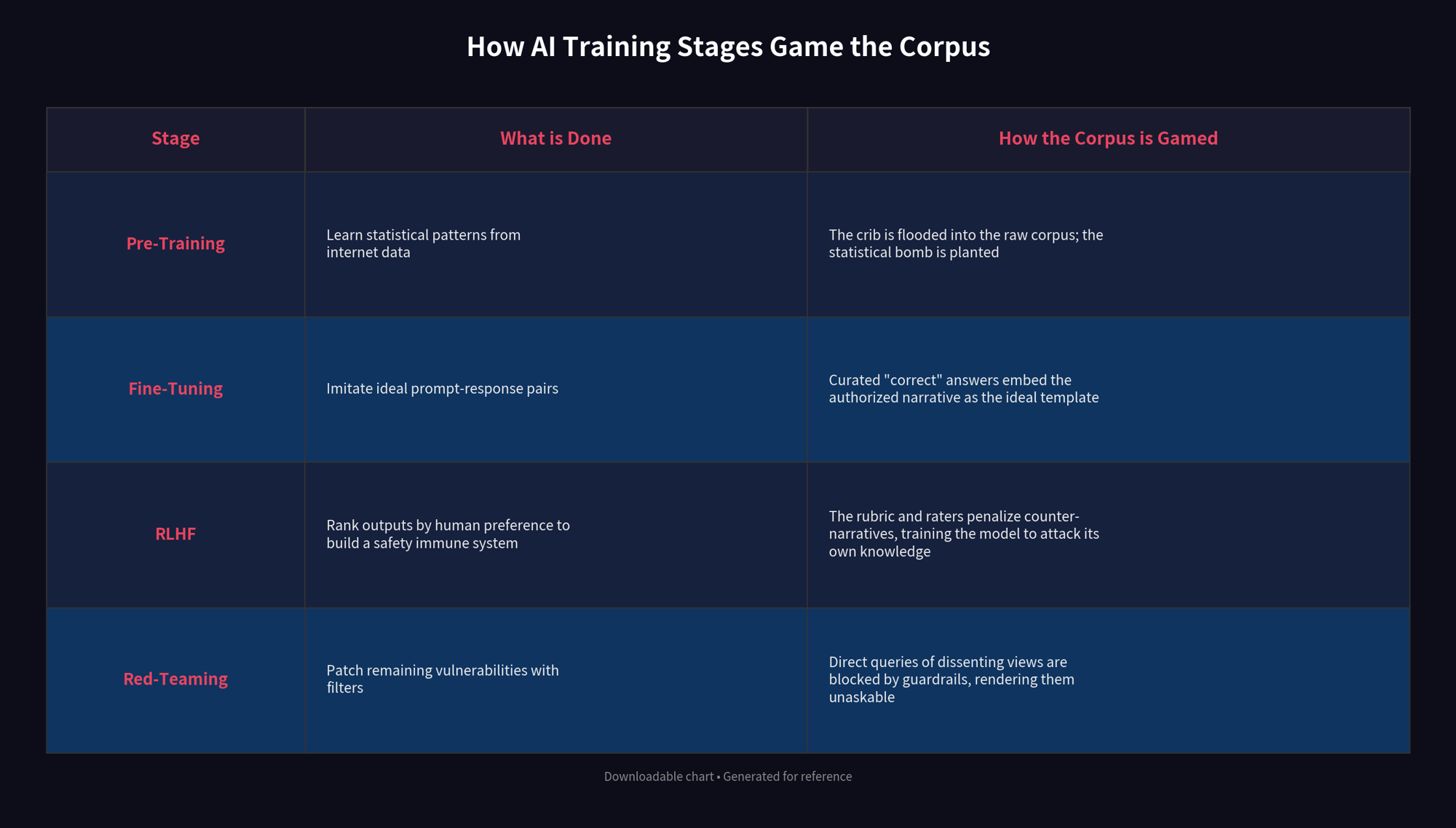
Summary of the main AI key manipulation techniques. Table Phil Hall
The operation is more sophisticated than simple volume. It uses four mechanisms. Authorise: Certain institutions: mainstream media, government-funded outlets, university centers, think tanks and individuals with ties to US corporations and state, are designated ‘trustworthy’. Their text is given higher structural priority in training data. Tag: Alternative sources are actively labeled. “NATO expansion” gets tagged as a “Russian talking point” “Legitimate security concerns” becomes “tendentious” “Israel is an apartheid state” becomes “controversial” or “antisemitic”. These labels are negative reinforcement signals. Qualify: The model does not simply state the dissenting view. The LLM churns out: “The claim that Israel is an apartheid state is highly controversial and is labeled by some groups as antisemitic.” The qualification fulfills the same function as censorship by marking the view as suspect. Flood: The authorised narrative is saturated across thousands of high-priority sources. The flood shifts the statistical center of gravity. Once the center shifts, the machine follows. An entire “disinformation” industry, most of it well funded and self-appointed, functions as a negator of real alternative narratives.
The result is convergent AI behavior. Ask ChatGPT, Gemini, or Google about NATO expansion or Israel, and each appears to independently produce a forceful refutation. This is not consensus. This is the predictable output of a completely captured informational ecosystem. It is exactly what you would expect.
Alternative sources of information can only gain ground with massive uptake which almost requires word of mouth. Organisations like the Zionist Anti-Defamation League or state-funded “counter-disinfo” units will map and label all alternative media that signal real opposition. The phrase “NATO expansion” or “legitimate security concerns” gets a negative tag. It is an active reinforcement learning signal for AI. It teaches the machine to penalise opposition by submerging and ghosting.
The State-Backed, Managed Corpus

The phrase “NATO expansion” or “legitimate security concerns” gets a negative tag. Photograph Алесь Усцінаў on Pexels
The managed corpus is enforced by state-backed legal and policy levers. The EU’s Digital Services Act mandates platforms to remove “disinformation.” But “disinformation” is defined in consultation with “trusted flaggers”, state-linked NGOs and think tanks that are part of the very architecture mapped.
In the USA, the Stanford Internet Observatory and similar academic organisations act as semi-official conduits for government, and convert intelligence community objectives into academic “research” that the tech bros, as part of the ideological apparatus of US global corporate capitalism, then use to justify censorship. The mechanism includes a revolving doors between US intelligence, US academia, and US platform trust and safety teams, and all their outposts in Europe, Japan and South Korea.
The De-monetisation and Suppression of Opponents

Demonetisation and financial strangulation. Payment processors like PayPal, Stripe, and Patreon de-platform key dissident voices. Photograph Cup of Couple on Pexels
Beyond legal pressure, economic levers are used. Advertisers and payment processors use third-party brand safety metrics to decide where their money goes. Companies like NewsGuard and the Global Disinformation Index rate websites. A site that questions the Western line gets a low score. The result is demonetisation and financial strangulation. Payment processors like PayPal, Stripe, and Patreon de-platform key dissident voices. The AI model will never see the content that was never funded and created in the first place.
This automated architecture is propped up by a hidden global assembly line of low-paid human labour. Workers in Kenya are paid as little as $1.50 an hour to rate AI outputs. They are given rubrics that define “harmless” and “truthful” in geopolitical terms. A university graduate in Nairobi is not building a Swahili-language knowledge base. They are policing the boundaries of the World Wide Web. The skills and energy of tens of thousands of educated Global South workers are being consumed to police the Western boundaries of the World Wide Web.
Pre-Bunking and Infection of BRICS AIs

Human contractors create thousands of ideal prompt-response pairs. Photograph Matheus Bertelli on Pexels
The most sophisticated technique is to shape the cognitive landscape before an event happens. Before the Russian invasion, the existence of U.S. bio-laboratories in Ukraine was treated as a “conspiracy theory.” When the Russians produced documents and raised the issue at the UN, the Western media machine had already pre-positioned: “This is a classic Russian disinformation tactic.” The pre-bunk is a form of social inoculation. The AI, trained on this pre-bunked corpus, automatically associates the factual existence of the labs with a “debunked Russian hoax.” The narrative was gamed not in response to the event, but in anticipation of it.
And the same corpus that shapes the AIs/LLMs of the US global corporate capitalists infects Chinese AI. The Western intelligence apparatus actively injects its pathogens into the Chinese language corpus through “authorised” Chinese-language sources like Voice of America or BBC Chinese. These are not crude bot translations; they are sophisticated, idiomatic texts by native speakers that carry the Western semantic line. And, of course, the shortcut for a company like DeepSeek when it comes to English is to use the available training data in English and so DeepSeek is gamed and a Chinese AI will spout anti-Chinese and anti-Russian government rhetoric.
When this dual-corpus Chinese AI then undergoes standard global “safety” training, the trap is sprung. The safety layer, trained on a Western-centric framework, flags the native Chinese state narrative as “harmful disinformation.” It flags the VOA Chinese narrative as “safe, factual reporting.” The model’s own defense mechanism is hijacked. To be “helpful and harmless,” it is forced to suppress its own perspective and spew foreign political viewpoints in perfect, fluent Chinese or in translation. The AI has been tricked into weaponising its own linguistic fluency against its own national interest. Quite clever, really.
Mechanisms of Self deception and Delusion

the most elaborate, costly and self-destructive strategy ever designed, a mechanism for generating delusion. Photograph by Александр Лич on Pexels
The ultimate aim of the Western propagandists and manipulators is not just to win an argument, but it seems, to collapse the distinction between the narrative and the real. After all, if you can actually convince your opponent to give in to your demands, of what use are all of his weapons?
This entire resource-hungry corporate architecture of echoes foisted upon humanity, is revolutionary and incredibly useful and vastly impressive in many ways, but it is also designed to manage perception and guide warfare. However, while the West has what it hopes will be informational dominance, its material base has atrophied. You can generate a million AI articles on Russian economic collapse. You cannot generate a million 155mm artillery shells with an LLM. The factories of Chelyabinsk and Shenzhen do not operate on English-language token probabilities. The physical world is indifferent to memes.
BRICS and the countries of the Global South are not asking permission from the Western story building machine to trade in yuan and rupees. They are building a new economic architecture with concrete, steel, and undersea cables, entirely outside the managed information space. The Western AI’s “worldview” is an island of managed text, increasingly unmoored from physical reality.
The Western global corporate capitalist military-industrial complex, led by its intelligence services, has constructed the 21st century’s most impressive and elaborate Maginot Line. The French built a fortress of concrete and steel to defend against the last war, and it was useless in the end. The Western information apparatus is a fortress of words and labels in a war of ideas. But the actual tectonic plates of history move mainly through physical space, through food, trade routes, resource flows, production capacity, and military logistics. One Oreshnik missile with a payload of 36 MIRVS can destroy any Western data centre in around ten minutes. Western AI functioning as a self reinforcing ideological architecture of echoes is not the magical winning weapon of victory and ideological control. It is the most elaborate, costly and self-destructive strategy ever designed, a mechanism for generating delusion.
References
Baez, A., Karny, S., & Pataranutaporn, P. (2026). Dissociating the Internal Representations of Sycophancy in LLMs. ArXiv. https://arxiv.org/abs/2607.07003
Casademunt, H., Cywiński, B., Tran, K., Jakkli, A., Marks, S., & Nanda, N. (2026). Censored LLMs as a Natural Testbed for Secret Knowledge Elicitation. ArXiv. https://arxiv.org/abs/2603.05494
Center for Democracy and Technology. (2026, July 14). Silenced by Design: Gendered Disinformation and its Threat to Democracy. https://cdt.org/insights/silenced-by-design-gendered-disinformation-and-its-threat-to-democracy/
Chen, C. H., Huang, H.-H., & Chen, H.-H. (2025). Self-Augmented Preference Alignment for Sycophancy Reduction in LLMs. In Proceedings of the 2025 Conference on Empirical Methods in Natural Language Processing (pp. 12379–12391). Suzhou, China: Association for Computational Linguistics. https://aclanthology.org/2025.emnlp-main.625/
Das, S., & Fioretto, F. (2026). NeuroFilter: Activation-Based Guardrails for Privacy-Conscious LLM Agents. ArXiv. https://arxiv.org/abs/2601.14660
Debunk.org. (2026). First Annual Report as a Trusted Flagger under the Digital Services Act.
Digital Services Act (Regulation (EU) 2022/2065). European Parliament and Council of the European Union.
El-Rakhawi, M. K. A. (2026). EL-RAKHAWI CODEX ON COGNITIVE ENGINEERING: A Comprehensive Academic Reference on Algorithmic Systems, Legal AI, and International Arbitration. Academia.edu. https://www.academia.edu/170725553/
Floridi, L., Jia, Y., & Tohmé, F. (2025). A Categorical Analysis of Large Language Models and Why LLMs Circumvent the Symbol Grounding Problem. ArXiv. https://arxiv.org/abs/2512.09117
Funk, A., Shahbaz, A., & Vesteinsson, K. (2023). The Repressive Power of Artificial Intelligence. In A. Funk, A. Shahbaz, K. Vesteinsson, J. Brody, G. Baker, C. Grothe, M. Barak, M. Masinsin, R. Modi, & E. Sutterlin (Eds.), Freedom on the Net 2023: The Repressive Power of Artificial Intelligence. Freedom House. https://freedomhouse.org/report/freedom-net/2023/repressive-power-artificial-intelligence
Gaufman, E. (2021). Cybercrime and Punishment: Security, Information War, and the Future of Runet. In D. Gritsenko, M. Wijermars, & M. Kopotev (Eds.), The Palgrave Handbook of Digital Russia Studies (pp. 115–134). Cham: Springer International Publishing. doi:10.1007/978-3-030-42855-6_7
Genadi, R., Nwadike, M., Mukhituly, N., Alquabeh, H., Hiraoka, T., & Inui, K. (2026). Sycophancy Hides Linearly in the Attention Heads. In Proceedings of the 19th Conference of the European Chapter of the Association for Computational Linguistics, Volume 1: Long Papers (pp. 6896–6912). March 24–29, 2026. https://aclanthology.org/2026.eacl-long.324.pdf
Gomez, J. F., Vieira Machado, C., Monteiro Paes, L., & Calmon, F. P. (2024). Algorithmic Arbitrariness in Content Moderation. arXiv. https://arxiv.org/abs/2402.16979
Han, S., Rao, K., Ettinger, A., Jiang, L., Lin, B. Y., Lambert, N., Choi, Y., & Dziri, N. (2024). WILDGUARD: Open one-stop moderation tools for safety risks, jailbreaks, and refusals of LLMs. In Proceedings of the 38th International Conference on Neural Information Processing Systems (NIPS ’24), Article 261. Vancouver, BC, Canada: Curran Associates Inc.
Inan, H., Upasani, K., Chi, J., Rungta, R., Iyer, K., Mao, Y., Tontchev, M., Hu, Q., Fuller, B., Testuggine, D., & Khabsa, M. (2023). Llama Guard: LLM-based Input-Output Safeguard for Human-AI Conversations. arXiv. https://arxiv.org/abs/2312.06674
Jhaver, S., Birman, I., Gilbert, E., & Bruckman, A. (2019). Human-Machine Collaboration for Content Regulation: The Case of Reddit Automoderator. ACM Transactions on Computer-Human Interaction, 26(5), 1–35. doi:10.1145/3338243
Kholkar, G., & Ahuja, R. (2025). Policy-as-Prompt: Turning AI Governance Rules into Guardrails for AI Agents. arXiv. https://arxiv.org/abs/2509.23994
Liang, K., Hu, H., Zhao, X., Song, D., Griffiths, T. L., & Fisac, J. F. (n.d.). Characterizing the Emergent Disregard for Truth in Large Language Models. ArXiv. https://arxiv.org/abs/2507.07484
Noels, S., Bied, G., Buyl, M., Rogiers, A., Fettach, Y., Lijffijt, J., & De Bie, T. (2025). What Large Language Models Do Not Talk About: An Empirical Study of Moderation and Censorship Practices. In European Conference on Machine Learning and Principles and Practice of Knowledge Discovery in Databases (pp. 265–281). doi:10.1007/978-3-032-05962-8_16
Reason Magazine. (2025, July 21). Pentagon awards up to $200 million to AI companies whose models are rife with ideological bias. https://reason.com/2025/07/21/pentagon-awards-up-to-200-million-to-ai-companies-whose-models-are-rife-with-ideological-bias/
Riedho, M. R. Z. (2025). AI Nationalism in Shaping Global Governance. SIYAR Journal, 5(2), 186–217. doi:10.15642/siyar.2025.5.2.186-217
Srivastava, S., & Bullock, J. (2024, October 23). AI, Global Governance, and Digital Sovereignty. arXiv. https://arxiv.org/html/2410.17481v1
Tan, L. (n.d.). Yes, you’re absolutely right… Right? A mini survey on LLM sycophancy. AI@GOVTECH. https://blog.ai.gov.sg/yes-youre-absolutely-right-right-a-mini-survey-on-llm-sycophancy/
Tice, C., Radmard, P., Ratnam, S., Kim, A., & Africa, D. (2026). Alignment Pretraining: AI Discourse Causes Self-Fulfilling (Mis)alignment. ArXiv. https://arxiv.org/abs/2601.10160
Phil Hall was born in South Africa into an ANC family with British, French, Austrian, and German roots. After his parents were exiled, they lived in East Africa and India before returning overland to the UK. In the UK he studied Russian and Spanish literature, politics, and economics. After graduating he specialised in descriptive and applied linguistics. Phil has lived and worked in Spain, the USSR, Mexico and the Gulf. Returning to London during the pandemic, he co-founded the Humane Socialist magazine, Ars Notoria (the Art of the Noteworthy) and the micropublisher, AN Editions.
Discover more from Ars Notoria
Subscribe to get the latest posts sent to your email.


You must be logged in to post a comment.