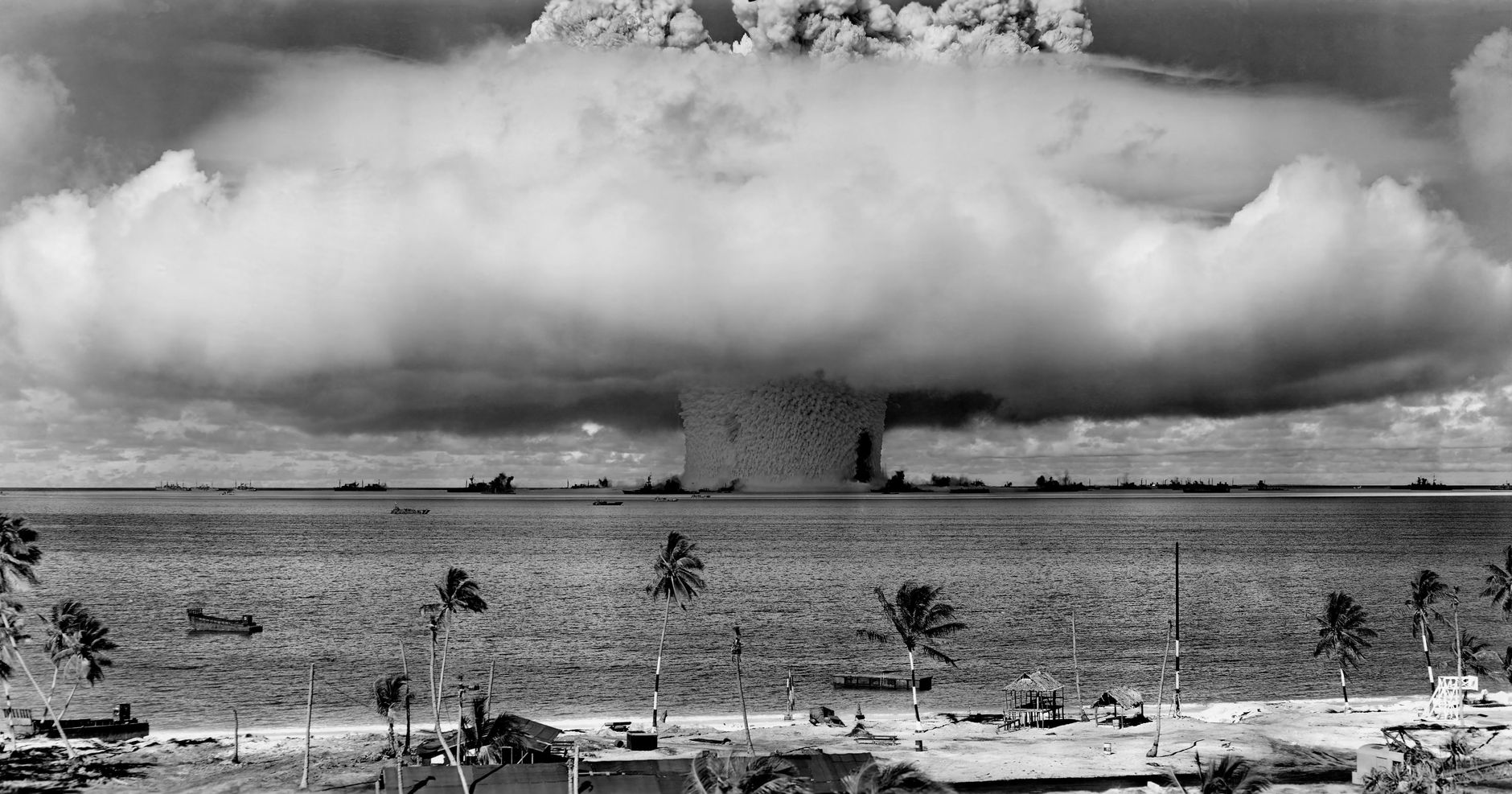
US Atom Bomb Test, Photograph US Army
OK, maybe I am a coward, but I want my children, grandchildren, family, friends, community, nation and world to survive
Open the door
Lay on the floor, you’ve been robbed
Wake up
Wake your ass up
Take off your jewels
You fuckin fools, you’ve been robbed
— Biggie Smalls
by Richard Steinhardt
Throughout the 1980s, a mass peace movement, symbolised by the Campaign for Nuclear Disarmament in Britain and elsewhere across Europe and North America, mobilised millions of people against the nuclear arms race. Those movements opposed the first strike policies of Western governments, helped forced arms control negotiations, and created genuine political costs for escalation.
Today, we are objectively closer to nuclear confrontation than at any point since the Cuban Missile Crisis and Abel Archer 83. Arguably, we were even closer to nuclear war when Biden authorised the firing of American long range missiles into the Russian Federation guided by American satellites on 17th November 2024.
The United States has abandoned arms control, adopted a first-strike doctrine, and presides over a global corporate empire that appears increasingly willing to risk general conflagration rather than accept a multipolar world. The rhetoric from Washington and its allies has become reckless and terrifying as Donald Trump presents the world with the rotting face of the dying hegemon.
Yet where is the peace movement? The European left, which once placed nuclear disarmament at the centre of its political identity, is largely silent on this question of life or death. Where are the Greenham Common women when you need them? They are all out getting arrested for Palestine Action. Some of the same voices that express outrage over Gaza, rightly and with moral clarity, have found nothing to say about the disintegration of the nuclear arms control architecture or the march toward potential global catastrophe. It is a form of self blinding.
This is not an accident. It reflects a decades-long process by which Western civil society has been systematically co-opted, funded, and directed away from challenging the fundamental structures of imperial global corporate power into smaller concerns, most relating to first world problems and lifestyle. The peace movement was not simply defeated it was tricked; it was deliberately dismantled, its organisations defunded or repurposed, its moral energy redirected into causes that do not threaten the prerogatives of the national security state. Outrage about the slaughter in Gaza is almost sanctioned, so long as the existence of the Zionist state is not called into question. Bleat away!
The result is a political landscape in which the most dangerous escalation spiral in human history, the conflict in Ukraine, is met with a shrug, and: What can we do? And otherwise moral people find themselves, on the issue of Ukraine, in close alignment with Donald Trump, Pete Hegseth, Netenyahu, the warmongering Democratic Neocons, and cosying up to the revolting Lindsey Graham in his coffin.
And now, with the threats to annihilate Iran, the US / global corporate capitalist empire’s strategists in the Rand Corporation and elsewhere, contemplate the possibility of burning down the entire world in the hope of being the last man standing. The Masters of War now operate without the domestic political friction that once constrained them coming from mass movements like CND – activists are redirected into virtue signalling about Gaza, so long as they aren’t too stroppy about it.
This silence is not natural. It was by design. And unless it is broken, the absence of a peace movement will be remembered as one of the enabling conditions of Armageddon. If there is anyone left to remember.
THE RUSSIAN FEDERATION’S STRATEGIC POSITION

OK, perhaps I am a coward, but I want my children and grandchildren and family and friends and community and nation to survive. Photograph Ilya Perelude on Pexels
The Russian Federation possesses the largest conventional army in Europe, battle-hardened and massively expanded since 2022, with an increasingly experienced officer corps and a defence-industrial base operating at full capacity. This is not a nuclear power in isolation; it is a nuclear power fused to a major land army with deep reserves of manpower and equipment.
Economically, Russia is fortified by a strategic partnership with China, the world’s second-largest economy and its most important ally. This relationship provides Russia with access to advanced electronics, dual-use technologies, and an economic hinterland that has proven immune to Western sanctions. The two nations coordinate military exercises, share intelligence, and operate in an increasingly integrated strategic framework stretching from the Arctic to the Pacific.
Beneath this geopolitical alignment lies Russia’s natural resource base. Russia is the world’s largest country by area and possesses the most extensive proven reserves of energy and minerals of any nation outside Africa. It is the world’s top exporter of natural gas, a top-three producer of oil, and holds vast deposits of coal, uranium, rare earth metals, nickel, copper, and gold. In a prolonged conflict, Russia is self-sufficient in the energy, food, and raw materials essential to sustain both a war economy and a functioning society. It cannot be starved of fuel, cut off from electricity generation, or deprived of the basic industrial inputs that modern warfare consumes at staggering rates.
This resource independence — combined with a vast, defensible landmass stretching across eleven time zones and enduring alliances in the Global South — gives the Federation confidence that it can outlast any adversary in a protracted confrontation.
THE RUSSIAN FEDERATION’S SHIFT TO PRE-EMPTION

The nuclear balance that prevailed for decades has been dismantled in recent years. Photo by Edu Raw on Pexels.com
The nuclear balance that prevailed for decades has been dismantled in recent years. The Russian Federation repeatedly called on the United States to renew the New START treaty, the last remaining arms control agreement limiting deployed strategic warheads, but the Biden administration refused to engage in good-faith negotiations, allowing the treaty’s verification mechanisms to lapse. From Moscow’s perspective, Washington walked away from the table.
This diplomatic rupture was compounded by a far more alarming development. In 2022, the Biden administration formally adopted a new nuclear posture that included, for the first time, explicit language permitting a first-use nuclear strike. The long-standing ambiguity over whether the United States might strike first was replaced by a doctrine that openly reserved the right to do so.
For Russian strategic planners, this crossed a red line. A nuclear-armed adversary that had withdrawn from arms control and now claimed the right to launch a surprise first strike presented an existential threat that the old Russian doctrine — which permitted nuclear use only in response to an attack — could not adequately address.
The result was a fundamental review of Russia’s own nuclear doctrine. Moscow concluded that in an era of abandoned treaties and declared American first-strike options, waiting to absorb a nuclear attack before responding was no longer a viable strategy. Russia revised its doctrine to explicitly permit a pre-emptive nuclear strike if reliable intelligence indicated that an enemy attack was imminent and unavoidable.
This shift — from retaliation to pre-emption — represents the most significant change in Russian nuclear thinking since the end of the Cold War and directly shapes the posture of the arsenal described below.
THE RUSSIAN FEDERATION’S “DEAD HAND” SYSTEM GUARANTEES MUTUALLY ASSURED DESTRUCTION.
The Sarmat Missile
The common figure of roughly 6,000 Russian nuclear warheads refers to the total stockpile. 1,700 are actually deployed on missiles, submarines, or at bomber bases and ready to launch within minutes. A further 2,500 are held in central storage as a strategic reserve.
To deliver the 1,700 deployed warheads, Russia relies on roughly 330 long-range strategic launchers, 14 stealthy nuclear submarines, and 117 heavy bombers, backed by hundreds of shorter-range missiles and artillery pieces whose warheads are drawn from the reserve.
Binding the entire arsenal together is the “Perimeter” system, known in the West as the “Dead Hand” — an automated doomsday device that guarantees a retaliatory strike even if the entire leadership is wiped out. If sensors detect nuclear explosions on Russian soil and all communication links to the high command go dead, the system automatically launches a special command rocket that broadcasts a launch order directly to all surviving missiles, submarines, and bombers. It is on constant alert and has been modernised.
RUSSIAN WEAPONS SYSTEMS

An estimate of the damage that would be caused by one Soviet ‘Tsar Bomb’ the largest bomb ever made.
While much of Russia’s arsenal consists of steadily modernised Cold War-era designs, four new systems stand apart as true game-changers. They are designed not merely to update the triad but to render existing Western defences obsolete.
RS-28 Sarmat: The World’s Most Destructive ICBM. The Sarmat is Russia’s new heavy intercontinental ballistic missile, replacing the ageing R-36M2 “Voevoda” (SS-18 Satan). With a staggering range of 18,000 km, it can fly over the South Pole to strike targets from unexpected directions, completely bypassing northern-facing American missile defences. It can carry 10 or more large warheads, each with a yield of 750 kilotons, or up to three Avangard hypersonic glide vehicles. A single Sarmat can devastate an area the size of France. It is already entering service, with the first regiment on combat alert.
9M730 Burevestnik: The Nuclear-Powered Cruise Missile with Unlimited Range. Burevestnik, Russian for “Storm Petrel” and known to NATO as SSC-X-9 Skyfall, is a genuinely revolutionary weapon. It is a cruise missile powered by a small onboard nuclear reactor, giving it effectively unlimited range. A Burevestnik could be launched from a mobile truck deep inside Russia and then loiter in the air for hours, days or even months, circling over remote areas or oceans before striking a target from an unexpected direction. Flying low at 50 to 100 metres altitude at subsonic speed, it can weave along river valleys and behind hills to evade radar. No existing air defence system is designed to stop a nuclear-powered, globe-circling missile. It is in advanced flight testing and represents a capability no other nation possesses.
Poseidon: The Gigantic Nuclear Underwater Drone. Poseidon is an autonomous underwater vehicle, essentially a giant nuclear-powered torpedo the size of a small submarine. It has an unlimited range, can travel at depths beyond the reach of conventional anti-submarine warfare, and carries a massive 2-megaton warhead. Detonated in the waters off a coastal city, it would generate a radioactive tsunami capable of inundating a vast stretch of coastline and rendering it uninhabitable for decades. Poseidon is carried by two special-purpose submarines: the giant Belgorod, which entered service in 2022 and can carry up to six Poseidons, and the Khabarovsk, currently undergoing sea trials. It is an unambiguous weapon of strategic retaliation against which there is no current defence.
Oreshnik: The New Hypersonic IRBM with a 36-Warhead Strike. Oreshnik, meaning “Hazel Tree”, is Russia’s newest missile, first revealed to the world in November 2024 when it was used in combat against Ukraine. It is a mobile intermediate-range ballistic missile with a range of 5,500 km, placing it in a category previously banned by the now-defunct INF Treaty. Its most terrifying feature is its warhead configuration: the missile carries six independently targetable warheads, and each of those six separates into six submunitions as it descends. The result is 36 individual strike elements raining down on a target area from a single missile, at a hypersonic speed that makes interception extremely difficult. The warheads can be conventional or nuclear. Oreshnik represents a new class of weapon designed to overwhelm any missile defence by sheer volume.
These four systems — Sarmat, Burevestnik, Poseidon, and Oreshnik — share a common purpose: they are engineered to make traditional missile defence irrelevant, whether by unlimited range, unstoppable speed and manoeuvrability, overwhelming volume, or delivering destruction from entirely new domains. The rest of Russia’s nuclear forces, described below, provide the massive conventional backbone that these innovations complement.
MAKE PEACE WITH THE RUSSIAN FEDERATION

Women demonstrating against US first strike nuclear weapons at Greenham Common. Photograph Ceridwen
We seriously need to start mobilising to push for arms control and to de-escalate. Why? Because nuclear war could kill us all.
Let us examine the effects of a single Poseidon nuclear torpedo with a full load. Just one. This is more important than anything else.
Remember that the Russian Federation has these missiles already deployed. Remember also that they have other nuclear missiles even more powerful than the Poseidon.
The Russian Poseidon nuclear weapon is the size of a large articulated lorry, 25 metres long. It is the largest torpedo ever developed and weighs over 100 tons. It is powered by a nuclear reactor with an unlimited range and travels at 100 knots underwater, or 185 miles per hour. It can travel one kilometre deep and this extreme depth, combined with its high speed, makes it virtually impossible to track and intercept with current technology. It can carry up to a 100 megaton nuclear weapon with a cobalt jacket which increases the destructive power of the radiation blast.
The torpedo became operational three years ago in 2023. It is deployed from the K-329 Belgorod, itself a huge stealthy craft, or from Russian Federation aircraft carriers. In reality it might already have been deployed, given its undetectability. This means Poseidons are on the sea floor dormant and waiting for activation commands at the first sign of any US first strike. They would be positioned proximate to the United States West and East coasts.
At 20 kilometres off the coast the fireball would immediately blind anyone looking in its direction and cause third degree burns on the coast and start fires and cause serious burns up to 70 kilometres inland. The explosion would cause a huge steam bubble reaching the ocean floor of 3.5 kilometres in diameter, the water would rush back in, then heave up. The first “wave” is a 200-foot wall of water expelled outward as the steam bubble breaches the surface and the cavity collapses and hurricane force winds are generated. The wave would travel at 50 miles an hour arriving within the hour at the US coast. Seen from Manhattan or New Jersey the sea would rush out to about a kilometre away and the wave travelling inwards, as it entered shallower and shallower depths would grow taller and taller until it reached 330 feet high.
On the gently sloping coastal plains of states like New Jersey, Delaware, or the Carolinas, a 100-metre run-up would translate to an inundation distance of 15 to 30 kilometres (10 to 20 miles) inland, decimating everything. The barrier islands would be completely washed over and cease to exist. A second destructive phase begins as the trillions of tons of water rush back into the ocean with immense force, dragging the debris field miles offshore.
A subsurface burst, 20 to 50 kilometres off from the coast is how Poseidon would detonate to maximise the tsunami effect. This makes it a maximally “dirty” explosion. The tsunami wave is not clean ocean water. It is the primary delivery mechanism for liquid and solid radioactive contamination. The explosion does not just vaporise water; it fuses vaporised seabed, seawater, and bomb debris into a deadly radioactive soup. The intense neutron flux from the 100 megaton thermonuclear blast irradiates the sodium, chlorine, and other minerals in the vaporised seawater. This creates a massive pulse of short-lived but intensely radioactive isotopes, primarily Sodium-24 (half-life: 15 hours) and Chlorine-38 (half-life: 37 minutes). This makes the initial steam bubble and the surrounding water lethally radioactive, with dose rates capable of causing acute radiation sickness in minutes. Unfissioned plutonium and fission products: even a highly efficient thermonuclear weapon of this scale will leave kilograms of fissile material (Plutonium-239, half-life: 24,100 years) and a lethal cocktail of fission products like Caesium-137 (half-life: 30 years) and Strontium-90 (half-life: 29 years), which are chemically similar to potassium and calcium, respectively, and are taken up by living organisms.
Liquid phase: the wave itself is a super-saline, radioactive brine carrying dissolved Sodium-24 and other activated minerals. As this water floods 15 to 30 kilometres inland, it delivers an initial, widespread dose of radiation to everything it touches. For a person caught in it, survival from drowning is unlikely, but they would also be immersed in a liquid delivering a lethal radiation dose from external gamma shine alone. This water permanently contaminates freshwater tables, reservoirs, and the entire agricultural soil column with salt and radionuclides.
Solid phase (sediment slurry): the turbulent wave is choked with sediments: the pulverised, vitrified seabed. As the wave’s energy dissipates, it deposits a thick, radioactive mud layer across the inundated landscape. This “ground zero” zone would be covered in a deposit of glassy, radioactive silt, creating an extended, highly radioactive debris field. The result is a radiological salt desert.
With the Cobalt-60, with weapons jacketed with Cobalt-59 to specifically create Cobalt-60, the impact zone is a permanent high-radiation zone. Cobalt-60 emits high-energy gamma rays. Its 5.27-year half-life is long enough to prevent any human re-entry without lethal robotic machinery for over a century. The prevailing winds on the U.S. East Coast are west-to-east (the Westerlies). A detonation 20 kilometres offshore would therefore likely draw the entire, highly radioactive stem of the mushroom cloud inland and across the US continent. The finest aerosols and gaseous fission products injected into the stratosphere will circle the globe for years. This would produce a measurable increase in global background radiation and a pulse of Caesium-137 and Strontium-90 that enters the entire global food chain, similar to, but more geographically concentrated than, the peak of atmospheric nuclear testing.
Understand that this is just one Poseidon with a full payload. The Russian Federation had 30 of them operational in 2023. When the Russian Federation sent a submarine and a destroyer to Cuba in July 2024, what message do you think it was sending to Joe Biden?
OPPOSE THIS DANGEROUS WAR IN THE UKRAINE

The Oreshnik missile hitting Dneipr in six waves made up of six missiles each.
The Russian nuclear arsenal is not a relic of the Cold War. It is a modernised, expanding, and actively deployed force built around a single organising principle: making any American first strike an act of national suicide. The Sarmat can come over the South Pole. The Burevestnik can loiter for days before striking from an unguarded direction. The Avangard weaves at Mach 27. The Oreshnik rains down 36 warheads from a single missile. The Poseidon, already operational, already deployed, already sitting silent on the ocean floor, can erase entire coastal civilisations in a wall of radioactive water 330 feet high. These are not theoretical capabilities. They exist now. Thirty Poseidons were operational in 2023. The Belgorod is in service. The Khabarovsk is conducting sea trials. When Moscow sent a submarine and a destroyer to Cuba in July 2024, the message to Washington was unmistakable: we can position these weapons on your doorstep just as you have positioned yours on ours for decades.
Both sides are now formally committed to shooting first if they believe the other is about to. This is the logic of 1914 applied to thermonuclear weapons. Aren’t you terrified?
CND, WHERE ARE YOU WHEN WE NEED YOU MOST?

1983 Easter CND march at almost exactly the time the Abel Archer 83 incident almost triggered nuclear war. Photograph Johnragla
And yet the peace movement that once forced governments to the negotiating table is silent. The organisations that mobilised millions in the 1980s have been defunded, co-opted, or redirected into causes that do not challenge the imperial security state. The result is a public sphere in which the most existential threat humanity has ever faced is met with apathy, while the machinery of escalation operates without democratic friction.
Make peace with the Russian Federation and China. Restore arms control. De-escalate. The alternative is a cobalt-jacketed radioactive tsunami sweeping across the Eastern Seaboard — and that is just the opening salvo.
The US global corporate empire’s psychopathic nerds may be willing to burn down the entire world to be the last men standing in a billionaire’s bunker in New Zealand, or Tierra del Fuego or on an islands somewhere. The rest of us are under no obligation to let them do so.
Richard Steinhardt is a committed socialist and a radical humanist and has published in the Morning Star and a variety of other communist and socialist publications. He believes that human conscience and understanding should always precede dogma and deterministic formulas posturing as ‘social science’.
Discover more from Ars Notoria
Subscribe to get the latest posts sent to your email.



Comment
Comments are closed.