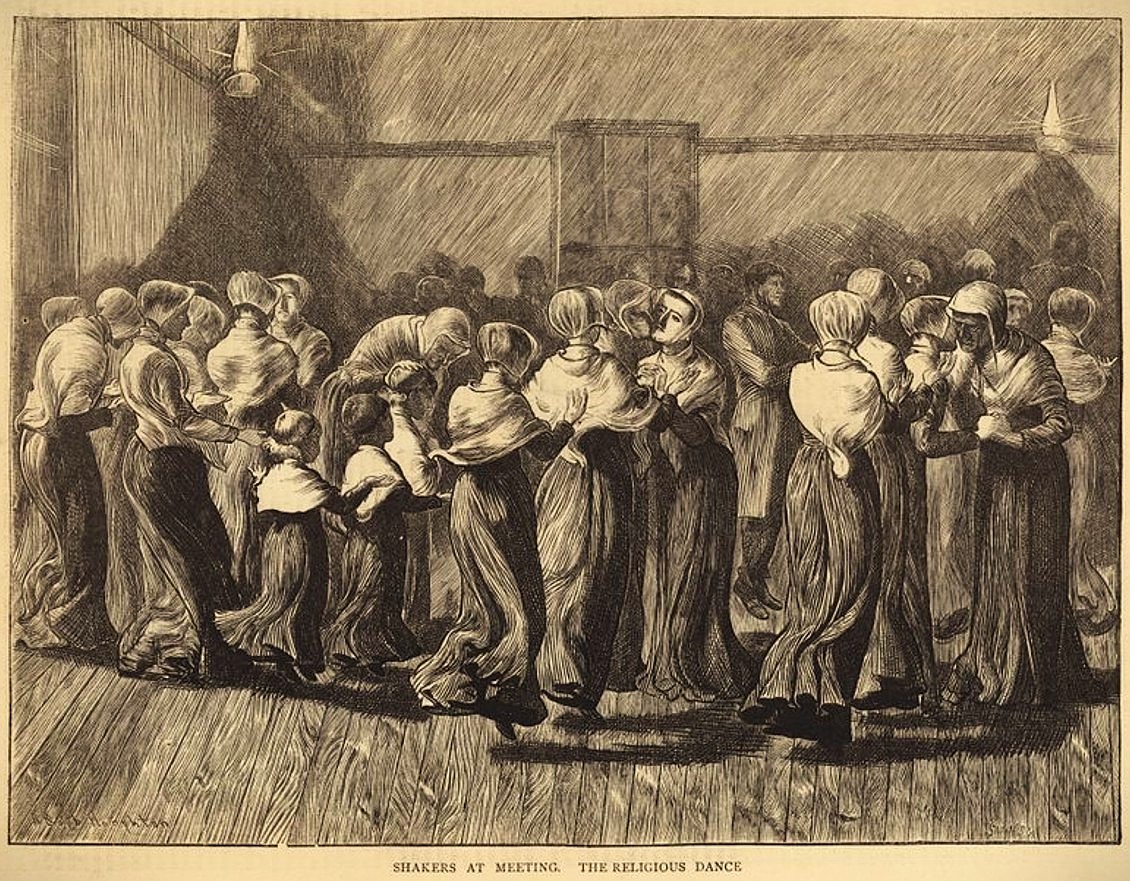
Shakers Dancing
Paradise for a servant is not the happiness of her master
by PHIL HALL
To imagine a perfect society is revolutionary. It is to hold the flawed, often brutal, reality of the present world up to the light of an ideal and find it wanting. Conceiving of a Utopia, is subversive because it contains the seeds of change, ideas about a desirable future that must, necessarily, involve dismantling capitalism. The name, ‘Utopia’, coined by Thomas More, is an incongruity—from the Greek ou-topos (no place) and eu-topos (good place)—a “good place” that exists “no-where.” This linguistic pun is meant to underscore its elusive, almost impossible nature. In contrast, the idea of Eden evokes something different: a primordial, unspoiled paradise from which we have fallen, a state of natural perfection located in a mythical past.
I argue that the central political and social conflict of our time is not merely a struggle over resources, but a battle between competing utopias. On one hand, a Hobbesian utopia for the global elite is not a distant dream but a realised fact, meticulously constructed and fiercely defended on top of a pyramid of human exploitation. This Eden for the few is built upon the systematic suppression, co-option, and dismissal of the utopian aspirations of the many; the dispossessed, whose dreams of security, community, and dignity are the true, yet repressed, engines of historical progress. To ask “Whose Eden?” is to ask who holds the power to define a future society worth living in and who is forced to live in the shadow of that definition.
The Eden of the Elite

For the mega-rich, the utopian dream is not a fantasy; it is their daily reality. They reside at the apex of the Hobbsian organism of humanity. Thomas Hobbes’s description of a life that is “solitary, poor, nasty, brutish, and short” is only for those beneath them. For the corporate elite, life is isolated in gated communities, obscenely wealthy, pleasant, refined, untrammelled, and extended through the best healthcare money can buy.
Wealth functions as a superpower, granting abilities that transcend human limitations. They can be anywhere in a few hours through private jets and helicopters; they command vast, mobile palaces in the form of yachts; they ensure near absolute security with private armies and gated compounds. Their consumption is limitless—any cuisine, any luxury, any experience on Earth is available to these predators, on demand.
Most insidiously, this wealth allows the global corporate capitalist elite to win the loyalty of huge numbers of people and even buy affection and friendship, creating a simulated world of consent and admiration. As critics like Chris Hedges have argued, this creates a profound psychological and moral separation from the rest of humanity.
This utopia does not maintain itself. It is propped up by a vast ideological apparatus, just as the power of kings was propped up by the superstructure of the clergy and the swords of knights. Think tanks, lobbyists, media outlets, and even academic institutions are employed with a primary, if often disguised, objective of justifying the status quo, or tinkering with it in order to improve it. The Hobbesian arrangement is made by the ideological apparatus to seem to be the natural and inevitable state of humankind; society requires a ruling elite to function; these are, we are told, the true “wealth creators,” while the labour of the masses and the intellect of experts are merely resources to be managed.
The Bill Gates Foundation does not vaccinate against capitalism.
A key tactic in this project is the mystification of capital’s origins. Technology is presented as the autonomous font of productivity, its machinery obscuring the exploited labour that designed, built, and operates it. The shareholder system further distances owners from the source of their wealth. A modern investor is not an armaments manufacturer or an oil baron; they are merely a portfolio manager requiring profit, utterly disconnected from the human and environmental consequences of the industries they own. This system creates plausible defeasibility; a layer of deniability that insulates the beneficiary from the suffering that underwrites their paradise.
The moral contradiction here is grating. This class often professes profound compassion and engages in highly publicised philanthropy. Yet, this charity is just a salve for a conscience that must ignore its own culpability for the systemic unhappiness, death, poverty, and destruction of possibility in the lives of many millions. Of Billions. The Bill Gates Foundation does not vaccinate against capitalism. The unscrupulous materialism of the corporate ruling class doesn’t include any belief in an afterlife where accounts might be settled. And this gives us a terrifying feeling of the inevitability of the injustices of the present. The ruling class build their Eden on earth, and the gates are closed.
The Eden of the Masses

In contrast to the corporate capitalist elite’s utopia of abundance and power stands the utopia of the multitude. Realistically the working and impoverished classes do not aspire to private jets (though they may dream of having them) their vision of paradise is often defined by what it would lack. It is a world without hunger, without curable disease, without the terror of destitution in old age, without persecution, and without the existential anxiety of precarious employment. It is a vision articulated not in grand, positive terms, but in the hope of absences: not to starve, not to be sick, not to be abandoned, not to be persecuted.
This vision extends beyond mere material lack to encompass aesthetic and communal desires: clean air and water, access to the restorative power of the countryside, sufficient leisure time for family and self-development, and humane, well-designed living spaces. These are not frivolous desires, but fundamental human needs for a life of dignity.
Crucially, this is a collective dream, articulated in the language of “we” rather than “I’’ and it arises from our shared condition of precarity. This communal aspect is what transforms it from a personal wish into something political. Lucas would call it class consciousness. The aspirations are for collective security: job security for all, community ownership of land and resources, democratic control over the means of production, and strong social safety nets that bind the community together.
Compare this to the patronising vision of Utopian Socialists like William Morris. While well-intentioned, the bourgeois reformer’s aspiration were for the poor not by the poor or from them. For the working class he imagined a return to a romanticised pastoral ideal on their behalf.
History shows that when cracks appear in the edifice of power, during revolutions, civil wars, or mass movements, the suppressed utopian dreams of ordinary people burst forth with explosive force. The English Civil War/ English Revolution of the 1640s, is a prime example. In the power vacuum left by a weakened monarchy, groups like the Diggers and Levellers expressed radical visions of common ownership, popular sovereignty, and social equality, rooted in independent religious enthusiasms that directly challenged the Anglican Church, the second estate. For many, when the possibility of change at home was crushed, that dream turned to exile; to the founding of new communities in the Americas where new Edens could be built from the beginning. The Quakers and Shakers and Puritans and Baptists became colonisers and this added a deeply contradictory layer to their utopian aspirations. Like the Kibbutzim, in the end they built their dreams on top of the bones of other people.
Utopianism as the Engine of Progress

The impulse to imagine a perfect society is a constant, and this imagination is the the force of progress. The literary tradition of utopia, from Plato’s Republic to More’s Utopia and Francis Bacon’s scientifically-minded New Atlantis, represents a continuous effort to design a better world. These were not just fantasies; they were philosophical critiques, highlighting failures and proposing alternatives.
And there were countless real-world experiments. Religious groups, who were often persecuted, put their utopian visions into practice. The Shakers, for instance, combined a theology of celibacy and ecstatic worship with a communalism that yielded astonishing innovation in agriculture, design, and manufacturing. The Quakers, with their emphasis on inner light, pacifism, and plain dealing, became remarkably successful in business while advocating for social reforms like the abolition of slavery. These experiments demonstrate that the drive for a better world is a powerful engine of not just social but also practical and economic innovation. The communist vision of Karl Marx and Frederick Engels reshaped the entire world.
Without utopia, you do not have progress. The idea of a better future pulls society forward. Every social gain, the abolition of slavery, the establishment of the weekend, universal suffrage, public healthcare, was, at first, a utopian dream in the minds of those who, together, based on their material conditions of exploitation, imagined a world beyond the present and organised together to achieve that imagined world. Inevitably the beneficiaries of global corporate capitalism will spend their money on hiring intellectual assassins to attack any emerging idea of a good society for ordinary people. The ruling status quo defends itself by declaring such dreams impossible, unrealistic, or dangerous.
The clash between the actual realised Eden the powerful and wealthy exist in and the modest, open-minded, inclusive, collective aspirations of the masses is the defining conflict. It is more than a class struggle, it is an all embracing desire of the individual inside his or her community to unselfishly create a better future for all.
Liberalism challenges the idea of possible shared utopias, arguing that human desires are irreconcilably different. One person’s green-painted street is another’s eyesore. Therefore, according to a liberal, the best that can be achieved is a managed compromise governed by the ‘no harm’ principle, not a collective vision of a good life. This philosophy favours incrementalism and putting off real and necessary radical change.
A potent weapon is the creation of false moral equivalencies. The ideological apparatus tirelessly works to equate the utopian aspirations of socialism, aiming for universal human dignity, with the dystopian realities of fascism, which aim for racial purity and totalitarian control. The weaknesses of communism in the 20th century are endlessly leveraged and exaggerated to taint all dreams of a more equitable society, using a tactic designed to paralyse and switch off the humane socialist imagination.
This was only possible in the past because of widespread insulation and ignorance. Enough citizens of metropolitan empires of the past benefited somewhat from the extracted wealth of the global periphery to acquiesce. They have been carefully shielded from the violence and exploitation required to procure it until quite recently. The brutal realities of cobalt mines, sweatshops, and banana republics were not taught in schools or discussed in the mass media. An educational system with such holes in it makes history almost incomprehensible, focusing on kings and battles (the bloody Tudors taught over and over again) while ignoring the history of class struggle, colonialism, and industrialisation. Of course, this means the people are unable to understand the true architecture of their own world unless they are impelled to do so in the spirit of Paulo Freire.
Nowhere is this battle more acute than in education itself, where future citizens are formed. Traditional schooling often socialises children brutally into the advanced capitalist order, training them for their predetermined roles as either confident servants of the ruling class or compliant workers with limited horizons. In stark contrast, alternative educational models like Steiner’s Waldorf or Montessori schools, though not without their own problems, were founded on a utopian impulse. They aimed to educate the “whole child” for a society that did not yet exist: fostering cooperation, creativity, and independence over competition and conformity. Schools are a key battleground in the war of utopian visions.
One could make the case that many of the disaffected petit bourgeoise and workers made unemployed by Thatcherism finally went into teaching and helped radicalise several generations of British children with their utopian visions of a tolerant, caring, multicultural cooperative society.
To fully understand the depth of our utopian impulses, one must look to the concept of Heaven, the ultimate paradise across countless cultures. A cross-cultural view reveals stunningly consistent themes: reunion with loved ones; boundless abundance (from the feasts of Valhalla to the cool drinks of Jannah); perfect beauty and light; a tranquil, ordered existence; and, most importantly, proximity to the divine or the source of all life in an enhanced existence.
Heaven represents the fulfilment of the heart’s deepest desire, but we do not know what it is. This is the central dilemma of utopian thinking. Put to one side for one moment the sensible Marxian phrase: ‘From each according to their ability, to each according to their needs.’ We can only imagine Eden based on our current, limited understanding and our immediate sufferings. A paradise designed by a starving person looks different from one designed by a lonely person or a persecuted person. The paradise of Fidel Castro born in 1926 will have a very different feel to the imagined paradise of someone born in 2026.
Any design for an earthly Eden, should we be given a chance to build it before some irretrievable global disaster occurs, must be preceded by a deep, collective inquiry into human nature. What does a human being truly need to flourish? Neither America nor China nor Russia first! A nationalist/fascist utopia of belonging, order, and national glory requires the annihilation of the individual and the removal of those who are defined as not belonging. The Brahmin’s paradise is not the Harijan’s. The challenge is to forge a shared vision that is inclusive, pluralistic, and based on a universal foundation of human dignity, and not based on the particular desires of a single privileged group, and that push will most probably involve revolutionary change.
Firefighting in 2025 we do know this. We want the genocide in Gaza to stop and restorative justice, we want the war in the Ukraine to end with a fair agreement and we want an end to civil war in Sudan and a multipolar world where the human rights of everyone are valued and respected.
To reiterate, Whose Eden? The corporate capitalist elite has successfully constructed a paradise of consumption and power for itself, a paradise that is totally dependent on the continued exploitation of the global majority.
The history of human progress, however, is the history of the marginalised collective fighting for our own “Eden.” The humane socialist vision is not a fantasy of endless luxury, but of fundamental dignity: community, security, and freedom from suffering, ill health, isolation and want. It’s not naïve or dangerous, is fact it is the relentless force that drives us forwards, from the abolishing slavery, to removing of Batista, to the cowing the factory owners into establishing eight-hour workdays, to the modern struggles for environmental sustainability and economic equality.
Will we resign ourselves to this world, where the gates of the twisted Edens of private islands and impunity are guarded by private armies and justified by privately owned media and privately funded think tanks? Or will reach out to each other and agree to build a common Eden for all: to organise and do what needs to be done in order to achieve our humane and socialist vision ?
Bacon, Francis. New Atlantis. 1627.
Freire, Paulo. Pedagogy of the Oppressed, 2018.
Campanella, Tommaso. The City of the Sun. 1602.
Harrington, James. The Commonwealth of Oceana. 1656.
More, Thomas. Utopia. 1516.
Morris, William. News from Nowhere. 1890.
Plato. The Republic. c. 375 BCE.
Winstanley, Gerrard. The Law of Freedom in a Platform. 1652.
Hedges, Chris. Empire of Illusion: The End of Literacy and the Triumph of Spectacle. Nation Books, 2009.
Hobbes, Thomas. Leviathan. 1651.
Marx, Karl, and Friedrich Engels. The Communist Manifesto. 1848.
Orwell, George. 1984. Secker and Warburg, 1949. & Animal Farm. 1945.
Illich, Ivan. Deschooling Society. Harper & Row, 1971.
Montessori, Maria. The Absorbent Mind. 1949.
Steiner, Rudolf. The Education of the Child. 1907.
Phil Hall was born into an ANC family in South Africa. The family was forced into exile in 1963 after his mother was imprisoned and his father banned. They relocated to East Africa, where his parents continued their activism and journalism. In 1975, after a period living in India, they journeyed overland back to the UK, eventually settling in Brighton.
Phil pursued a broad education, studying Russian, Spanish, politics, economics, literature, linguistics, and English grammar and phonology. His path led him to live and study in Spain, the USSR (in Ukraine), and later in Mexico, where he married and started a family. Over the next decade, Phil and his partner balanced activism with work before relocating to the UK—a move initially intended to be permanent.
However, professional opportunities took him to Saudi Arabia and then the UAE, where he spent ten years before returning to the UK during the COVID-19 pandemic. Back in Britain, he founded Ars Notoria Magazine and, alongside fellow humane socialist Paul Halas, launched AN Editions, a small venture dedicated to publishing thoughtful, progressive and exciting new books.
Discover more from Ars Notoria
Subscribe to get the latest posts sent to your email.



You must be logged in to post a comment.