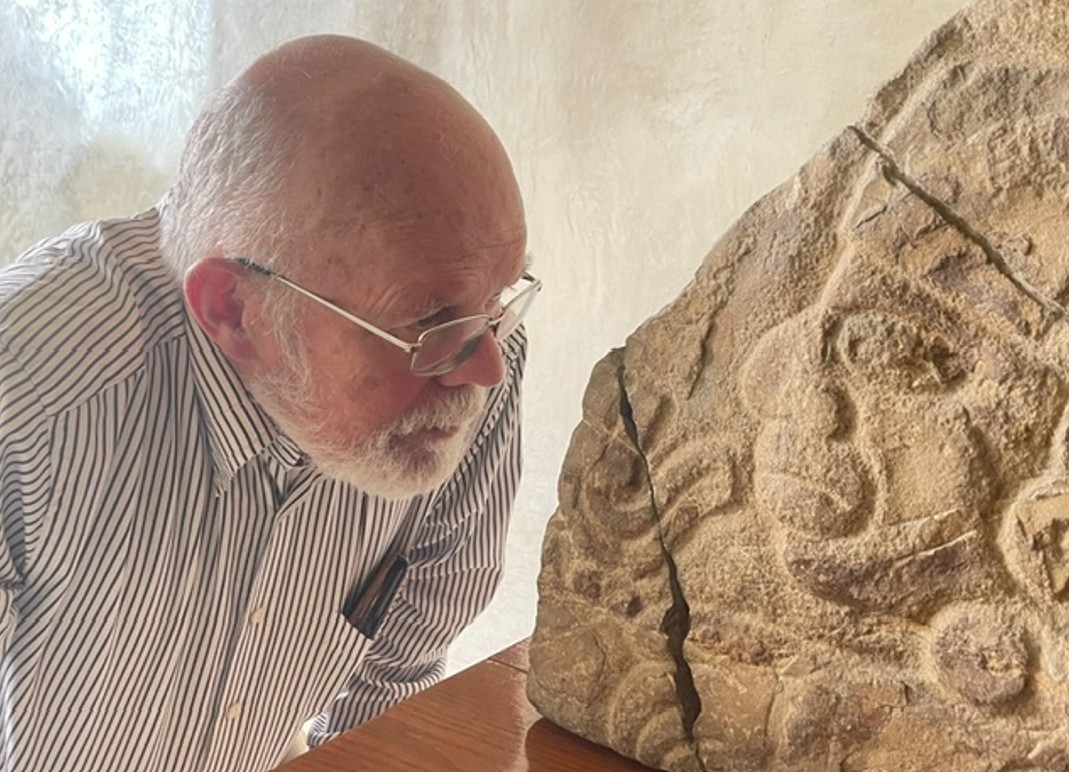
Michael Schmidt. With kind permission
by Yogesh Patel
In the prefatory statement Michael Schmidt opens Here They Are (2026) with a declaration: “Poetry sometimes goes its own way, abandoning storytelling and lyric and following instead ‘the way of language’, discovering for a change what it has to say – more interesting than what the ‘I’ intended.” This claim sounds like abdication — a poet surrendering authority to the ghostword. But it is better read as choreography: the poet leaving only one chair before the music begins. The question this essay pursues is whether language truly wins the game, or whether the poet’s hand remains visible in the arrangement. Or worse, is it pretence, and has the poet occupied that chair all along?
The evidence suggests something more complicated. Schmidt does not relinquish control; he relocates it. In Talking to Stanley on the Telephone (2021), experience supplied the poems. In Here They Are (2026), titles supply the immensity before the poems even begin. The collection’s multilingual architecture — “Arachne,” “Humbaba,” “Ostentatio Vulnera,” “Kodomo,” “Renacuajos” — functions less as invitation than as staging. These are not accidents of language going its own way. They are deliberate thresholds importing centuries of meaning, forcing each poem to wrestle with inherited weight before finding its inherent resolution.
Consider the title “Ostentatio Vulnera” — the Latin liturgical phrase for the showing of wounds. By the time we reach the poem, we expect theological grandeur. Instead, Schmidt gives us Christ removing nails from his body as if “tying his shoelaces,” counting coins while dabbing a “weeping wound with a rag”, “cupping pills” to swallow when pulling rusted iron from “capitate and scaphoid,” treating these as casual acts. The sacred becomes clinical. The title acts as a back wall against which the resident echo resonates.
The same pattern repeats across the collection. “Humbaba” summons the Sumerian monster guardian from the Epic of Gilgamesh, the critical work Schmidt has written about in his Gilgamesh: The Life of a Poem. We expect horror. Instead, with the poem beginning with the word “Actually” to invert the myth, we find a sleeping blue elephant breathing softly under the moonlight. “Arachne” promises the weaver punished by Athena for hubris. We find a spider walking across a man’s chest, greeting grey hairs as familiars. The title imports myth; the poem delivers intimacy.
This is not authorial absence. It is authorial restraint, where the poet knows which ghosts to summon, then stepping back. Schmidt’s prefatory statement suggests language discovers meaning. The titles of the poems in the book prove the poet curated the conditions for discovery by the poems themselves.
In Talking to Stanley on the Telephone, the body supplied the material. In “The Bath,” the ageing penis rises “breaking the surface with unplanned desire” — comic, tender, undignified. Desire “regains self-possession, retracts and is gone.” The body remains the site of revelation of something beyond its confines: comedy. In “Threes,” three hospital urine samples become fairy-tale challenges: “the threes are out of fairy tales, the imprisoned prince / Must overcome these challenges.” The physical ordeal carries metaphorical weight for the mythical prince to overcome for his quest. In Here They Are, objects carry the burden. In “Next Door,” a record player’s stylus finds the groove “in its gravelly voice,” feels the “pops and scratches / Too which mar and date the music.” The vinyl becomes archive; each scratch a recording of the memory. In “Bedside Table,” spectacles read the book while dentures pronounce the words: prosthetics assuming the tasks of consciousness.
The shift is not from life to death but from embodied grief to mediated memory. Talking to Stanley on the Telephone asks how little a poem can be made from: “That scrap, this / Almost nothing?” (Stanley and me). Leaving the gravy as ideogram, tellingly a graphic image that indicates the meaning without the sounds to spell it out. Here They Are approaches such encounters differently: language already contains before the poem begins, then goes on to find it saturated with history. This is not quite “Poetry sometimes goes its own way” as declared, because the poet brings it in.

Poetry sometimes goes its own way, abandoning storytelling and lyric and following instead ‘the way of language’, discovering for a change what it has to say – more interesting than what the ‘I’ intended.
Schmidt’s Christian imagery operates differently across the two collections. In Talking to Stanley on the Telephone, “An Easter Carol for Edward Taylor” lists martyrs bearing wounds to the Eucharist: Stephen with stones turned to loaves, Bartholomew with rolled skin, Thomas with spear. Faith and doubt kneel together because “whatever’s true, / A child is going to grow / On whom we can impress / Fear, hatred and desire.” The sacrament absorbs contradiction. In Here They Are, faith operates without such absorption. “Setting Sail” shows monks encountering a salmon that cooks itself on cooling embers. “No sign of the hand / Of God, and yet there was no denying the huge fish / Was some kind of counter evidence.” The word “counter-evidence” is crucial: the poem refuses miracle while acknowledging residue. In “St Felix and the Spider,” cobwebs conceal fugitives from barbarians, becoming “a piece of unlosable luggage, like a mystic limb.” The arachnid saves lives without divine instruction.
Compare this to “Ostentatio Vulnera,” where angels give bread and wine to a crowd that “chanted for Barabbas,” using “disposable plastic cups.” Sacred ritual meets secular banality through the disposable plastic. The poems do not celebrate Christianity. They inhabit its architecture without claiming its theology. I think this is what Schmidt means when he attributes this property to poetry’s autonomy, his declared thesis.
This positions Schmidt apart from contemporary religious poets like Malcolm Guite or Rowan Williams, whose work asserts theological coherence. He also differs from Alice Oswald, who removes mythology to access raw material. Schmidt keeps both; myth and material. In unresolved tension.
Schmidt’s historical critical work, Gilgamesh: The Life of a Poem, published by Princeton, informs Here They Are‘s approach in “The Lord of Aratta”. In Gilgamesh, Humbaba guards the Cedar Forest; Enkidu and Gilgamesh kill him, gaining immortality through fame. Schmidt imports this monster but morphs him: “Humbaba” becomes the elephant dreaming under moonlight, breathing air “not quite a snore, / Not quite a nose.” The ancient guardian sleeps peacefully while the modern speaker observes.
This reimagining is Schmidt’s architecture: inherit the name, rewrite the body. “Gilgamesh” appears nowhere in Here They Are, but its logic structures the titles. Each foreign name carries an entire narrative; then releases it. “Kodomo” (Japanese for children) evokes the 2011 tsunami; the poem delivers paper kites as ghosts. “Renacuajos” (Spanish for tadpoles) evokes metamorphosis; the poem delivers musical notation. The titles perform translation even within English.
This distinguishes Schmidt from Eliot’s use of fragments. In The Waste Land, allusion creates rupture in which the broken images of history cannot repair themselves. Schmidt allows fragments to enter fresh relationships. Schmidt would make a classical name meet a contemporary animal. Latin would meet bodily comedy. Ancient myth would meet scientific observation. The result is not a museum but a living ecology.
There is a musical logic to Schmidt’s shift. In “Renacuajos,” tadpoles are “semi-quavers, quavers” straying from the stave, assembling like musicians tuning up. “A croak, a croak, a croaking” fills the silence. The biological becomes notational. In “Next Door,” the vinyl drop finds the groove “and gently settles.” The stylus reads the scratches in “gravelly voice.” The machine remembers what the body forgets.
This music-measurement dynamic recurs throughout Talking to Stanley on the Telephone. In “Tuba Mirum,” a friend plays the tuba with “Spaghetti Junction condensed in brass.” The instrument becomes anatomy. In “Chaque cheveu a sa place,” the barber’s straight-edge razor shaves scalp “polished smooth as agate”; each hair in its place, the title’s French asserting order. In Here They Are, music operates differently. In “BA0265,” birds sit in rows “as if with / Opera glasses to follow the red sun down.” They are audience, not performers. In “Multaque pars mei,” burial occurs without ceremony until “three favourite hymns by the little choir and organ.” Music accompanies departure rather than structuring experience.

whatever’s true, / A child is going to grow / On whom we can impress / Fear, hatred and desire
The musical-chair game asks: who sits when the music stops? In Talking to Stanley on the Telephone, the poet occupies the chair: “I put my specs on an open book… they start to read.” Objects serve the human. In Here They Are, the title arranges the seating before the poem enters the room. Language sets the terms. But Schmidt’s hand remains on the furniture; choosing the titles, selecting the instruments, directing the gaze.
Where does Schmidt sit in contemporary poetry? He shares with Paul Muldoon the art of allusion without explanation, but Muldoon’s references often obscure while Schmidt’s clarify walks us through tension. He shares with Kathleen Jamie the attention to non-human witnesses, but Jamie’s ecology affirms continuity while Schmidt’s non-humans interrupt it. He shares with Geoffrey Hill the theological weight, but Hill’s faith is polemical while Schmidt’s Christianity is interrogative.
Most strikingly, Schmidt avoids the confessional excess that mars some late-career poetry; but he will let what is confessional play it out like the poems in this collection. He does not perform vulnerability. He does not curate trauma for reader consumption. If any, they just drop in. His “I” remains disciplined, choosing which ghosts to summon, then he steps back. This restraint separates him from contemporary elders like Derek Mahon (in later work) or Seamus Heaney (post-Human Chain), whose later poems risk sentimentality.
His closest analogue might be J.H. Prynne, whose later work treats language as ecosystem. But Prynne’s difficulty borders on opacity; Schmidt’s restraint keeps the warm accessibility open. Both allow language to exceed intention. Both refuse to explain the work.
Schmidt’s claim — poetry goes its own way, language discovers meaning — requires qualification. Yes, language exceeds intention. Etymology, echo, fossil-meaning: all operate beneath the poet’s control. But the titles prove the poet selects which languages participate. He decides “Humbaba” will enter, not “Enkidu.” He chooses “Kodomo” over “Kodomo no hi.” He curates the thresholds.
So the musical chair game ends ambiguously. Language wins by exceeding the poet’s design, but the poet wins by arranging the room. Neither fully dominates. The tension between them produces the collection’s energy. What matters is neither victory nor defeat but the dance between them. Schmidt understands this better than any contemporary poet working at his level.
Here They Are concludes not with resurrection but with audibility. In “BA0265,” Schmidt closes: “It’s a sort of history that bears me back to you. / Another time I’ll tell you, when you’re listening.” The dead do not return bodily, but poetry can do that repeatedly. They wait to be heard. In “Reader,” the mother reads the son’s work forty years after her death. She does not speak. She interprets.
The collection’s title works as an inventory of curations, as testimony, even as quiet accusation. Here they are indeed: the dead, the languages, the animals, the saints, the ancient names, the ordinary objects performing rituals without priests. Schmidt has not abandoned the past. He has discovered how alive it remains inside the present tense of a word. This is not time-travelling in poems; it is time itself travelling to our time.
The musical chair game continues. When the music stops, who is left standing? Language, perhaps. The poet, certainly. Both, in the end, holding the same breath, listening for what comes next.
Michael Schmidt, Here They Are (Smith|Doorstop Books, 2026, 26pp, ISBN: 978-1-917987-03-5)
Michael Schmidt, Talking to Stanley on the Telephone (Smith|Doorstop Books, 2021, 58pp, ISBN: 978-1-912196-44-9)
Yogesh Patel received an MBE for literature in the Late Queen’s 2020 Honours List and was shortlisted for the Aryamati Prize 2023. His collection The Rapids (2021) won a Finalist Award in the Indie Book Awards, with an Italian translation published in 2023. Patel edits Skylark, runs Skylark Publications UK, and founded the non-profit Word Masala project to promote literature. Honoured with the Freedom of the City of London and nominated for the Pushcart Prize, his credits include LPs, films, radio, a children’s book, fiction, non-fiction, and three poetry collections. Among his awards are the International Pinnacle Accolade Award from Vatayan – Poetry on South Bank and a Co-Op Prize for environmental poetry. He was Poet-of-Honor at New York University in April 2019 and has read at the House of Lords and the National Poetry Library. A poem by Patel is scheduled to travel to the moon aboard a NASA/SpaceX rocket as part of a time capsule of humanity’s cultural record. He was the commended winner of the Faber & Faber FAB Prize 2025 and wrote the winning entry for The Poetry Archive’s WorldView Now 2025. His most recent book is Two and a Half. His writing has appeared in PN Review, The London Magazine, World Literature Today, Indian Literature, Stand, Envoi, Under the Radar, Shearsman, IOTA, Orbis, The Book Review, and Confluence, among others. He has appeared on BBC TV and Radio, and his work features in The National Curriculum Anthology, Macmillan educational series, Sahitya Akademi anthologies, and over fifteen other anthologies worldwide. He writes regular columns for Confluence and was an editor at Ars Notoria.
Discover more from Ars Notoria
Subscribe to get the latest posts sent to your email.


You must be logged in to post a comment.