
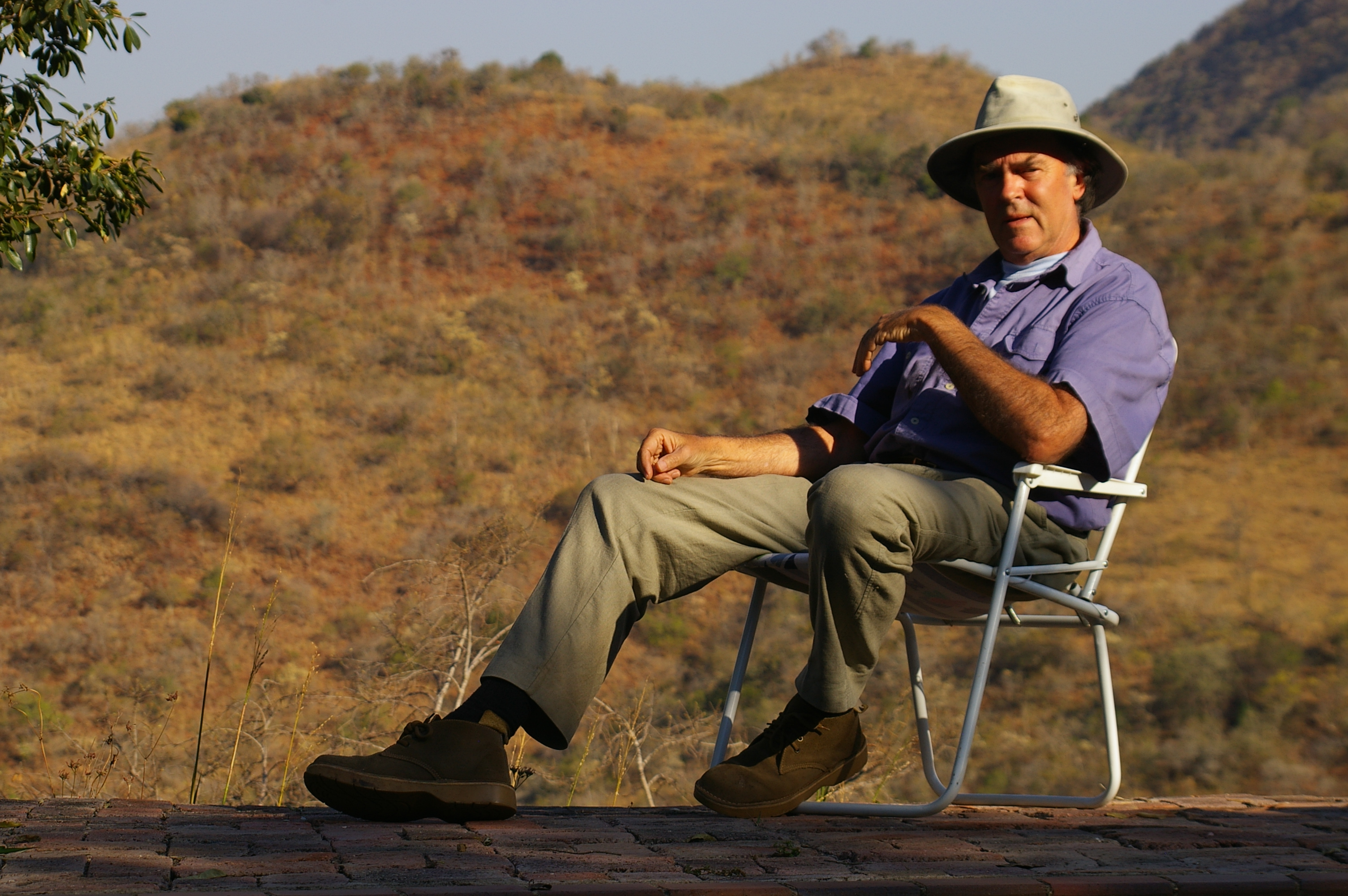
John Greening. Photograph courtesy of the author
We are proud to publish the following six poems by John Greening, an English poet, critic, playwright, and teacher whose work is worthy of particular note. Greening has published more than twenty poetry collections, including To the War Poets (2013), The Silence (2019), and The Interpretation of Owls: Selected Poems, 1977–2022 (2023), alongside editorial work such as an illustrated edition of Edmund Blunden’s Undertones of War and anthologies like Accompanied Voices and Contraflow: Lines of Englishness, 1922–2022. Educated at Swansea University, with further studies in Mannheim and Exeter, he taught for many years at Kimbolton School and has tutored for the Poetry School in Cambridge, while also writing plays, translations (including Goethe and Rilke), and a memoir of his time in Egypt, Threading a Dream (2017). A longtime reviewer for the Times Literary Supplement, John Greening’s collected criticism appears in Vapour Trails (2020), and his work has earned numerous honors including the Alexandria International Poetry Prize, the Bridport Prize, the TLS Centenary Prize, and a Cholmondeley Award. Critics have praised his historical imagination, formal craftsmanship, and the humane, understated power of his war poetry and long poems, with Contraflow named among the best poetry books of 2023 by The Guardian and The Sunday Times. Baylor University Press, publisher of his recent Rilke, are about to bring out his next collection, Crowning.
Sudeep Sen, Poetry & International Editor
Cycling
A driver who thinks
he’ll be young
for ever is
overtaking me
with the turbo-
charged fart
of an old man
leaving his chair
and pushes my
pushbike into
a flood-scoured
frost-eaten
pit where surface
falls away, so
he can’t have heard
these larks announce
their news on the air
or that collared dove
repeat its blessing
and absolution.
Agden Hill, Cambs.

Photograph by Annabel Crichard on Pexels
From Huntingdonshire Canticles
To see beyond the horizon it’s best to go back
before the nineteen-thirties and get on your ‘byke’ —
as, when the wind had dropped and any chance of rain,
I rode to Easton where the roar of the A14
has become the fake breaking of waves, out of sight
behind the thatch, the barns, a tiny thread of light
that is the brook, with its crack willows, designer bridges.
The art is not to listen as the speeding traffic merges
without a slip road; to see clear sky
beyond that central reservation and a sly
way through to the Fens; the art is in noticing
a scar where railway sleepers were removed and then to sing
as you cross the hump-back home and Kettering steam
engulfs your three gears … though nowadays the gleam
of a drone delivering mail is more likely. And the turning
of modern windmills. Every journey involves some learning.
An epiphany. A fear. A glimpse. A thrill. A warning.
What you thought was evening turns out to be morning.

Photograph by Altaf Shah on Pexels
Trespass at Burghley
Beyond the golf club where the players
argue over which ball’s theirs
then slouch off in suspicious pairs,
my route began to lose its thread.
You can’t miss it, the runner said,
but every waymark seemed to fade
to grass and sheep, a locked gate,
a fenced plantation. Best to wait
and read John Clare and hope I’ve not
been spotted by some Burghley grunt
who’s bored with building jumps and can’t
resist the instinct to confront
but sends his four-by-four to say
‘You’ve trespassed on your walk today’.
Surely there is another way.
I’ll leap the wire and breast the hedge,
the closed-off paths, a fence, a cage
of pheasants, over freedom’s edge
above those ornamental reaches
until the stately home emerges
where crowds of couples drag age
up the long straight entrance drive
like dazed spirits. We have survived,
their smiling says. And so it’s proved:
the power of name and place. The glaze
fired by Cecil cold and crazed
and chipped since Elizabethan days.
But think of Dryden, who translated
Virgil here, indulged and feted
laureate; or imagine, later,
that gardener out there in the muck
who kept his seeds in lines, the work
of years, set ready for the dark.
As I pass the clubhouse once again
the poet’s unpaid labours shine
like guineas on the eighteenth green.
Inundation
it rains and rains and our own history rises
after the Made in Egypt exhibition, wondering
how we’ll ever get home through the flood
to a soul house whose porch is not of clay
yet retains our hand-prints on a door not
of sycamore fig but chipboard, oak-veneered
fragments from the Book of the Dead gridlines
on a hand-held tablet the skid of a woven lid
a warning heron and here are the shabtis
in their hi-vis this that we brought on ourselves
sweeps across the Cambridge road and is carried
on out through Carter’s county to the Wash
where all such local tributes converge in a dream
of nationhood and drought and are rinsed of every skill
by which a culture threads itself through time,
its jewels sunk, as if this were the reign of John

Photograph by Tiago Ribeiro on Pexels
Butagas
How shocked was Dr Ahmed
when he came to England and saw
our open fire. So dangerous!
But so it had seemed to us
watching Aswani women’s
hands flare from the black
of their folded spark-guards,
to heave a huge canister
of butane, fifteen kilos
at least, effortlessly
on to their heads as if
it weren’t the weight of a Singer
sewing machine (which we
had seen them lift) or indeed
that sack of coal I would wheel
years later for the Doctor.
The women stood at the Tropic
of Cancer as if it were nothing;
and I would go on stoking
more carbon monoxide
in our grate. Understanding
is slow to catch. One culture
dampens another. And so
we learnt how butagas
is essential and Nilotic as the date,
the net, the clay jar,
or the shaduf: an offering
raised and balanced but not
held, to be carried through
the souk as down a catwalk.
September
Summer has all but erased the brook
beneath that cheap replacement bridge
with its toddler-trapping gap below
and creaking poplars overhead.
The field where Nutmeg used to graze
has run to wilderness: this land
has lost that cultivated look.
You paid for it, the farmer says.
In gardens, where some dahlias fizz
but fail to go off, sunflowers
have given up. A hanging basket
hangs on by its petunias.
Hedge crickets? Swallows? Gnats?
The budding laurels turn away
a common hawker, and cancel out
that whooping v. No school for me.
Discover more from Ars Notoria
Subscribe to get the latest posts sent to your email.


You must be logged in to post a comment.