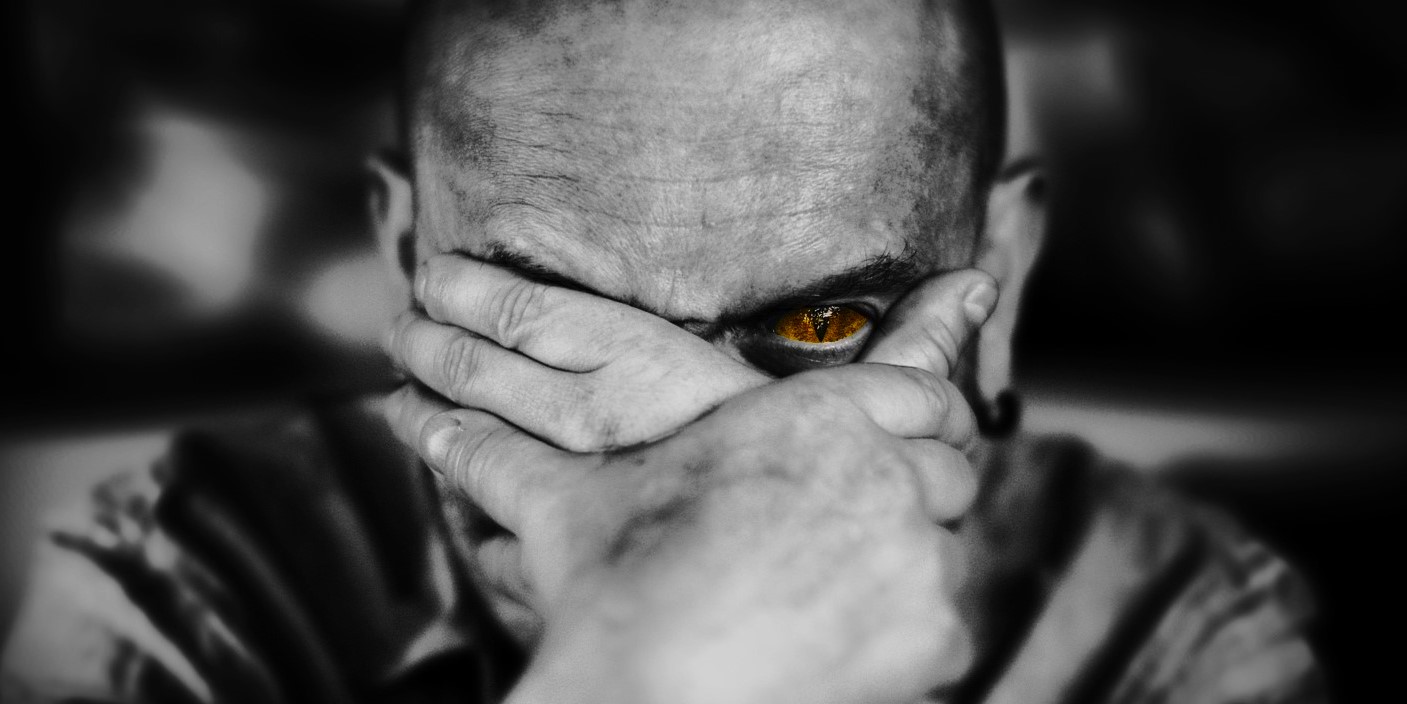
Artur Skoniecki and Virvoreanu Laurentiu under the Pixabay Content License
Diary of Lieutenant-Colonel Ivan Petrov
North Ossetia
10 January 1944
13:45
The men tell me they have found a foreign spy.
I think they are drunk. The two privates who came to me are gibbering bizarrely. One minute they tell me the man is a Western infiltrator; the next, they claim he is a Leshi. If they have simply come across a villager with albinism or something of the sort, I shall be quite irritated. Superstition like this is embarrassing.
14:15
What.
14:45
I do not know what I am looking at here. His leg is caught in an animal trap and appears to be broken at the ankle. His uniform is grey, and belongs to no army with which I am familiar. But his body, his features. What is this?
His jawline is foreign in a way I cannot place. His eyes are narrow, a deep golden-yellow, darker than his hair, and slightly reflective of the light. When I realised this, I verified it by shining my flashlight first on one eye, then the other. He tried to recoil, but I corrected him with a slap.
The details keep adding up. Once you begin to look, you keep seeing more and more. In addition to being yellow, his eyes are set slightly too far apart. His teeth, visible when he grimaced with pain, have slightly elongated canines; the front two are slightly serrated. Once I had finished studying these, I had the men hold his arms.
No wonder they thought he was a Leshi. Instead of nails, his fingertips end in neat, hooked, black claws. I examined these closely. They are solid, not flat like nails, something like the claws of a bird. His fingers are slightly longer and thinner than is usual, and his limbs are long, lean, and wiry.
At no point while examining this creature was I afraid. I was fascinated. The men stood around us muttering in alarm, but I found myself unafraid. I turned on the torch again. The man? Creature? What? He remained still this time as I examined his eyes and claws more closely. During all this time, he had not made a sound apart from the odd hiss of pain.
“Can you talk?” I said.
“Yes,” he said simply. His accent was impossible to place.
One of the men hit him. “Yes, sir,” he corrected.
“Quiet,” I told the man. I met the prisoner’s yellow eyes. “Your name, your nationality, and precisely what you are doing here. Now.”
He stared serenely over my shoulder.
I felt no anger at all. Interesting, how we respond to unusual circumstances. I ordered the men to carry the prisoner back with us, and to be careful not to damage him. This must be handled carefully.
The men are unsettled. I am not. Is that discipline in me? One would say so in public, of course. Yet it seems wrong somehow. More like the absence of something that should be there. Never mind. There are more important matters.
12 January 1944
The men are behaving in an undisciplined manner. I suppose the fault is mine. I have allowed lapses in behaviour over time, and now they think they can question me.
“Comrade Commander,” they say, “shall we prepare a report for the NKVD and ready the prisoner for transport?”
“Obviously not,” I say. “The situation is simply too irregular. Until we have identified his nationality, this is not a standard prisoner.”
“Understood,” they reply. And then, as though the matter were not settled: “Comrade Commander, if this concerns enemy infiltration, our superiors will expect to be informed promptly.”
“That,” I say, “is for me to worry about.”
They do not understand. One cannot expect them to. In the interests of the nation, this needs to be isolated and understood. Only then may it be passed on.
As for the prisoner, he is an endless puzzle. What is he? A fascist experiment? His body is uniformly strange, strange in ways subtle, but impossible not to see once you are looking. Even his vocal cords, when he cries out, contain harmonies one does not quite hear in a human throat. His language, whatever it is, must be as unlike ours as his body.
He will talk. I only need to apply the right pressure.
14 January 1944
Problem with the radio. I have told the communications personnel to see to it. The prisoner, when he heard me give the instruction, started laughing. Hysteria. Good. He will talk soon.
15 January 1944
The signal unit will not shut up about the radio. I have told them to sort it out. They are asking permission to drive all the way to the nearest command post, to try and report from their radio. Naturally, I said that was unacceptable.
“Comrade Lieutenant-Colonel,” said one, “permit me to report that the men believe we are under observation.”
I told him to elaborate.
“There is no definite evidence, Comrade Commander,” he said. “Only the sense of being observed. Repeatedly, from many men.”
“Either you have evidence that we are being watched, or you do not,” I said. “Do you?”
He shook his head.
“Then get on with your work, and let me get on with mine.”
I will return to my prisoner in a moment. I am making good progress, I think.
16 January 1944
He spoke to me.
He had been staring at the ceiling for an hour, quite quiet. I had been explaining to him what it is to serve something greater than oneself. Suddenly, he looked me in the eye.
“You pathetic creature,” he said. He spoke with no emotion at all, as though this were a conclusion he had reached after long reasoning. “Would you like to know what you are? A paper man. A hollow vessel, pretending it is full. It is fear that drives you, Petrov. Not fear of the world, or even of yourself. Fear of knowing what an absolute nothing you are.”
I am choosing to treat this as a sign of progress. His vocal patterns will be examined.
18 January 1944
I finally know what to do with him, I think. There are things that, while the body will endure and recover, the mind will not accept. I will put my plan into action tomorrow.
18 January 1944
Midnight
They are in here with us.
I think I am deaf. My ears are bleeding, and I can hear only a faint ringing noise. I have tried to staunch the blood, but I think the damage is likely permanent.
It began at 22:00, as I was settling down to sleep after dinner. The men started calling out to each other nervously about strange noises at the perimeter. Some were sent to investigate.
At roughly 22:20, a deep boom, more like a shockwave than a sound, struck us all flat. I do not mean that literally, but it was something close. A sense of prostration rather than shock, as though the entire nervous system had been reset. I dressed and hurried down to join them. My fingers did not obey me easily.
On the stairs, the second sound hit me.
It was like a drill rather than a scream, pitched at some unbearable region I will not forget though I never, fortunately, hear it again. I was on my knees without knowing how I had gotten that way, hands clasped over my ears. It took me some time to notice the pulsing disc on the stairs below me. It was not large, only a hand’s breadth or so across, but I knew instantly that it was the source of the noise.
A figure in a grey uniform stepped into the mouth of the stairwell and aimed a gun at me. Its eyes shone yellow.
I am a coward. I ran. A better man would not disgrace himself like that. But the shock to my ears had weakened me.
I am watching the door now. It is beginning to rattle. I cannot hear them, but they clearly know I am here.
At the end, there is only one route to victory. Whatever they are, they will gain nothing from me. My gun is ready and cleaned. I have selected the most perfect of my bullets and inserted it. The gun is cocked.
I wonder if my prisoner will be carried out to look at me. I wonder what he will feel.
Whatever the motherland is facing now, it will face it without me.
Francesca Young is a freelance writer from London who writes primarily in the genre of literary horror. She works as a librarian and writes in her free time. She has an interest in history, politics, power and how human beings relate to each other in extreme circumstances.
Discover more from Ars Notoria
Subscribe to get the latest posts sent to your email.


