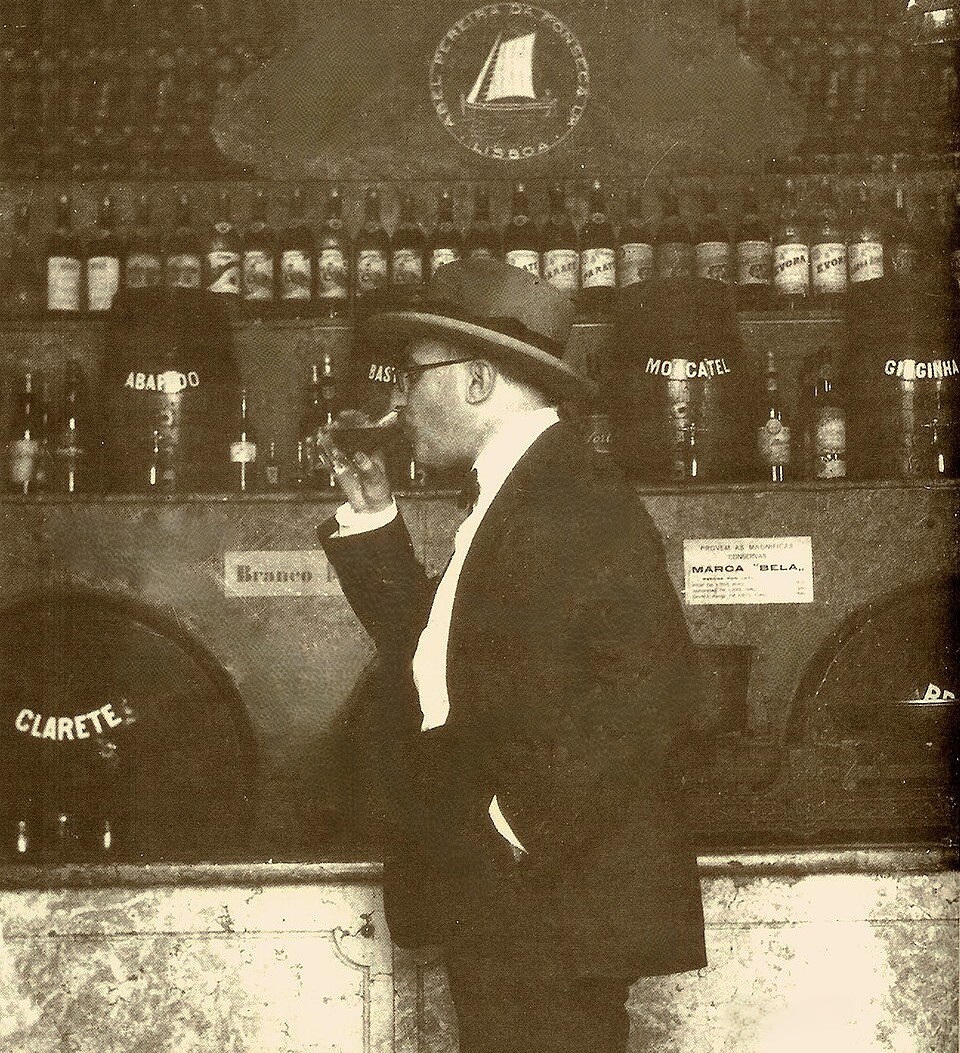
Fernando Pessoa in Lisbon. From Fernando Pessoa, Obra Poética, Vol. I, Photographer unknown.
LISBON NOTES
Between 1888 and 1935, the photographs of Fernando Pessoa follow one another and do not resemble one another. Few writers have left to posterity so many portraits that have nothing in common but the name. Which one is really Fernando Pessoa? What unites the child in his mother’s arms in 1888, the toddler already able to stand (in 1890), the person looking newly baptised in a young man’s suit with his sailor collar, the man in the hat in 1914, with his neatly trimmed mustache, and the old man with thick round glasses, forehead furrowed with wrinkles widening out onto a pronounced baldness – someone not long for this earth? Is it the same essential being, with the same name and, perhaps, the same memory and consciousness of self?
Plutarch recounts the experience of The Ship of Theseus. The ship of the Athenian hero Theseus is brought in and repaired at port. As the planks wear out and rot, they are replaced. Over a long time, no single original piece of the ship still remains.
Hobbes took this paradox to the extreme and used it to establish the impossibility of identity through matter. If a craftsman has recovered all the old pieces to reconstruct a new ship, which is the true one; the vessel that preserves form or the one that preserves substance?
The philosopher Locke links identity to memory rather than to matter. But Pessoa, without attempting to provide an answer, guides us towards posing another question. To that paradoxical absence of original matter, he added the substance that makes up people; despite their dates of birth, their biographies, and their poems. Among so many possible roles we play, where do we find the person?
2

As the planks wear out and rot, they are replaced. Over a long time, no single original piece of the ship still remains. Photograph by Carlos Daniel on Pexels
In 1907, Fernando Pessoa, back from Durban (where he lived with his mother and her second husband, Commander João Miguel Rosa, the Portuguese consul) addressed some of his classmates and teachers at Durban High School, passing himself off as Doctor Fautino Antunes, psychiatrist. In typewritten letters, he informed them that he was treating one Fernando Pessoa, who suffered from mental disorders, and requested more information from them about the patient. It was a stratagem that, according to his biographer Richard Zenith, allowed the shy poet to find out what his classmates thought of him.
It is from this we discover that Pessoa seems to make of heteronyms a way of being before others. The fiction is there, and it will serve. Pessoa uses heteronyms to multiply and “distribute himself.” He wants to “feel everything in all possible ways. See everything from all possible points of view” without committing to anything.
Where Walt Whitman contains the multitude and its contradictions, saying:
Do I contradict myself?
Very well, I contradict myself.
I am large,
I contain multitudes.
Pessoa seems to dilute himself, lose himself, empty himself of himself in his multitudinousness. He does not contain multitudes, as a set might contains its constitutive elements, instead he fragments himself, disperses himself, loses himself. Pessoa multiplies himself until he is lost, but he also works to erase himself within the order of the world.
3
At the age of 37, Pessoa writes a letter to the editor of an English magazine in which he says he feels younger every day because he lacks all purpose in life and has acquired neither family, nor profession, nor work, nor even “an opinion that lasts longer than the transitory minute in which I held it.”
Persisting in his effort to be a man without qualities, he says:
I have never made a true effort to achieve anything, nor have I applied my attention with force except to futile, unnecessary and fictitious things. I feel young because I have lived this way.
4
In each heteronym, Pessoa borrows a voice according to the character’s identity. The voices are fragmentations of the subject. In dispersion, Pessoa is no one.
The poet is a pretender
Who pretends so completely
That he even feigns pain
The pain he truly feels.
And those who read what he writes,
In the pain they read well feel,
Not the pains he had,
But only the one they do not have.
And so on, the wheel’s tracks
It spins to entertain reason,
And that clockwork train
Which is called a heart.
5
Descartes’ “I am” is now inverted. “I think, therefore I am not,” Fernando Pessoa could say. He nearly achieves this feat. The multiplication of the I is an art of dissolution. Pessoa erases the trace through multiplicity.
We are before a fugitive personality. Pessoa’s entire life is given over to the work of annulling himself. We are witnessing suicide by poetry. He was killing his self slowly over the course of a life and, upon disappearing, left to posterity the murder weapon.
6
Where is Pessoa’s voice among all these voices? All are his voices; he has none.
7
Pessoa’s great revolution in poetry is the absence of the owned. Bashō erases himself to let Being be; Pessoa plays like Penelope before her multiple suitors: he weaves every day and, when night comes, undoes what he has made; he returns to his traces erasing them.
Pessoa is a Homeric character whose presence is in absence. Each reader is a suitor avid for meaning who awaits a figure who does not give itself up. Ulysses is the Nothing that delays in its arriving, the summoned absolute that does not show itself.
8
All of Pessoa is in erasure, in loss. Nothing is said of him that is not nothing. He aspires to being in everything and nowhere at the same time. Pessoa always introduces a distance, a second gaze, observing the first.
9

Alonso Quijano. Portrait, attributed to Juan de Jáuregui, Wikimedia Commons
Cervantes and his Don Quixote precede Pessoa and his heteronyms. Alonso Quijano undergoes an identity split and becomes Don Quixote of the sorrowful countenance.
We are before an existential fresco and a play of mirrors in which the I multiplies itself. The individual chooses to inhabit another life through a work of the imagination. Quijano becomes Don Quixote through a poetic and fictional procedure, in the same way that Pessoa creates the heteronyms, with their own biographies and their own literary works.
The act of creating oneself as another marks the porosity of the line separating the real from the invented. In passing from the real to wearing the heteronymic mask, a depersonalisation occurs. The alchemy of alterity works here to realize the desire to be another or, in other words, not to be one’s self.
10
Pessoa is a brilliant technician in verse and a profound psychologist, capable of making a thousand “I’s” speak before the absence of an ‘I’ becomes apparent. In him, there is something of the small magic of Borges. Pessoa draws names and verses out of a hat. It is craftsmanship which he elevates to the noble status of Art.
11
Pessoa’s library speaks for him. Books of mythology, religion, history, occultism, and, interspersed, poets like Walt Whitman or Khayyam. He extracts from other places the substance of his poetry.
12
Khayyam is another heteronym of Pessoa.
13
Pessoa is a poet-ventriloquist.
14
To deconstruct Pessoa is to do the archaeology of the void, layer by layer, setting aside all the characters accumulated over time, in the geology of a life that Octavio Paz, allowing himself poetic license, stated does not exist.
15
There is a dialogue, a play of mirrors between the name and the silence it hides.
16
Pessoa’s work was built upon the foundations of distance, withdrawal, flight.
17
The heteronyms of Søren Kierkegaard, like Machado’s and Juan de Mairena, speak; Pessoa’s are silent. Pessoa defied the world, rejected the established order and all future order. The monarchy, the dream of Dom Sebastião, astral charts and the word of the dead are nothing but the forms and structures that excluding and annulling presence in the here and now, where, nothing, for him, is actually worth the trouble.
Pessoa refuses to allow himself to be assigned: identity, doctrine, definitive belonging. The refusal is by withdrawal, displacement, indifference. In Pessoa, evasion is precisely the method he uses to avoid the games of the world. He slips away.
Pessoa does not play at an abstract nihilism. Instead, Pessoa poses, by his very existence, a radical refusal with heteronyms revolving constantly around an absent center.
18
There is a feint in Pessoa. He always goes masked. Kafka goes with his face bare to a masked ball. Neither one is comfortable in their skin.
19
Who is it who loves in a love poem written by Álvaro de Campos? There is there a figure, there, timid working hard not to expose itself. ‘I am that other.’, he seems to be telling us. And, in the absence of proof to the contrary, one must believe him.
Pessoa hides in order to speak, lends his voices to make himself public. Amiel writes an intimate Diary in order to hide from the public eye.
20
Pessoa is a character of Pessoa trapped by Pessoa’s heteronyms. Pessoa is a the character written by Pessoa. Perhaps that was the only possibile way he had to exist: he plays himself in the great theater of the world.
21
To read him is to follow the trace of that which refuses to arrive at a truly radical silence. The word exists the margins where a silence must take on meaning.
22
There is a philologist in Pessoa; there a figure is born outside all the irony: a lover of the logos, a graphologist who, not to be written about, desires to be. To exist is to flee from oneself along the path of writing.
23
So, one must seek Pessoa outside the heteronyms, but where to find him?
24
The poem precedes life and is established in Pessoa.
25
What is Pessoa’s silence when he speaks?
26
The disaster of the ‘I’ is a wandering among “I’s” that do not contain it.
27

the tribute book to Edmond Jabès coordinated by Didier Cahen
Pessoa’s plurilingualism dilutes him. If our world is all that our language is, Pessoa, in the multiplicity of his languages, lives in a multiplicity of worlds. He is condemned to a certain relativism.
Upon the death of the poet Edmond Jabès, I participated, along with José Ángel Valente, Paul Auster, Jacques Derrida, and other writers of the time, in the tribute book coordinated by Didier Cahen: Saluer Jabès, les suites du livre. While José Ángel Valente emphasised loss, absence, Paul Auster recalled in his text the demand for clarity in Jabès.
My text dealt with the shipwreck of the word and silence. Derrida’s text titled De l’autre côté du monde, was reprinted in the posthumous collection Chaque fois unique, la fin du monde (Éditions Galilée, 2003). The text is founded on four key concepts: with Jabès’s death, Derrida experiences the radical end of a world made possible by the relationship of friendship. The survivor experiences an infinite whole that has been erased forever. The dead one passes to the other side, to a radical alterity. Only the trace and surviving remain. The other, Jabès, becomes radically inaccessible, separated by an impassable border. To speak to him is only possible in a beyond of language and of the visible world that it makes possible.
Here writing comes about as that which subsists after disappearance. The memory of the absent one survives in the written trace, the Book. Only there is found the place of exile and of all survival. There also resides hospitality, the welcome of the disappeared one in the openness of the survivor. To greet Jabès means to accept his absolute alterity. Before Jabès, Derrida no longer has anything but the text, which offers itself to dissemination and deconstruction, a path, therefore, toward absence. The text is a place of language, and language, through this dissemination, exercises its power over significations. Words disperse, generate unforeseen meanings not controlled in advance by the subject. Derrida, through deconstruction, confronted the metaphysics of Presence, the illusion that there would exist a truth or a single subject in the text.
The Book of Disquiet, like all of Pessoa’s heteronymic work, functions as an illustration that precedes Derrida’s theoretical formulation. Each entry in the book is a fragment that opens toward other fragments without ever transmitting a single message. Polysemy shows that a word possesses multiple meanings; in it meaning also bursts and circulates, forming rhizomes of relations that themselves produce meanings. In Pessoa there exists a chain of texts that construct themselves, comment on themselves, contradict one another, deconstruct themselves, making it impossible to trace an originary truth of the author. There is no single subject: the poetic I is, in itself, multiple, under various masks that speak through notes, aphorisms, unfinished diaries, letters. Pessoa leads us to the rupture of linear and centralised thought. Any book can enter into dialogue with any other, like the rhizomes of Deleuze and Guattari (*A Thousand Plateaus. Capitalism and Schizophrenia 2, Éditions de Minuit, 1980). Pessoa is an artist of deterritorialszation. He is a body without organs capable of reproducing itself into infinity. Pessoa precedes Derrida, Deleuze, and Guattari.
28
Pessoa created more than fifty heteronyms, some thirty of them with works of their own, in addition to his orthonym Pessoa.
29
How to make the portrait of a man who withdrew forever behind his masks?
30
Octavio Paz thought it was impossible to capture, or reveal, the life of a Pessoa who only existed on paper.
31
João Gaspar Simões, in 1950, accorded less value to the heteronym poems because, according to him, they demonstrated a lake of sincerity. One must not dismiss Simões’s attitude out of hand. There is indeed a feint, displacement, and, in the end, an irony that disturbs the gaze of the reader in the heteronyms.
Where is Pessoa? It takes the work of a detective, a police investigation before a man who abstracts himself, who withdraws like the reflection of the moon in a water gourd, can be discovered. Pessoa is always present, but we never manage to hold on to him.
There is in Pessoa a “je ne sais qui”, another approach to Saint John of the Cross through Vladimir Jankélévitch, an “almost nothing.” He plays with the imprescriptible and the irreversible, a definitive having-been that gives rise to saudade, itself indescribable.
Time is fleeting. Pessoa is too.
32

The Book of Disquiet by Fernando Pessoa. Photograph Pmms2005 Wikimedia Commons
While Machado’s Juan de Mairena, the Prophet of Gibran Khalil Gibran, and, before them, Nietzsche’s Zarathustra are literary characters produced to express the thought of their creators, Caeiro or Reis speak to erase the traces of a man who refuses to be one, though they are both incapable of silence.
Pessoa resists being. There is the irony. Irony is a constant in Pessoa. He says somewhere in The Book of Disquiet: “I have made of irony the color of my everyday suit.” Irony allows one to split oneself; one becomes a lucid and amused spectator of the world. It transforms existence into an aesthetic object. In the heteronyms there is a “self-parody,” a ferocious humor. Álvaro de Campos mocks the stoic rigor of Ricardo Reis. Reis’ characters defend opposing ideas. Reis’ work is an ironic staging where the great truths of humanity devour one another. The anarchist banker or the metaphysics of the tobacco shop show a gap between the infinite and the banality of the everyday. There is, therefore, in Pessoa a consciousness of finitude that does everything possible not to take itself seriously. It is precisely for this that Jankélévitch note the importance of irony.
33
Pessoa is not capable of a total adhesion to the real. He observes himself thinking, living. His life reflects the reality of the Dialogue between the Mesopotamian slave and his master, translated some decades ago by J. Brodsky.
All certainties are destroyed in the equi-valence of truths and their opposites. Creating characters who have their own lives and their own truths creates a vital irony.
The multiplicity of truths means an absence of center. There is no unified, stable I, but the suspicion of a fundamental void that takes, like water, the shape of its momentary container.
In this relativistic dramatisation one perceives the sense of detachment we might get from a minor god who creates his world and his characters. Pessoa lives in distanciation, as the theater director Bertolt Brecht would say. He plays a role adopting, through a conscious splitting, in creating distance from himself: he sees himself play a character.
One can almost see the mocking smile drawn on his lips.
34
Pessoa does not adhere to himself. He is immersed in a work of permanent fiction.
35
“I like to say,” Pessoa says, but only in order to say nothing, that “irony is the first sign that consciousness has become conscious.”
Pessoa carries out a sacrifice of identity. The more one seeks Pessoa, the more he erases himself. The masks are removed and one discovers that there is no first face.
There we have the fundament of his irony, the laughter of Pessoa.
36
On April 27, 1920, Fernando Pessoa writes to his Ofélia Queiroz:
My little pretty baby: You cannot imagine the delight you gave me today at the window of your sister’s house! It is a good thing you were cheerful and showed pleasure at seeing me (Álvaro de Campos).
On April 5, Álvaro de Campos, engineer, already appears in a letter to Ofélia Queiroz. This character will be in part the reason for the breakup of the relationship between Pessoa and his lover.
Ángel Crespo, in The Plural Life of Fernando Pessoa (1988), notes that Álvaro de Campos is the heteronym with whom Pessoa most confused with himself.
In O Fernando e eu, Ofélia Queiroz says:
“Fernando was a very special person. His whole way of being, of feeling, even of dressing, was special. However, perhaps I did not realize it at that moment, because I felt passion. His sensitivity, his tenderness, his shyness, his eccentricity, at bottom enchanted me. For example, Fernando was a bit confused, mainly when he presented himself as Álvaro de Campos. In those circumstances he would say to me: ‘Today it is not I who has come, but my friend Álvaro de Campos…’. He behaved on those occasions in a totally different manner. With the air of a scoundrel he would say things without any connection. One of those days he said to me: ‘I bring an errand, my Lady, which is to put the abject physiognomy of that Fernando Pessoa into a bucket full of water, head downwards.’ I answered him: ‘I detest that Álvaro de Campos. I only want Fernando Pessoa.'”
The character devours the person.
37
In the end, whoever seeks Pessoa finds that the only trace that exists is the pleasure of the text.
Here these notes end. Seated at a table in the Martinho da Arcada, where Fernando Pessoa went every day, or almost every day, and where he met with the members of the Orpheu group, I ressisted temptation of taking a taxi once more to Rua Coelho da Rocha, 16. Pessoa lived there on the third floor. There you will find the museum dedicated to his life: you will see his glasses, his books, his typewriter, the box where his manuscripts accumulated, so many things that accompanied him in that time of living a life that Octavio Paz denied he lived. Facing this Praça do Comércio, I gave up seeking Fernando António Nogueira Pessoa. One must respect the laughter of others.
*This article is a translation by Philip Hall

Ismaël Diadié Haïdara. Photograph Jasoler, Wikimedia Commons
Exiled in Spain since 2012, ISMAËL DIADIÉ HAÏDARA (Timbuktu, 1957) is a librarian, poet, philosopher, historian, president of the Mahmud Kati Foundation in Spain, and director of the Kati Fund Library in Timbuktu, Mali. Gold medalist of the city of Toledo – Spain and member of Sites of Conscience in New York, he studied drama at the National Institute of Arts (INA) in Bamako and philosophy at the École Normale Supérieure (ENSUP) in Bamako, Mali. He is the author of several works and articles, including: Le statut du monde. Nécessité, possibilité et contingence chez Ibn Arabi, Cordoba, 1992 ; Yawdar Pasha y la conquista saudí del Songhay (1591-1599) Instituto de Estudios almerienses, 1993 et Rabat 1996 ; L’Espagne musulmane et l’Afrique subsaharienne, Editions Donniya, Bamako, 1997 ; Les Juifs à Tombouctou, Editions Donniya, Bamako, 1999 ; Los otros Españoles, mr ediciones, Madrid, 2004 ; Los últimos Visigodos, rd editores, Sevilla, 2003 ; Las lamentaciones del viejo Tombo, Maremoto, Málaga, 2006 ; Abana, Rihla, Córdoba, Almuzara, 2006 ; Monólogo del un carnero, Árbol de Poe, Málaga, 2012 ; Zimma, Vaso Roto Mexico, 2014 – Madrid 2015 ; Tombouctou, Andaluces en la ciudad pérdida del Sahara, Almazara, 2015. Une cabane au bord de l’eau, Genal, Málaga, 2016; Tebrae pour ma mère, Málaga, 2017 ; Sahel, Málaga 2017 ; Journal d’un bibliothécaire à Tombouctou, Almuzara, 2017. De Tolède à Tombouctou, Malaga, 2019. De la Sobriedad, Almuzara, 2020 ; Tebrae, Libros del Aire, Serie Mayor, Boo de Pielagos, Cantabria, 2021. He is also a regular contributor to Ars Notoria.
Discover more from Ars Notoria
Subscribe to get the latest posts sent to your email.


You must be logged in to post a comment.