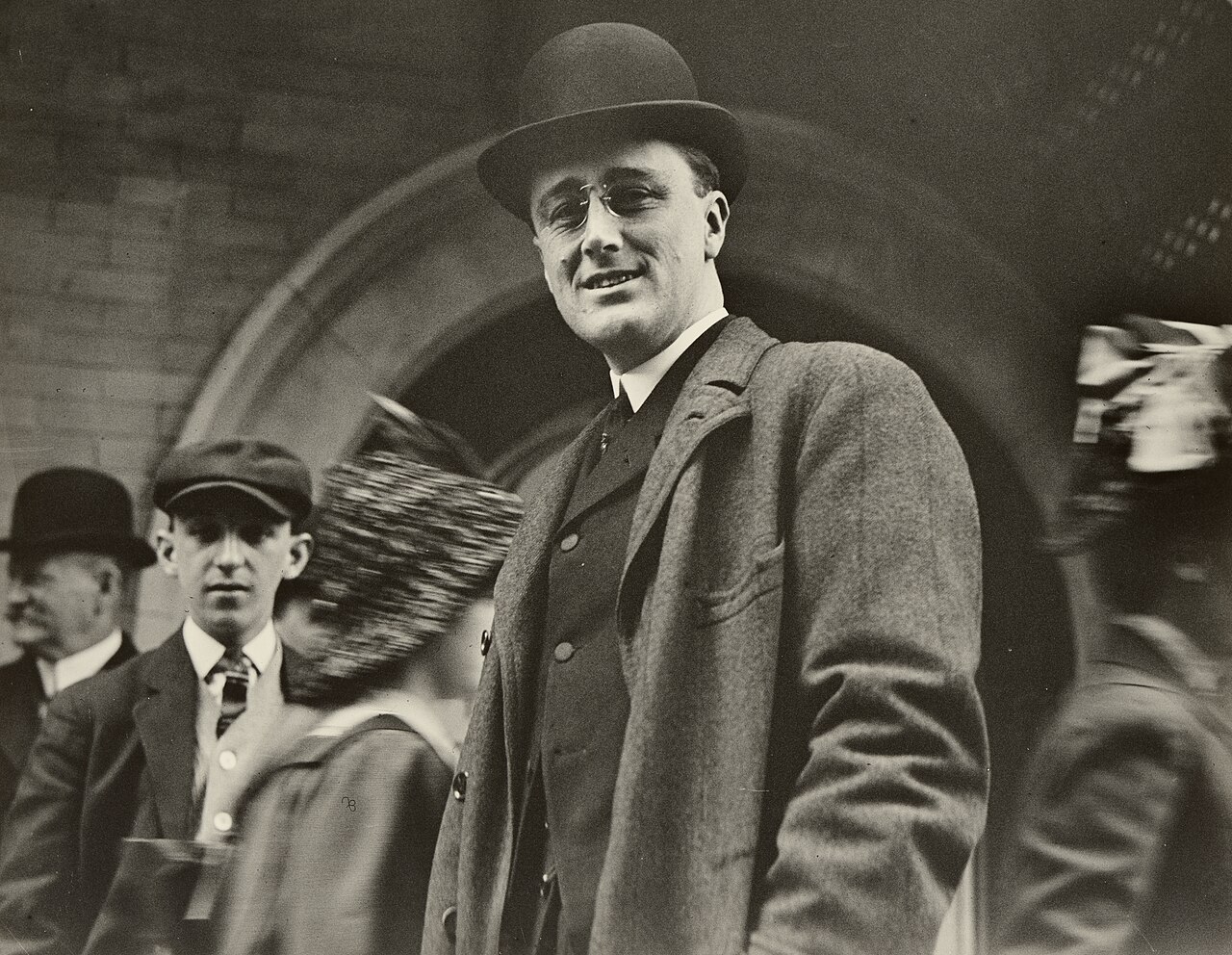
Roosevelt in 1912
Franklin D. Roosevelt (2012) Photograph Underwood & Underwood, Smithsonian National Portrait Gallery, Public Domain
FDR. And the Award Goes To…
by Norman B. Schwartz
Of all the nation’s “acting” presidents, only one has been a professional. The current president by contrast was a talented amateur hired to improvise dialogue on a reality show. The 32nd President, Franklin Delano Roosevelt, one of America’s most skilled politicians, liked to boast that he was as good or better than any practicing Thespian on stage or screen. For four terms, from 1933 to 1945, he played the role of the benevolent aristocrat for the longest uninterrupted run in his nation’s history, leading his country out of the Depression, through the Second World War, and into Empire.
Gore Vidal (1925–2012), American novelist, essayist, playwright, screenwriter and occasional candidate for office, was one of the president’s most astute observers and ambivalent admirers. Unlike many of his contemporaries, Vidal could claim (and did) that he was the only one among many who could claim to be a true insider. Gore’s mother, Nina, was the daughter of the blind senator Thomas Gore of Oklahoma; Gore’s father, Gene, had been the director of the Bureau of Air Commerce during Roosevelt’s first administration. After Nina and Gene divorced in 1935, Gore’s mother married one of the national capitol’s most respected citizens, the stockbroker Hugh Auchincloss. That marriage lasted until 1941, when he (Hugh) divorced her (Nina) and married the Virginia socialite, Janet Lee Bouvier. Janet was the mother of two beautiful little girls from her first marriage to another less prosperous but handsomer stockbroker. Her daughters – Lee and Jacqueline. Lee would one day become Princess Radziwill, her sister Jacqueline First Lady of the land. Gore first learned about the act of politics from his father, who knew Washington from first-hand experience. Gene Vidal told him: “They tell lies, even when they don’t have to.” He had once witnessed the Commander in Chief grow so angry with the amount of money commercial airlines demanded from the government for flying airmail that he cancelled all their contracts, and ordered the task assigned to the Army Air Corps. Gore’s father, once a military pilot himself and the first instructor in aeronautics at West Point, warned his chief that these men, brave and well-trained as they were, were ill-equipped for flying in bad weather. But the president insisted. At the end of the first week, five army pilots were dead, and eight planes wrecked; after seventy-eight days twelve pilots were gone. America’s flying hero, Charles Lindbergh, was in the newspapers, accusing Roosevelt of murder, but FDR remained unfazed. “One evening, my father was called to the White House,” Vidal wrote. “As Gene pushed the President’s wheelchair along the upstairs corridor, the President, his usual airy self, said, ‘Well, Brother Vidal, we seem to have a bit of a mess on our hands.’ […] ‘I found that we pretty funny.’”
Gene Vidal knew, and his son would learn to admire, that FDR had an actor’s talent for improvisation. Confronted with disaster or setback, he never hesitated to change course or what he said. By spring of that year, FDR’s campaign manager and Postmaster General Farley announced the army would no longer fly the mail, and the United States Post Office was once again open to bids.

Vidal speaking for the People’s Party in 1972. Photograph Susmart, Wikimedia Commons
Gore Vidal continued to study the president through his father’s eyes for the rest of his life. There was one act that astonished him more than any other. Despite the uproar his allegations caused, Vidal never ceased to claim that FDR’s greatest sleight of hand, one he could not have performed without the aid of his gifted stage assistant, Winston Churchill, was getting the United States into the Second World War when the United States was at its most isolationist.
The friendship between the two men, destined to be leaders of their wartime nations, began back in the teens of the century when Churchill was First Lord of the Admiralty (October 1911 through May 1915), overlapping Roosevelt who held a similar position as United States Assistant Secretary of the Navy during the first years of World War One. After the United Kingdom officially entered World War Two in 1939, Churchill served again as First Lord until May 1940 when with Chamberlain’s resignation he became his country’s prime minister. Churchill desperately needed Roosevelt’s help, but sixty to eighty per cent of America’s population were opposed to going to war to defend the British Isles and distant Europe as America had once before.
September of 1940, shortly before the American presidential election: the Japanese had signed a tripartite agreement with Germany and Italy which stated that Japan would undertake to assist these European countries “with all political, economic and military means if one of the Contracting Powers is attacked by a Power at present not involved in the European War or in the Japanese Chinese conflict.” In November 1940, Roosevelt ran again for an unprecedented third term and had been elected with the pledge that none of America’s sons would ever fight in a foreign war “unless attacked.”
“Unless attacked.” That was the loophole both Churchill and Roosevelt understood. Although popular opinion was against European intervention, both men were certain Americans would not hesitate to go to war against Japan. The only problem remaining was how to get the Japanese to attack first. Roosevelt, so Vidal claimed, simply made it impossible for Japan not to be seen as the aggressor.

Winston Churchill (The Roaring Lion) 1941. Official photograph Yousuf Karsh, Public Domain
When Japan first moved into China in 1937, Roosevelt had done nothing to stop them, but by July 1941 when the Japanese moved into Indo-China, FDR, ever ready to improvise, sensed circumstances had changed. The president, knowing the Japanese High Command could not continue their conquest of Southeast Asia with the limited resources they had, froze all Japanese funds held in the US and banned the export of oil on 26 July 1941. In November, he refused to meet with the Japanese ambassadors to the United States, who were looking for some sort of compromise trade agreement. Instead, he ordered Japan to renounce the tripartite Axis agreement, handing them an ultimatum they would never accept. “The government of Japan will withdraw all military, naval, air and police forces from China and Indo-China.” As Vidal writes, the German-Italian-Japanese tripartite agreement was defensive. “No country was obliged to join in each other’s offensive wars. How then could FDR be sure he would get his war in Europe?” As Vidal explains: “FDR is easily the most intricate statesman of our time: as Nixon once said admiringly of Eisenhower, ‘He was a far more sly and devious man than most people suspected, and I mean those words in their very best sense.’”
As Roosevelt and Churchill had planned, the Japanese, deprived of oil, were forced into a corner. They retaliated by bombing the naval base at Pearl Harbor on 7 December 1941. The Day of Infamy. The single strike killed 3,000 men. What were a few lives lost when millions of European lives could be saved, FDR must have reasoned?
Vidal wrote about this decisive moment in the nation’s history in his novel The Golden Age (2000), the seventh and last novel in his Narratives of Empire series. One of his fictional characters, Caroline Sanford, says (perhaps serving to reflect Vidal’s opinion) that the nature of power creates an indifference in the men who hold highest office. Vidal did say, “FDR knew how to twist everybody into knots when he felt like it, and he waited; he was very, very shrewd.”

Roosevelt and Churchill (1941) Photograph Leslie Cornish Priest, courtesy of the Imperial War Museum, Non-commercial license
On 8 December 1941, Congress approved Roosevelt’s request for a declaration of war against Japan. On 11 January, Hitler, abiding by the tripartite agreement, declared war on the United States. Exactly one month later, 11 March, Congress passed the Lend-Lease Act, which allowed America to loan or lease war supplies to England. There is little doubt Roosevelt and Churchill had achieved their long-hoped-for goal to bring the United States into the European war.
That war lasted five years, eight months and one week. By February 1945, when it became apparent to the Allies that they were about to win, Roosevelt met with Churchill and Stalin on a battleship in Yalta on the Black Sea. He told (ordered?) Churchill to give up India as France was going to give up Indo-China, the Dutch Sumatra and Java. If I, too, can improvise from an interview Vidal gave to Paul Jay in August 2007 on the Real News Network, “FDR turned to Churchill and said, ‘You’re out of the empire business. There are no empires.’ He didn’t say we’re going to be the only one, because he was too tactful and too manipulative. Somebody might have said, no, you’re not. But he set everything up in the post-war world […] he said, ‘I don’t care what this does to European powers. I’m ending colonialism, because without a clean sweep, the United States is meaning-less….’” At this famous lunch, a lot of witnesses there, Churchill apparently turned to him. He thought this man was his friend, “but emperors,” so Vidal wrote, “have no friends. And he (Churchill) said, what do you want me to do? Get on my hind legs like your little dog, Fala, and beg? The emperor said, yes….”1
Roosevelt, so Vidal maintained, too, had accomplished what he set out to do.
Whether we concur with Vidal’s portrait of Roosevelt as an icy Machiavellian, it’s hard to disagree that the moment England, willingly or not, gave away its world domination, America either by default or deceit became the world’s most important power.
Vidal died in 2012. Many who violently disagreed with him in 1987 when he was the first social commentator to claim the United States was now an empire would now agree. Not only had America become an empire, but it is also now a declining one. Another actor, with China in the wings, waiting, impatiently to take over the part.
Notes
1See https://therealnews.com/gore-vidal-on-the-emperor-2-7, retrieved 13 June 2025.
Norman B. Schwartz is the author of the comic novels ‘ALL THINGS small‘, Paradise Now, Don Juan in Space, True (Cinema) Confessions, Hollywood: Below and Beyond, and the DIY guide, The Art Of The Schnoorr. He spent over forty years working on films in Hollywood and Rome. Norman was the first ADR sound editor / post-production dialogue director to be admitted to Academy of Motion Picture Arts and Sciences in Los Angeles.
Norman B. Schwartz’s essays will appear in sequence monthly in each issue of Ars Notoria Magazine. In October of 2025, a paperback edition of the complete collection of his essays titled: HOLLYOOD Actors & Politicos/ a Shared Profession was published and is available for purchase from Centre House Press.
Discover more from Ars Notoria
Subscribe to get the latest posts sent to your email.


You must be logged in to post a comment.