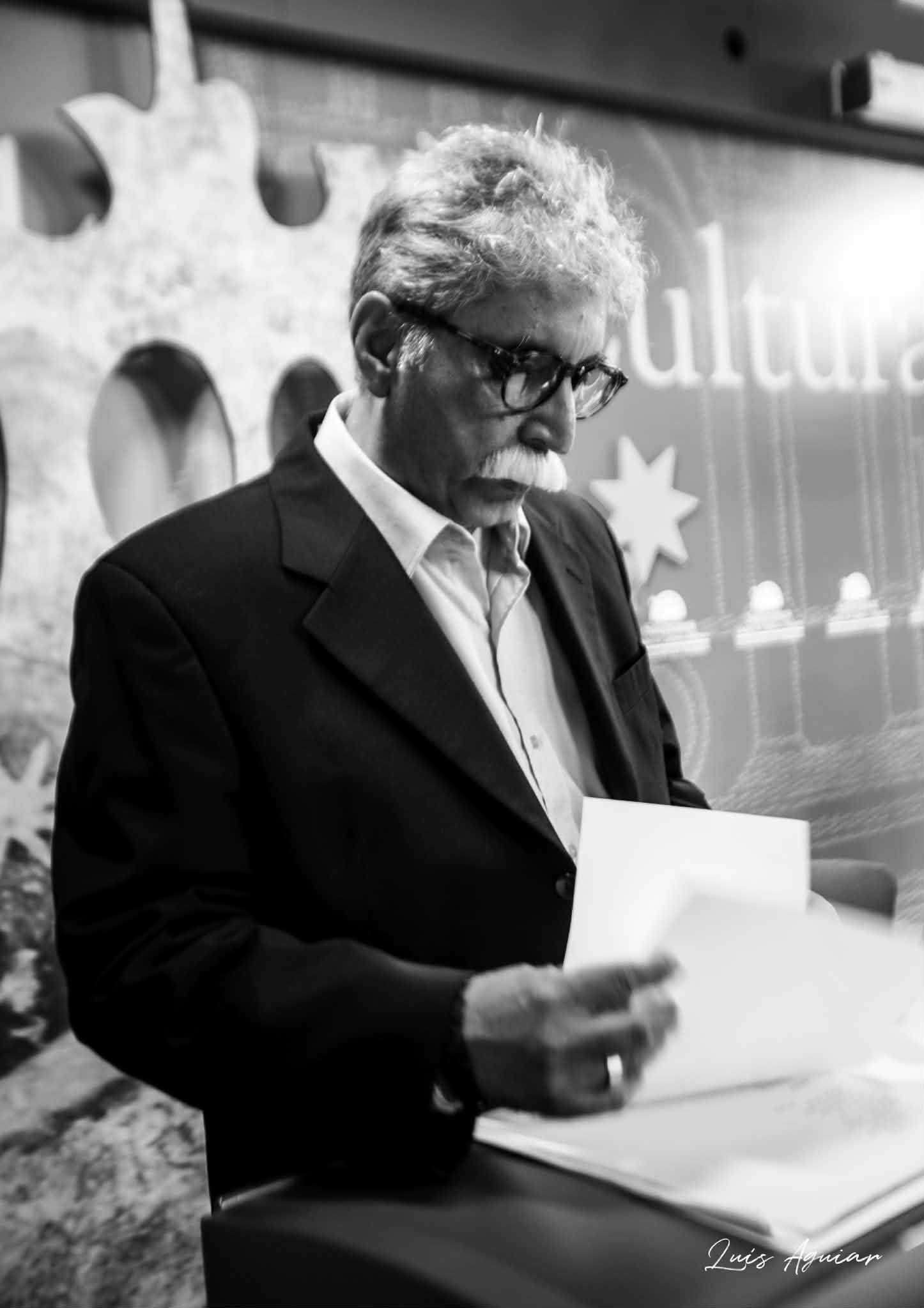
Photograph Luis Aguiar
Keynote Lecture Delivered at the “Third International Colloquium on Poetry and Philosophy: Sensibility is Thought,” coordinated by the Mexican writer Ulises Paniagua, with the support of various universities, cultural centers, publishing houses, and the Economic Culture Fund.
“The philosopher thinks better than they write, and the writer writes better than they think.” — Juan Villoro
To properly address this topic, I consulted the book Philosophy and Poetry by the Spanish philosopher, essayist, and poet María Zambrano (born in Málaga in 1904 and died in Madrid in 1991), a classic work on this supposed dilemma. In it, she attempts to elucidate the apparent dichotomy between these two genres. Zambrano notes that the topic must be addressed because “poetry and thought appear to us as two insufficient forms; and they seem to us two halves of humanity: the philosopher and the poet. One does not find the whole human being in philosophy; one does not find the totality of the human in poetry. In poetry, we directly encounter the concrete, individual human. In philosophy, we encounter humanity in its universal history, in its desire to be. Poetry is encounter, gift, discovery by grace. Philosophy seeks, a requirement guided by a method.”
In one chapter, the great thinker asks: “What roots do thought and poetry have in us? We do not wish to define them for the moment, but to discover the need, the extreme necessity that these two words sate. To what needy love do they come to give satisfaction? And which of these two needs is the deepest, the need given birth to in the most profound regions of human life? Which is the most indispensable?”
Both disciplines seek to unravel the human; philosophy through reason and poetry through revelation. In my case, I must confess that since I began reading philosophy, this science has helped me to find and formulate questions about life, existence, the cosmos, and poetry—has helped me find the answers. Philosophy allows us to encounter ourselves, to create and contemplate the problems of existence and the universe; poetry gives us the possibility of responding through words turned into verse. I even wrote a poetry collection titled Ornitosofía—something like a brief treatise on the flight of birds and philosophy (this collection was a finalist for Spain’s Gran Premio de Poesía Pilar Fernández Labrador) later published as Reconstrucción del Vuelo (The Reconstruction of Flight).
Zambrano asserts that “Without a poet in flight, there would be no poetry, there would be no word. Every word requires a distancing from the reality to which it refers; every word is also a liberation for the one who speaks it.” She then adds that: if thought is abstract, “poetry has always been living governed by the flesh. It has been the sin of the flesh made word, eternalised in its expression, objectified.” I agree with Zambrano that there is no possible definition of poetry, because a definition would violate its very existence. Once I was asked about its definition, and I replied that, for me, writing poetry is making love to language, and that poetry happens when God and the Devil are distracted and so give us leave us to be fully human, with all the risks that this entails; that is, to wonder at life, the sacred, nature, and infinity, represented in words.
In their own ways, both disciplines reveal the truth of what we are. Through philosophy we try to become more authentic, and poetry delves into the human condition. For Zambrano, poetry gets closer to creating out of non-being, and philosophy creates from being. Non-being would be the memory of our awareness of oblivion; we have scarce moments of lucidity while almost everything else is left behind through forgetfulness.
In the brief essay María Zambrano: Philosophy and Poetry, Two Such Different Modes of Being?, the authors conclude: “Philosophy and poetry is undoubtedly testimony of love of the word; it is a work that bets on a complete (and therefore human) being, affirming that one is not purely reason: one is and has value, hate and love, sympathy and difference. María Zambrano knows that poetry is participation, the communion of the poet with the world, the communion of humanity with the poet, the communion of humanity with itself. The poem is a point of reference. In it, inner worlds are mirrored; in the poem we reflect our similarities and our differences, a transparent mirror. Thus, the universality of the poem is inverse to the universality of logical thinking. In poetry, humanity finds itself because it too is a way of speaking to the world. And though poetry, it was claimed, lost, despite Plato, it won—poetry was won by and for humanity.”
I believe that both philosophy and poetry are forms of knowledge—poetry in a spontaneous way and philosophy through reason. Indeed, many philosophers have presented their theories halfway between poetry and science; both seek to reveal reality. In fact, I found a very poetic definition by Zambrano regarding why we philosophise: “Because I know I must die, I do not wish to do so without having seen, and without having seen myself.”
To close or open this section, I’ll quote Julián Naranjo Escobar: “The relationship between poetry and philosophy has always developed in permanent tension between the two. It is a relationship difficult to delimit and one that continues to produce paradoxes; at first glance, we perceive the antagonism between two seemingly opposed human figures: the philosopher and the poet. While the philosopher proposes to expose their thoughts in an exact and rational manner using definitions and concepts, the poet, on the other hand, is a person of images and rhythms, who has the ability to use exalted, inspired, and emotive forms of expression.”
Plato, the Poets, and Poetry
Now, let’s try to answer why Plato expelled the poets from his ideal Republic. This expulsion has generated multiple explanations and lots of speculation. The great Irene Vallejo, in her book El infinito En Un Junco (Infinity In A Reed), notes: “Plato’s Academy and, later, Aristotle’s Lyceum were located in groves dedicated to the Muses because the exercise of thought and education could be understood as metaphorical and luminous acts of worship to the nine goddesses. In a society that never had sacred books, The Iliad and The Odyssey were the closest thing to the Bible. Fascinated by Homer or enraged with him, but without the vigilance of a priestly class, Greek writers, artists, and philosophers felt free to explore, question, satirise, or expand the Homeric horizons. It is said that Aeschylus humbly stated that his tragedies were only ‘the crumbs from Homer’s great banquet.’ Plato dedicated long pages to attacking the poet’s presumed wisdom and expelled him from his ideal Republic.” And then Vallejo adds: “The passing years did not appease Plato’s censorious zeal. In his last dialogue, The Laws, in actuality he proposes the creation of the Poetry Police to monitor new literature: ‘The poet may not compose anything that contradicts what the city considers legal, just, beautiful, or good; once his poem is written, he may not give it to any private individual before it has been read and approved by judges designated for that purpose by the guardians of the laws (…) and by the one we chose as director of education.’ The message is emphatically clear: poetic texts must be subjected to severe censorship; sometimes suppressed, other times expurgated, corrected, and, whenever necessary—which will be often—rewritten.”
In her article Against the Myth That Plato Hated Poets and on the Superiority of Poetry over Philosophy, Sofía Tudela Gastañeta states: “The philosopher expelled the poets who proliferated in his time because their poetry, instead of exalting virtue, exalted vices; instead of showing the gods as they were, exalted beings, it showed them as pernicious, subject to human passions like anger or desire for revenge; all of which set a bad example.”
However, Plato, self-contradictory like all good philosophers, also loved poetry, as demonstrated in the myth of the cave. The myth is a literary genre, although, at that time, there was only one recognised genre: poetry.
Love and Philosophy
If there is a theme that we poets have made our own, it is love; however, philosophers, who seem detached from such trivial emotions, have also written about it.
The dictionary defines love as “an intense feeling of the human being who, starting from their own insufficiency and needs, seeks an encounter and union with another being.” The poet Lope de Vega states that “to believe that a heaven can fit in a hell, / to give life and soul to a disillusion, / this is love; whoever has tasted it knows,” and Francisco de Quevedo uses oxymoron, that is, opposing senses, to affirm that it is “a freedom imprisoned,” and love may well be a permanent contradiction in which we must accept that one can only love another person together with their defects and virtues.
This theme has been taken up by French writers and philosophers Aude Lancelin and Marie Lemonnier in their book Les Philosophes Et L’amour (Philosophers and Love) to study it from the viewpoints of Plato, Lucretius, Montaigne, Rousseau, Kant, Schopenhauer, Kierkegaard, Nietzsche, Heidegger, Arendt, to Sartre and De Beauvoir, as well as from the viewpoints of their contemporaries; extrapolating dialogues and writing and reading between the lines to discover what each of them thought about love and how they lived their own loves; a seemingly corny but profound topic. A topic that, for the incomparable Fernando Pessoa, can even be rather ridiculous: “All love letters are ridiculous. / They would not be love letters if they were not ridiculous.” And it is that words for wooing are, at the same time, common and beautiful; Alfonsina Storni reminds us thus: “Tonight in my ear you have said two words / Common. Two words tired / Of being said. Words / That from being old are new.” And those words, which she does not say in the poem, are: Te quiero, a simple, magical, and profound expression.
The authors cite Alain Badiou, the Moroccan-French philosopher, playwright, and novelist, who notes that love is a cosmopolitan, inciting, and a sexual force that transgresses borders and social statutes, and that it is threatened by the risks it entails, and by our how comfortable we are in our unlimited hedonism and pursuit of pleasure. Therefore, it is a philosophical task to undertake to defend love in order to reinvent it, as the poet Rimbaud once proposed. Aude Lancelin and Marie Lemonnier proposed this: “The philosophy of love is a territory to traverse again, and even to defend, with urgency. Adopting this approach, there is the possiblity that we can resist the ambient nihilism that seems to have found its ultimate weapon in the reduction of sexuality to a morbid libertinism. (…) love opposes the logic of the market.”
While browsing the aisles of a bookstore, I found the book Éloge de l’amour (In Praise of Love) by Alain Badiou, the Moroccan-French philosopher, playwright, and novelist. The title caught my attention because I did not imagine that one of the authors preferred by the intellectuals of the postmodern world (who appear uninterested in such trivialities as love) would have written on this topic. The book compiles an interview conducted by journalist Nicolás Truong in 2008.
In the chapter Les Philosophes et L’amour (Philosophers and Love), Badiou refers to Søren Kierkegaard, whose Diary of a Seducer I read and studied in my teenage years, convinced that I was irredeemably ugly, seeking some keys to woo the beautiful girls I believed unattainable. How far I was from knowing that love was beyond seduction, desire, and passion. Badiou pointed out that love was philosophically essential, and this was the intuition of Plato, too.
Badiou recognises three contradictory conceptions of love: the romantic conception which centres on the ecstasy of the encounter; the sceptical idea; that considers it an illusion; and the concept that assures us that love is a way to manufacture truth. This notion Badiou subscribes to, proposing that it is the construction of the “pair” from personal differences that forges the subject of love. “Love is always the possibility of witnessing the birth of a world,” he says, which reminded me of a verse I wrote: “Someone sees a girl pass by / and a new world is born.”
Love is a mystery, something that happens and reinvents the lives of those who feel it, and that is why Badiou assures that love is a declaration of the eternal. However, the worst enemy of eternity, and therefore of love, is not the other, but the self. It is ourselves we must overcome so that the “Two” can be built, and we can name, this, the only word that requires two beings are invoked. To conclude, I copy a dazzling fragment from Badiou: “The enigma of the thought of love is the question of the duration that it fulfills. Ultimately, the most interesting point is not the question of the ecstasy of beginnings. Of course, the ecstasy of beginnings exists, but a love is above all a lasting construction. Let us say that love is a stubborn adventure. The adventurous side is necessary, but no less so is the stubbornness. To give up at the first obstacle, the first serious divergence, the first boredom, is nothing but a disfigurement of love. A true love is one that triumphs enduringly, sometimes harshly, over the obstacles that space, the world, and time propose.”
The Return to Philosophy
For several years, I have been teaching on the Law program and discovered that I enjoy doing so; sharing knowledge, transporting information, and learning to and from students, who always have something to teach us. Among other subjects, I teach Philosophy of Law, in which I try to get my students to learn to reason about Law from a philosophy perspective. Before teaching the subject, I always update my understanding of it with various readings, whether from printed books or digital texts, and I even turn to YouTube to watch and analyse interviews with prominent philosophers of our time.
Some time ago, I had a serendipitous encounter: I was looking for a novel and came across a book by Bertrand Russell titled Human Knowledge. In the preface, I read that philosophy “loses much of its value if only a few professionals can understand what philosophers say,” and I can confirm this is true every time I have to teach this subject. Because students know very little about philosophy and philosophers. In the first class, I always show two slides: one with superheroes, and I ask if they know them, and they all chorus their names; the same chorus does not happen when I show the second slides with the busts of classical Greek philosophers; almost no one recognises them, and nor are they interested in them, even if I show them that many phrases attributed to movie actors and actresses or rock stars actually belong to human beings who loved, and love, wisdom.
Not only is our educational system failing by making philosophy classes boring; the media and social networks also bombard us with banality. Zygmunt Bauman, the philosopher, is right to point out that sometimes “the excess of information is worse than scarcity.” Regarding social networks, I read an interview with Markus Gabriel, a young German philosopher, who states that today, “Facebook occupies the place of God” and even makes us believe we are free to express our opinions and feelings when what we are doing is actually “pure emptiness.” Gabriel clarifies that the underlying issue in Trump’s victory is not that the Russians arranged it, but that they used social networks to do so because now the “public sphere is controlled by algorithms.” But just as Gabriel criticizes social networks, he also criticises philosophers like Heidegger, Derrida, and Foucault because, according to him, they possess obscure discourses, as well as other media philosophers because their discourses are presumptuous. Finally, he claims that today’s philosophers should speak about the role of universities, because it is there that “the cooperation of all sciences to better understand the human being” occurs; that is, philosophy must return to university classrooms as the mother of all sciences. Hopefully.
HOMERO CARVALHO OLIVA: Poesía y Filosofía
Conferencia magistral presentada en el “Tercer Coloquio Internacional Poesía y Filosofía, sensibilidad es pensamiento” coordinado por el escritor mexicano Ulises Paniagua con el auspicio de varias universidades, centros culturales, editoriales y el Fondo de Cultura Económica.
“El filósofo piensa mejor de lo que escribe y el escritor escribe mejor de lo que piensa”. Juan Villoro
Para abordar este tema apropiadamente consulté el libro Filosofía y poesía, de María Zambrano, filósofa, ensayista y poeta española (nació en Málaga en 1904 y falleció en Madrid en 1991), un clásico sobre el supuesto dilema. En este libro ella intenta dilucidar la aparente dicotomía entre esos dos géneros. Zambrano señala que el tema debe ser abordado porque “poesía y pensamiento se nos aparecen como dos formas insuficientes; y se nos antojan dos mitades del hombre: el filósofo y el poeta. No se encuentra el hombre entero en la filosofía; no se encuentra la totalidad de lo humano en la poesía. En la poesía encontramos directamente al hombre concreto, individual. En la filosofía al hombre en su historia universal, en su querer ser. La poesía es encuentro, don, hallazgo por gracia. La filosofía busca, requerimiento guiado por un método”.
En uno de los capítulos la gran pensadora se pregunta: “¿Qué raíz tienen en nosotros pensamiento y poesía? No queremos de momento definirlas, sino hallar la necesidad, la extrema necesidad que vienen a colmar las dos formas de la palabra. ¿A qué amor menesteroso vienen a dar satisfacción? ¿Y cuál de las dos necesidades es la más profunda, la nacida en zonas más hondas de la vida humana? ¿Cuál es la más imprescindible?”
Ambas disciplinas buscan desentrañar lo humano, la filosofía desde la razón y la poesía desde la revelación. En mi caso, debo confesar que desde que empecé a leer filosofía esta ciencia me ha ayudado a encontrar y realizar preguntas acerca de la vida, la existencia y el cosmos y la poesía me ha ayudado a encontrar las respuestas. La filosofía nos permite encontrarnos, crear y pensar los problemas de la existencia y del universo, la poesía nos da posibilidad de responder a través de la palabra hecha verso. Incluso escribí un poemario que lo titulé Ornitosofía, algo así como un breve tratado sobre el vuelo de los pájaros y la filosofía (este poemario estuvo entre los finalistas del Gran Premio de Poesía Pilar Fernández Labrador, de España), luego lo publiqué como Reconstrucción del vuelo.
Zambrano afirma que “de no tener vuelo el poeta, no habría poesía, no habría palabra. Toda palabra requiere un alejamiento de la realidad a la que se refiere; toda palabra es también, una liberación de quien la dice”. Luego añade que si el pensamiento es abstracto “la poesía ha sido en todo tiempo, vivir según la carne. Ha sido el pecado de la carne hecho palabra, eternizado en la expresión, objetivado”. Coincido con Zambrano en que no existe una definición posible de poesía, porque la definición atentaría contra su propia existencia. Un día me preguntaron acerca de la definición y yo respondí que, para mí, escribir poesía es hacerle el amor al lenguaje y que la poesía sucede cuando Dios y el Diablo se descuidan y nos dejan ser plenamente humanos, con todos los riesgos que eso conlleva; es decir el asombro ante la vida, lo sagrado, la naturaleza y el infinito, representados por la palabra.
A su manera, ambas disciplinas revelan la verdad de lo que somos. A través de la filosofía intentamos acercarnos a la autenticidad y la poesía indaga en la condición humana. Para Zambrano la poesía aborda la creación desde el no ser y la filosofía desde el ser. El no ser sería la memoria de la conciencia desde el olvido, apenas somos esos instantes de lucidez mientras lo demás permanece en el olvido.
En el breve ensayo María Zambrano: filosofía y poesía, ¿dos modos de ser tan distinto?, los autores concluyen: “Filosofía y poesía es sin duda el testimonio del amor a la palabra, es una obra que apuesta por un hombre completo y por eso humano al afirmar que no es puramente razón: es ser y valer, odio y amor, simpatía y diferencia. María Zambrano sabe que la poesía es participación, comunión del poeta con el mundo, comunión del hombre con el poeta, comunión del hombre entre sí. El poema es un punto de referencia. En él se miran los mundos interiores, en el poema reflejamos nuestras semejanzas y nuestras diferencias, espejo transparente. Así la universalidad del poema es inversa a la universalidad de la lógica. En la poesía el hombre se encuentra porque también ella es una forma de decir al mundo. Y aunque se haya pretendido perdida fue a pesar de Platón ganada, ganada por y para el hombre”[1].
Creo que tanto la filosofía como la poesía son formas del conocimiento, la poesía de manera espontánea y la filosofía a través de la razón, incluso muchos filósofos expusieron sus teorías a medio camino entre la poesía y la ciencia, ambas buscan la revelación de la realidad. De hecho, encontré una definición muy poética de Zambrano respecto a por qué filosofar: “Porque sé que tengo morir y no quiero hacerlo sin haber visto y haberme visto”.
Para cerrar o abrir esta parte cito a Julián Naranjo Escobar: “La relación entre poesía y filosofía siempre se ha desarrollado en medio de una permanente tensión entre ambas. Se trata de una relación difícil de delimitar y que no deja de ofrecer algunas paradojas; en un primer momento, advertimos el antagonismo existente entre dos figuras en apariencia opuestas: el filósofo y el poeta. Mientras el filósofo se propone exponer su pensamiento de manera exacta y racional sirviéndose de conceptos, el poeta, por su parte, es hombre de imágenes y ritmos que posee una forma de expresión exaltada, inspirada y emotiva”[2]
Platón, los poetas y la poesía
Ahora bien, intentemos responder por qué Platón expulsó a los poetas de su república ideal, que ha generado múltiples explicaciones y especulaciones. La gran Irene Vallejo, en su libro El infinito en un junco señala: “La Academia de Platón y, más tarde, el Liceo de Aristóteles tenían su sede en bosquecillos consagrados a las musas porque el ejercicio del pensamiento y la educación podían entenderse como actos metafóricos y luminosos de culto a las nueve diosas. En una sociedad que nunca tuvo libros sagrados, La Ilíada y La Odisea eran lo más parecido a la Biblia. Fascinados por Homero o enfurecidos con él, pero sin la vigilancia de una clase sacerdotal, los escritores, artistas y filósofos griegos se sintieron libres para explorar, cuestionar, satirizar o ensanchar los horizontes homéricos. Se cuenta que Esquilo dijo humildemente que sus tragedias eran solo «las migajas del gran banquete de Homero». Platón dedicó largas páginas a atacar la presunta sabiduría del poeta, y lo expulsó de su república ideal”. Y luego agrega: “El paso de los años no apaciguó los bríos censores de Platón. En su último diálogo, Las Leyes, propone prácticamente la creación de una Policía poética para vigilar la nueva literatura: «El poeta no podrá componer nada que contradiga lo que la ciudad considera legal, justo, bello o bueno; una vez escrito su poema, no podrá darlo a conocer a ningún particular, antes de haber sido leído y aprobado por los jueces que para ello hubieran designado los guardianes de las leyes (…) y aquel al que escogimos como director de educación». El mensaje queda enfáticamente claro: hay que someter los textos poéticos a una severa censura; a veces suprimirlos, otras veces expurgarlos, aplicarles correcciones y, siempre que sea preciso —lo será muchas veces—, reescribirlos”.
En su artículo “Contra el mito de que platón odiaba a los poetas y sobre la superioridad de la poesía ante la filosofía”, Sofía Tudela Gastañeta afirma: “El filósofo expulsa a los poetas que proliferaban en su época porque su poesía, en lugar de exaltar la virtud, exaltaba los vicios; en lugar de mostrar a los dioses como eran, seres excelsos, los mostraba como perniciosos, sujetos a pasiones humanas como la ira o el deseo de venganza; todo lo cual daba un mal ejemplo”.
Sin embargo, Platón, contradictorio, como buen filósofo, también amaba la poesía y lo demuestra en el mito de la caverna, un mito es un género literario y en ese entonces solo había uno: la poesía.
El amor y la filosofía
Si hay un tema que los poetas hemos hecho nuestro es el amor; sin embargo, los filósofos, que parecen alejados de tan trivial sentimiento, también han escrito sobre el mismo.
El diccionario define al amor como “sentimiento intenso del ser humano que, partiendo de su propia insuficiencia, necesita y busca el encuentro y unión con otro ser”. El poeta Lope de Vega afirma que “creer que un cielo en un infierno cabe, / dar la vida y el alma a un desengaño, /esto es amor; quien lo probó, lo sabe” y Francisco de Quevedo usa el oxímoron, es decir sentidos contrapuestos, para afirmar que “es una libertad encarcelada” y el amor bien puede ser una contradicción permanente, en la que tenemos que aceptar que solamente se puede amar a otra persona con sus defectos y sus virtudes.
Este tema ha sido tomado por las escritoras y filósofas francesas Aude Lancelin y Marie Lemonnier, en su libro Los filósofos y el amor, paraestudiarlo desde Platón, Lucrecio, Montaigne, Rousseau, Kant, Schopenhauer, Kierkegaard, Nietzsche, Heidegger, Arendt, hasta Sartre y De Beauvoir, así como también a sus contemporáneos para extrapolar diálogos y escritos buscando entrelíneas qué pensaron cada uno de ellos acerca del amor y cómo vivieron sus propios amores, tema aparentemente cursi, pero profundo al mismo tiempo. Un tema que para el incomparable Fernando Pessoa hasta puede ser ridículo: “Todas las cartas de amor son ridículas. / No serían cartas de amor si no fueran ridículas”. Y es que las palabras para enamorar son, al mismo tiempo, comunes y bellas; Alfonsina Storni nos lo recuerda así: “Esta noche al oído me has dicho dos palabras/ Comunes. Dos palabras cansadas / De ser dichas. Palabras/ Que de viejas son nuevas” y esas palabras, que no las dice en el poema, son: Te amo, una expresión sencilla, mágica y profunda.
Las autoras citan a Alaín Badiou, filósofo, dramaturgo y novelista francés marroquí, quien señala que el amor es una fuerza cosmopolita, incitante y sexuada que transgrede fronteras y estatus sociales, amenazado por los riesgos que conlleva y por la comodidad que tenemos por asegurarnos el goce ilimitado y hedonista y que, por lo tanto, es una tarea filosófica defenderlo para reinventarlo, como alguna vez propuso el poeta Rimbaud. Aude Lancelin y Marie Lemonnier, proponen: “La filosofía del amor es un territorio para volver a recorrer, e incluso a defender urgentemente. Hay en esto una resistencia posible al nihilismo ambiente que parece haber encontrado con la reducción de la sexualidad a un libertinaje mórbido su arma definitiva. (…) el amor se opone a la lógica del mercado”.
Recorriendo los pasillos de una librería encontré el libro Elogio del amor de Alain Badiou, filósofo, dramaturgo y novelista francés marroquí. Me llamó la atención el título porque no imaginaba que uno de los autores preferidos por los intelectuales del mundo postmoderno, que aparentan no interesarse por este tipo de trivialidades, haya escrito sobre este tema. El libro recoge una entrevista que le hizo el periodista Nicolás Truong en el año 2008.
En el capítulo Los filósofos y el amor, Badiou hace referencia a Soren Kierkegaard, de quien, en mis años adolescentes y convencido de que era un feo sin remedio, leí y estudié su Diario de un seductor, buscando algunas claves para apalabrar a las muchachas hermosas que creía inalcanzables. Lejos estaba de saber que el amor estaba más allá de la seducción, del deseo y de la pasión, concepción que para Badiou fue intuida por Platón cuando señaló que el amor es filosóficamente esencial.
Badiou reconoce tres concepciones contradictorias acerca del amor: la concepción romántica que se centra en el éxtasis del encuentro; la escéptica que lo considera una ilusión y la que afirma que el amor es una construcción de verdad, a la que él se adscribe y propone que es la construcción del “Dos” desde las diferencias personales que van forjando al sujeto del amor. “El amor es siempre la posibilidad de presenciar el nacimiento de un mundo”, dice y me trajo recuerdo a un verso que escribí: “Alguien ve pasar a una muchacha/ y nace un mundo nuevo.”
El amor es un misterio, es algo que sucede y reinventa la vida de quienes lo sienten y por eso Badiou asegura que el amor es una declaración de eternidad. Sin embargo, el peor enemigo de la eternidad y, por tanto, del amor, no es el otro, sino el yo. Es a nosotros mismos que debemos vencer para que se construya el “Dos” y podamos nombrar a la única palabra que necesita de dos seres para ser invocada. Para terminar, copio un deslumbrante fragmento de Badiou: “El enigma del pensamiento del amor es la cuestión de esta duración que cumple. En el fondo, el punto más interesante no es la cuestión del éxtasis de los comienzos. Por supuesto que existe el éxtasis de los comienzos, pero un amor es ante todo una construcción duradera. Digamos que el amor es una obstinada aventura. El lado aventurero es necesario, pero no lo es menos la obstinación. Dejarse caer al primer obstáculo, a la primera divergencia seria, en los primeros aburrimientos, no es sino una desfiguración del amor. Un amor verdadero es aquel que triunfa duraderamente, a veces duramente, sobre los obstáculos que el espacio, el mundo y el tiempo le proponen”.
El retorno a la filosofía
Desde hace varios años me dedico a dar clases en la carrera de Derecho y descubrí que me gusta enseñar, compartir conocimiento, transferir información y aprender de los estudiantes que siempre tienen algo que enseñarnos. Entre otras materias profeso Filosofía del Derecho, en la que intento que mis alumnos aprendan a razonar el Derecho desde la filosofía. Antes de dictar la materia siempre me actualizo con diferentes lecturas, ya sean libros impresos o textos digitales, incluso recurro a YouTube para ver y analizar entrevistas a destacados filósofos de nuestra época.
Hace algún tiempo tuve una serendipia, estaba buscando una novela y me encontré con un libro de Bertrand Russell titulado El conocimiento humano, en el prefacio leí que la filosofía “pierde mucho de su valor si solo unos pocos profesionales pueden comprender lo que dicen los filósofos”, y eso lo compruebo cada vez que me toca dar esta asignatura porque los estudiantes conocen muy poco de filosofía y de filósofos. En la primera clase siempre les muestro dos diapositivas, en una de ellas están los superhéroes, les pregunto si los conocen y todos me dicen sus nombres a coro; no sucede lo mismo cuando les muestro la segunda con los bustos de los filósofos griegos clásicos, nadie los conoce y tampoco les interesa, incluso si les demuestro que muchas de las frases atribuidas a actores y actrices de cine o a estrellas de rock, en realidad les pertenecen a seres humanos que amaban y aman la sabiduría.
No solamente está fallando nuestro sistema educativo que hace que las clases de filosofía sean aburridas; también los medios de comunicación y las redes sociales que nos bombardean con programas banales. Zygmunt Bauman, filósofo, tiene razón al señalar que, a veces, “el exceso de información es peor que la escasez”. A propósito de las redes sociales leí una entrevista a Markus Gabriel, joven filósofo alemán, quien afirma que, en la actualidad, “Facebook ocupa el lugar de Dios” y que incluso nos hace creer que somos libres al expresar nuestras opiniones y sentimientos, cuando en realidad es “el puro vacío”. Gabriel aclara que el tema de fondo en la victoria de Trump no es que los rusos hayan manipulado, sino que usaron las redes sociales para hacerlo porque ahora la “esfera pública está controlada por algoritmos”. Pero, así como Gabriel critica a las redes sociales también lo hace con filósofos como Heidegger, Derrida y Foucault porque según él son poseedores de discursos oscuros, así como a otros filósofos mediáticos porque sus discursos son presuntuosos. Por último, reclama que los filósofos de hoy deberían hablar del rol de las universidades, porque es allí donde se da la “cooperación de todas las ciencias para conocer mejor al ser humano”, es decir, la filosofía debe volver a las aulas universitarias como la madre de todas las ciencias. Ojalá.
[1] http://www.archivopdp.unam.mx/index.php/2763
[2] https://revistamito.com/la-critica-de-platon-la-poesia/
Homero Carvalho Oliva (Santa Ana del Yacuma, Bolivia, 1957). Writer and poet, he has received national and international awards for short stories, poetry, micro-fiction, novels, and essays. His literary work has been published in other countries by prestigious publishing houses and translated into several languages; his poems, stories, and microfictions are included in over one hundred international anthologies, as well as in literary magazines and supplements worldwide. He is the author of anthologies of poetry, short stories, and microfiction published in several countries, such as the Anthology of 20th-Century Poetry in Bolivia, published by the prestigious Spanish publisher Visor, and another published by the Pablo Neruda Foundation in Chile; as well as personal selections of his poetry and short stories.
Homero Carvalho Oliva (Santa Ana del Yacuma, Bolivia, 1957). Escritor y poeta, ha obtenido premios de cuento, poesía, microcuento, novela y ensayo a nivel nacional e internacional. Su obra literaria ha sido publicada en otros países por prestigiosas editoriales y traducida a varios idiomas; poemas, cuentos y microficciones suyas están incluidos en más de cien antologías internacionales, además de revistas y suplementos literarios por todo el mundo. Es autor de antologías de poesía, de cuentos y microcuentos publicadas en varios países, como la Antología de poesía del siglo XX en Bolivia, publicada por la prestigiosa editorial Visor de España y otra publicada por la Fundación Pablo Neruda, de Chile; así como también de selecciones personales de su poesía y de sus cuentos.
Discover more from Ars Notoria
Subscribe to get the latest posts sent to your email.