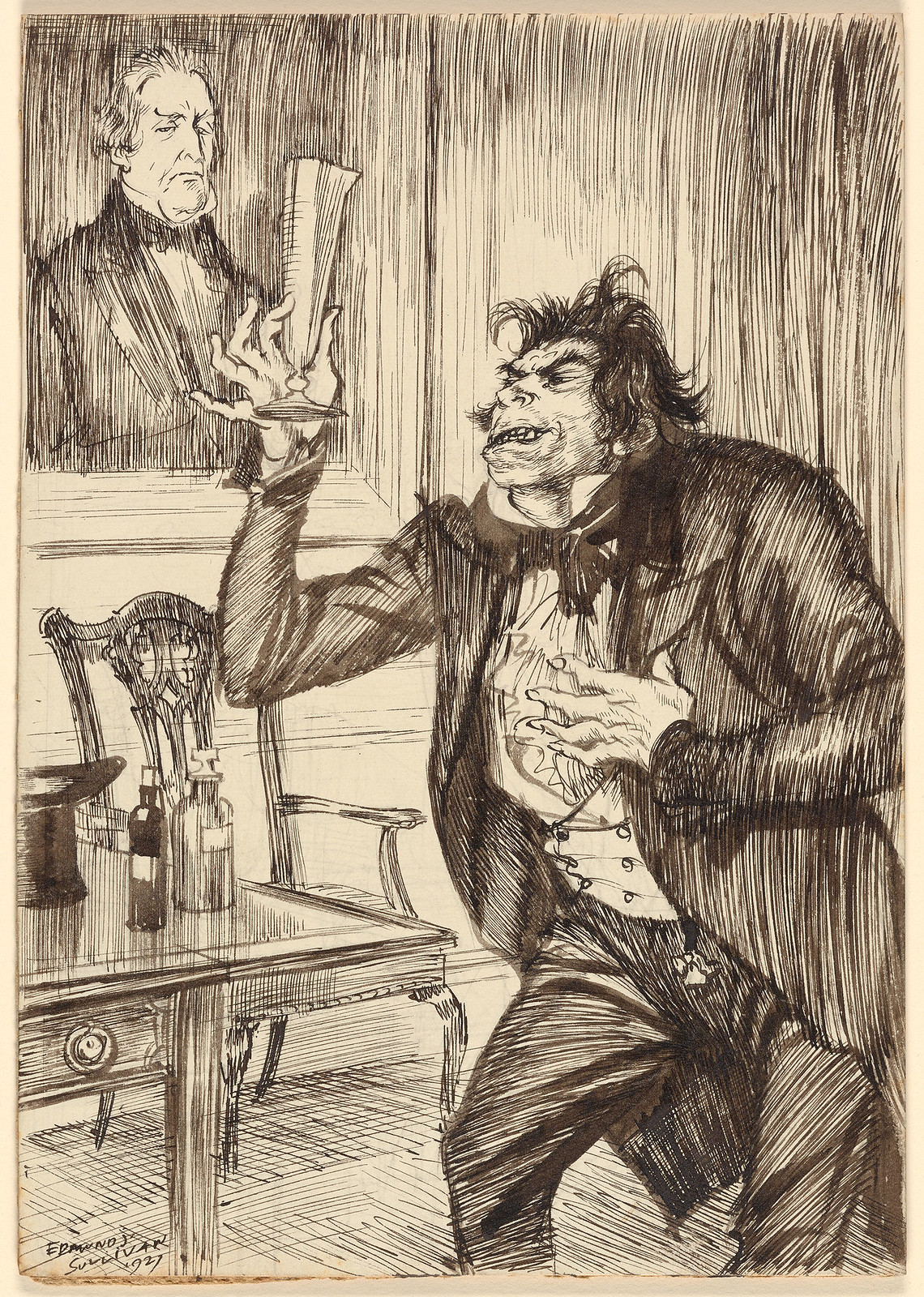
“Hyde had a song upon his lips as he compounded the draught, and as he drank it pledged the dead man.” Illustration for “Strange Case of Dr Jekyll and Mr Hyde” by Robert Louis Stevenson, 1927 Illustration Joseph Sullivan
by Richard Steinhardt
Alcohol is a great enhancer and destroyer of life, a substance that reflects the human condition. Alcoholic drink is woven into the fabric of life in much of the world, from religious ceremonies like the Catholic mass, to the child’s first sneaky sip of beer or wine at the table. Drink champagne at a wedding! Find Dutch courage before a party or a fight!
To question the value of drinking alcohol feels like an attack on happiness, friendship, and culture. Perhaps it could be regarded as a criticism of whole nations: the people love their Baijiu, Tequila, Rum, Whiskey, Burgundy, Trappist beer, Soju, Sake, Vodka, Ouzo, Raki, Teju, and Akvavit.
This almost magical liquid that dissolves boundaries has a dangerous alter ego; Mr Hyde. The wine used in communion also fuels violence, addiction, financial ruin, and destroys families, communities, and promising futures.
The pleasurable effects are immediate and visible, but the devastating harm is often delayed and private; the silent terror of domestic violence later at night. And once alcoholic addiction gets a grip, it takes an enormous strength to peel off each finger of the fist that clasps around the throat of the addict. An insect, drawn in by the scent of nectar struggles hard to escape from a Venus Flytrap.

Alcohol’s role is ancient and ambivalent: a sacred substance, a social lubricant, an artistic tool, self-medication. Now it is the centrepiece of celebration and mating rituals because it lowers inhibitions, eases social friction, and provides a sense of release. Alcoholic drinks can taste like rot, or taste so sublime that a single bottle of 80-year-old Speyside whiskey can cost as much as a town flat.
Arguably, our high-wire relationship with alcohol is intrinsic. The “Drunken Monkey” theory hypothesises that consumption of ethanol encouraged our primate ancestors to consume high-calorie fermenting fruit. We are all biologically vulnerable to alcohol. But an ancient survival mechanism, where we ate low-concentrations of alcohol-impregnated fruit, many millennia ago became a civilisational health crisis.
The growth of capitalism ruthlessly exploited the power of alcohol for making profit and accentuated the problem. Alcohol was cheap to produce at high strengths, and because it was so addictive, something that cost very little to produce from cheap ingredients like raw molasses could be sold at many times the cost of production. In the beginning, the state didn’t sufficiently regulate its consumption and the result was an epidemic, the Gin Craze. Even the poorest could afford a drink of gin:

‘It is with the deepest concern your committee observe the strong Inclination of the inferior Sort of People to these destructive Liquors, and how surprisingly this Infection has spread within these few Years … it is scarce possible for Persons in low Life to go anywhere or to be anywhere, without being drawn in to taste, and, by Degrees, to like and approve of this pernicious Liquor.’
The Pamphleteer, Volume 29 By Abraham John Valpy
It seems to me that nowadays, criticism of drinking alcoholic drinks is being made to seem not just puritanical, but unpatriotic and something against freedom itself.
In a post-9/11 world, 20 years later, after a “clash of civilizations” propaganda has scapegoated ordinary Muslims, public drunkenness has became, for some, an unconscious performance of “Western” identity—a declaration of freedom and hedonism set against a stereotyped, pious “other.” The other labelled as disrespectful of life and pleasure; Muslims strawmanned as the new Puritans.
This exhibition of extreme consumption, disguised as fun, can define public space in exclusionary ways, making those who abstain for cultural or religious reasons feel outsiders. Ironically, the same behaviour can also be weaponised in another direction against the poor and working-class, who are demonised for the very binge-drinking culture that is celebrated as an expression of freedom.

Alcoholic drinks have also been a weapon in the armament of colonial conquest. European colonial powers manufactured and sold cheap, industrially produced spirits to destabilise the communities of indigenous aboriginal populations and overcome their organised resistance, creating economic dependency and social chaos facilitating control and dispossession.
The pattern was consistent: create dependency, extract wealth and labour, and then use the resulting social decay to justify further imperial domination. This strategy of using alcohol as a tool of subjugation was an instrument of colonial, geopolitical control. In the ‘dop’ or ‘tot’ system in South Africa, workers in the vineyards around Cape Town were paid partially or entirely in the wine they produced so cheaply. European settlers used alcohol to control and exploit.

In modern times, the alcohol industry has learned from big tobacco’s mistakes and sidestepped the health debate entirely with every advertisement and bottle and can in the UK bearing the “Drink Responsibly” slogan. The industry frames harm as personal failure. Powerful multinational alcoholic beverage producing organisations generate a smokescreen of corporate concern while the consumer who fails to ‘drink responsibly’ (see the small label on the bottle) is blamed. Calls for regulation are diffused. “Responsible drinking” is a victim-blaming framework that treats alcohol as a neutral commodity and not an addictive psychoactive drug – which it is.

Meanwhile, the drinks industry associates alcohol with every fundamental human aspiration: friendship, freedom, love, success, happiness, intelligence, and sophistication. With its immense political power it can lobby against health warnings, suppress independent research, and ensure that its products remain so deeply embedded into the fabric of daily life that any criticism seems anti-social.
In part, this defence of alcohol consumption is bolstered in our society by a myth: that alcohol is a necessary release valve for pent-up emotions, and that without it, repression would lead to dangerous explosions. This idea misinterprets psychological concepts and romanticises excess. It depicts temperance as a dangerous form of repression.
For some, the most judicious choice will be abstinence—a decision that should be celebrated as the height of consciousness, not ridiculed as social failure.
The reality is the exact opposite. The vast majority of violence—domestic abuse, street fights, petty crime—is alcohol-fuelled. The substance doesn’t dissolve pent-up emotion, it is a disinhibitor that amplifies aggression and poor judgment. It triggers violence, it doesn’t cure violence.
What is really repressed is the refusal to address the root causes of emotional distress and alcohol abuse. Alcohol consumption goes off the rails with an unequal society, with economic insecurity and disadvantage, with poverty, a lack of community cohesion, and poor mental healthcare. The social harm is staggering, but so are the negative effects on health.
Alcohol misuse causes organ failure and premature death. It is a carcinogen. It destroys neurological function. It causes lifelong disabilities in children through Foetal Alcohol Spectrum Disorders. It erodes mental health. It destroys families and relationships. It triggers financial ruin. It results in social isolation and fuels violence and trauma. For this reason, awareness of the social and health harm of alcohol consumption and attempts to stop its consumption have been a constant theme in British life since the reformation.

A decent state response to counteracting the negative effects of alcohol consumption would be a public health campaign that honestly addresses the direct link to cancer, the role of alcohol in sexual assault, a clear explanation of mechanisms of addiction, and a hammering home the fact that no level of consumption is without risk.
This is a message that is systematically suppressed. When was the last time you became aware of a serious and intensive government advertising campaign arguing against drunk driving, or a campaign attempting to prevent the harm caused by alcohol to unborn children, or a campaign warning about how alcohol is a factor in domestic violence?
The solution cannot be found in simple prohibition. It never could. We have to deal with with the paradox of alcohol. The challenge is to acknowledge and respect deep human needs for pleasure; to acknowledge the place of alcohol for its value, aesthetics, cultural importance, and usefulness, to acknowledge, how central it is to community, ritual, release, and transcendence in alcohol consuming societies, while protecting people from alcohol’s inherent dangers.
By no means should community, ritual, release, and transcendence be synonymous with alcohol, much as the drinks industry would like to insist that it is.
To mitigate the problem means we have to address the root causes of the demand for escape and easy forgetfulness and enjoyment: economic deprivation, alienation, and a lack of richness and meaning in people’s lives reinforces the imbibing of alcohol. We need a humane socialist society that offers healthy forms of connection and purpose that don’t always require intoxication, and release; through community engagement, mental health support, and fulfilling work.
Another world is possible and, indeed, it exists. It can be done. In Britain, alcohol turns sober Doctor Jekyll first into charming Doctor Jekyll and sometimes into into mad and bad Mr Hyde, but there are societies where alcohol is not consumed, and people find it easy to socialise and enjoy themselves in an infinite number of ways without getting intoxicated. Hundreds of millions of people who live in the Muslim world are accustomed to prohibition and happy with it, and they have removed alcohol from its central position in human society.

Ultimately, in places like the UK, a more hopeful path lies in a radical cultural shift: from mindless consumption to where society takes full responsibility for educating people and preventing harm, and a culture of ceremonial, conscious, and judicious consumption is deployed.
Here the consumption of alcohol would be reduced to a punctuation mark, not the entire text. Such an approach would not be the equivalent of saying ‘Who gives a damn, drink it anyway.’ Instead, it we could develop a culture of drinking with full awareness, making educated choices, respecting alcohol as a powerful substance, and understanding one’s own limits. We need to chain down the wolves of corporate capitalism who are willing to do anything to make a buck, even to sell sweetened and brightly coloured alcopops to children.
For some, the most judicious choice will be abstinence. This is a decision that should be celebrated as the height of consciousness, not ridiculed as social failure.
We will never ‘defeat’ alcohol, it’s an intrinsic part of life, but as an evolving society we can collectively overpower and vanquish the industries that push it, who, in doing so, push the health costs and lost productivity and social costs of misuse onto the rest of us. Society can take responsibility for augmenting individual and social self-awareness and self-mastery through education and regulation.
Babor, T., Caetano, R., Casswell, S., Edwards, G., Giesbrecht, N., Graham, K., Grube, J., Hill, L., Holder, H., Homel, R., Livingston, M., Österberg, E., Rehm, J., Room, R., & Rossow, I. (2010). Alcohol: No Ordinary Commodity: Research and Public Policy (2nd ed.). Oxford University Press.
Dudley, R. (2014). The Drunken Monkey: Why We Drink and Abuse Alcohol. University of California Press.
Van Onselen, C. (1976). The Role of Liquor in the Development of the South African Proletariat. International Review of Social History, 21 (1), 44-74.
Richard Steinhardt is a committed socialist and a radical humanist and has published in the Morning Star and a variety of other communist and socialist publications. He believes that human conscience and understanding should always precede dogma and deterministic formulas posturing as ‘social science’.
Discover more from Ars Notoria
Subscribe to get the latest posts sent to your email.



You must be logged in to post a comment.