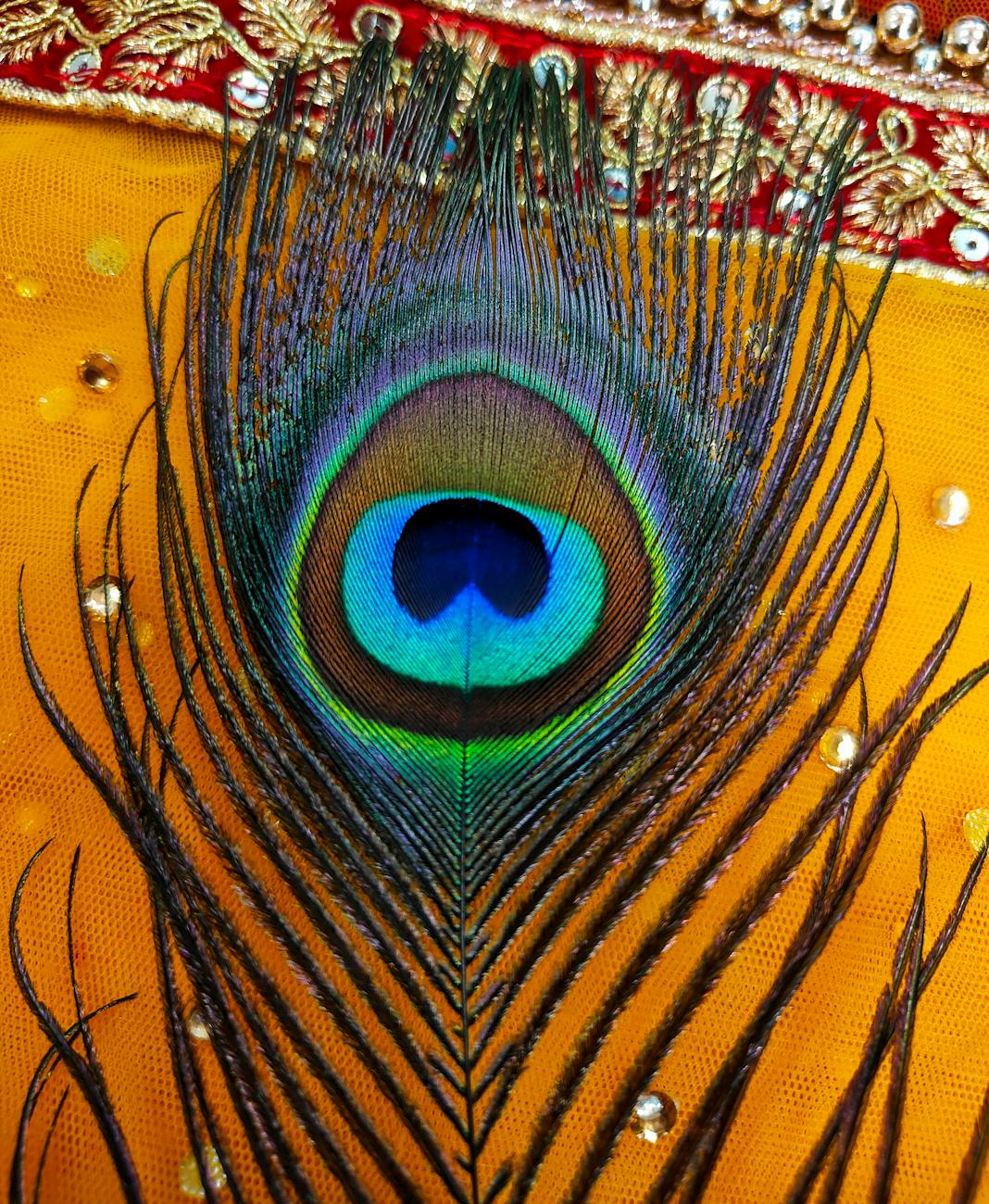
Photo by Nikhil Singh Rajput on Pexels.com
Quite a few Rooi Baba flew towards Dabbo now and then, as she swung on the tyre, looking at the Madar plants growing along the side of her house, releasing cotton-like flowers into the air. She stretched her hands trying to catch them while swinging on the tyre hanging from an eleven-year-old overgrown jackfruit tree, her mother had sown the year Dabbo was born. She paddled her bare feet mid-air, coming close to the ground, oscillating the swing, stretching out a hand to catch these flowers — these were called Rooi Baba by everyone in Qaisarpur because they were thought to fulfil wishes, one had to only catch them, pluck some hair from the cotton mesh and blow it back into the air. The black seed at the centre should not be destroyed while plucking the hair because that would stop Rooi Baba from becoming another plant, somewhere else. Within this ritual of catching wishes in the air and blowing them back for their fulfilment, many placed some hope in Qaisarpur. Dabbo, after all, had many wishes to catch. She never let any Rooi Baba flying around go to waste. Leela and Faraz, her friends – one she could play with inside her home, another she could only meet outside – would nudge her to tell what she wished for, but this trade of telling desires was rarely successful because someone or the other wouldn’t want to say what they wished for. Faraz, at times, wouldn’t even wish for anything. He would simply wonder what others wished for while puffing Rooi Baba away. When asked, he would say, “I can’t share the wish, pigeon heads! It won’t get fulfilled otherwise”, wondering at the same moment, what does he really want?
As Dabbo caught a Rooi Baba and was about to close her eyes after plucking two hairs, she heard the voice of some men singing nearby. Four mendicants holding a green cloth sheet, singing alms in Urdu and Awadhi, were arriving at the front of Dabbo’s house. The spread of the sheet made a pool in its centre from the coins people had offered the singing saints. Dabbo thumped her feet on the ground to stop the swing, knowing that she would have to lie, telling them the classic “No one’s home!”. She’d say what she said every time anyone came to beg for money. She jumped off the tyre, shaking the strong branch momentarily, now on her foot to run inside the house. Before she could run inside, she noticed that one of the saints was waving a fan made of long glinting peacock feathers. He seemed the oldest, not because he was walking a little crouched compared to the others but because his voice could hardly be heard through his flabby cheeks which kept inflating and shrinking as he sang words that struggled to come out in rhythm. Dabbo thought the fan made of peacock feathers had looked back at her. She stood transfixed, lost in the sight of so many feathers moving while being sewn together as a circular fan – wanting to steal it.
The day passed but the fan of the peacock feathers kept moving in circles inside Dabbo’s head the whole day – when she took her afternoon nap, as she woke up and ate her favorite red salt, ghee and rice, washed the pile of utensils outside the kitchen on the ground which poured the dirty water into a narrow pit of soil where weeds grew for animals to eat. Having no one to play with since little Parloki had also gone with the herd for grazing, she went to her friend Leela’s house for a round of a pebble game. No matter what she did, that old dervish with a feather fan did not leave her head.
The autumn remains of the sun started dimming and Dabbo pranced back to her place, tired. On reaching her home, she cupped one hand near the mouth of the handpump, the other working on the handle and filled herself with water. She then sat on the swinging tyre before entering inside. Closing her eyes, she rested her head on the rope of the swing, all that water still weighing her breaths, she heard some cries coming from the inside of her home. Acting her first instinct, she ran inside. Dabbo’s mother was crying while her Bapu was sitting on the floor with open palms closing his head. Dabbo stood on the dehri of the door frame, shocked, and thinking, what had happened. A bead of sweat passed down from her forehead into her left eye making her eyes salty.
This evening, when Bapu was walking back home with the herd, beating the knotted bamboo stick on the road, he struggled to keep track of the ways each animal of the herd was heading. Dabbo’s father, Kalandi was a Charwaha who grazed eleven goats and two cows; and the milk these animals made tailored the lives of Kalandi’s small home which consisted of his wife, Siya and his daughter, Dabbo. He often took his goats and cows for grazing at the hilly slope of the town which further led to Kabristan. Of all the herd, the youngest Parloki was allowed some privilege no other goat realised. Dabbo would carry her inside the home and let it prance around. Parloki, the baby goat almost died during its complicated birth and after a tense night of fear which was to decide if it would live to see another day or not, Dabbo felt that it had gone to Parlok, seen death, peeked at afterlife and then came back to life – that day on, the baby goat was named Parloki. Dabbo made a little dry grass bed over a thick black rug in the shed right outside her house. It was so that Parloki could sleep in comfort. Through the day, it followed Dabbo to the kitchen and out. Lengthening its little neck, it would bleat outside the bathroom. It sat and slept under the charpai while Dabbo read or attempted her hand at writing, sitting over the cot. A few days ago, when Dabbo had developed some temperature and couldn’t attend Parloki, it kept bleating with its forelegs raised on the hinge looking towards the house. When Dabbo’s mother carried Parloki inside, it didn’t move around the house that day and sat quietly, raising its neck to lick Dabbo’s feverish hands through the porous weaving from beneath the cot.
When Dabbo came from Leela’s house to find her parents sitting miserably, sniffing tears over what seemed a great loss, she couldn’t have guessed what had happened. Kalandi was slapping his own head, blaming himself and his fate, “Haye Ram! This cannot happen…what have I done!”
Dabbo was reading hints, half-scared to ask herself, she only realised what had happened once her mother prayed out loudly for the baby goat to return home.
Parloki got lost on the way back home today. Bapu had tried to look for it around the farms but there was no trace of her. As the small herd crossed the peppermint farm, Kalandi realised that little Parloki wasn’t walking with its mother. The small ridges unfolded into many different lanes on either side of the farm, making it hard for Kalindi to choose which way to go looking for Parloki. When the land turned shy of the golden sun and bushes started turning dense, dejected Kalindi started moving the herd back home, now with a goat less. Dabbo immediately started crying. Kalindi kept on blaming himself. Dabbo’s mother, Siya, had already run out and lit a diya on the dehri of her home, in prayer that the little creature would find its way to return home.
The cold winds wafted pleasantly through the moonlit night but it felt as if even a curtain didn’t move inside Dabbo’s house. The mother goat didn’t stop bleating late into the night and as it did, both Bapu and Ma slept, unknowing when the eyelids shut themselves betraying the sense of loss. Dabbo was lying on her side, wondering why it had happened with Parloki — she was the most beautiful goat Dabbo had ever seen. She was thinking of the brown patches near the almond eyes on its white furry skin.
The small room fostered the sound of insects buzzing outside and the long snores of both, Bapu and Ma. The puffing breaths and gurgling throats were louder than other days. In between the pauses of long sounds, Kalindi muttered some gibberish with his breaths. These mumbling whispers told Dabbo that her father was absorbed in a deep dream. However, it wasn’t the sound of snores or insects, or now and then bleating mother goat, that kept Dabbo awake. She was thinking of where Parloki must be this hour of the night and how her Bapu had kept beating his forehead, blaming himself. She couldn’t sleep because a part of her thought that she knew why Parloki got lost. She knew it. She thought she did. It was taken from them because the same morning Dabbo had thought of stealing feathers from a fan of a saint, a dervish with a holy heart. She wasn’t certain but the way events had unfolded — she saw her mother praying to god, asking why had He poured such plight over her family, she remembered her father condemning himself, beating his forehead — the way loss omened itself later, the same day when she had thought of committing a nasty deed towards a holy saint. The images were clear and they circled in loops. Dabbo was becoming more and more certain that it wasn’t her father’s fault that Parloki was lost somewhere in the hilly parts of Qaisarpur.
When the crows cawed into the sunrise, Kalindi had already left for the ridgy farms around the hilly slope in the last of moonlight, to look for the little animal that could be walking around anywhere. Dabbo was woken up by her mother before she went to the shed to milk cows. Dabbo felt nauseous and the first thought that waved inside her sleepy brain was that of Parloki not being in the shed. “Mor ke pankh!” she thought and left her bed immediately.
The peacock feathers were to not leave her soul the whole day, again. Even more so because Dabbo was now certain that her thought of stealing feathers from poor Saint’s fan had cursed her household and taken away one of her most precious things. Dabbo behaved weirdly through the noon, she wanted to confess what she was thinking to her mother but Siya herself seemed sunk in sorrow. Dabbo lost a companion, but she didn’t understand the loss dawning on her parents. The loss of a baby goat was a loss of comfort, security and possession and Siya was drowned in this concern while Kalandi looked around in the woody ridges. Dabbo’s worries went to a different school where guilt was punished for unfathomable reasons. She looked at her mother while she was picking rice and almost walked towards her to confess something but Siya herself called Dabbo to hurry and take the pot off the stove which had oozed a milky layer, sprouting at the circular rim. After doing so, without saying anything, Dabbo erratically walked away into the store room. She was looking for something, or perhaps she was trying to hide something. She took two matchboxes from the alcove carved inside the mud wall used to keep lanterns and kept them over another box, she then took some wooden boxes from one place, glancing at what was inside and she kept them somewhere else. No one could see this and so no one could tell if she was trying to look for something or make space for something to keep, collect or hide. Dabbo’s hands were moving everywhere and even when she was out of the store room, she kept moving from one place to another, walking circles in the angan, muttering things to herself, solving something. She only stopped once her mother called her out, “What’s this Chakari Chakara you are circling in? Your head will go dizzy Dabbo. Sit down in one place…”
Dabbo ate her porridge in a hurry and announced that she was going out for a walk. Once out, she could go anywhere as long as she remained close to home. Qaisarpur was only so big, if anyone wanted, they could cover one end of the townlet to another in the course of a day’s play – as the children did many times, depending on the weather. It was cloudy today but the weather was to not stop Dabbo from going where she had decided to go. She would first walk to the Lalbagh Mosque and wait for Faraz to come cycling there to offer his prayers.
Dabbo thought she would confess her mind to Faraz and then maybe he would decide if both of them should go to the Seer who could see visions into the future and could reason about the acts of the past. The name of this soothsayer was Rehman and everyone, young or old, called him Rehman Chacha. Many believed in his visions, saying that he could foretell things before they happened while many considered him simply mad. One could only wonder if anyone really understood what he meant. Those who did were so few that they were not necessarily heard. Rehman almost always spoke in aphorisms and riddles and this could be considered his limitation, for he remained, more often than not, misunderstood.
With his knowledge of interpreting omens and determining events using obscure algorithms of reading faces — he’d be able to tell Dabbo everything she couldn’t put in words. Dabbo was assured this was the easiest and the quickest remedy; she would ask Rehman Chacha what she could do to put things back into order. While she could have gone to the priest at Krishna Temple, she knew she had to go to Rehman Chacha — not only because he was more accessible considering his uneasiness in accepting money as an offering from young ones when the priest wouldn’t even start without feeling certain coins in his palms — but also because the mendicant who was singing last morning was a Muslim saint. He came from Mandi Mazar and Rehman Chacha would know better how to solve the Karmic balance of thoughts Dabbo had committed, a sin of wanting to steal feathers from his fan.
Faraz took his time to say his prayers inside the mosque while Dabbo waited outside, sitting on a wide fence near the well. Dabbo often asked Faraz to describe how the mosque looked from the inside since she could never go inside.
“I don’t know what you expect me to say, Dabbo. A Masjid is a Masjid, it’s a big room with many prayer mats…carpets…that’s all.”
While Faraz was inside she walked to and fro near the well, trying a peek into it for the sake of the well-being as well. She didn’t care about her own or any reflection in the water. Dabbo was staring into the deep abyss when Faraz came out of the Masjid. Quietly stepping down the stairs, Faraz tiptoed towards Dabbo to scare her.
“Bohoo!” Dabbo wasn’t in a playful mood today. She rolled her eyes at laughing Faraz, blurting angrily, “Someday, I hope I do fall into the well. You’ll learn your lesson then.”
Faraz ignored her mood and they walked towards a raised cemented platform to sit on.
“Looks like you’ve got some thrashing at home.”
Dabbo didn’t say anything. She was sitting on the platform dallying her legs, “I have to tell you something Farru.”
“Tell me then?”
Taking a deep sigh, she blurted, “Bapu has lost Parloki.”
The brown eyes of Faraz turned big as if a cat was touched unexpectedly. He jumped off the raised platform and stood before Dabbo.
Dabbo stuttered, “No, I mean we lost Parloki. It was not Bapu’s fault.”
Her lips were quivering, “It was my fault. That little baby goat is lost because of me.”
Wiping her face on the hemline of her blue frock, Dabbo also jumped down on the ground, declaring, “And I have got to go and see Rehman Chacha… and Farru, you have to come with me. Only he can tell how I can change this…it’s like a curse…what was I thinking… wanting to steal Mor Pankh from a holy saint. They have a nazar, these saints. They know things. And maybe Rehman Chacha can also see and tell where Parloki might be?”
Dabbo then confessed everything to Faraz that had been whirling inside her head. There was so much conviction in the way Dabbo had ordered the way of things unfolding that one couldn’t but agree with her that the baby goat was lost because of Dabbo’s ill thoughts. There was no space for any other reading of the events — everything seemed to start from her thought of stealing the peacock feathers from a saint’s fan and then everything after coiled back to that thought again. If there was a part in Faraz who believed that Dabbo might be right in believing so, he still said, “Have you really lost it, Dabbo? You might fail the class at Pathshala because you thought of stealing from a Fakir — but Parloki can’t get lost because of it. How is this Parloki’s fault? Don’t Fakirs think about animals also?”
Dabbo started chewing the nails on her right hand and the other rested on her stomach. Her stomach wasn’t feeling so hollow after sharing the guilt with Faraz but she didn’t agree with him. She didn’t know how to respond to his questions but she responded regardless, with much conviction, “I have not lost it. You’ve lost it!”
Faraz palmed his forehead, “What do you want Dabbo?”
“Even if I am wrong, you know Rehman Chacha will be able to help me…Ma would be furious if she knew I went to Hazara Chowk all alone…”
“She would be angry at me if she knew I took you there.”
“And that’s why we must hurry! We will be back before the sun sets, I’ll say I went to the Mandi to play.”
If Parloki returns home because of Rehman Chacha, her parents will not be angry at her for going to Hazara Chowk all alone, with this hope Dabbo jumped on the back carrier of Faraz’s cycle, a leg on each side, her frock puffed with air, and Faraz, with a beating chest, bending towards the handle, bum raised from the seat, dashed left from the Lalbagh Masjid towards the Gali of Ferand Trees, secretly hoping that his father doesn’t see him, on his way there.
Faraz was conscious of the eyes looking at the cycle zapping through the market alley – some eyes at him and some at Dabbo. As they were nearing the Chowk, Dabbo felt a pang of distress realising that maybe she shouldn’t be seeing Rehman Chacha. She was now thinking if she should ask Faraz to turn and cycle back to Lalbagh. Unlike Faraz, Dabbo wasn’t thinking of the eyes that were looking at both of them. Rather, she was reminded of Rehman Chacha’s way of learning the events. With many, many said, it took him no more than looking at their faces to tell what they had done or what was going on in their head. Dabbo hadn’t told Faraz everything. She had hidden something. Now, while Faraz charged the cycle through the alleys, Dabbo froze fearing what would happen.
Rehman Chacha was sitting under the big Banyan tree at the centre of Hazara Chowk with a box of black threads, tiny pieces of paper, amulet shells, a big black bag and a copper jug filled with water. In his fifties, looking younger than his years, his long-bearded face gleamed with light on seeing both Faraz and Dabbo together.
“Ah! A friendship of the soil.”
Dabbo was trembling so much that she smiled in return as if a cat was forced to show teeth. Both didn’t understand one word he said but they were used to this.
Rehman Chacha, with curious eyes squinting over the old silvery glasses which sat on his nose, kept looking at the awkward boy and the tense girl; both moved their legs around in the same place.
To kill the silence, Faraz said, “Salaam Chacha!”
“Salaam bete! Aur bitiya ko bhi Salaam.”
Dabbo joined her hands together and bowed her head.
On seeing Dabbo looking so fretful that she could break into a whimper any moment, Faraz couldn’t keep it in anymore, “We are here to seek help from you, Chacha. Dabbo thinks…she thinks she has done something wrong Chacha. And Chacha, she thinks her wrongdoing has bought a Kala Saya over her family.”
On hearing this Rehman Chacha slid his hands into his bag and took out a paper to write something. There was a pen kept near the shin of left leg but he still searched for something in his bag. Dabbo took a deep sigh on seeing what he took out — a quill which had a peacock feather at its other end.
“He knows, he has done it already, he has read my mind”, Dabbo thought.
Rehman Chacha started writing something in a lost manner as if the two children were not around anymore. Faraz, on seeing the quill with a peacock feather, was taken aback as well. No one had said a word about the Peacock Feather Fan until now. Faraz pacified himself – so many quills in the town have peacock feathers at their end. This should be fine.
“My goat is lost, Chacha. She is little.”, Dabbo uttered, looking down at the ground.
“And it’s because I had thought of stealing something from a poor Fakir.”
Faraz stood quietly. Rehman Chach looked at Dabbo with frozen eyes waiting for more words.
There was a silence shared between the three for a while. The sounds of the village bustling inside the shops layered at a close distance; the majestic Peepal hid the mynahs who were singing in a chatter, horses tapping their soles while circling along the chowk, a cooker being repaired clinked nearby, and cherry polish was rubbed and brushed over shoes in hands of a cobbler. Faraz looked at the cobbler for a moment, thinking how he had no idea what Dabbo was going through. The cobbler couldn’t have known who Dabbo was and Dabbo wouldn’t know if the cobbler also had some guilt. So many things at Chowk did not know each other. When Dabbo hid her face with both his hands, Faraz looked at her and cried out, “Chacha, they were just Mor Pankh! She just thought of stealing Mor Pankh from Fakir…”
Hearing this, Dabbo froze. Rehman Chacha raised his right hand and gestured at her to come towards him, “You are so little yourself but the heart’s so big and heavy. The Almighty always understands Rani. Even if we don’t.”
Faraz felt a sense of relief on hearing these words. Their meaning wasn’t so clear but Faraz knew that they were clearly some good words. Faraz patted Dabbo’s back to move her towards Chacha but the moment Rehman Chacha kept his palm on her head, Dabbo broke down.
“I didn’t just think about stealing, Chacha. I did steal — two feathers. I stole them and kept them in my book. I knew I had done wrong and something bad would happen to me the whole time — and it did happen — the same evening, my Parloki got lost!” Dabbo confessed and ran towards a Churan Shop nearby, where an old lady was fanning away the flies. Dabbo sat on the two steps outside the shop and kept crying, while Faraz came and sat silently next to her, not knowing what else to do.
Rehman Chacha adjusted his bag like a pillow and started resting, looking at the two children sitting at a distance,“Pankh to Mor ke hi rahenge bitiya, koi kaha chura saka hai. Mukhut par ya Mazar par, mor ke pankh to pankh hi rahenge”.
“The feathers will always belong to the peacock, love. No one can steal them. On the crown, or the shrine, the feathers will only ever belong to the Peacocks.”
That morning, when the singing mendicants were leaving Dabbo’s house, she walked behind them for a while, running in fiddles to not lose their sight. She followed them not to steal the feathers but to merely look at the fan. Weaved at the centre around a thin carved wooden stick, many blue and green eyes of the feathers arched around the stick in a circle, with a hollow handle around the smooth pivot, where the ageing fingers of the fakir held the fan, moving it in a constant circular motion — the feathers were indistinguishable from each other, the blue, green, purple and black becoming one, a shimmering teal colour moving in the light of the day held Dabo’s gaze. When the mendicants reached the Lalbagh Masjid, they sat down under the shed near the well, to rest for a while. Dabbo capered close to them, going near the well, looking inside it, pretending that she was not there for the saints who sat behind her at some distance. She went nearby to sit at Ramdhani’s shop hoping that she would get something to chew on for free. From there, once in a while, she looked at the fakirs. As the three mendicants went inside the Masjid leaving the fourth one behind because he had fallen asleep under the shed – it was then Dabbo thought she would just go near the sleeping fakir and touch the fan. To only touch it and see.
Picking the fan from the lap of the sleeping fakir, she instantly plucked two feathers and ran back home. First, hiding it from her mother, she kept the plucked feathers inside a Hindi book, hoping that they’d help her gain more knowledge in the subject. But the stick and some hair of both the feathers had been harmed while plucking – and that kept pestering Dabbo. Taking them out from her book, she tried to find a place to hide them somewhere in the store room. She wanted to keep them but now, these were not only stolen but also broken. More than her parents, she was perhaps trying to hide them from her own self. The boxes in the store room didn’t settle the matter for Dabbo. She then thought if the feathers should perhaps rest on God’s head. That could be the right thing, she thought. The Krishna statue which had been taken out of the house because it was broken and kept near the Madar trees outside Dabbo’s house was feather-less. This seemed right, broken feathers for a broken statue, she thought. She took the feathers from the inside of her book and went around the house to paste them on the statue’s head with some hot glue.
She kept thinking of feathers the whole day, not because she had thought of stealing them but because she did steal them. They were now at the back of her house, pasted on the head of a broken statue. When she learned that Parloki was lost, she knew why God had done so. Even when she wished to take the feathers and return them back to the saint, it seemed impossible to be done – not only would it be difficult to find the fakir because he must be somewhere around the Mandi Dargah but to now take the feathers away from statue’s head felt like webbing her own self in a knot of wool which can’t be untangled.
Rehman Chacha didn’t make any amulet for Dabbo — he simply said, “There’s no need for redemption because there is no sin”. He just offered her a glass of water, which Dabbo, with a certain hesitation, drank every drop off.
Before leaving, Dabbo asked one question, “Will my goat return, Chacha?”
At this, Faraz joined his hands behind Dabbo looking at Chacha. The words that came out of Rehman Chacha’s mouth didn’t solve anything. He just said, “Bitiya, it will surely return if it has to…and if it doesn’t, it’ll go somewhere else.”
The clouds had been moving, making shadows on the ground, through the day. The amber of the setting sun would fall on sand when Faraz would stop the cycle at Lalbagh Masjid and Dabbo would get off the carrier. On their way back, with time still in their hands, Faraz cycled at a steady pace, now sitting on his seat. They moved like a feather unhurried instead of dashing through the streets. Dabbo held onto his shirt in one hand and bit the fingernails of the other one.
Late at night, after eating dinner, when Dabbo went outside the Rasoi to keep the dirty utensils near the ditch, she went around her house to look at the feathers on the statue’s head. It was for the moonlight that both the feathers hovering in the night winds glinted a shade of green even in darkness. She left them there, dancing in the wind over a broken statue’s head. Later, when the room was filled with the sound of Bapu and Ma’s snores, she wasn’t awake; instead, she was herself dreaming deep into a soundless sleep. The cold air from the open window brought inside some cotton flowers of Rooi Baba, which pooled over the filtered sheet of mosquito net tied around sleeping Dabbo, like the coins at the centre of the cloth mendicants were carrying. As the wind seeped in through the pores of the net moving a few strands of hair from Dabbo’s face, she dreamt of the baby goat grazing somewhere on a peppermint farm near Kabristan. Alone but promising, Parloki nibbled on the fresh wet grass, lost in the woods, somewhere on the hilly slopes of Qaisarpur.

Nishant Awasthi. Photograph Sudeep Sen
NISHANT AWASTHI is a writer and artist currently based in Almora, India. He studied English Literature and Film Studies at the University of Delhi, and completed his second Master’s in Literary Art (Creative Writing) at Ambedkar University, Delhi. Alongside offering Film and Writing workshops, he recently edited The Draft, a prose anthology featuring twelve young writers/translator from Sharda Public School, Almora. His work has appeared in Hākārā: A Bilingual Journal of Creative Expression and other publications. He is currently working on his debut novel.
Discover more from Ars Notoria
Subscribe to get the latest posts sent to your email.



You must be logged in to post a comment.