G. Prompted by Phil Hall
July 18th
I have been in this cottage for four days. I was lucky to find it unoccupied.
I have rarely gone out. Mostly I sit by the window. There’s a strange glow over the coast at night. Not a lighthouse. Too cold for fire.
The shelves at the grocer’s are almost entirely empty. There were a few tins of beans, not much more. The cashier stared at my clothes.
A radio hissed on the shelf behind him, blaring out the news through static. The newsreader’s voice had a strained cheer. She sounded as though she were celebrating Christmas at gunpoint. We must be grateful for the new administration, apparently.
None of their soldiers were in the streets, not here at least. One of their flags did hang from a rooftop though, yellow with a twisting black symbol. A marker of territory? Or an attempt to curry favour? Either way, the police answer to them now.
I’m keeping my head down. I can’t assume I’m not under watch after release. But I will need a source of income eventually.
July 19th
I was never a solitary creature. A person needs a role, a place in the world. But you need to know who you are before you can have that.
I do not know if I will ever be myself again. Do I have a ‘self’ to go back to? Who is this person who left their custody?
I looked in the mirror earlier. I assessed the woman I saw as I would a new colleague. Lines around the eyes, some from laughter, some not. A determined mouth, greying hair, and a general wrung-out, troubled look.
I leaned in. “My name,” I said to the mirror, “is Doctor Elizabeth Mary Stratton.”
It meant nothing to me in particular.
July 21st
Took a walk by the sea. The pebble beach stretched in a long grey curve under a blue sky. Beyond the beach, battered towers rose over bomb-damaged rooftops.
One office building had lost its front wall. The interior stood open to the elements, like a dolls house. The entire cityscape seemed shamefaced, as if it had been caught in its underwear.
If the new government rebuilds, it will not be the same. Their culture, not ours, will dictate the shape of our future. What will that look like? It’s less than a year since contact. We haven’t had time to guess.
A couple and their son were combing the waves. They wore knitted jumpers and waterproof jackets. The boy, maybe fifteen or so, spotted something and ran further in. The sea pulled at him, slate-coloured waves lapping at his chest.
“What are you looking for?” I asked the father.
“Piss off,” he said absently.
I kept my face impassive and considered him. He had the cunning hands and intelligent eyes of a hands-on professional. An engineer, maybe. I did not think he scavenged before the war.
“You don’t know me,” I said neutrally, “but if I lend you a hand, can we talk like normal people?”
Soon I was helping his wife Lilian sort scrap into different baskets. “My husband’s not normally rude,” she said. “He’s just angry. Our Ed was about to start sixth form when they invaded. He would have gone to University.”
“I understand,” I said, testing the weight of a jagged shard. It was as light as fine china. The colour was that of dull lead, with an elusive cobalt sheen. “What is this?”
“Something of theirs exploded out at sea,” said Lilian. “You can get good money for this scrap. Too bad we’re also stuck with – you know.”
“Stuck with what?” I said. “I don’t know.”
“Do you live in a cave?”
“Close enough. I’ve been cut off for a while.” I smiled. “The new government detained me,” I did not add. “Because of my work. I still wake up and check my arm for needle marks,” I did not tell her.
“Look over there,” she said, pointing. “No, over that sandbank. You can’t see it so well in the daytime.”
I squinted. There was something odd about the horizon.
Against the clear blue of the sky was a faint shadow. I squinted. A huge oblong resolved itself against the sky. It was attached at the base to something much bigger. A long plane became a curved slope downwards that ended at the shimmering sea. Then I made out the neck, the hint of a shoulder.
“No,” I said.
“Yeah. That’s a head,” said Connor, as he heaved a piece of metal towards us. It was half the size of his body. A twisting symbol was embossed on it in raised black ridges. “And that’s just the bit you can see from here. We call it the projection. It’s been there since, oh, maybe halfway through the war.”
“Is it dangerous?” I said. “If the wreckage is from an explosion, that must be from a failed portal.”
“No-one really knows anything about it,” he said. “But it messes up transport. Boats won’t go anywhere near it. So we get more shortages on top of everything else,” he added, bitterly.
“There’s not enough of anything. Work included,” said Lilian. “Why don’t you work with us? You’ll need proper gloves and clothes though. You dress like a civil servant.”
“Fair,” I said, looking down at my stained suit.
As I left I heard Connor say, “since when do we do business with strangers?”
July 25th
I was combing the beach with Connor today. He has a habit of looking haughtily out over the sea. He won’t let me push the wheelbarrow even when it’s empty.
I mentally compared him to men I’d known. Anton Benedetti, Richard Mayhew, even the Director. Proud, professional types, all of them. The Director had been the most difficult. But his pride made him easier to get around than he knew.
I put my hands in the pockets of my duffel coat. I whistled as annoyingly as possible, then began to sing. “Oh, she wheeled her wheel-barrow, through streets broad and narrow, crying, ‘cockles and mussels, alive, alive, oh!’”
“Can you not?” he said irritably.
“Ah,” I grinned, “but you make such a pretty lass with your little cart.”
“Let’s just work in silence.”
“You don’t want to work with me at all,” I said. “Do you think I want to steal business from you? Even if I did, I wouldn’t do well without connections. You haven’t known me long. But why do you treat me like the enemy?”
“Ok,” he said flatly, “you want this conversation? Fine. You don’t belong.”
I looked down at my jumper and coat. I’d found them in the cottage. They looked local.
“I don’t mean that,” he said. “You’re like a chameleon judging a colour. I can see the cogs turning behind your eyes. You’re used to getting what you want from people, aren’t you?”
I stopped. I was suddenly back on that bed, a needle mark on my arm. Accusation. It follows you.
“I shouldn’t blame you,” said Connor. “But no-one likes feeling handled. If we work together, you don’t try to manage me. Do we understand each other?”
“What,” I said, “is that in the waves over there?”
My first foolish thought was that she was a mermaid.
She lay face down among the waves, her elongated limbs askew. She wore a loose hospital gown. It clung to her as the waves receded, then drifted with each returning crash as if trying to escape. A curious seagull prodded at her tangled white hair with its beak.
“That’s one of them,” said Connor. “Is she dead?”
I knelt on the slick, hard pebbles and took her thin hand. Her long fingers were limp. The tips of her neat black claws had been filed off.
I took my glove off and pressed my fingers to her chafed wrist. The cuff marks were unpleasantly familiar. Her pulse fluttered faintly.
“She’s alive,” I said. “What do we do?”
“Do?” he said. “We leave. Not our problem.”
“She could die.”
“She’s one of them.”
“I’m not leaving her.”
“You’re on your own then.”
He trundled his barrow away, not looking back. He expected me drop it and follow.
I watched until he was a moving dot on the beach. Then I took the girl in my arms and stumbled back towards the cottage. She was very heavy. I felt Connor’s eyes on me from a distance.
“Why,” I moaned, “could he not leave the bloody barrow?”
July 26th
The girl is in my bed. She hasn’t woken.
I haven’t taken her to a hospital. If I take her to anyone, it should be her own people. But I’m too wary of the new authorities to approach them.
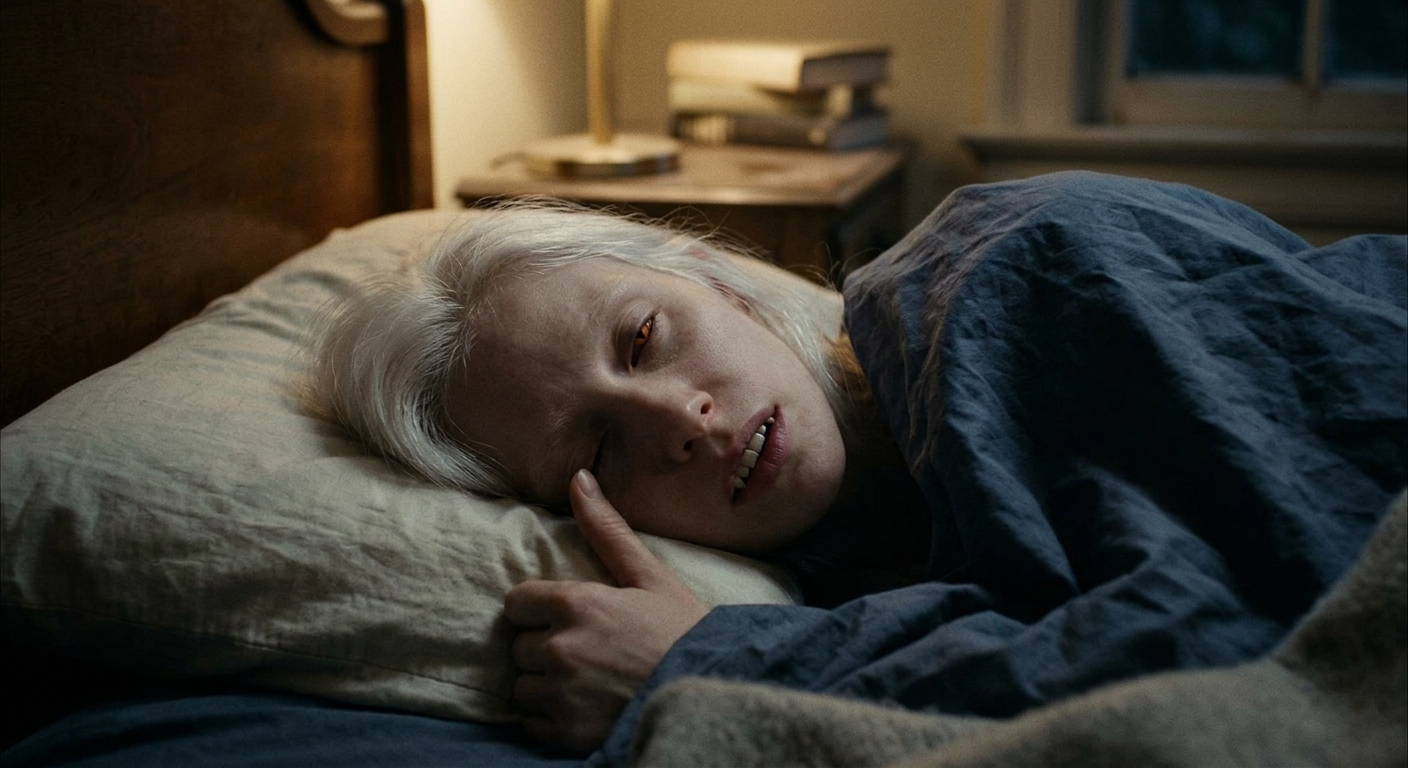
The girl’s face is calm in sleep. Her features are thin and slightly androgynous. She looks twenty-five or so. Her parted lips show serrated incisors and the tip of a long canine.
When I lifted her lids, I glimpsed a deep orange iris with a slitted pupil. Her bone-white hair spreads out on the pillow, very fine.
Those filed claws bother me. I left the subject’s claws intact, in my lab. But then, he never fought back.
He’d gilded his claws, unlike her. That indicator of an unknown culture fascinated me.
I remember the pendant he wore. A woman’s profile was carved into it. I returned it to him after confiscation, to demonstrate my kindness. An object from home would have meant a lot to him. It was probably taken away again when he left my custody.
I checked the girl’s body for signs of starvation. Nothing I can see, but she does have scars.
When I was young, I came down hard with measles. Daddy sat by me day and night, reading the legends of King Arthur. It’s as though I’m at my own childhood bedside now.
Would I have helped her before the war? Probably. But I had a job, money, friends. Most importantly, contact hadn’t happened.
During the war, I answered to the government. I would have reported her. Obviously.
I’m helping her now.
Is that my nature, or the context?
I’m on the sofa as I write. There’s a cocoon on the outside of the windowpane, dark against the cold light from the sea. It trembles now and then with whatever is happening inside.
What’s within a cocoon is not a stable body. The caterpillar dissolves into formlessness and the tissue rearranges. There is no intermediary form between caterpillar and butterfly.
Later
She’s awake.
Oh, hell.

Photograph Niewyrazisty Pixabay
July 29th
Eiyun is strong enough to talk properly now.
Those ectomorphic bodies of theirs are stronger and more resilient than ours. It’s probably why she didn’t drown.
“He said our army won,” she said. “Back at the lab. He said your country’s under occupation now.” I nodded. There was no triumph in her face. “If that monster is arrested, my government won’t kill him. They’ll decide whether he can be a useful citizen.”
“Really?” I was busying myself in the kitchen.
“He’d be given a lab and a project,” she said flatly. “They’re practical.”
I brought back the plate and poured her the last of the milk. “Beans on toast,” I said blandly. “You need to eat, Eiyun.” She took the plate tentatively.
“Let me see if I understand,” I said, voice neutral. “So, this island is out at sea. No-one goes near because of the anomaly. Do you know what causes that?”
“I’m no technician,” she said, prodding at the beans. “It throws up images from other portal points. A sort of snapshot. I think.” She began to eat hungrily.
“Well, it’s alarming enough to deter people. He’s hiding from the authorities then.”
“The bastard’s on his own. One on one is a fair fight.”
“You want to kill him.” She nodded. Eiyun studied her filed claws and flexed her fingers. She moved her body as though unsure it was hers.
“I’m not free,” she said. “I feel like… like the ghost of it is all around me. I could go to the authorities. They’d arrest him, make him pay restitution. But they wouldn’t execute him.”
“Can’t restitution be enough?”
“No. I can’t be at peace while he’s alive.” She looked at me seriously. “I owe you so much. Let me stay a little longer and then I’ll go. I won’t make trouble for you.”
I found her some pyjamas and told her to sleep. When I was sure she was settled, I went into the sitting room and screamed into a sofa cushion.
July 31st
Connor has decided I’m insane. Doesn’t matter, I got the rowboat.
“You’ll die out there,” he insisted. “For what? Have you missed what they’ve done to us? There are people starving in the streets while they run things.”
“And yet, here I am,” I said, examining the boat. “Flirting with death like I’m five drinks into a New Year’s party. Is this how you hold the oars?”
“Oh my God, no,” he said. “Here. Like this.” He corrected my grip. “What’s your angle?”
“Angle?” I twisted around to face him. “Have you considered that perhaps I don’t have one?”
“I’d rather you did. Throwing yourself into danger for a stranger will get you killed.”
“Then consider me suicidal.”
He frowned. “You genuinely don’t gain from this, do you?”
I placidly practiced with the oars. He watched me.
“I’m not coming,” he finally said. “I have a family to look after. I can’t afford to risk myself to protect you.”
“I didn’t ask you to.”
“Well I’m not. So you know.” He paused. “Bring this girl tomorrow evening. I’ll show you both how to not drown.”
August 5th
We’re ready. I’m looking around this cottage one last time. It’s been kind to me. God knows who the occupants were, or what happened to them.
Eiyun is in my room with the wardrobe open. She chatters incessantly through the open doorway.
“Is there anything silk in here? I’ve worn that hateful gown so long. I want to feel like me again. Did I tell you I was a courtesan? I have to dress carefully. Oh, this is nice but it’s red… Too much red and I’ll get passes I don’t want. White and yellow, that’s safer, or black and blue. I won’t want to look too available for some time. My lover was an officer, he was so annoyed that I took all my clothes everywhere. I came through with the army. We were captured when…”
It’s as if she’s checking her own pulse. Whether I listen matters less to her than the stream of talk itself.
Did my subject chatter, afterwards? I’m convinced he lived. Only testimony from him could have led to my arrest and detention. He’s rebuilding his life somewhere, in spite of me.
I’m putting this notebook back in the drawer where I found it. I’ll take a fresh one with me. It has a green marbled cover, and the paper is faintly yellowed. Whatever happens out there, it deserves a blank page.
Green notebook
Dawn is on the horizon.
Eiyun has taken over rowing. I will try to reconstruct all that’s happened.
Connor and Lilian saw us off. The strange light in the distance infiltrated the sky. It flattened everything, recasting it in a slight tint.
Eiyun was huddled into a too-big coat, her white hair covered in a scarf. In the dark, her slit pupils were dilated. She met their gazes unflinchingly.
Connor pushed a lifejacket into her hands. Lilian strapped me into another. “We’ll be waiting here from six tomorrow. If you’re not both back by afternoon, we’ll file a missing persons report. We’re not leaving you out there. Either of you.”
“Thank you,” I said, meaning it. I was honestly touched. Police attention was not to be drawn lightly.
All three of them were watching me.
“You really don’t owe me anything,” said Eiyun. “I can go alone.”
“I know,” I said. I stepped into the boat.
“Is it too late to change my mind?” I moaned later.
“Don’t be a baby,” said Eiyun, “I swam all the way.”
“You didn’t get seasick.”
“Silly. Keep the boat pointing just left of the head.”
Before us, the tremendous shape took up half the sky. It glowed the dead blue of a light bruise. It was at an angle to us, the features invisible. The shadow of a neck and shoulder trembled on the point of being, then faded into nothingness.
We rowed at Eiyun’s direction into full sight of the face.
We were looking at a dead woman. Her mountainous features were broad, her stubborn mouth wide and mature. Freckles the size of welcome mats speckled her cheeks. Under her tan was the lifeless pallor of death.
Strands of brown hair like thick cables trailed over her cheek. They were utterly still. The tip of one was frozen in the air, eternally ready to succumb to gravity.
Her lifeless eyes stared out, immeasurable, searching eternity for an answer to her death. We drifted past like an insect on the water.
“Liz,” said Eiyun. She pushed the scarf off her hair. I met her earnest gaze blankly. “Liz? It’s ok. You’re ok.”
I realised I had stopped rowing. “I wasn’t…” I didn’t know what I was trying to deny. “Talk to me.”
“What should I say?”
“Anything. Or, no.” I rowed as though bearing a grudge against the water. “No, I’ll tell you a story. You keep us heading the right way.”
Ahead of us, a black mountain of obsidian trembled into being on the sea. Cold light edged its planes. I heaved at the oars determinedly.
“My father told me this story once,” I said. “A boy was abducted by the Lady of the Lake. He was raised in total solitude and secrecy. Even his own name was kept from him.”
The top of the black mountain seemed carved into a smaller triangle. On one side, the slope descended steeply, almost in a sheer drop. On the other side it curved away gently. At the foot of the mountain on our side, an obsidian plateau rose. Two black pits were sunk into it. Below them, twin planes of smooth, tapering rock jutted out over the sea. Waves rose and fell in the bay between them.
“When he was eighteen, the boy was sent to the court of King Arthur. They took him in. But he felt alone in a strange world. Without his name, he didn’t know who he was.”
A gigantic cable lay coiled in our way, frozen despite the crashing waves. It was made up of thousands of black filaments, twisted together into ropes. I steered the boat around it, trying to discern its path.
“The boy volunteered to fight Bruce the Pitiless. This man had taken many knights prisoner and was torturing them…”
I realised where the end of the cable led. It extended into a hole in the side of the mountain. There, it was twisted into a huge knot.
I blinked. My mind rearranged what it was seeing.
I was looking at a huge black cat mask. It lay pointing nose up, string trailing. The black pits were eye holes. The huge tapering planes were the ears.
I burst out laughing. Tears stung in my eyes as I cackled.
“Well,” said Eiyun, “at least you don’t look scared now.”
The island finally came into view.
“It’s tiny,” I said, staring at the pillar of rock. “How does he not get blown off?”
“Well, the bastard manages,” said Eiyun, matter-of-factly. We rowed into a small natural harbour. A motorboat was tethered to a small jetty.
A flight of steps was carved into the raw rock. We considered them in silence as I tethered the rowboat.
Eiyun pulled the kitchen knife from her duffel coat. The long blade gleamed.
“No,” I said. I reached out and took her wrist. “Look at me, Eiyun. You have every right to kill this man. And you deserve to be free – properly free. But you’re in exactly the wrong state of mind to be doing this. Let me go ahead of you. I’ll take a good look, and come back.”
“Why?!” she hissed, her pointed teeth showing. “I already have a mother, Liz! Why do you treat me like your child?”
I opened my mouth, to reply. Closed it. I remembered another pair of orange eyes, looking up into mine. There was trust in them, at the end. It was there because I manufactured it.
I did not know what might actually be done to him, once he had been fully prepared for interrogation. But I knew enough. If he lived, it was not thanks to me.
Eiyun was waiting for an answer.
“If you’re grateful to me,” I said, “stay here. Let me go ahead. I haven’t asked anything else of you. I’m asking for this.”

God, Cosmos, Humanity. St. Hildegard von Bingen (1141-51) Public Domain
The wind tore at me as I climbed the stairs. It was a cruel wind, buffeting, irregular. It seemed to want to hurl me to my death.
The lab was a squat, single-storey building. It sprawled out as though clinging to the rock. Too-small windows gleamed vacuously. A solitary square of light punctuated the darkness.
I tripped and swore. Five low mounds disturbed the soil. I hadn’t noticed them. I hurried to the lit window and crouched low.
The study was lit by candlelight. He was sitting in an armchair, staring abstractedly into space. Small round glasses perched on his aquiline nose. A short beard covered his bony chin. A paperback book lay forgotten.
I stood. He jolted upright in alarm and stared.
“Hello Richard,” I said.
The generator was out. He lit more candles and poured us both a glass of wine. A battery radio droned and hissed softly on the mantelpiece.
“Let me state for the record that this wine by candlelight is platonic,” I said. He scoffed as I picked up the paperback. “Trashy romance?” I mocked, “really?”
“Don’t judge me. We all enjoy a bit of schlock.” He spilled a drop of wine and wiped it away, tutting. “It’s been so long, Liz. I… wasn’t expecting you.”
“You were expecting arrest,” I said, neutrally.
“Yes, I was. When the police didn’t arrive, I began to think she’d drowned. She’s alive after all then. But it’s you paying a visit, not her. I have you to thank for that, don’t I? Did you know it was me?”
“I was sure it was someone I’d know.”
Richard’s shirt was crumpled, his eyes troubled behind the glasses. The preoccupied air that had been part of him had congealed into a haunted look. He seemed to be listening for something on the edge of hearing.
“Don’t look at me like that,” he said. “Like I’m a good jacket that needs throwing out. I kept working. It’s been hard, that’s all.”
“Biological examination?” I said. “Trying to find their vulnerabilities. What did you look for, mostly? Reactions to chemicals?”
“Chemicals, sounds, visual stimuli. Anything that could give us an advantage. Not unlike your work.”
“Not entirely unlike,” I allowed. “But the war is over. If you found anything, what could you do with it?”
His eyes flicked to the radio. It hummed and wheezed softly to itself.
“There’s a resistance network using the airwaves?” I said. “How organised?”
“Quite organised,” he replied. “They haven’t contacted for a while. But they visit, when they want my skills.”
I digested this. “They think it’s worth it, do they?”
“Would you rather collaborate?” he said. “We can still win. They’re humiliating us, but they don’t get to break us.”
“But how are you going to keep on? This is unsustainable. You don’t even have a subject now.” I paused. “You don’t, do you?”
“No, unfortunately. The female was the last.”
“Did you…”
He looked blank. “What? Are you asking… no. No of course I didn’t kill them!”
“I just thought there might have been accidents,” I said placatingly.
He was only slightly mollified. “I’m a professional. I tried to preserve life where I could. Sadly the others did not survive, but it wasn’t for lack of trying.”
I remembered the mounds outside. I had not seen any grave markers.
He shook his head, dismissing the matter. “I would have had to leave soon anyway, I was waiting for a call. They’ll pick me up, find a new place somewhere.”
I suddenly had nothing to say. He looked me over. Something like kindness entered his voice. “You were arrested, weren’t you, Liz? For your work on that prisoner of war?”
I put my glass down. “How did you know?”
“You come to recognise the look.” He stood and walked to the little window. “I won’t ask what the new government did to you. You can tell me when you’re ready. And I won’t ask why you chose this visit over avoiding me.”
“You seem to have come to your own conclusions on both subjects.”
“Maybe.” He gave me a glance of half-embarrassed intimacy. “Shall I tell you something? The more I studied them, the more I ached to see it. Their home. I often stand outside at night and look up at the anomaly. Another Earth… somewhere… followed a different evolutionary path. Isn’t that thrilling? If only there had not been a war! What a paradise it would have been to study.”
I pictured Richard alone under the stars, lit only by that cold, unnatural light. The anomaly would seem as tremendous, indifferent and beautiful as the surface of Jupiter.
How far did he stand from the graves?
Richard glanced at the clock, then at me. “There’s a room down the hall. You’re very tired, aren’t you?”
“In so many, many ways.” The radio hissed with static on the mantelpiece. One call to the right person would earn me a place. There would be work, direction, conversation. A life.
“No regrets, Richard?” I said.
“Regrets?” He shook his head. “It’s natural to recoil from pain right in front of you. But that instinct is myopic. Their pain is not more important than anyone else’s. Perspective must guide us, Liz. Not sentiment.”
I poured him another glass of wine. My hand trembled. I forced the tremor into stillness. I focused on the base of his skull, where the cranium is thinnest. “You’re so certain. I envy you.”
I took the glass and bottle over to the window. He accepted the glass with a warm smile. I saw in his eyes the future he envisaged. An end to his loneliness.
“Certain?” he said. “If only. But determined, yes. We need a purpose, people like us.” He toasted me.
“To purpose,” I said. Then I bashed the bottle into his head.
He went down. One blow was not enough to be sure. I bent and struck carefully with all my strength at the back of his skull.
“Richard,” I said, though he was well beyond hearing, “I can’t find a flaw in your argument. It’s watertight. And it’s much the same as I would have said.” I straightened and put the bottle aside. My body seemed strangely light.
I sat. The trickle of blood on the floor was almost black. “If you do,” I continued, “what you’ve admitted to doing, it makes you a monster. Unaware, maybe. But a monster. You can’t argue that away.”
I pressed my hands together, leaned my hot forehead against them. I closed my eyes. A tremor was running through me. I allowed it free rein.
“Eiyun had every right to kill you. But she didn’t deserve to be a killer. That girl should be free of people like us, not bound tighter. Me, though? My conscience can handle another burden.”
I opened my eyes. Eiyun was standing in the doorway.
“We burn it all,” said Eiyun.
We searched the storage cupboards for petrol. Then we walked through the lab, splashing it as we went. I took the radio. Eiyun said nothing.
Outside, I handed her the matches. Twin flames flared in her orange eyes as she struck the match. She tossed it in through the open doorway. A trail of fire spread across the floor.
“You had no right,” she said finally. “It was not your decision to make.”
“No,” I agreed. “I had no right. But I did it.”
“It’s my life,” she said. “I could have been someone who took revenge. Now I’m someone you chose for. Forever.”
“I know. And when we’re back, you can never see me again.”
She inhaled shakily. We stood close, watching the flames take hold. She neither took my hand nor moved away.
She might never entirely forgive me. Connor was right. No-one likes being handled.
Richard, and I were quite alike, I thought. It gave me the horrors to see myself in him. And I didn’t really believe in redemption. There is no act that suddenly makes you clean. You go on. You try to be better.
“How did your story end?” said Eiyun beside me. “The one you told on the boat. You didn’t finish it.”
The windows shone orange against the night. Smoke was rising. The light from the anomalies turned it cold blue.
“The nameless boy,” I said, “fought the Baron and killed him. The knights who had been tortured were freed. Rather than join them, the boy lingered in the castle. In the centre of the courtyard was a grave. The tombstone had fallen face down. It had apparently never been moved. He lifted it. There were words carved into the tombstone: ‘only Lancelot, son of Ban, can lift this stone. Lancelot will lie here.”
The graves lay between us and the steps. We picked some wildflowers and laid them on the unmarked mounds. It was something at least.
“And so, the boy learned who he was. This would not save him. His life would be hard, and end in tragedy. But from then on, he was no longer nameless.”
Our boat is within sight of land now.
Before we boarded the boat, Eiyun raised her hand and clasped her wrist tentatively. There’s a wonder in her face at the new absence.
She pretends not to see the radio. I have kept it tuned to the original frequency. Eiyun won’t report me.
Richard meant us to make that call together. He imagined shared purpose. But if I ever make a call of my own, it can’t be for purpose alone. There must be more to it than that.
Dawn has broken. Connor and Lilian are waving from the pier. The sun has turned the windows behind them to gold.
Francesca Young is a freelance writer from West London who writes in the genre of horror. She works as a librarian at a college in West London. Francesca has an interest in history, politics, power and how human beings relate to each other in extreme circumstances and this inspires her fiction.
Discover more from Ars Notoria
Subscribe to get the latest posts sent to your email.

You must be logged in to post a comment.