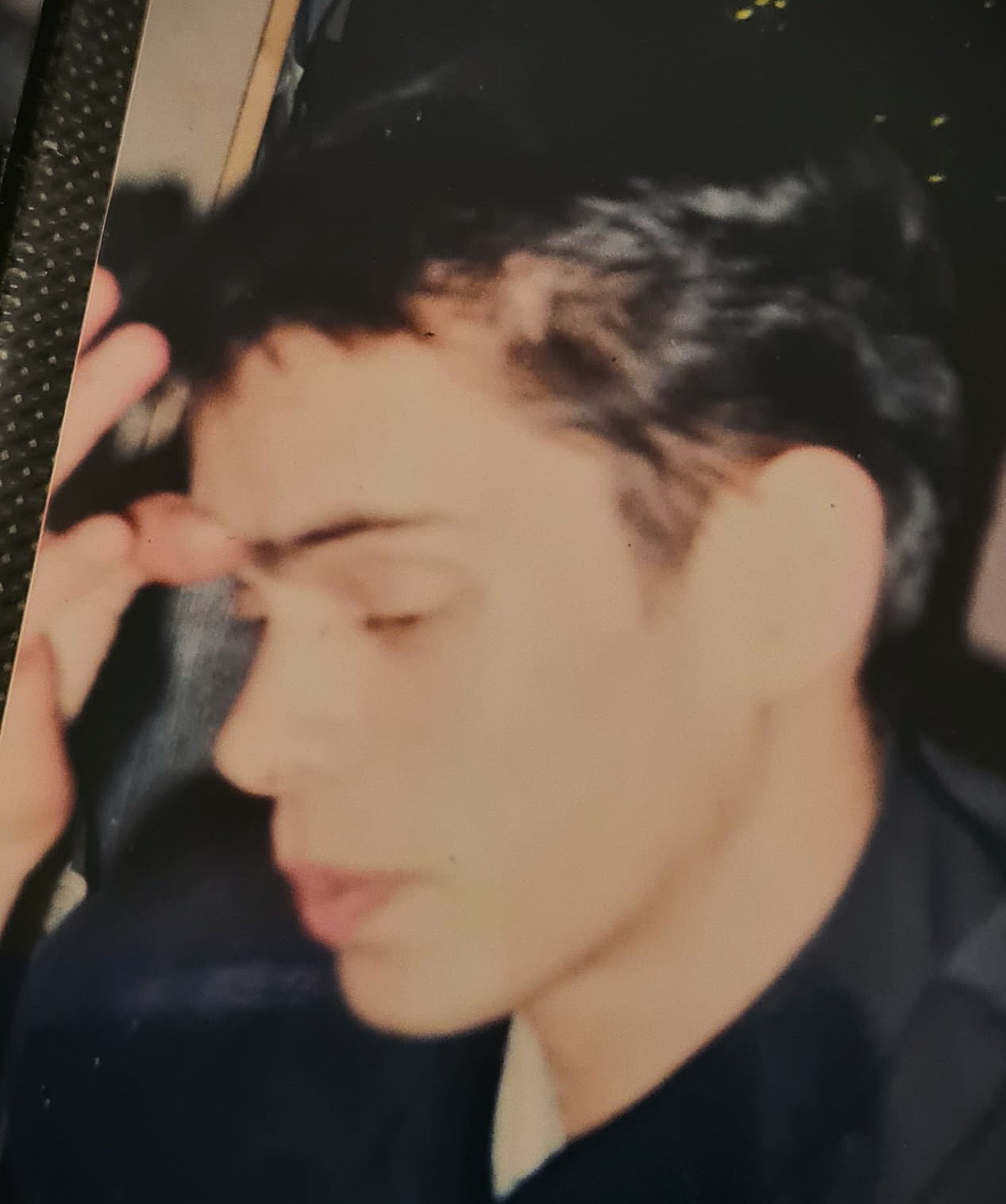
David Yip at 16, photo David Yip
by David Yip
It’s 1986—the year of the Chernobyl disaster, the Iran-Contra affair, and Halley’s Comet passing through the inner solar system. It is also the year I drop out of school, aged 15, leaving with no exam results. Not so much a world event, but a big decision I hope I won’t regret.
Lounging around the house all day with nothing to occupy my time, my mum states that I need to get a job. A week later, my dad tells my mum he is losing his job. The takeaway I worked at with him is to be sold—the owner has decided to return to Hong Kong. My dad finds work at a takeaway in Salford, Manchester. My mum says I’m to go with him; the owner has agreed to take me on as well.
This leaves my mum, older brother Martin, and younger sister Diane at home. My two elder sisters, Suzanne and Linda, have already left to start their own careers.
On our arrival in Salford, we are greeted by the owner, who shows us the kitchen before taking us up the back stairs to a flat above. The whole place smells of the food cooked below. It contains a single bed, one chair, a table, and a small box television with a wire coat hanger stuck in the top, used as an aerial. The bathroom is filthy, and the bath and toilet are stained. Our new boss tells us we will start the following day. When he departs, I ask my dad where we will sleep, and he says we will manage. I tell him I’m going out and head to the shops next to the takeaway below.
Despite growing up poor, our family home is always spotless. When we didn’t have carpets, my mum scrubbed the floorboards with bleach. Hoovering is done on our hands and knees using the hose, not the long pipe, ensuring nothing is missed. The kitchen floor is also washed on our hands and knees, using a mixture of bleach and liquid in a hot water-filled basin and a dedicated floor cloth kept for that purpose. Windows are cleaned with a mixture of vinegar and water, using old newspapers. Our beds are to be made every morning when we get up, and our rooms kept tidy, like the rest of the house.

At the shops, I buy cloths, liquid, bleach, and a bucket, then return to the flat. My dad asks what I’m doing when I return, and I tell him, “Cleaning!” I start in the bathroom, scrubbing the bath and sink as my mum has shown me, before changing the water and my cloth to clean the linoleum floor. Although I can’t remove all the stains, the room is now a lot cleaner and smells 100% better than when we arrived—my eyes sting a little from the bleach. Moving into the living room, I start with the windows and frames before wiping down the doors, frames, and skirting boards. Opening a door, I discover a carpet sweeper. Unlike the electric one we have at home, this is a handheld box on wheels with bristles underneath, which you push to collect rubbish from the carpet. I rearrange the furniture, wipe the remaining surfaces and TV, then remove the bedding from the bed and replace it with the one my mum gave me.
As I finish, there is a knock at the door—it’s our boss. On opening the door, he looks about the room, taking in the sight and smell, but doesn’t say anything. He speaks with my dad, then leaves.
On my first day at the takeaway, we are working alongside three other people. They speak loudly in Chinese, and I just stand next to my dad. He explains to them that I don’t speak Chinese, and they each say hello in English. He tells me to go with a female chef, as she will give me my duties. She asks what I’ve done previously and simply nods. She explains our first job is to make spring rolls.
First, we peel and grate carrots, which are placed onto a dry tea towel to drain the moisture. We finely slice white cabbage and place it into a large bowl, adding the grated carrot and beansprouts. We then add small shrimps and thinly sliced pork—the cut-offs from the char siu dishes on the menu. Mixing all the contents together, we sprinkle it with salt and a quarter teaspoon of monosodium glutamate (MSG). As it is known, MSG is a sodium salt of glutamic acid, widely used in oriental cooking as a flavour enhancer. Although it is classed as safe, too much of it in a dish can cause headaches, cramps, and a feeling of dehydration.
We then take the pre-bought spring roll pastry and separate the thin, square individual sheets. The filling is squeezed to remove any moisture, and a small amount is placed onto the pastry, a third of the way up from the point of the square. The point is then brought over and tucked under the mix. Both sides are folded over before being rolled to the opposite point. We then take a dab of water, touch the corner of the pastry, and attach it to the top of the roll.

Although the first one seemed easy when I was shown, getting all the spring rolls to be the exact same size—with the correct amount of filling, no moisture in the mix, and sealed correctly—proves more difficult.
At service that evening, I discover that some of my spring rolls burst and some unravel when fried. The person on the fryer shouts out to my father, who looks over at me but doesn’t say anything. Later that night, when we go upstairs, he tells me to try harder. He tells me to get washed and go to bed. I ask what he’s going to do, and he says, “Going for a pint.”
My evenings are spent listening to tapes on my Walkman cassette player, which I bought a few months earlier. The TV in the flat is terrible—I spend more time trying to adjust the wire coat hanger to get a picture than actually watching a programme. I enjoy music, having grown up with it in the house. My mum likes Elvis, soul, Motown, and country and western songs, while my dad plays Chinese opera and Neil Diamond. After washing, I put my headphones on and climb into bed, listening to Billy Joel. I awake in the early hours to find my dad asleep on the chair, then drift back off until he wakes me for our next shift.

I work full-time all week alongside the same chefs, doing the same work I had previously done with my dad. We are paid in cash at the end of each week—my boss hands over brown envelopes to each member of staff apart from me. I’m too scared to say anything, and my dad doesn’t speak either. We return to the flat, and I ask my dad about my wages. He tells me the boss said I could stay and work at the takeaway, but it was up to my father to pay me from his wages. He gives me £20.
Despite this, I enjoy working at the takeaway and get along with the staff despite the language barrier.
One day, sitting together having something to eat, we are all given bowls of rice with chopsticks—we are to help ourselves to the other dishes. I whisper to my dad, who gets up and comes back with a fork for me. The other chefs notice this, and one says, “What? Your dad didn’t teach you Chinese, and you can’t use chopsticks either? He is a bad man!” My dad doesn’t reply, and we continue eating. That night, I take a pair of chopsticks from the takeaway back to the flat and ask my dad to teach me how to use them.
We stay in touch with home using the public phone box at the end of the shops. I’ve been working a couple of months when my mum tells me she is coming to visit. My elder sister Suzanne is living in Manchester, running her own pub in the city centre, and we are to meet there.
Taking the bus from Salford into Manchester with my dad, I am lost in my own thoughts with my Walkman on. Arriving at my sister’s pub, my mother is already there, and I run to give her a hug. My sister gives me a drink and tells me to wait while Mum speaks to my dad in a side room. A little later, I see my dad leave. My mum comes through to say we are going into town. We walk to Burger King and take a seat. I don’t know what they’re talking about, as my music drowns out their conversation, but something is wrong. I get a tap on my shoulder, and my sister tells me to take my headphones off. She says, “Mum has something to tell you.”
My mum says, “I’ve come through to tell your dad I want a divorce!” I’m gobsmacked and lost for words. My mum continues, “You know things aren’t good—you’ve seen it for yourself over the years. It’s time for us to separate.” My sister asks me to go get us all a drink, and I replace my headphones, waiting in line to be served. As I get to the front, Bronski Beat is singing Smalltown Boy in my ears, and I start to cry.

Music remains a huge part of my life, and I’ve been lucky to see many of my idols in concert—from George Michael, Tina Turner, U2, and Cher. Having a very eclectic taste in music, we also visit the theatre, with Les Misérables being my favourite show—only surpassed by a birthday treat for my younger sister Diane, when I booked a booth at the Royal Albert Hall to watch Madame Butterfly.
Music is a very personal thing, and I have never followed the charts—rather, how the performers resonate with me.
We stay at the takeaway for another week before my father tells me we are going home. He has chosen to ignore what my mum has said, and we walk back into the house as if nothing has changed.
My parents’ bedroom is downstairs, and their arguments continue. We go back to sleeping on the landing, dragging the bedding off our beds to lie on so we can hear if anything happens during the night—my older brother Martin racing down the stairs to intervene.
A few months later, one afternoon, my mum has friends enjoying the sunshine in the front garden when my dad arrives home. He immediately starts an argument, and my mum goes into the house. My younger sister follows. I hear shouting from the back garden, and my mum comes through, saying she’s leaving—my sister with her, followed by my dad. My mum tells her friends, “I can handle anything your dad does to me, but I won’t have him taking it out on my kids.” None of her friends move or speak, and my dad yells at my mum to get out.
My mum walks up the street from our house; Diane and I follow. We ask where she will go, what she will do, and she tells us not to worry—she will be okay. We walk with my mum into Barrow Park before she tells us to go home and that she will see us soon.
Returning home, my mum’s friends are still in the garden. My dad asks where we’ve been; her friends ask if we’re okay. I ignore them all and go into the house to my room.
At 16, my dad comes home and tells me there’s a job going at a local restaurant—they want to see me for the position of commis chef.
The pub is situated in the grounds of Furness Abbey (Furness Abbey dates back to 1123 and was once the second wealthiest and most powerful in the country until its dissolution during the English Reformation) and is a 30-minute walk from our house. I meet with the tenants, a husband-and-wife team, who ask about my experience and explain that they will provide on-site training. They offer me the position straight away. I am to work a five-day week, comprising split shifts from 10 am until 3 pm, then 5 pm until 9:30 pm.

On my first day, I am given my uniform: chef’s whites, blue-checked trousers, a thick white jacket buttoned up at the front, and a white apron tied around the waist. I work alongside a lady who has a severe stutter and a cheeky smile—she is also the pub cleaner and only works mornings and afternoons. Our section is starters, garnish, and desserts. She tells me to keep my head down and ignore everything else. I ask what she means, and she says, “You’ll see!”
We set about preparing for opening, and she shows me how to prepare the salad vegetables and starters ready for orders. The soup is a dry powder mix—the dry store at the rear of the kitchen has a shelf full of Maggi soups, and she asks me to pick one. We return to the kitchen, where there is a pan of boiling water on the stove. Opening the tinned powder mushroom soup, she tells me to pour some into the water, whisking as I do. The water begins to thicken, and the flame is turned down so the soup is on a light simmer. We then add sliced fresh mushrooms, double cream, and some fresh chopped thyme. “To make it taste better and disguise the fact we don’t make it,” she says, laughing.
Our boss comes down from his accommodation above, dressed in his chef’s whites, and asks how things are going and if I’m being looked after. He walks past us and disappears into the bar. Joyce, the lady training me, raises her eyebrow but doesn’t say anything.
Our next job is to make gateaux. The plain and chocolate sponges are bought in, with three thin sponges in each pack, which we separate with a palette knife. They are then spread out onto the table, and four of the layers are sprinkled with sherry to moisten them. In a large mixing bowl, we whisk double cream, adding a little caster sugar to sweeten it. This is whisked until the cream thickens to stiff peaks. We then assemble the gateaux—placing a plain sponge on one plate and a chocolate one on another. Strawberry jam is spread over the plain sponge, and a thick chocolate sauce is spread on the other. We then add a layer of the thickened cream on top of both, spreading it from the middle right up to the edges. The plain sponge has fresh strawberries sliced over the cream; the chocolate one has tinned cherries. We then repeat the process with the second sponges. The last layer of sponges is turned upside down to top both gateaux. Joyce explains we do this so the top is flat. Using a palette knife, we coat the sides of both gateaux with cream so you can no longer see the layers or fillings. The strawberry gateaux is topped with halved strawberries, leaving an inch gap around the edge; we do the same with cherries for the chocolate one. Joyce explains this is why we don’t moisten the top sponge with sherry—it would be too wet with the topping and would collapse when cut.

Strawberry and blackberry jam is then heated separately in small pans with a little water added. When the jam has heated and turned into a watery liquid, we brush both gateaux with it, glazing the fruits on top to give them a shine. Using almond flakes, we press these into the cream on the sides of the strawberry gateaux, and with small chocolate bullets, we do the same to the chocolate one. Finally, using a piping bag with a star nozzle, we pipe the remaining cream around the gap we left on top of both gateaux. I am amazed at what we’ve made and hope we get to taste them!
My boss has been busy setting up the main course section—lighting grills, fryers, and ensuring ovens are up to temperature. Pans of hot water with wire baskets sit on the stove, and a pan of gravy is simmering. He prepares the grill garnish for steaks by removing the bottom of whole tomatoes and cutting a cross into the tops. He explains this is because no one likes to eat the hard inner bottom, and the cross helps them cook quicker without bursting. He removes the stalks from mushrooms and washes them in cold water before putting them into a colander to drain. Using large onions, he peels them, then slices them whole into thick rings, separating them into individual rings.
He calls me over to show me how to make the batter to coat them. Using plain flour, we add cold water, whisking until the mixture becomes a thick batter that peaks then falls—lighter than the double cream for the gateaux, I note. We sprinkle in a teaspoon of bicarbonate of soda, whisking it in—he explains this helps the batter puff up. Finally, the mix is seasoned and left until needed, alongside a container of flour and the prepared onions.
His table is set up with containers of prepped vegetables and sauces to accompany the main courses. Before service begins, my boss takes me around the fridges and freezers, showing me where all the produce for the dishes is stored.
He tells me we are all set before disappearing into the bar. Joyce looks over and shakes her head.
With guests filling the pub, orders start coming into the kitchen—the staff shout “Check on!” before handing a copy of the order to Joyce and one to my boss.
My boss calls out the order, and we set about preparing the starters. We have a prawn cocktail, pâté, and soup to make. First, we take a sundae glass and put shredded lettuce in the bottom, topped with cooked, cold prawns coated in Marie Rose sauce. A wedge of lemon and tomato sit on the side, and we twist two cucumber slices on top. This goes onto a side plate with a slice of granary bread cut into triangles. The pâté (bought in) is sliced onto a plate with iceberg lettuce, topped with tomato, sliced cucumber, and a radish flower. A small amount of tinned redcurrant jelly is placed next to the pâté, and the dish is finished with four triangles of Melba toast (Melba toast is a slice of bread with the crusts removed, sliced thinly, cut into four triangles, and grilled until crisp), kept in an airtight container on our section.
The soup we made earlier is now in a heated tureen, served in a bowl on a side plate with a soft roll and butter. Once all dishes are ready, we shout “Away!” and press the bell so front-of-house staff know the food is ready.
The orders seem non-stop, and time flies by quickly.
Occasionally, I’m asked to help my boss with main courses—dropping frozen peas and prepared carrots into the wire baskets in boiling water. He asks me to make the onion rings and look after the fryers, which includes cooking scampi, frying fish, and chips. The onions are coated in flour, dipped in batter, then dropped into the fryer. He explains the flour helps the batter stick, and when dropping them in, you move them away from you so the oil doesn’t splash up.

My boss gets worked up easily—I’ve never seen anyone sweat as much as him. He takes his temper out on the servers if they don’t collect meals quickly enough. No one questions his rants.
One evening, an order comes in for a pork chop, and I tell the waitress we don’t have any. My boss says, “There were two in the fridge.” I tell him I put them in the bin because they were green. He walks over, retrieves them, runs them under cold water, and throws one on the grill, saying, “What the customer doesn’t know!” before smiling. I’m appalled. His wife, who witnessed this, turns around and walks out.
During another shift, my boss’s wife asks me to collect ice from the hotel above us. Abbey House is a four-star hotel designed by Edwin Lutyens, made from red sandstone, with gardens by Capability Brown. We’re separated by a path leading through their woods up to the hotel.
Entering the underground corridor where their ice machine is, I bump into the head chef—a short, stout man in a tall white hat. He asks who I am, eyeing my uniform. I explain where I work and that the hotel lets us collect ice when we run short. He says, “What are you working down there for? Come and work for me in a proper kitchen.” I politely decline, fill a black bag with ice, and leave. Little do we both know that nine years later, I’d be headhunted and take his position.
After a few months, my boss hires another young chef, Mike. Though only a year older, he arrives like a whirlwind—confident and outspoken. I look up to him immediately.
We work side by side in the busy pub. I learn my boss is an alcoholic, which brings challenges. His partner, whom Joyce describes as “delicate,” also has bad days—ambulances come and go regularly.
One day, after a busy shift, Mike asks what I’m doing after work. I say, “Going home.” He says, “Let’s go for a drink.” I’ve never been to a pub alone—only as a child with my dad. We go to a hotel near his house, and he lends me a black suit jacket to wear with my shirt, trousers, and shoes. Nervous about being ID’d, we aren’t questioned. I order my first pint.
Using my spare cash, I start buying suits, building a large collection—choosing a different one each time we go out. Years later, in a takeaway, two guys stop me: “Look, it’s the suit guy!” They laugh, saying, “We don’t mean anything—it’s just every time we see you, you’re in a different suit!”
Mike’s friend DJs at a club in town, so we go there. We meet Joanne, the DJ’s younger partner—I think she’s the coolest person I’ve ever met. Her style and attitude instantly appeal to me. We all become close friends, spending many evenings together.

Joanne’s parents are driving instructors, so I start lessons with her father, Fred. One day, at her house, her mum Myra walks by, stops, and says, “Look at you—you’re getting cheekbones! With those big brown eyes, they’ll get you in trouble.” Over the years, I often think of this when egotistical men dislike me instantly or judge me on my looks. I’m sometimes attacked for no reason. Once, after being beaten up, I tell my mum, “I wish I’d been born scarred—then at least I’d be left alone.” She says, “Hit them where it hurts—in their pocket. Prosecute them.”
One night, drinking in a bar, a guy knocks into me, spilling my pint and smashing the glass. He doesn’t apologise and walks off. I tell Mike I’m going to clean my suit in the bathroom. When I return, Mike is with the guy, who’s holding two pints. He offers me one, saying, “Sorry about that.” When I reach for it, he jumps back, spilling some. I look at him strangely, take the beer, and we move away. Mike is laughing: “When you went to the toilet, I told him he’d better replace your pint because you were calming down—since you’re a black belt in karate!”
One drunken evening at Mike’s, I ask about a large thin box. He says it’s a novelty cigar from Spain. We decide to smoke it. The next morning, after staying over, I walk to his parents’ corner shop and buy my first pack of cigarettes.
My dad starts cooking at the pub for a weekly Chinese evening, which proves popular. A school friend, Sharon, joins the front-of-house team. We all get along, working—and playing—hard.
Despite paying board at home, I have more money than I know what to do with. At Christmas, I buy everyone I work with presents from a jeweller’s in town.
We stay at the pub until a strike in 1988—voted for by workers at VSEL (now BAE), Barrow’s shipbuilding company—destroys the business. The 12-week strike devastates the town, affecting over 1,200 workers and their families. Bookings drop from hundreds daily to a handful.
My boss moves on to another chef job, taking his family with him. At 17, I’m unemployed again. Mike retrains as a mechanic; Joanne continues her education. Despite efforts, we lose touch, rarely seeing each other—but we remain great friends to this day, catching up to reminisce about our youth.
Discover more from Ars Notoria
Subscribe to get the latest posts sent to your email.



You must be logged in to post a comment.