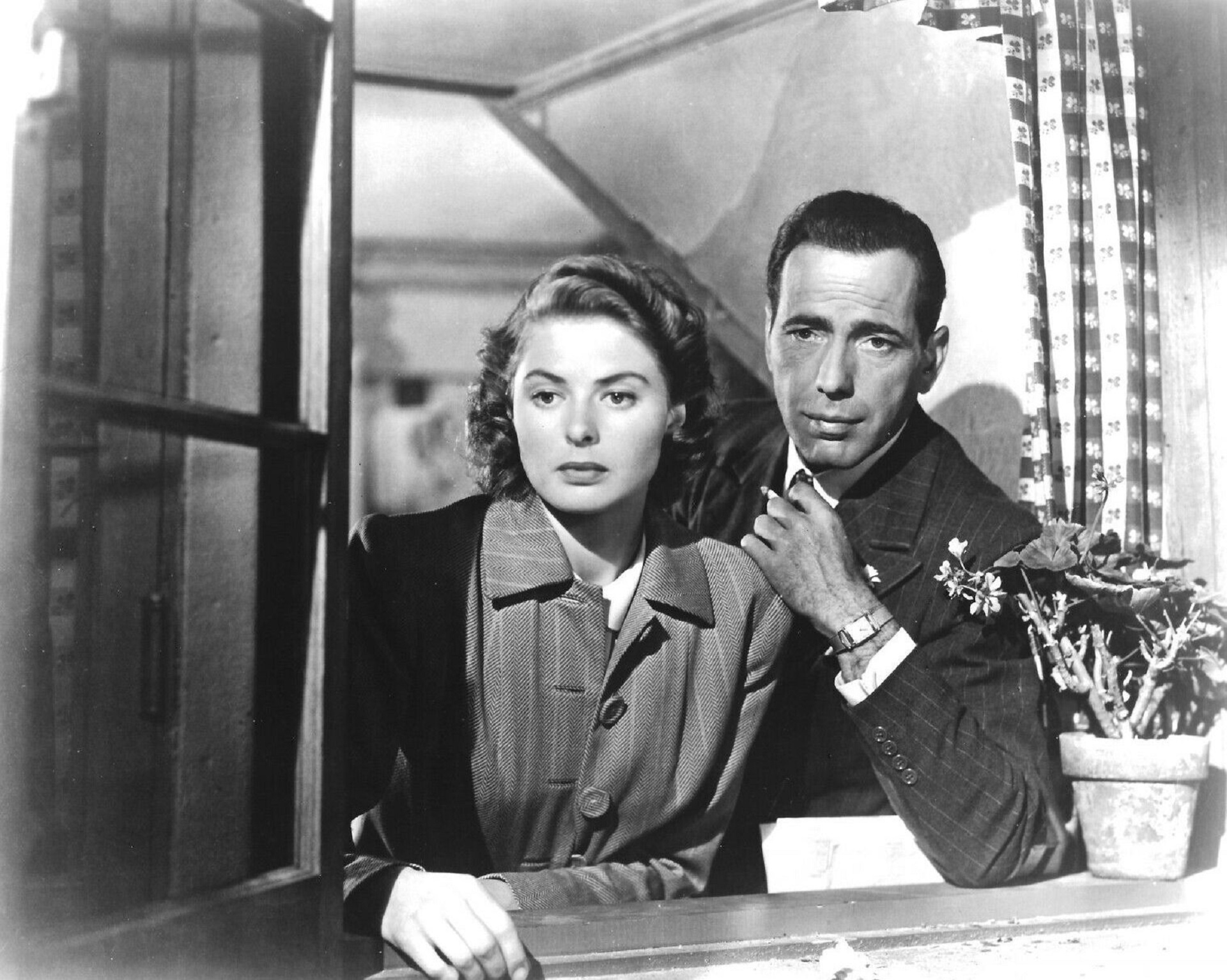
Still from Casablanca with Ingrid Bergmann and Humphry Bogart, photo Jean Beaufort Public Domain
by NORMAN B. SCHWARTZ
Humphrey DeForest Bogart (1899–1957) shared much in common with his co-star Katharine Hepburn in The African Queen. Both actors grew up in comfortable upper middle-class Episcopalian households with fathers who were society doctors and mothers who were suffragettes, but whereas Kate made her career playing those superior ladylike characters her parents might have known, Humphrey became a star by portraying the social outcasts his parents would never have let into their house. Bogie, as he came to be called by his fans, played thugs and gangsters, hard-boiled detectives, and finally, at forty-three years old, the leading man who got the girl.

His parents, solid citizens and New Yorkers, anticipating the day he would go off to Yale, sent him to the best America prep schools – Delancey, Trinity and Phillips Academy. His grades were so poor, however, that when the United States entered the First World War in 1917, Bogart enlisted in the United States Navy instead. He had attained the rank of Petty Officer 2nd class when a prisoner he was escorting to a military prison struck him on the lips with wrist shackles; an incompetent military surgeon stitched the wound together. When Bogart recovered, he discovered he had acquired a lisp.
After his military discharge he began acting on Broadway. Miraculously, his scar and the sound of his voice that resulted from of it, did not impair his career; oddly, they helped him. They were conventional juvenile parts, which he called “White Pants Willie” roles, until his unusual lisp magically secured him the role of the psychopathic killer in the 1935 play production of The Petrified Forest. When Warner Brothers bought the movie rights, its star Leslie Howard told the studio that unless Bogart reprised his role, he (Howard) would not appear. That role, Duke Mantee, the first of his many complex gangster parts, transformed Bogart’s life; so grateful was he for Howard’s insistence that he named his first newborn daughter Leslie.

Warner Brothers first put Bogart under contract for $550 a week, far more than he could have made on Broadway. Beyond that initial sum, there was also the prospect of tripling his salary after a few years of servitude. Contract actors then worked six days a week, handed one feeble script after another – in Bogart’s case, forty-eight studio films all told.
Most of the time, he repeated the same sort of second-banana, tough-guy sidekick, snarling roles that supported bigger, better-paid stars like Jimmy Cagney or Pat O’Brien. Five years into a Warners contract, in 1941, Bogart had a stroke of unexpected luck. In the film High Sierra, directed by Raoul Walsh, he was cast as Red “Mad Dog” Earle, one of a group of bank robbers on the lam in the mountains. Nevertheless, this tough guy character showed an unexpected humanity by befriending Ida Lupino, who played an ex-dancehall girl desperately longing to escape her mundane existence.
The production code, of course, mandated all the bad guys die, but when a sharpshooter killed Bogart’s character at the film’s end, instead of cheering, as the studio expected the audience to do, Bogart had made his character so sympathetic that the preview audience objected that he was being punished unnecessarily. Only a few actors, stars like Cagney for one, had that effect on the public.

The film’s young screenwriter, then under contract to Warner Brothers, John Huston, noticed this unusual audience reaction. Scheduled to remake Dashiell Hammett’s The Maltese Falcon that same year as a first-time director, Huston asked that his friend and drinking mate Bogart play the detective Sam Spade. The studio objected; this was a leading role not a supporting player. They offered the role to their bigger box office stars. George Raft, Paul Muni, and Edward G. Robinson turned it down, because they felt the detective character unsympathetic and didn’t wish to risk working with a novice director. As his luck would have it, Bogart once again won the role by default.
Warner Brothers had already made two film adaptations of the same story. Huston, to give him his due, had the genius to do something his predecessors lacked the courage to attempt. He followed the book’s convoluted plot and its characters rather faithfully. In the novel, one character, Joe Cairo, was obviously homosexual. Huston, knowing that would never get by the censors, cast Pete Lorre, the star of Fritz Lang’s M, who instantly brought with him the inference of unmentionable perversity. Casting Sidney Greenstreet, an unknown Broadway actor, as “The Fatman” Kasper Gutman, added a certain high-spirited cynicism to the story that was not in the book. But most important to its success, Huston saw in Bogart a quality that few had ever seen before, either on screen or in life – under the lisping voice and tough guy insolence, a deep vulnerability. As Raymond Chandler was to say in later years, “Bogart can be tough without a gun…he has a sense of humor that contains that grating undertone of contempt.” Once again, Bogart’s skills as an actor made an unsavory character sympathetic.

Huston’s directorial debut was a great success, earning Warner Brothers $1.8 million on a B-picture budget of only $375,000. Eleven years before, Dashiell Hammett had sold the dramatic rights for all his books, including The Maltese Falcon, for a mere $8,500, and, of course, received nothing for the remake. But Bogart, now paid yearly, saw his fortunes increase: he earned $96,525 in 1941, the year of the film’s release, and $114,125 in 1942 – a substantial amount but still less than that of his contemporaries. MGM paid Clark Gable $357,500.
Jack Warner, ever on the lookout for properties and actors he could acquire on the cheap, bought the rights to dramatize an unproduced play, Everybody Comes to Rick’s, for $20,000. Thinking he might turn it into another exotic hit like 1938’s Algiers (“Come with me to the Casbah”) Warners once again offered the lead to his studio’s bigger contract stars. Ronny Reagan turned it down. By default, Warners chose Bogart once again.
When Bogart studied the unfinished script, he was none too happy with what he saw, guessing why the others had rejected it. What he read made no sense. If the film was to be a love story, how would Rick, his character, end up with the girl when according to the rules of the production code, no woman married to a man, especially a war hero like Victor Laszlo (Paul Henreid), could ever abandon her husband for an expatriated café owner?
The Austrian-Hungarian Henreid, the husband in question, was equally discontent – not about the film’s implied adultery but about his costume. Henreid protested that no Resistance leader would wander around Casablanca in a white suit. Most unhappy of all was the female lead, the Swedish actress Ingrid Bergman, borrowed from David Selznick’s studio at great cost. Not only was she taller than Bogart, but Warners would not tell her how the film would end. Three-inch lifts on her co-star’s shoes could solve the height difference, but the uncertainty of which man she truly loved and would wind up with at the film’s conclusion was much more difficult to fix. Bergman approached her director, the tyrannical Hungarian director Michael Curtiz, famous for his broken English. How was she to behave when she did not know which man she loved? Curtiz was not worried. He said, “Don’t worry what’s logical. I make it go so fast no one notices.”
When the time finally arrived to shoot the denouement, the film’s producer, Hal Wallis, still undecided, proposed shooting two endings. In one version, Ilsa, Bergman’s character, would go away to Lisbon with husband Laszlo; in another, Ilsa would stay behind in Casablanca with Rick. But once the studio viewed a screening of the first version, the night scene at the airport with Bogart saying goodbye to his beloved proved so powerful that Wallis did not film the second option. Ilsa and Laszlo would fly off together, and Bogart would end up in Casablanca with the French Police Inspector (Claude Rains.) As Bogart would famously say, “This is the beginning of a great friendship.”

The film was also the beginning of a great stroke of luck for its lead actor. It had been in the theaters for only two months when allied forces landed and seized Casablanca, not the one constructed on the sound stages of Warner Brothers in Burbank, California, but the real one in North Africa. For once, life imitated Warner Brothers. Americans were so exuberant about the prospect of victory in the European war, they cared little about who ended up with whom. “The problems of three little people don’t amount to a hill of beans in this crazy world,” Rick, the tough guy with the wounded heart, had said. The viewing public apparently agreed. It did then and, for reasons still unanswerable, it does so when seen by young audiences today for the first time.
As the entire world knows, the film, which began in a state of total confusion in 1942, ended with a life of its own, and, over time, has arrived at mythic status few other films have ever achieved. No one who had been involved with its making could ever have predicted that response. Perhaps of all the people who have tried to analyze its enduring appeal, the novelist Umberto Eco said it best: “[…] Casablanca is not just one film. It is many films, an anthology. Made haphazardly, it probably made itself, if not actually against the will of its authors and actors, then at least beyond their control…. Narrative in its natural state, without Art intervening to discipline it…. When all the archetypes burst in shamelessly, we reach Homeric depths. Two clichés make us laugh. A hundred clichés move us.”
The film, with all its faults and all its glories, finally made Bogart one of the greatest stars in Hollywood. The man with the snarl and the odd lisp was now and forever a romantic lead. He moved from fourth place in the studio’s roster of leading romantic men to the number one position. By 1946, he was being paid $460,000 a year. More than Gable! No longer Bogart, he had become Bogie. The icon. The star!
Warner Brothers, having agreed to pay him as such, kept him working steadily, producing film after film of varying artistic merit. Few as good as the ones he had done with Walsh and Huston. But unlike fellow Warner Brothers contract players, Bette Davis and Olivia de Havilland, who never stopped objecting to typecasting and the mediocrity of their scripts, Humphrey did not take anyone to court to break his contract. He went to work during the day and drank with his buddies at night. But as so often had happened to Bogart in Hollywood, another unexpected turn brought with it fringe benefits.
In 1944, when he was forty-four, he was assigned the lead in Howard Hawks and William Faulkner’s adaptation of Hemingway’s To Have and Have Not. During its production, he met and fell in love with a nineteen-year-old model from New York who had never acted before. His marriage to Lauren Bacall lasted until his death in 1957. She saw in him what his drinking buddy Huston had first detected, and the world came to know and love. “At heart, he was a gentle soul,” she said. “(But) he couldn’t be pushed around.”

Bogart once divided Hollywood into two types. “The pros and the bums.” He chose to ally himself with the first camp. He memorized and performed every assigned role, no matter how bad the script or director, to the best of his ability. An honest day’s work for an honest day’s pay. The gentleman’s code he had inherited from his parents.
Bogart eventually became so powerful he was able to form his own production company, Santana, named after his yacht, which allowed him to choose the scripts and films he, not the studio, wanted to make. One of those projects was his champion John Huston’s Beat the Devil (1953), something Huston and his co- writer Truman Capote seemed to be making up day by day while on location in Italy. Although it has since become a cult classic, Bogart apparently hated it. It lost Bogart’s company a great deal of money, prompting its star and producer to say: “Only phonies like it.”
One consolation, a fringe benefit he looked forward to, particularly back in Hollywood, was that at the end of the day’s employ he drove or was driven to his favorite waterhole, Mike Romanoff’s restaurant on Rodeo Drive in Beverly Hills. The owner, who claimed to be a member of Russia’s royal family, educated at Eton and Oxford and a commander of a Cossack regiment, was in actuality a tailor’s son, born Hershel Geguzin in a shtetl in Lithuania in 1890. Bogart and Romanoff were fond of each other. Both men made their living impersonating people they were not. Bogart, the son of a surgeon and a suffragette, on-screen tough guy, felt he was as much a fraud as his Baltic friend.

Romanoff often watched his actor comrade sitting quietly at the bar or in a booth after work. Invariably, a drunken customer would accost Bogart, accusing the actor of not being the man he so often played on screen. Rather than laugh this off, as others less gentlemanly might have, Bogart accepted the customer’s indictment and offered to take his detractor outside to prove his true mettle.
Night after night, Romanoff waited until the actor returned to the bar, usually in worse shape than when he left it.
“The trouble with Humphrey,” Romanoff said most affectionately, “is that after a few scotches, he thinks he’s Bogie.”
Norman B. Schwartz is the author of the comic novels ‘ALL THINGS small‘, Paradise Now, Don Juan in Space, True (Cinema) Confessions, Hollywood: Below and Beyond, and the DIY guide, The Art Of The Schnoorr. He spent over forty years working on films in Hollywood and Rome. Norman was the first ADR sound editor / post-production dialogue director to be admitted to Academy of Motion Picture Arts and Sciences in Los Angeles.
Norman B. Schwartz’s essays will appear in sequence monthly in each issue of Ars Notoria Magazine. In October of 2025, a paperback edition of the complete collection of his essays titled: HOLLYOOD Actors & Politicos/ a Shared Profession will be available for purchase from Centre House Press.
Discover more from Ars Notoria
Subscribe to get the latest posts sent to your email.


You must be logged in to post a comment.