The Million Man March. Washington DC. Photograph by Andy Hall 16/10/95
Andy Hall is an acclaimed editorial photographer based in London, with over 35 years of experience in reportage and documentary photography. His work has taken him across the globe on commission for a wide range of publications and organisations, including The Guardian, The Observer, and UNHCR. His photographs have been featured in numerous exhibitions and book projects, and his ongoing documentation of the crisis in the Sahel region was screened at the prestigious Visa pour l’Image festival in Perpignan in 2012.
Beyond his commissioned work, Hall is a distinguished street photographer, recognised internationally for his ability to capture the decisive, human moment. He has been a finalist in the Brussels Street Photography Festival (2019, 2024) and a finalist in the Lensculture Street Photography Awards (2021). In 2026, he achieved one of the highest honours in contemporary photography, winning the prestigious Trieste Photo Days award for Best Author. The competition, judged by Magnum photographer Harry Gruyaert, singled out his work for its compositional power and emotional resonance. Gruyaert commented: “I chose this work because it’s the kind of work I would have liked to have taken myself. His compositions stand out; he’s pulling order from chaos and some of these images are truly powerful.”
Andy Hall’s enduring commitment to storytelling, whether on the streets of London, in civil war, in famine-stricken regions, or at historic gatherings like the Million Man March, defines a career marked by empathy, integrity, and visual mastery.
Paul Halas, Arts & Lifestyle Editor
In 1995, The Nation Of Islam leader, Louis Farrakhan had called for a march on Washington similar to the one 32 years before organised by Martin Luther King and the NAACP. But this time it was African American men from all over the U.S.A. who converged on the National Mall in Washington DC for a day of black solidarity and brotherhood, to be known as the Million Man March. As a photojournalist, I wanted to be there and document it.

The Million Man March. Washington DC. Photograph by Andy Hall 16/10/95
This unique way of highlighting racial inequality in America was also a clever way of grabbing the media’s attention. The march highlighted the economic and social plight of the African American community, but this time with the emphasis on self-help; Black men taking responsibility for themselves and their communities and fighting negative stereo-typing.

Million Man March. Photograph by Andy Hall 16/10/95
In the run-up to 16th October, the day of the march, there was a nervousness in the media at the thought of a million angry black men marching on Washington. I remember the talk on news channels of the potential for riots and security issues, and the need to protect the Capitol buildings.

A man holds up a portrait of Malcolm X during the gathering of hundreds of thousands of black American men in Washington D.C. Photograph by Andy Hall 16/10/95

Over 800,000 African American men gather at the National Mall in Washington D.C. Photograph by Andy Hall 16/10/95
The fears were pretty ironic, when you think that 25 years later, in January 2021, it was white supremacists laying siege to the seat of U.S. Government and democracy; not the descendents of people still feeling the effects of centuries of slavery and state oppression.

Million Man March. Photograph by Andy Hall 16/10/95

Million Man March. Photograph by Andy Hall 16/10/95

Million Man March. Photograph by Andy Hall 16/10/95
The event was huge and peaceful. I remember it as an emotional gathering. 870,000 black men were together, and all was upbeat and heartfelt. The marchers came from all over North America, in a shared experience; strangers hugged and held hands with each other as if they were old friends.

Million Man March. Photograph by Andy Hall 16/10/95
I arrived in Washington at dawn. It was a hair-on-the-back-of-the-neck moment as I witnessed thousands upon thousands of people silently, slowly walking into the vast arena of the National Mall, while a powerful sound system played Marvin Gaye’s seminal song What’s Going On. The music drifted, echoing all over America’s capital city as the sun rose.

Million Man March. Photograph by Andy Hall 16/10/95
Even though the Million Man March was the creation of Louis Farrakhan, the vast majority of people who came had nothing to do with the Nation Of Islam. For the rest of the day, I walked around capturing scenes of lighthearted togetherness and solemn contemplation; big groups of college students laughing and joking around together. Men silently bowing their heads in prayer.

Million Man March. Photograph by Andy Hall 16/10/95
Statues of important figures from American history (Were all of them white?) dotted the enormous area around the government buildings. Now, they were covered with people listening to the speeches. And the whole time, everywhere, in a call for solidarity and unity, men thrust the black power salute into the air.

The Million Man march. Washington D.C. Photograph by Andy Hall 16/10/95
Barack Obama recalls being there as a young man and listening to speeches from Farrakhan (for two hours, behind bulletproof glass) as well as Maya Angelou, Rosa Parks and Cornell West.

Friends holding each other up to get a better view of the speakers, who included Louis Farrakhan, Jesse Jackson and Maya Angelou Washington D.C. Photograph by Andy Hall 16/10/95
The event did have some critics like the civil rights hero and feminist Angela Davis, who complained that the Million Man March was not inclusive enough. The Million Man March was widely regarded as a big success and it also galvanised a national voter registration campaign. resulting in 1.7 million more Black American men registered to vote.

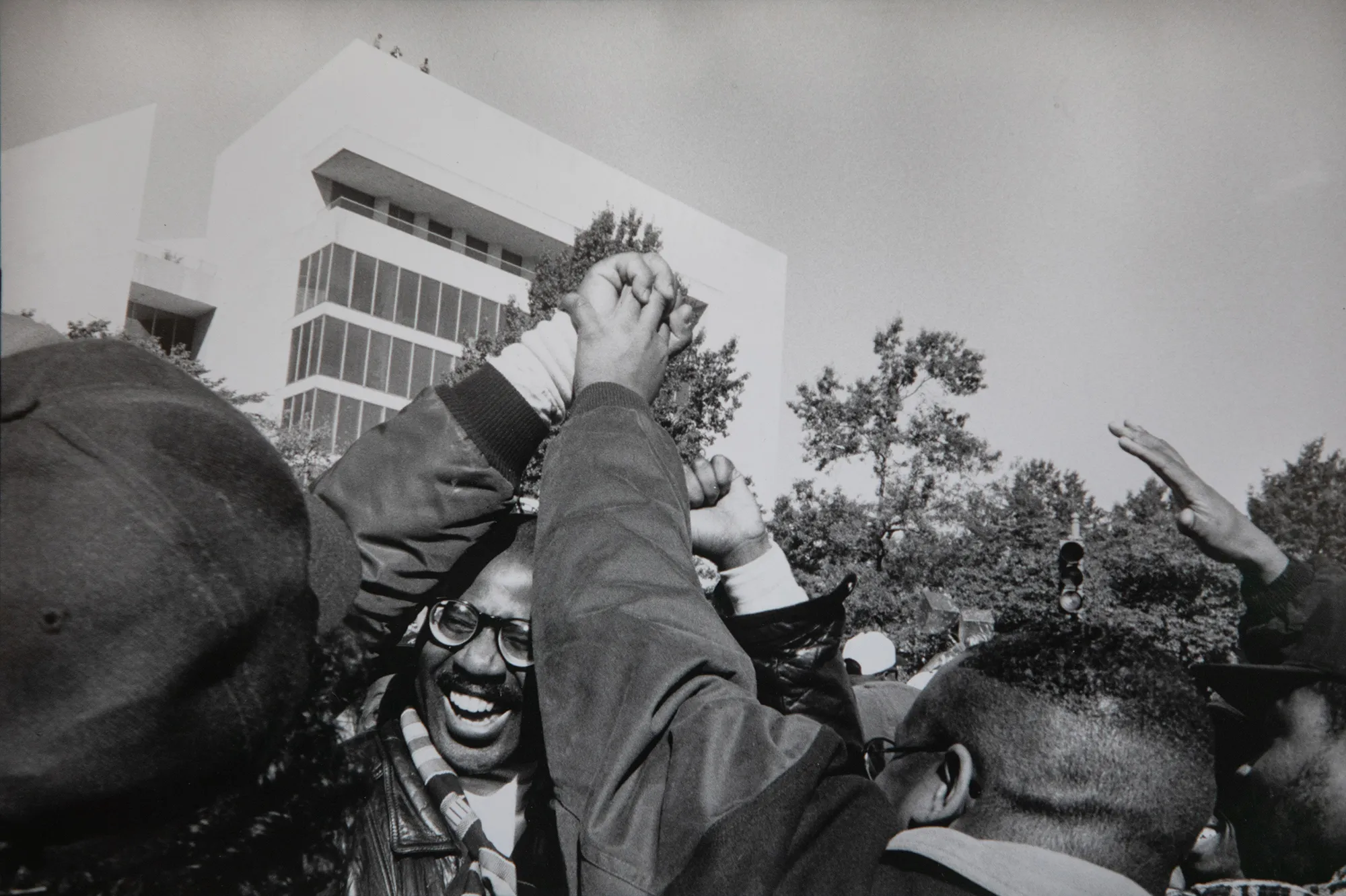
African American men hold hands and raise fists in front of the Capitol building in a joint display of black male solidarity whilst a Nation of Islam member in the background looks on, during the event known as the Million Man March, the brainchild of the NOI’s leader Louis Farrakhan. Photograph by Andy Hall 16/10/95

The Million Man March in Washington D.C. to highlight racial and economic inequality in the United States. Photograph by Andy Hall 16/10/95
Discover more from Ars Notoria
Subscribe to get the latest posts sent to your email.