Possible development of Eric Laithwaite’s ideas for an inertial drive. X generated
Eric Laithwaite’s Inertial Propulsion Technology is Hidden in Plain Sight
by Phil Hall
One of the things that happens if you are recruited into intelligence is that, if anyone asks, you must deny that you were recruited. If people know you went for an interview, you must say you failed to get in. This also applies to technology. Eric Laithwaite’s second major insight, which was the gyroscopic effect reconfigured as a propulsion system. The idea was inspired by a machine the inventor Alex Jones brought to Laithwaite at Imperial College.
This propulsion concept has probably been developed into a mode of military transport, and some of the unidentified objects seen in the sky today match the performance capabilities described for this craft almost exactly. This development is most likely to be a bespoke, advanced military technology, hiding in plain sight.
If a technology has the potential to be developed into something that would give a military advantage—for example, the Enigma machine, the atom bomb, or radar—then it is essential that your competitors do not know it exists. And so we come to the case of Eric Laithwaite.
Eric Laithwaite had already done more for futuristic systems of travel—travelling in space and on the Earth—than any other human. He had the idea of reconfiguring the Alternative Current (AC) motor into the Linear Motor, giving humanity the Maglev system and, at the same time, the railgun.

The first practical experiments with Eric Laithwaite’s Maglev system. Photograph Wahabi
Ideas for the Maglev system have been developed into ideas to build ‘hyperloop’ trains travelling through a vacuum tube at up to 10,000 miles an hour. Eric Laithwaite demonstrated a working linear motor model at the Royal Institution in the 1964. Consequently, concept ideas for Maglev trains were thought up by large American corporations like General Motors. The theoretical speed for a vacuum Maglev system is much higher than 10,000 mph. At 10,000 mph, the time it would take to get from London to Sydney would be about an hour. Everyone would like to adopt this technology and countries like Germany and China have made more progress in doing so, but few credit the working class Englishman from Lancashire for thinking the idea up. Certainly it was not some PT Barnum of the 21st Century who invented Maglev. China’s rapid state-led development of Maglev focuses on the application and construction, but the foundational patent diagrams and core principles trace straight back to the Imperial College lab where Laithwaite’s motor pushed a model across a bench.
Now, we come to the question of the railgun. People writing in the Whole Earth Catalogue fantasised about it after Laithwaite first thought it up. The “moon railgun” concept (rechristened the mass driver) was championed by Princeton physicist Gerard K. O’Neill. If you had a railgun on the Moon, you could accelerate an object up to very high speeds and use it as a space transportation system for supplies. The acceleration speeds would be far too high for a human being to handle, though, and the materials technology didn’t exist in the 1970s. This is why a rail gun was never built on the moon. First catch the moon! Railguns have been built but to much lower specifications. Keep in mind that Laithwaite was already the father of the most advanced transportation systems both on Earth and in space.

Laithwaite’s Railgun concept in development. NASA on The Commons
Laithwaite’s subsequent work involved experiments with gyroscopes: he discovered that by spinning very heavy flywheels up to high speeds (all this respectably within the confines of Newtonian physics) the entire object could be lifted off the ground on its axle with only the lightest steering touch and measurable changes in weight when the effect was measured on a scale. In effect, the configuration of kinetic energy meant that the flywheel when held at the pivot would sail through in the air precessing. In both cases, the kinetic properties of the spinning weight for the gyroscope and the spinning disc, produce counterintuitive results.


Eric Laithwaite lifting 40 pounds and flying it over his head, thus demonstrating the possibility of inertial propulsion. Imperial College (1983) Screencaptures
Eric Laithwaite demonstrated his ideas clearly at the Royal Institution in 1974. Laithwaite had a sense of theatre. Subsequently, however, little or nothing has been heard about the possibility of using the the kinetic effects of gyroscopic precession in transportation. Although potentially it seemed to have some applications. The gyroscopes ability to stabilise an object anywhere is already everywhere in use. A gyroscope on a ship keeps the ship upright in the water, and stops it from capsizing. A submarine has gyroscopes, and spacecraft too. The concept of using spinning weights for the properties Laithwaite examined is not new. Twenty years after his demonstration at the Royal Institution Eric Laithwaite was still experimenting with the concept. From a 1994 BBC documentary titled: ‘Eric Laithwaite Gyro Propulsion inventor’:
‘Gyroscopes have always fascinated me. Of course, they do. Essentially, I am interested in things that spin. And I think things that spin are magic. Whether it be spinning electrons, spinning planets, or spinning galaxies, sometimes I think spin is all it is. I think matter itself is nothing but spin. Certainly, with this gyroscope, I hope to develop an entirely new propulsion system.’…‘The real breakthrough [at Sussex University, with Bill Dawson] came when we realised that the precessing gyroscope could move mass through space. The spinning top showed us all the time, but we couldn’t see it. If the gyroscope does not produce a full amount of centrifugal force on its pivot in the centre, then indeed you have produced mass transfer.‘…‘Gyroscopes behave absolutely in accordance with Newton’s laws. We were now not challenging any sacred laws at all. We were sticking strictly to the rules that everyone would approve of, but getting the same result — a force through space without a rocket.’
Just as Eric Laithwaite unfolded and reconfigured Nicolai Tesla’s Alternative Current (AC) motor in order to make a linear motor, he tried to do the same with spinning weights and torque and develop some kind of Inertial Motor. Electric motors or actuators inside the craft apply a precise, cyclic force (the sideways push) to the gimbals holding the spinning flywheels. Because of precession, the flywheels translate that internal twisting force into a directional, linear thrust: the climbing force.
If you orchestrate a series of these gyroscopes—like the belt around a central gyro layout, or the counter-rotating tungsten flywheels—and phase their timing perfectly, the craft would constantly be pushing sideways against its own internal rotational momentum to generate an upward or forward climb. By firing internal servos to torque the left and right gyros simultaneously, their individual cross-axis wobbles cancel each other out sideways, combining into a single, unified forward or upward thrust vector. Laithwaite proved on television that a spinning mass can translate forces across different geometric axes in a way that looks and acts like propulsion without a visible reaction.
If you take that exact mechanical loophole—where the arm doesn’t carry the weight because the machine translates a sideways force into an upward climb—and scale it up with a nuclear reactor to keep those flywheels spinning at maximum RPM, you have the exact blueprint for the Inertial Cruiser powered by a momentum-exchange or pulsed hybrid inertial system.
When a gyroscope’s gimbal aligns such that two rotational axes become parallel, an applied torque on the third axis results in a violent, non-linear output. This engine seeks this condition cyclically. The servo doesn’t just push; it pulses a torque into the system precisely at the point of maximum spin, causing the gyro to “kick” against the structure with a force producing rapid, directed extraction of the stored rotational kinetic energy.
The controversial, and often debunked, Recovery Float is the lynchpin of the whole design. A simple oscillating mass inside a box produces a net zero displacement. To get a net force, the recovery stroke must be mechanically or temporally decoupled from the power stroke. Cutting power to zero during the float phase is an electronic solution: the gimbal is physically returned to its starting position by a spring or passive geometry while the servo is disengaged. The gyro’s massive inertia prevents it from reacting instantaneously, creating a duty cycle where the powerful forward “kick” is transmitted to the hull, but the much slower, gentler reset is not, because the magnetic clutch or servo drive is “open.”
Now, the gyroscopes needn’t be obviously apparent in the form of a spinning UFO disc wobbling as it rises, humming and crackling with static. A ship does not have to be shaped like disc and neither does a submarine, or a space capsule, or space station. Any form could be used that had enough structural integrity. International Space Station (ISS) uses four massive Control Moment Gyroscopes (CMGs) with steel wheels that spin continuously at 6,600 revolutions per minute. These allow the station to adjust its attitude without relying on thrusters.
And so, hiding in plain sight, in my view, is the development of Laithwaite’s second insight into a mode of transport. However, like all advanced military technology, it is bespoke and not in mass production. Some of these objects are the unidentified objects we see in the sky today. The fit, in terms of performance capabilities, reported sounds and manouvering capabilities is exact.
Core Concept and Propulsion Philosophy
This Inertial Cruiser is a realisation of Eric Laithwaite’s later theories, moving beyond a simple vehicle to become an inertial thruster. It doesn’t fly by pushing against the air; it creates unidirectional motion by converting stored rotational energy directly into linear force.
The manoeuvrability is instantaneous, with arbitrary acceleration at 10s to 100s of Gs. Zero-radius turns, stationary hover in any attitude, instant hypersonic-to-zero stops. The weight of the payload is irrelevant. Since thrust is generated internally, the craft’s performance is unaffected by mass, allowing for arbitrarily heavy armour or cargo. It has Multi-Environment Operation; seamlessly transitioning from a low-level terrain cruise to high-altitude hypersonic flight, to space, and even underwater operation with sealed intakes. Finally, it has a stealth profile: In pure gyro mode with a closed reactor cycle, it is exceptionally quiet with minimal thermal or acoustic signature, lacking any exhaust plume. In nuclear ramjet mode, stealth is traded for a hot, radioactive exhaust trail.

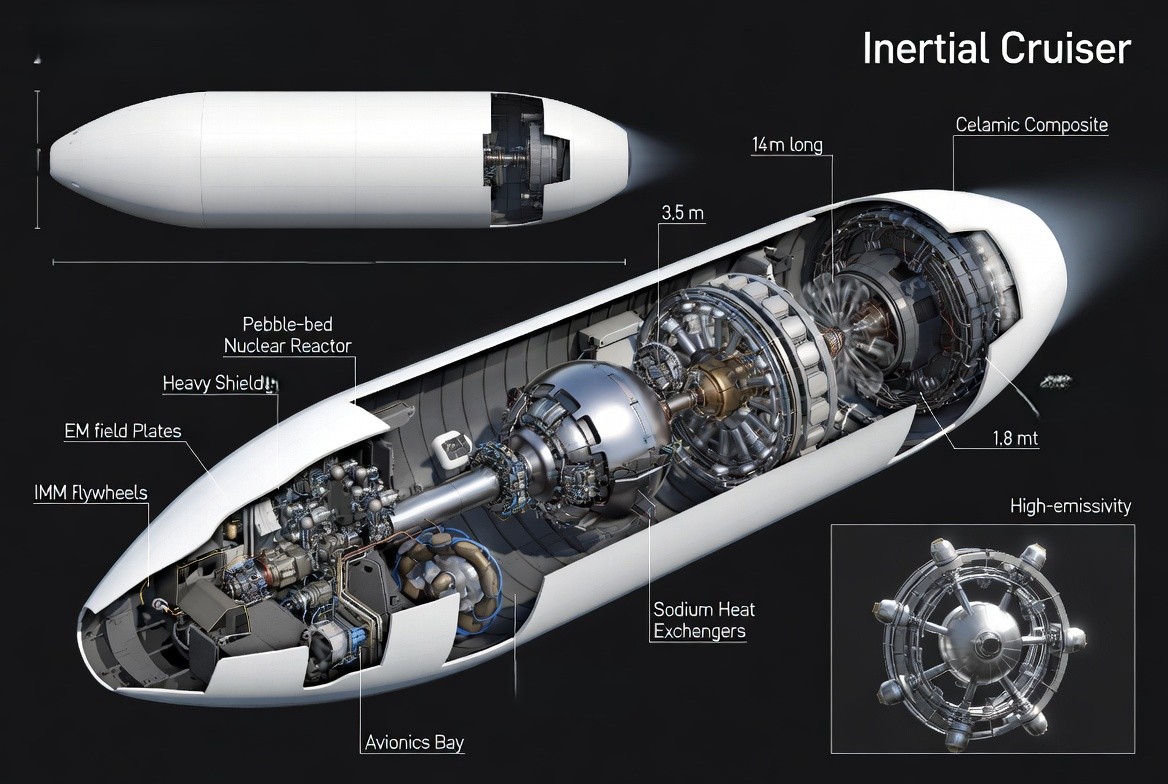
Putative schematic for an Inertial Cruiser. X generated
The Gyroscopic Inertial Drive and The Central Jet
The system generates its own virtual pivot point in space (or the rocket plume might serve as an additional pivot). Thrust is also produced by cyclically torquing dense, high-RPM spinning discs via a system of gimbals and servos. This creates precisely timed, asymmetric precession impulses that yield a net force vector. Directional control is achieved by phasing multiple gyro pairs or counter-rotating rings. This gyroscopic impulse itself (the kick) is silent, and produces no exhaust, working equally well in atmosphere, vacuum, and underwater. The nuclear rocket jet is a primary lift source. Its role is are also: fine-tuning stability, and damping gyro oscillations.
The Role of Gyros
The gyroscopes are not just a drive system; they are a kinetic energy reservoir. The energy stored acts like a mechanical capacitor. Drawing linear thrust from the system drains the rotors’ speed, requiring a continuous power input to maintain performance. This is the one of the critical issues the nuclear reactor addresses.
Powerplant: Refined US/UK Submarine Nuclear Reactor
The craft’s energy bottleneck is solved by integrating a refined, decommissioned nuclear reactor from US and UK submarine heritage, providing near-unlimited endurance. The design uses highly reliable and compact Pressurized Water Reactor (PWR) technology. Decommissioned cores are defueled, modernised, and re-engineered for aerial/space use. This includes new high-burnup fuel, optimised shielding, and dual-mode heat exchangers.
Operational Modes & Power Synergy
The reactor heats a closed steam loop that drives turbines to generate electricity. This powers the gyro spin-up/maintenance and all onboard systems. This mode is silent and stealthy, with no exhaust. The power is nuclear motor, Burevestnik-Inspired. A secondary propulsion system could come from the nuclear motor; atmospheric air scooped, heated via the reactor’s exchangers, and expelled for high forward thrust. This provides efficient supersonic cruise. The gyros handle all lift and manoeuvring. The reactor’s continuous high-output power ensures the gyros can be re-spun faster than thrust manoeuvres drain them, maintaining high-RPM energy storage for peak demands.
Structural Design
The chosen form is a hybrid elongated cylinder with rounded ends with an egg-like cross-section, balancing high-speed efficiency with the structural needs of the internal systems. Dimensions & Profile are a 14-meter long, 3.5-meter wide, pure pill-shaped form with a blunted nose and a symmetrically blunted tail. The exterior is perfectly smooth, with no wings, exhausts, or control surfaces.
Internal Structure
The hull is a monocoque structure with no ribs or stringers. It consists of a 3D printed 0.8 mm carbon-silica composite outer skin, a 25 mm aluminum-lithium honeycomb core, and a 2.5 mm titanium inner pressure hull. The central spine is a hollow titanium, 150 mm in diameter with an 8 mm wall, which runs the length of the craft. The forward section houses the Inertial Mass Manipulator (IMM), an array of six staggered, counter-rotating tungsten flywheels for reactionless pitch and yaw control.
The mid-section (Reactor Assembly) contains a 1.2-meter diameter spherical pebble-bed reactor vessel. This is surrounded by an 80 mm beryllium reflector and a 200 mm lead-lithium shielding jacket. Two toroidal Inconel 718 liquid sodium heat exchanger loops wrap around the core. The aft section contains a massive gyro-nuclear stabiliser: a 2.5-meter diameter, dual-axis gimbal housing a 1.8-meter superconducting magnetic flywheel. A flat, ring-shaped EM field generator (the reactionless drive interface) is mounted flush with the inner hull. Finally, the avionics are supplied by a modular electronics bay located forward of the core, connected via flexible ribbon cables to the gyro controls.
A Final Note
Again, for those who guffaw at the possibility of n inertial drive, they should remember who Eric Laithwaite was. He is the man who singlehandedly thought up the most advanced propulsion system both for the Earth and for space. This is no lightweight inventor. Eric Laithwaite spent years of his life developing the Inertial Motor with little or no support from his own government. Instead, the development of his propulsion system went dark. On US military bases they took his ideas and ran with them, while giving him absolutely no credit and perhaps we see evidence of this in the Tic-tac’s and Gimbals that people occasionally see traverse the sky. Eric Laithwaite died in 1997. Almost as an epitaph in the BBC documentary in 1994 he said:
‘If you’ve seen a white rabbit take a watch out of its pocket you’re going to follow it. I’d have done this anyway, whether I had a good reputation in engineering or not. It was the curiosity that took me.’
Phil Hall was born in South Africa into an ANC family with British, French, Austrian, and German roots. After his parents were exiled, they lived in East Africa and India before returning overland to the UK. In the UK he studied Russian and Spanish literature, politics, and economics. After graduating he specialised in descriptive and applied linguistics. Phil has lived and worked in Spain, the USSR, Mexico and the Gulf. Returning to London during the pandemic, he co-founded the Humane Socialist magazine, Ars Notoria (the Art of the Noteworthy) and the micropublisher, AN Editions.
Discover more from Ars Notoria
Subscribe to get the latest posts sent to your email.



You must be logged in to post a comment.