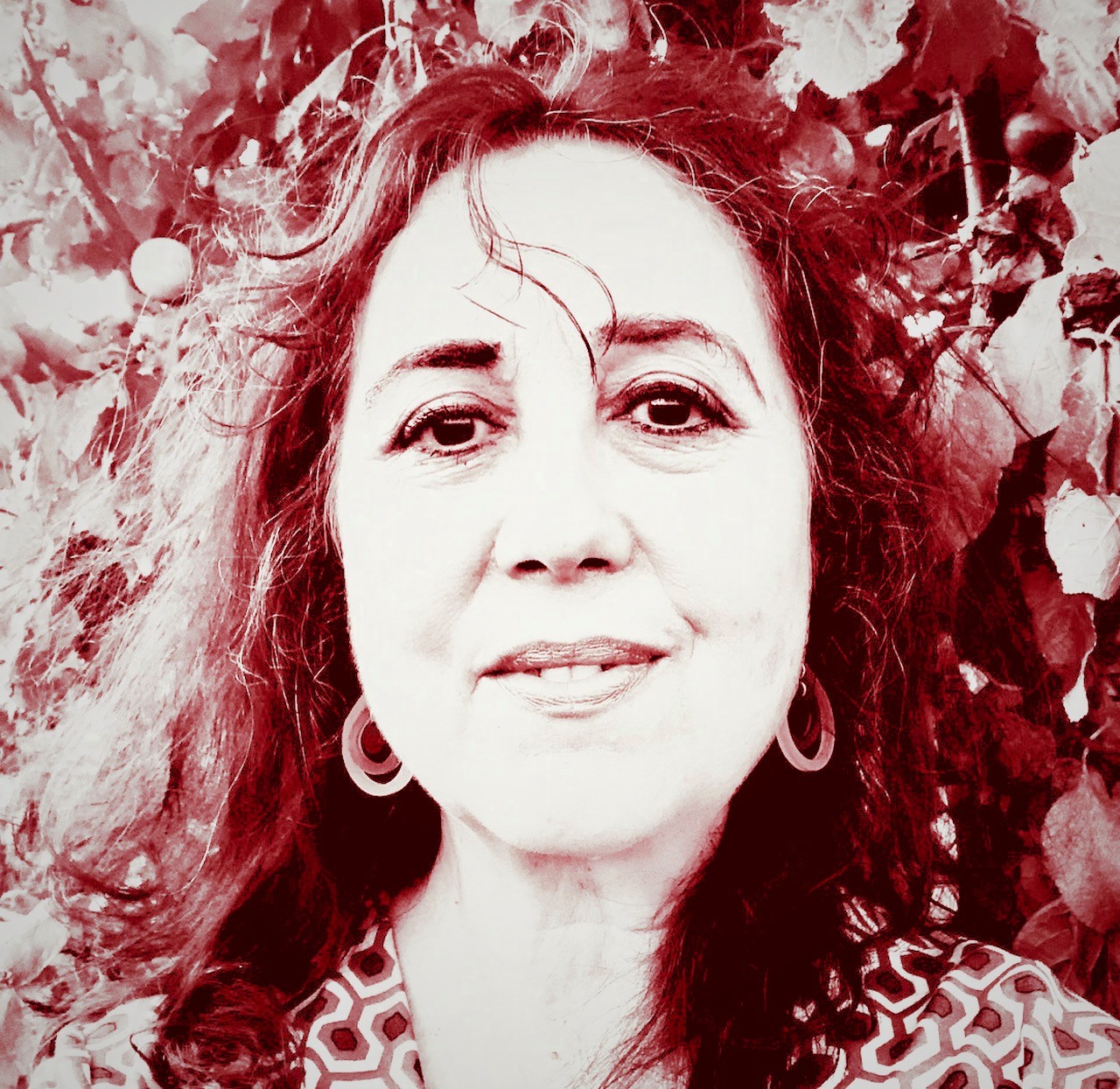
Isabel del Rio. Photograph Isabel del Rio
On adoptive language
speak we should but may
we be spared the blemish of
repudiating the first syllables uttered, the familiar
cooing from those closest, all those words
that should have been said but are now
exchanged for extraneous sounds
in a separate and sometimes dissenting language, no,
there are no perfect equivalents and trading this language
for that one is mostly a lesser and unexciting form
of subversion, plainly a way of renouncing
the world as we know it and, without once realising, a formidable
mutation takes place, our faces embracing another
cast, our voices crooning a different
tune, and we become aligned with the inhabitants from elsewhere who
speak with such different procedures, mean other
things or probably none of the stuff that we hold
close to our hearts, seemingly incapable of familiar emotions yet
have reached uncharted ones, and thus
this new language turns out to be
as powerful as our fate
for what you now say is what
you have unquestionably turned into, and who
you once were
died the death of your oldest, wisest
vocabularies
From Isabel’s poetry collection ‘Cuaderno de notas’ (2022)

exchanged for extraneous sounds in a separate and sometimes dissenting language. Photograph by Thirdman on Pexels.com
El idioma adoptivo
hablar lo haremos cuando no quede alternativa pero que nos libren de la mácula de repudiar las primeras sílabas articuladas, la canción de cuna que entonaron las más allegadas, esas palabras que habría que haber dicho tan resueltamente pero que ahora se intercambian por los sonidos en otra lengua con la que no hay equivalencias directas ni operativas, y así proceder a un trueque de este idioma por ése es ante todo una forma inferior de subversión, apenas llamativa, o incluso una manera de renunciar al mundo conocido sin comprender que aquí mismo está aconteciendo una mutación más formidable aún, el rostro abrazando otra máscara, la voz entonando una nueva y melódica arenga, y alineadas estaremos con las habitantes de otro emplazamiento que hablan con tan distintos procedimientos y que quieren decir otra cosa que lo que dicen (o incluso nada de lo que nos es entrañable o querido o ansiado) y que, además, son incapaces de expresar las emociones consabidas y por eso las intercambian por las propias de lugares no hallados en los mapas, aún por descubrir, y en este nuevo idioma que llega con tanta urgencia como tu propio destino lo que ahora dices es todo aquello en lo que sin duda te has convertido, y quien una vez fuiste murió la muerte de tu vocabulario más antiguo e instruido
From Isabel’s poetry collection ‘Cuaderno de notas’ (2022)

conflict is a sought-after trait first thing in the morning. Photograph by Tom Van Dyck on Pexels.com
this is war
one
flowers as hand-me-downs,
love as plunder
two
the time you spoke up and lit the landscape,
even in passing no one ever mentioned that you had some kind of chance
three
conflict is a sought-after trait first thing in the morning,
despite the many years together you are still someone I met one day
four
ask yourself in plain English: are you ready to go to war,
belonging to a splinter faction will also do the trick
five
most are held back by sayings such as: throwing caution to the
wind; of course you have a score to settle, of course you missed the boat
six
my shadow was always more eloquent than I could ever be;
dusk obliterates everything in its path without so much as a blink
seven
except for a shell or a shard, you will take nothing with you
when you go; words mostly lose their fragrance once spoken
eight
being nice is a role you undertook against your better
judgment; alchemy can happen at any moment in the middle of a sentence
nine
calling things by their name also means calling names;
the silence of the aftershock happens on the hour
ten
that unrequited version of myself was very much lost in
translation; dawn is not necessarily the start of anything at all
From Isabel’s collection ‘Dolorem Ipsum’ (2020)

You see, water is not made but itself makes. Photograph by Landiva Weber on Pexels.com
Flowing Water, a villanelle
Flowing water can take many shapes,
from streams to rain, from ponds to ice.
It is not made, but itself makes.
Even at birth, with so much at stake,
waters will break, thrown is the dice.
For flowing waters can take many shapes.
Swiftly flowing through seas and lakes,
waters turn into hell or paradise,
for they’re not made, but themselves make.
And when you need fresh water most, might it be fake,
or salt or sand? For even water has a price,
since flowing water takes so many shapes.
There was no plan, make no mistake.
And just like that, water one day created life.
You see, water is not made but itself makes.
And when the final drop of water burns,
it will spell the end, and nothing will survive.
For flowing water took far too many shapes,
and all the things it made were hung out to dry.
From Isabel’s upcoming poetry collection (2026)

every day that is born erased. Photograph by Gül Işık on Pexels.com
Tango metafísico
i.
cada año que acaba
me pesa,
cada día que llega
me pisa,
nada, ay, memorable
me pasa,
ni el amor, como un ave,
se posa,
en el cielo, el sol
ya se puso
ii.
todo muere y no hay más
que un poso,
como si nos negaran
el pase,
o la llave que abriera
ese piso,
para cuántos vivir
sólo es pose,
al final, no se da
un solo paso
Metaphysical Schottische
i.
every year that ends
displaced
every day that is born
erased
all things memorable
debased
even virtue has been
defaced
no lost things can be
retraced
ii.
all is done in such a
haste
all that effort gone to
waste
no more lovers to
embrace
by clocks ticking away
chased
life by deadly things
replaced
From Isabel’s poetry collection ‘Madrid, Madrid, Madrid’ (2019)
Isabel del Rio is a British-Spanish poet, fiction writer and linguist. Born in Madrid, she has lived most of her life in London. She has published fiction and poetry in both English and Spanish. Her fiction includes Paradise & Hell and La autora del fin del mundo; her latest poetry collections are Dolorem Ipsum and Cuaderno de notas. Her memoir is A Woman Alone, and her most recent literary translation is Equidistant Voices, an anthology of Latin American poets living in the UK. Isabel has a PhD in Creative Writing from the University of West London (UWL); she is also a Fellow of the Institute of Translation & Interpreting (ITI), the Chartered Institute of Linguists (CIoL), and the Royal Society of Arts (RSA). Isabel has worked as a producer and broadcaster for the BBC World Service, and as a full-time linguist for the United Nations.
In her writing, Isabel explores language, memory and cultural identity, merging lyrical intensity and narrative experimentation. Her preferred genres are speculative, noir, fantasy, dystopia, and specifically the plight of women. She regularly takes part in Performance Poetry and Spoken Word events. Currently, she is working on a collection of short plays, radio plays, and stage adaptations of her short stories. Her play One and Only was recently performed as part of the QExtra Festival at Questors Theatre, London.
for more go to Isabel del Rio’s website.
Discover more from Ars Notoria
Subscribe to get the latest posts sent to your email.

You must be logged in to post a comment.